What Should a Whole-House Humidifier Be Set to in Winter?
Set a whole-house humidifier to about 35% RH at 20°F (-7°C) outside, about 30% at 0°F (-18°C), and about 25% at -10°F (-23°C); older or leakier homes may need about 5 points less. Too much humidity causes window sweat, frost, mold, and sometimes wood swelling. This guide gives a simple winter setpoint rule by outdoor temperature and home type, plus how to lower it safely when condensation starts.
What should a whole-house humidifier be set to in winter?
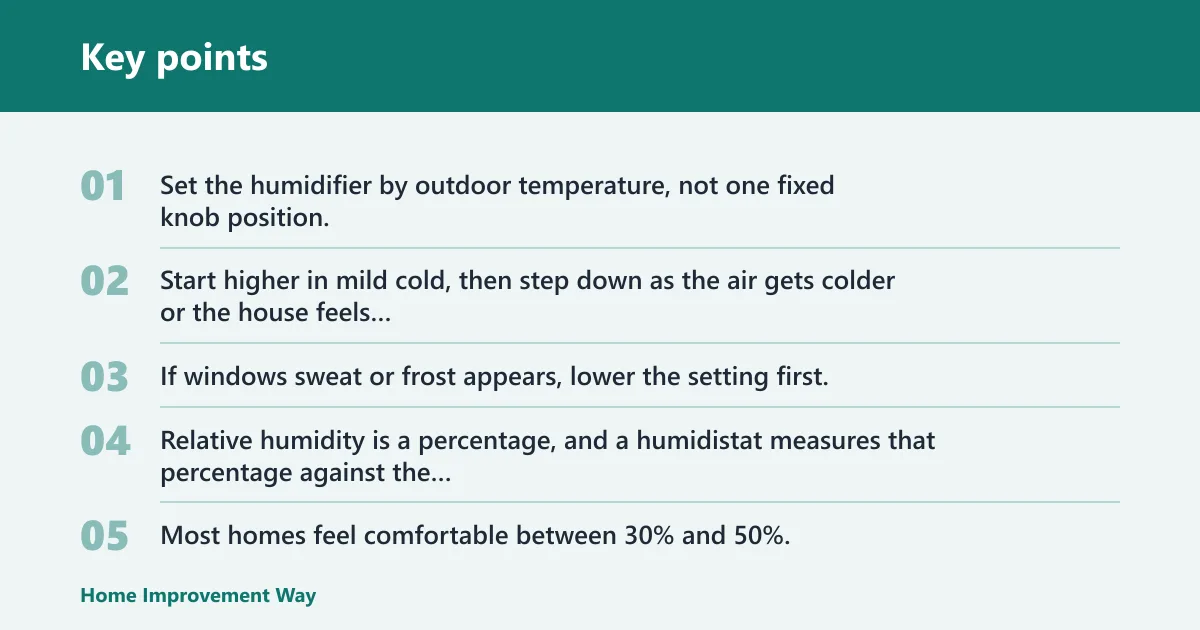
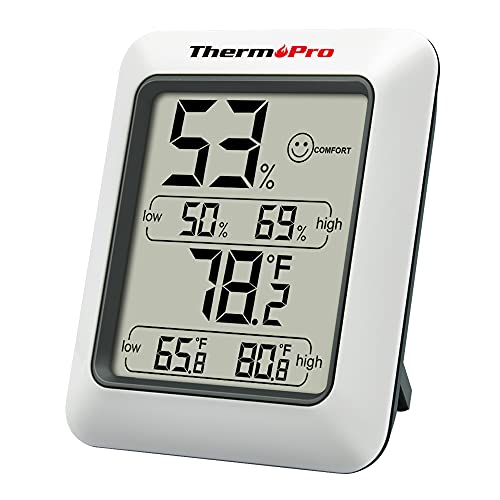

Set the humidifier by outdoor temperature, not one fixed knob position. Start higher in mild cold, then step down as the air gets colder or the house feels tighter. If windows sweat or frost appears, lower the setting first.
Use relative humidity, not a fixed dial position
Relative humidity is a percentage, and a humidistat measures that percentage against the air’s moisture capacity at a given temperature. Most homes feel comfortable between 30% and 50%, but colder weather usually needs a lower target to avoid condensation on windows, exterior walls, or attic surfaces.
Start with a lower target in colder weather
Cold outdoor air lowers the safe indoor target. A tighter home usually needs less added moisture because it holds heat and moisture better. A leakier older home can often take a slightly higher setting, but only until you see signs of condensation.
Adjust downward first if windows sweat or frost
If the first sign is moisture on glass, a frosty pane, or damp wall corners, lower the humidifier setting before changing anything else. That is the safest first move because the problem is usually too much humidity for the cold surfaces in that home.
Winter humidity setpoint table
Use this as a starting point, then trim the setting if your home shows condensation. Pick the lower end of each range for tighter homes, homes with cold exterior walls, or homes that already show window sweat at the current setting. Pick the higher end only if the home is leakier and stays dry.
| Outdoor temperature | Recommended indoor RH | When to use the lower end |
|---|---|---|
| 30°F to 40°F | 35% to 40% | Tight homes, new windows, any condensation history |
| 20°F to 29°F | 30% to 35% | Most homes with average insulation or mixed leakage |
| 10°F to 19°F | 25% to 30% | Homes with cold exterior walls or visible window frost risk |
| 0°F to 9°F | 25% | Newer airtight homes, upstairs bedrooms, cold glass |
| Below 0°F | 20% to 25% | Very tight homes or any room with recurring frost |
How to use the table in leaky vs tight homes
Older, leakier homes can sometimes hold a slightly higher target because warm indoor air escapes more easily, carrying moisture with it. Newer airtight homes usually need the lower end of the range because they trap humidity longer, which raises condensation risk on cold surfaces.
When to choose the lower end of the range
Choose the lower end if you see damp window frames, frost lines at the bottom of glass, moisture on attic sheathing, or darkened paint on outside corners. Those are signs that indoor moisture is reaching cold surfaces and condensing.
Why winter humidity needs to stay lower
Winter humidity has to stay lower because cold surfaces cool indoor air fast. When air hits a cold pane or wall, its moisture can condense into water. Mold risk rises when relative humidity reaches 55% or higher, so the goal is comfort without pushing surfaces into a wet zone.
Relative humidity and condensation risk
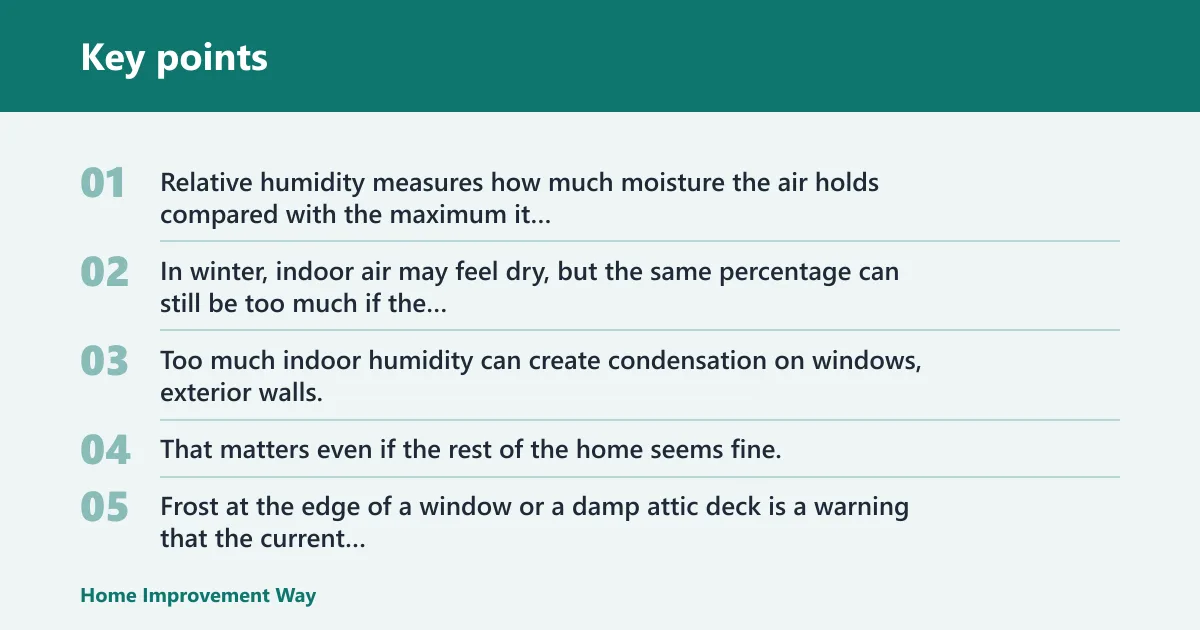
Relative humidity measures how much moisture the air holds compared with the maximum it could hold at that temperature. In winter, indoor air may feel dry, but the same percentage can still be too much if the outside temperature is low enough to chill windows and walls.
Window frost, cold walls, and attic moisture
Too much indoor humidity can create condensation on windows, exterior walls, or attic surfaces. That matters even if the rest of the home seems fine. Frost at the edge of a window or a damp attic deck is a warning that the current setpoint is too high for the weather.
Mold risk signs to watch
Watch for recurring window wetness, musty odors near exterior walls, or soft paint around corners and sill joints. If any of that appears and the humidifier is set above 30% during cold weather, lower the setting and watch the house for a day or two.
How a humidistat and outdoor sensor work
The humidistat is the adjustable control for the humidifier. It sets the relative humidity target, and some controls use an outdoor temperature sensor so the target drops automatically in colder weather. The control may be mounted near the thermostat or near the furnace, depending on the system.
What the humidistat controls
A humidistat tells the humidifier when to add moisture and when to stop. Many controls offer high, medium, or low settings, while others show a percentage. If the control is near a thermostat, make sure the room around it is not unusually damp or dry, or it can read a skewed condition.
How an outdoor temperature sensor changes the target
Some advanced controls use an outdoor temperature sensor to lower humidity as the air gets colder. That helps prevent window condensation without constant manual tweaking. It is the simplest way to keep the setting aligned with weather changes.
Where the control is usually mounted
A whole-home humidifier is mounted near the HVAC furnace and feeds moist air into ducts. The control may sit on a return duct, near the thermostat, or close to the furnace cabinet. Placement matters because a sensor that sees warm supply air or a drafty wall can misread the home.
Which whole-house humidifier type fits your home?
The type matters, but it does not replace the need for the right setting. Bypass units depend on furnace airflow, fan-powered units add their own fan, and steam units provide the most precise control. Choose the type that matches your climate, HVAC setup, and moisture demand.
Bypass humidifier basics
A bypass humidifier relies on furnace airflow, so it only works when the furnace is on. It is often the economical choice, but its output is lower than steam. That makes it a better fit for moderate winter dryness than for very cold climates or very tight homes.
Fan-powered humidifier basics
A fan-powered humidifier uses an internal fan and can run independently of the furnace. That gives it middle-ground capacity and makes it useful when the furnace runtime is short. It still depends on duct airflow, water supply, and proper drainage.
Steam humidifier basics
Steam humidifiers provide precise humidity control and the highest output of the common whole-house types. They cost more upfront and may need a dedicated electrical circuit. They are often the better pick for cold climates, large homes, or homes that need moisture even when furnace runtime is limited.
What changes the right setting in your home?
Two homes on the same street may need different winter settings. Older homes, newer airtight homes, insulation level, leakage, furnace runtime, and zoning all affect how much moisture the home can hold before windows or cold walls start to sweat.
Older homes versus newer airtight homes
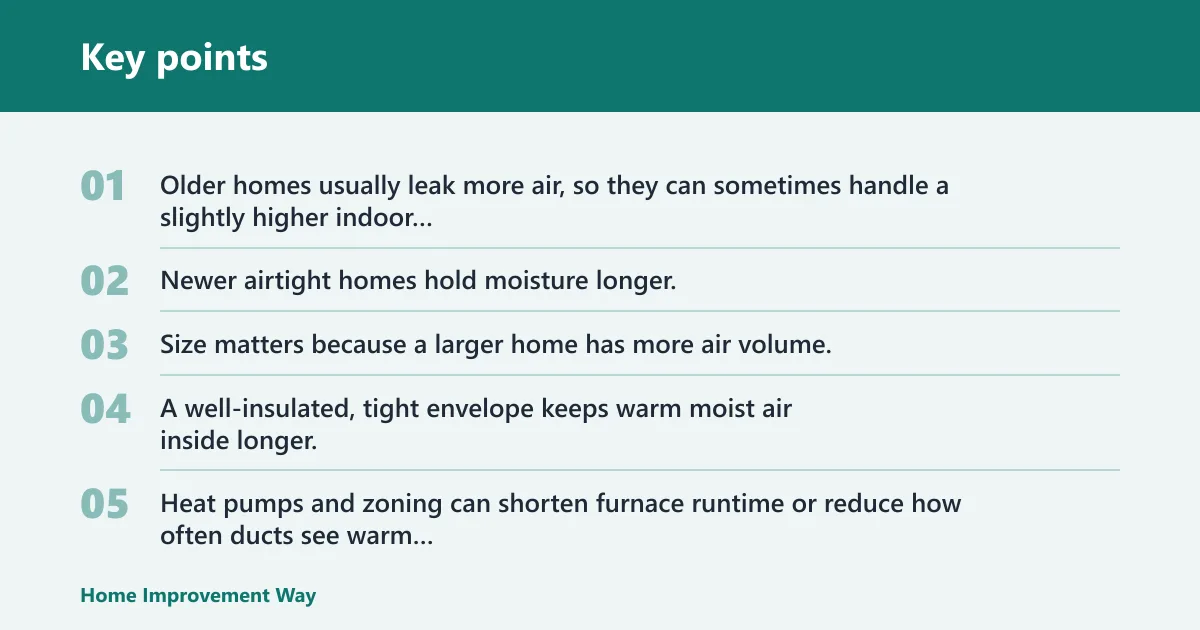
Older homes usually leak more air, so they can sometimes handle a slightly higher indoor humidity target in winter. Newer airtight homes hold moisture longer, which means they often need a lower setpoint to stay free of condensation.
Home size, insulation, and leakage
Size matters because a larger home has more air volume, but insulation and leakage usually matter more for winter setting decisions. A well-insulated, tight envelope keeps warm moist air inside longer, while a leakier shell sheds that air more quickly.
Heat pumps, zoning, and furnace runtime
Heat pumps and zoning can shorten furnace runtime or reduce how often ducts see warm airflow. That matters for bypass humidifiers in particular, because less furnace runtime can mean less moisture output. Fan-powered and steam units can keep moisture delivery steadier when airflow changes.
Say your 1980s split-level house sits at 30% RH when it is 25°F outside, and one bedroom window starts to fog each morning. Drop the humidistat to 25% and wait a day. If the window dries out, the prior setting was too high for that temperature band.
Suppose a new airtight home with triple-pane windows feels dry at 20% RH but the living room sill shows a little frost at 0°F outside. Keep the lower target. That frost is the warning sign, and raising the setting would likely make the window problem worse.
What whole-house humidifier be checklist
If you see window sweat, frost, or damp exterior-wall surfaces, lower the humidity setting first. Then check whether the problem is limited to one room or appears across several cold surfaces. If the reading still seems wrong, verify the humidistat sensor and airflow.
- Lower the humidistat by 5 percentage points.
- Wait 24 hours and check the same windows again.
- Inspect window glass, frames, and sill corners for moisture.
- Look for frost or dampness on exterior walls and attic surfaces.
- Check whether one room is colder than the rest of the house.
- Verify the humidistat sensor location is not near heat, supply air, or a draft.
- Confirm the HVAC system is moving air through the humidifier as designed.
Why is my whole-house humidifier not raising humidity?
If the humidifier is on but the house still feels dry, the usual causes are weak water flow, a worn evaporator pad, little furnace runtime, or an airflow problem. Check the water supply and drain first, then look at the pad or media, then confirm the HVAC system is actually moving air across the unit.
Water supply and drain checks
A whole-house humidifier usually has a drain line as part of the setup, and it needs a steady water supply. Hard water can contribute to problems, and mineral deposits on the pad can block water flow and reduce humidification. If the drain is restricted, performance can fall too.
Evaporator pad wear and mineral buildup
The evaporator pad, sometimes called the water panel or media, needs regular replacement. When mineral buildup coats the pad, less water can pass through, so the humidifier looks active but delivers less moisture. That is one of the most common reasons output drops over time.
Furnace runtime and airflow issues
A bypass humidifier only works when the furnace is on, so short heating cycles can reduce output. Fan-powered units need their fan and airflow path to work correctly. Steam units are less dependent on furnace heat for moisture generation, but they still need proper control and distribution.
Frequently asked questions
What should a whole house humidifier be set at in winter?
Start around 35% RH at 20°F outside, 30% at 0°F, and 25% at -10°F, then lower it if windows sweat or frost appears. Older or leakier homes may tolerate slightly more, but tighter homes usually need the lower end of each range.
Where should a whole-house humidifier be placed?
It is usually mounted near the HVAC furnace and connected to the ductwork so moist air can move through the system. The control should not sit where it sees unusual heat, a draft, or supply-air blast, because that can distort the humidity reading.
What indoor humidity should I aim for in winter?
Most homes feel comfortable between 30% and 50%, but winter targets are often lower because of cold glass and exterior walls. A practical goal is to stay as high as you can without seeing condensation, frost, or attic moisture.
Why does my whole-house humidifier cause window condensation?
The indoor humidity is probably too high for the outdoor temperature and the window surface temperature. Lower the setting in steps, then watch the same panes. If the problem stops, the old setting was above what that home could hold safely.
Should I use outdoor temperature to adjust my humidifier setting?
Yes. An outdoor temperature sensor can lower humidity in cold weather automatically, which helps prevent condensation. Even without a sensor, outdoor temperature is the simplest way to choose a sensible winter target instead of using one fixed setting all season.
Do whole-house humidifiers work when the furnace is off?
It depends on the type. A bypass humidifier only works when the furnace is on, while fan-powered humidifiers can run independently of the furnace. Steam units also have their own moisture generation, but they still need correct controls and distribution through the HVAC system.
Sponsored / affiliate links. As an Amazon Associate I earn from qualifying purchases. I may earn additional commission from eligible campaigns.
 ROVSUN 18000 BTU Mini Split AC/Heating System with Inverter, 20 SEER2 Energy Saving 230V Ductless Split-System Air Conditioner with Pre-Charged Condenser, Heat Pump, Remote Control & Installation Kit
 Faryuan Bladeless Fan, 25inch Heating & Cooling & Filter Combo Tower Fan 80° Oscillating with Remote, 9H Timer, 8 Speeds, Portable Quiet for Indoor, Bedroom, Home Office Room(Grey & Red)