What Do Furnace Blinking Light Codes Mean?
A furnace blinking light can signal normal standby, a recoverable airflow or ignition fault, or a shutdown safety alert. Steady repeating flashes are often normal, but rapid or repeating fault codes mean you should check the manual before resetting. Ignoring the pattern can lead to repeated lockouts, unsafe operation, or avoidable service calls. This guide explains how to read the blink pattern, what to check first, and when to stop and call for service.
The furnace control board LED stores fault information and uses blink patterns to signal problems. You will usually find the board near the blower door, and the furnace may use one LED or two LEDs depending on brand. The exact meaning comes from the model-specific code legend, so pattern first, brand second.
Blinking light codes vary by brand and model

- Includes a digital multimeter, non-contact voltage pen, and GFCI outlet tester
- Measures AC/DC voltage, DC current, resistance, continuity, and diodes
- Comes with test leads, batteries, and a carrying case
That matters because a blinking light is not a universal language. Carrier, Trane, and Lennox each use different LED setups, and the same blink count can mean different things on different furnaces. Even within the same brand, code meanings can vary by model year, board revision, or serial range, so always verify the exact legend for that unit.
Most furnaces print the code legend on a sticker inside the blower door. If the sticker is missing, use the manual for that exact model. Match both the blink count and the pause pattern before you decide whether you are looking at normal operation, a recoverable fault, or a safety shutdown. For brand-specific examples, Carrier documents two-LED diagnostic logic in its legacy furnace literature, Trane notes slow red LED standby behavior on some models, and Lennox explains normal dual-LED status patterns in its homeowner support materials.
How to read the blink pattern correctly
Count flashes, pauses, and repeats as a unit. A single flash repeated at a steady pace can mean standby, while a fault code usually comes as a counted sequence, then a longer pause, then the sequence repeats. Do not count every flicker the same way.
Two-LED systems need extra care. Some furnaces use yellow and green furnace flashes as separate digits, so you must count each color on its own. On other models, one red LED handles all status and fault reporting.
Read the light in three steps
- Watch for a full cycle, not one flash.
- Count each burst of light, then note the pause length.
- Compare the pattern with the code legend inside the blower door or in the manual.
A common first-timer mistake is to count a normal heartbeat blink as a fault. Suppose a furnace shows one slow red flash every few seconds, with no longer pause and no repeated error sequence. That pattern may be normal standby, not a problem.
If the furnace goes dark, restarts, then repeats the same blink pattern after a longer pause, treat it as a fault code until the legend says otherwise. The repeated pause is part of the message.
Blink pattern triage chart
| Can heat still run? | Blink behavior | Likely meaning | Urgency | Reset once / do not reset | First homeowner check | Call-a-pro guidance |
|---|---|---|---|---|---|---|
| Yes | Slow heartbeat blink | Normal standby on some models | Low | Do not reset | Confirm the furnace is powered and the thermostat is calling for heat | No service call unless heat is missing or the pattern changes |
| Yes | Synchronized dual slow blink | Normal operation on some two-LED systems | Low | Do not reset | Check the exact brand legend before assuming a fault | Call only if heat is not working or the legend shows an error |
| Sometimes | Counted fault sequence | Stored error code, model-specific | Medium | Reset once after basic checks | Match the count and pause to the sticker inside the blower door | Call if the code returns |
| Usually no | Pressure switch-style code | Venting or airflow problem | Medium | Reset once after checking the vent path | Check condensate drain, intake, exhaust vent, and obvious blockage | Call if the drain is clear but the code stays or returns |
| Sometimes | Limit-code style code | Overheating protection, often from restricted airflow | Medium | Reset once after correcting airflow basics | Check the air filter and supply/return airflow | Call if a fresh filter does not clear the fault |
| Sometimes | Flame-sensor-style code | Ignition not being proved reliably | Medium | Reset once after a cautious cleaning only if the manual allows it | Check whether the sensor rod is dirty if the manual allows cleaning | Call if cleaning does not restore normal operation |
| No | Rollout-style code | Critical safety fault, possible flame rollout | High | Do not reset | Turn the furnace off | Immediate call-now issue; do not reset it yourself |
Is a blinking red light on my furnace normal?
Sometimes yes. A blinking red light can be part of normal standby, especially on single-LED systems that use a slow heartbeat pattern. On some furnaces, the light is simply telling you the board has power and is monitoring the system.
Some Trane models are described as using a single red LED. Trane’s homeowner materials note that a slow red heartbeat can indicate standby on certain models, while fault codes use counted sequences with a long pause. Lennox also documents dual-LED status patterns, and slow synchronized blinks can mean the unit is operating normally.
That is why color alone is not enough. Red does not automatically mean trouble, and a flashing red light on one brand may mean something entirely different on another.
Picture a Lennox furnace with both LEDs blinking slowly together while the blower is cycling normally. That pattern can be standard operation. Compare that with a red light that flashes in a count, pauses, then repeats; that pattern points to a stored fault.
What do common furnace codes point to?
Common codes usually point to airflow, venting, ignition, or safety shutdown. The first step is to identify which system failed, because the fix for a dirty filter is very different from the fix for a rollout fault or a bad wiring connection.
Carrier diagnostic LEDs
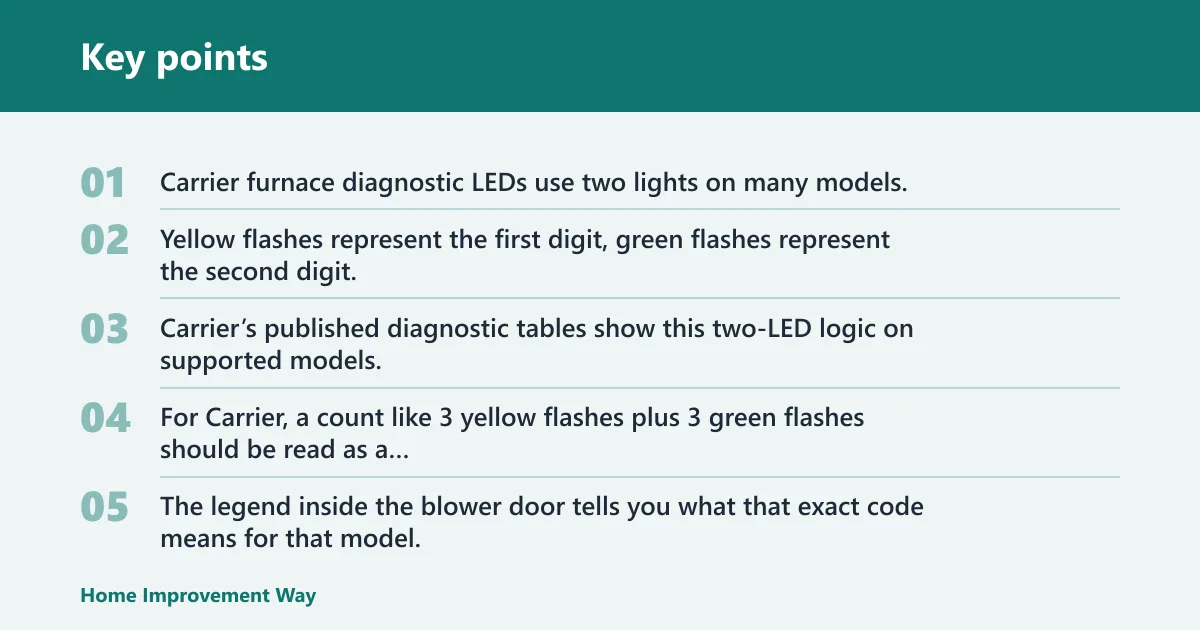
Carrier furnace diagnostic LEDs use two lights on many models. Yellow flashes represent the first digit, green flashes represent the second digit, and Code 33 means 3 yellow flashes, a pause, then 3 green flashes. That is why counting both colors matters. Carrier’s published diagnostic tables show this two-LED logic on supported models.
For Carrier, a count like 3 yellow flashes plus 3 green flashes should be read as a two-part code, not as a single six-flash pattern. The legend inside the blower door tells you what that exact code means for that model.
Pressure switch faults
A pressure switch is a safety switch tied to venting and airflow. A pressure switch code may point to the condensate drain or exhaust vent, and it can also show up when the intake is blocked, the vent is frozen, or the drain is plugged.
Start with what you can see. Check for a clogged condensate drain, a blocked exhaust vent, kinked tubing, or ice at the outdoor termination. If those look clear and the code returns after one reset, stop there and call a pro.
High-limit switch faults
A limit circuit fault can be tied to overheating. In many homes, the first suspect is restricted airflow, often from a dirty filter, blocked return, closed supply register, or a blower issue.
Because the high-limit switch protects the furnace from heat damage, do not keep restarting the unit without checking airflow first. A filter change can clear some limit faults, but a repeated code after a fresh filter can point to a deeper airflow problem.
Flame sensor faults
A flame sensor code may point to an ignition problem, often because the sensor rod has a mineral coating. If the manual allows it, the rod can often be cleaned gently with fine emery cloth, then reinstalled firmly before one reset attempt. Use caution here: manufacturers generally treat the flame sensor as a delicate part, and aggressive scrubbing can damage the sensing surface or the mount.
If the furnace lights and then shuts down, or if it tries to light several times before locking out, a flame sensor is one likely cause. Wiring issues and grounding problems can look similar, so a clean sensor is not the whole answer if the code returns. Trane, Carrier, and other manufacturer guides generally advise verifying the exact code and handling the sensor only as the manual permits.
Rollout switch faults
Rollout switch codes are marked as immediate call-now issues. They can indicate flame rollout and possible carbon monoxide hazard, so this is not a DIY reset, not a filter issue, and not a code to ignore while you keep running the furnace. Lennox, Carrier, and other manufacturers treat rollout-related faults as safety shutdowns that require prompt service rather than repeated reset attempts.
Turn the system off and have it checked by a pro. Do not keep cycling power on a rollout fault.
When should you stop troubleshooting?
Stop troubleshooting when the code points to rollout, when a reset brings the same fault back, or when the furnace shows signs of venting, ignition, or overheating problems that do not clear with the basic checks. One reset is reasonable after you inspect the obvious causes.
If the furnace still faults after that single reset, or if the pattern comes back right away, the next step is service. Repeated resets can mask the real issue and may leave you with the same shutdown, only later.
Use this stop point
- Turn the furnace off if the code points to rollout.
- Check the filter, vents, and drain if the code suggests airflow or pressure trouble.
- Reset the furnace off and on once only after those checks.
- Call for service if the same code returns.
For example, if your furnace is about 90,000 BTU and the light shows a counted pressure-switch code after a snowstorm, check the usual pressure-switch and airflow causes. If the exhaust termination is blocked, clearing the blockage may restore normal operation. If the code comes back after one reset, the issue may be a drain, vent, switch, or wiring problem that needs service.
Suppose the unit flashes a limit code after several clogged filters in a row. Replacing the filter may help, but repeated overheating often means the blower, return path, or ductwork also needs attention.
Frequently asked questions
What do furnace blinking light codes mean?
They are the control board’s way of storing fault information and signaling status through flash patterns. On many furnaces, the code legend is printed on a sticker inside the blower door. The pattern can mean normal standby, a recoverable fault, or a safety shutdown.
How do I read the blinking light on my furnace?
Count the flashes, note the pause, and watch for repeats. Then compare that exact pattern with the code legend for your model, usually found inside the blower door or in the manual. On two-LED systems, count each color separately.
What does a furnace blinking 3 times mean?
It depends on the brand and model. Three flashes may be part of a counted fault sequence, but it is not a universal meaning. On Carrier two-LED systems, you must read yellow and green flashes as separate digits, so the total pattern matters more than the number alone.
What does a furnace blinking 4 times mean?
Four flashes can signal different things on different furnaces, so do not assume a single meaning. The code legend inside the blower door is the only reliable guide. Check whether the pattern repeats after a longer pause, which usually marks it as a fault code.
What does a furnace blinking 7 times mean?
Seven flashes is also model-specific. On one furnace it may point to ignition trouble, while on another it may mean something else entirely. Match the count, pause, and brand legend before you reset anything, especially if the code suggests venting or safety shutdown.
Why is my furnace light blinking continuously?
Continuous blinking can be normal standby on some furnaces, especially if it follows a slow heartbeat pattern. If the light is blinking in a repeating counted sequence, it is more likely a fault code. The pause pattern is what separates normal operation from a stored error.
What does a blinking red light on a furnace control board mean?
It can mean power, standby, or fault status depending on the model. Some Trane furnaces use a single red LED with a slow heartbeat for normal standby. Other brands use red and green LEDs, or separate yellow and green digits, so the brand chart matters.
What does a furnace yellow light blinking mean?
On some systems, a yellow LED is part of a two-LED code layout. Carrier uses yellow flashes for the first digit and green flashes for the second digit, so yellow by itself is only part of the message. The full pattern must match the model legend.
Sponsored / affiliate links. As an Amazon Associate I earn from qualifying purchases. I may earn additional commission from eligible campaigns.
 Garvee 14,000 BTU Portable Air Conditioner for Room Up to 750 Sq.Ft, 4 in-1 AC Unit with Cooling, Fan, Dehumidifier & Sleep Mode, Remote Control & Window Kit Included for Home, Office, Apartment,White
 ROVSUN 18000 BTU Mini Split AC/Heating System with Inverter, 20 SEER2 Energy Saving 230V Ductless Split-System Air Conditioner with Pre-Charged Condenser, Heat Pump, Remote Control & Installation Kit