Why Is My Furnace Blower Running Constantly?
Reviewed for HVAC service accuracy. Check thermostat fan mode, filter condition, return-air blockage, and whether the furnace is tripping a safety limit because of restricted airflow. A blower that runs constantly is often normal if the thermostat fan is set to ON. If it keeps running with the fan on AUTO, look at a stuck relay, a failed control board, or a limit switch reacting to restricted airflow. Leaving it alone can waste power, overcool rooms, and hide a heating fault. This guide shows how to separate normal fan operation from a blower problem using symptom-by-symptom checks.
Why the blower keeps running
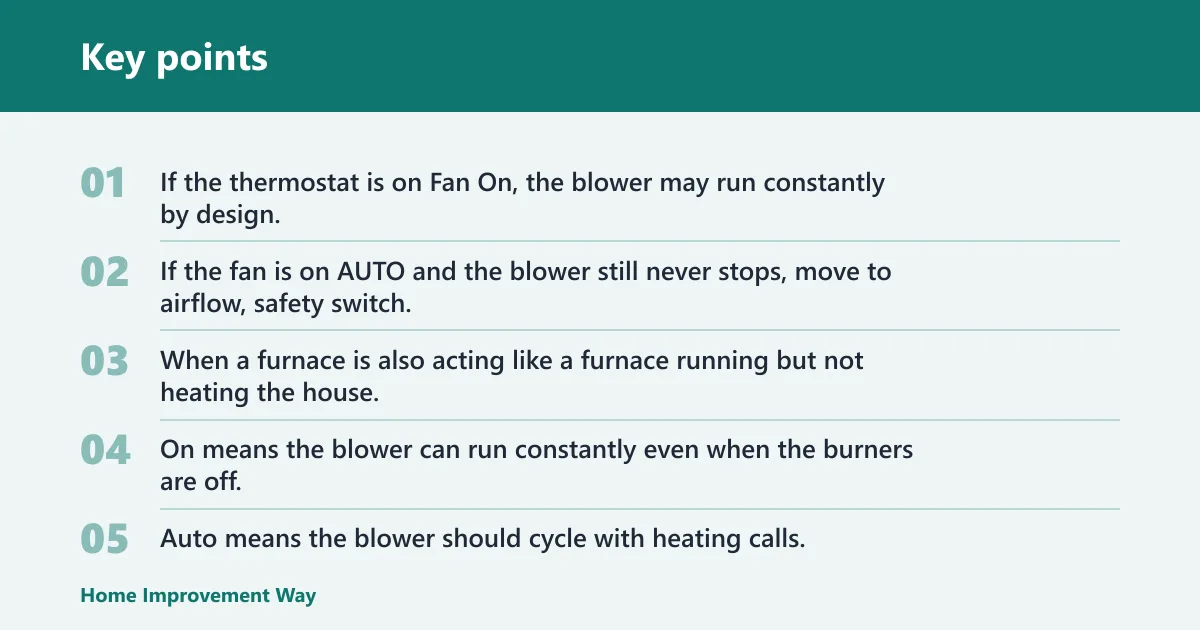


Start with the fan setting. If the thermostat is on Fan On, the blower may run constantly by design. If the fan is on AUTO and the blower still never stops, move to airflow, safety switch, and control checks. When a furnace is also acting like a furnace running but not heating the house, the blower symptom is only part of the diagnosis.
Fan On versus Auto
Fan mode is the first divider. On means the blower can run constantly even when the burners are off. Auto means the blower should cycle with heating calls, and a nonstop fan in Auto points to a fault or a safety response. Smart thermostats can also change settings after schedule edits, app updates, or power interruptions.
When nonstop blower is normal
Continuous fan operation may be intentional. It can provide cleaner air through constant filtration and keep indoor temperatures more even. Set the fan to Auto if you want the blower to run only when heating. If the blower is running all day because of a circulation schedule, that is a settings choice, not a failure.
When nonstop blower signals a fault
If the furnace is heating normally but the blower stays on after the burners stop, the problem is often in control logic, airflow protection, or the blower itself. If the furnace is also firing too often or running too long, the cause may be broader than the fan motor. That difference changes the diagnosis path. A fan that stays on after a heat cycle can be a control issue, while a fan that keeps returning on its own can point to a safety limit or a relay stuck closed.
Furnace blower troubleshooting matrix
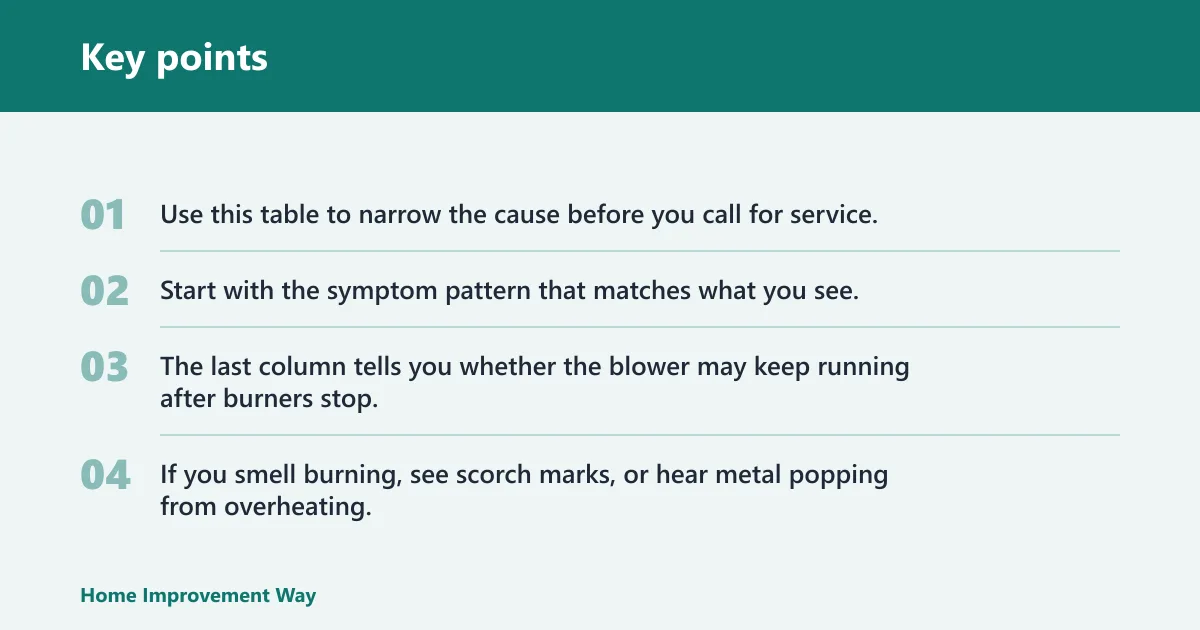
Use this table to narrow the cause before you call for service. Start with the symptom pattern that matches what you see, then move to the safest check you can do without opening electrical panels. The last column tells you whether the blower may keep running after burners stop. If you smell burning, see scorch marks, or hear metal popping from overheating, stop using the furnace and call for service before further troubleshooting.
| Symptom pattern | Most likely cause | Safe homeowner check | Escalation level | What you’ll notice next | May keep running after burners stop? |
|---|---|---|---|---|---|
| Blower runs all the time, even with no heat call | Thermostat fan set to On | Check fan mode and change it to Auto | Low | Fan should stop after the next call ends; airflow returns to normal cycling | Yes |
| Blower runs longer than usual; airflow feels weak | Dirty or clogged air filter | Inspect the filter in the return grille or return duct and replace if dirty | Low | Airflow should improve quickly; if not, return restriction or duct issues may remain | Often |
| Blower runs nonstop; some rooms feel starved for air | Blocked return air | Clear furniture, rugs, or grilles that block return openings | Low to medium | Return air noise may drop and room-to-room temperatures may even out | Often |
| Blower runs after a heating cycle ends, then may stop and start again | Limit switch stuck or reacting to overheating | Check filter, returns, and visible vents for restriction | Medium | You may notice hotter cabinet air, a hot-metal smell, or repeated cool-down cycling; stop if burning odor appears | Yes |
| Fan stays on in Auto even when thermostat is not calling for heat | Thermostat wiring short or fault | Inspect thermostat settings and batteries; note any recent wiring work | Medium to high | Mode changes may not affect the fan; a service visit is often needed if wiring is suspected | Yes |
| Fan runs continuously with no clear airflow problem | Control board fault | Reset power once, then watch whether the blower still ignores mode changes | High | Fan may ignore Auto, run after the thermostat is satisfied, or react inconsistently to commands | Yes |
| Blower hums, runs erratically, or won’t respond to normal cycling | ECM blower module failure | Note whether the fan speed is wrong or the blower will not shut off | High | Expect erratic speed, delayed shutoff, or a blower that comes on and stays on despite normal settings | Yes |
| Heat runs for a long time during extreme cold and the blower seems nonstop | Undersized furnace or high heating load | Compare runtime on mild days versus very cold days | Medium | The blower may look continuous simply because the furnace is meeting unusually high demand | Sometimes |
Is your thermostat telling it to run?
Yes, and this is the first thing to verify. If the fan is set to On, the blower can run constantly by design. If it is already on Auto, a smart thermostat, bad wiring, or a stuck signal becomes more likely. Confirm the heat call ends normally before looking deeper.
Check fan mode first
Look at the thermostat display and confirm Fan mode: On versus Auto. In On, the blower can run continuously even when heat is satisfied. In Auto, the blower should run only during heat calls. If the setting looks correct but the fan still never stops, move to wiring and control checks.
Look for smart thermostat schedule changes
Smart thermostats can change settings after app edits, learning-mode changes, or power loss. A fan schedule set for constant circulation can look like a failure when it is only a mode change. Check whether the thermostat recently switched to a circulation or continuous-fan program without being noticed. That is especially common after power interruptions or app-based adjustments.
Confirm whether heat calls end normally
If the furnace burners shut off but the blower keeps going, the problem is not the same as a furnace that will not satisfy temperature. That points toward the fan control path, not just heating demand. A common first-timer mistake is assuming any nonstop blower means the whole furnace is overworking.
Could airflow be the problem?
Yes. Restricted airflow can raise temperature at the heat exchanger, which can trigger the limit switch and keep the blower running after a heat call ends. A dirty filter, blocked return, leaky ductwork, or heavy heat loss can all make the system behave as if it never quite recovers.
Dirty air filter
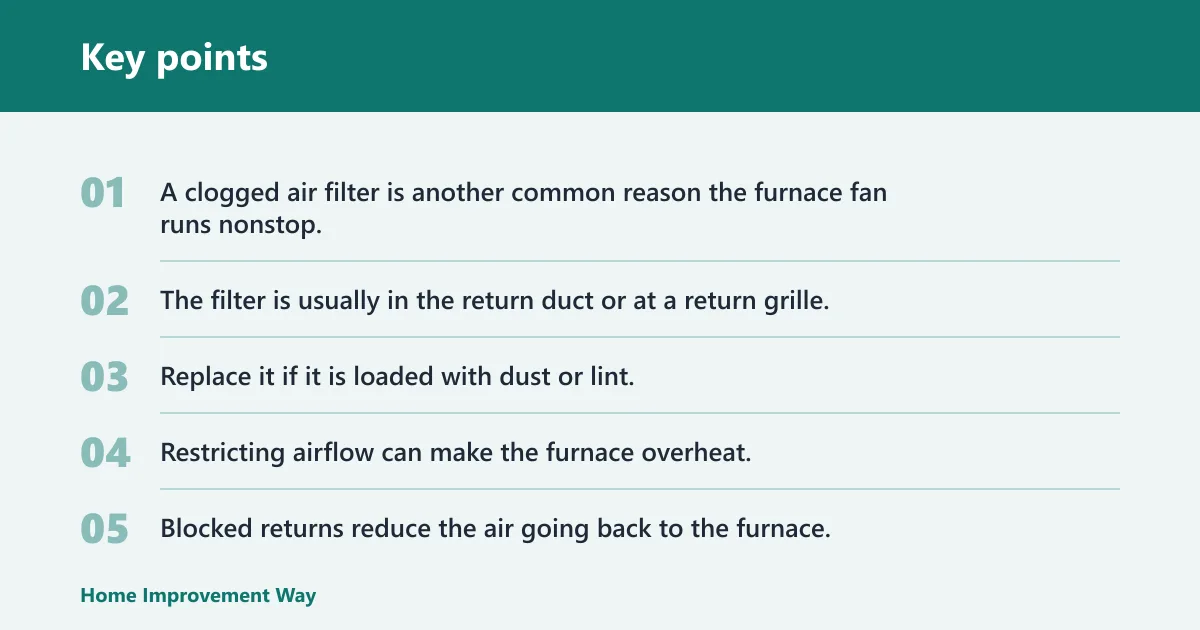
A clogged air filter is another common reason the furnace fan runs nonstop. The filter is usually in the return duct or at a return grille. Replace it if it is loaded with dust or lint. Restricting airflow can make the furnace overheat, and restricted airflow is a common reason furnaces blow cold air.
Blocked return air
Blocked returns reduce the air going back to the furnace. That can make the blower work harder, shorten the comfort benefit, and push the heat exchanger toward overheating. Check for closed furniture, rugs, boxes, or a dirty return grille. One blocked return can matter more than people expect. If a return is blocked, the next thing you’ll often notice is louder airflow noise, longer cycles, or a fan that keeps running after the burners shut down.
Duct leaks, heat loss, and overheating
Leaks in ductwork reduce delivered heat, and weak insulation or drafty windows and doors increase runtime. Attic and wall insulation affect run time, especially in cold weather. These issues do not usually make a blower fail, but they can make the furnace run longer and make normal operation look suspicious.
Say your filter is clean, but the return grille in a hallway is partly covered by a storage bin. The furnace may run longer, the blower may stay on after the burners stop, and the room may still feel cool. Clear the return first before assuming the control board failed. If you then notice the cabinet getting unusually hot or the system shutting down on safety, stop and have it inspected.
What if a safety switch is holding it on?
The limit switch is a safety device that tells the system to turn off once a certain temperature is reached. If airflow is restricted or the furnace overheats, that switch can keep the blower running as protection. Repeated cycling often means the furnace is reacting to a heat problem, not just a fan setting.
How the limit switch works
The limit switch monitors furnace temperature and protects the heat exchanger. If the furnace gets too hot, the switch can hold the blower on to cool the cabinet down. A limit switch failure can also cause the blower to run continuously, which is why this part sits near the center of the diagnosis path.
Why overheating changes blower behavior
An overheating trigger often starts with airflow restriction: a dirty filter, blocked return, or duct problem. The burners may shut off, then the blower may keep running to pull temperature down. If this happens often, the furnace may be cycling on safety rather than satisfying the thermostat. That pattern is a warning sign; if you detect a burning smell, stop running the system and seek service.
What repeated cycling can mean
If the blower runs, stops, then comes back on after short intervals, that pattern fits a limit-switch response better than a simple thermostat mistake. It can also signal a furnace that is struggling to move enough air. Do not ignore repeated safety cycling. It is a clue, not just an annoyance. Repeated cycling is one of the clearest signs that the furnace is protecting itself from heat buildup.
Could a control or wiring fault be sending the signal?
Yes. Thermostat wiring issues can keep the furnace fan running nonstop, and control board problems are another possible cause of a continuously running blower. These faults matter most when the fan stays on in Auto, the thermostat settings look right, and airflow checks do not explain the symptom.
Thermostat wiring shorts
Shorts or faulty wires can send a continuous fan signal. That can happen even when the thermostat is not calling for heat. If the problem started after thermostat work or a new thermostat install, wiring deserves a closer look. A professional inspection may be needed.
Control board fault
The control board acts as the furnace brain. If it fails, the blower may stay on even when the fan setting and airflow are normal. Electrical diagnosis is typically required because the fault can sit inside the furnace cabinet and mimic a thermostat problem. A board issue is more likely when the fan ignores mode changes, stays on after power is restored, or behaves inconsistently across cycles.
How to describe the symptom to a technician
Give the technician a simple sequence: fan mode, whether burners stop normally, whether the blower keeps running after heat ends, and whether the problem changes after a filter change or thermostat reset. Say whether the furnace is heating or only moving air. That distinction helps separate blower-only faults from whole-system heating issues. It also helps separate an airflow problem from a control fault, which saves time on the service call.
Could the blower itself be failing?
Yes. The blower motor may be ECM or standard, and both can fail electronically or mechanically. Some motors keep running because the electronics or relay logic has failed, even when the furnace is not calling for heat. That is more likely after settings, airflow, wiring, and board checks come up empty.
ECM blower module problems
An ECM blower module can fail in a way that leaves the fan running or makes it ignore normal shutdown commands. The issue may look like a thermostat fault because the fan never responds correctly. Newer variable-speed systems make this diagnosis especially important, since the motor control is part of the failure path.
Standard motor or relay failure
A standard blower motor can also fail mechanically or through a bad relay. If the relay contacts stick, the motor may keep running until power is cut. If the motor itself is failing, the fan may run continuously, start late, or behave unpredictably when the furnace should be idle. A stuck relay typically shows up as a fan that ignores thermostat mode changes.
Suppose the thermostat is on Auto, the filter is clean, and the blower still runs after every heat cycle. If the fan stops only when power is cut at the switch, that pattern suggests the issue is less likely to be settings-related and more likely to involve a relay, control board, or motor. That is one of the clearest signs that the fault is in the furnace controls rather than in the thermostat alone.
Frequently asked questions
Why is my furnace blower constantly running?
The most common reason is a thermostat fan setting of On instead of Auto. If the setting is correct, check for a dirty filter, blocked return, limit switch issue, or a control problem. A blower that keeps running after burners stop usually points to airflow protection or electrical control, not normal heating demand. If you also notice hot metal odor or unusual cabinet heat, use caution and shut the system down.
Why is my furnace fan running constantly?
Constant fan operation can be intentional if the thermostat is set to On. If the furnace fan runs constantly on Auto, suspect thermostat wiring, a stuck control board relay, or overheating caused by restricted airflow. The symptom pattern matters more than the fact that it is always on.
Should my furnace fan run all the time?
It can, but only when you choose that mode or when equipment behavior makes it necessary. It is not normal if the fan stays on in Auto with no heat call and no circulation setting. In most systems, continuous operation is a user choice, not a default safety condition.
Why does my furnace fan run constantly on auto?
If the fan runs nonstop in Auto, the thermostat is usually not the real problem by itself. Look for a wiring short, a stuck control board relay, or a limit switch responding to overheating from poor airflow. Dirty filters and blocked returns are the safest first checks because they can trigger the shutdown response. If a burning smell is present, stop using the furnace and have it inspected.
Can furnace blower run continuously?
Yes. A furnace blower can run continuously by design when the thermostat fan is set to On, and some systems use that mode for circulation and filtration. If it continues in Auto, especially after the burners stop, that is more likely a fault or safety response than a normal setting.
Why is my HVAC fan running constantly?
An HVAC fan that never stops may be responding to thermostat fan mode, a smart thermostat schedule, or a control fault inside the furnace. If the system also heats longer than normal during cold weather, the issue may be load, heat loss, or undersized equipment rather than a pure blower failure. The next clue is whether the blower shuts off normally when you change to Auto or whether it ignores the command.
Sponsored / affiliate links. As an Amazon Associate I earn from qualifying purchases. I may earn additional commission from eligible campaigns.