What to Do When Your Furnace Stops Working in Freezing Weather
If your furnace stops in freezing weather, check the thermostat, power, breaker, and filter, and shut it down if you smell gas, hear unusual noises, or see soot. Call for emergency help if indoor temperature falls to around 60°F or lower. Poor triage can leave you without heat longer and raise the risk of frozen pipes, carbon monoxide, or fire. This guide gives a first-hour safety plan and a technician-ready checklist of what to inspect, note, and save.
Is this a furnace emergency?
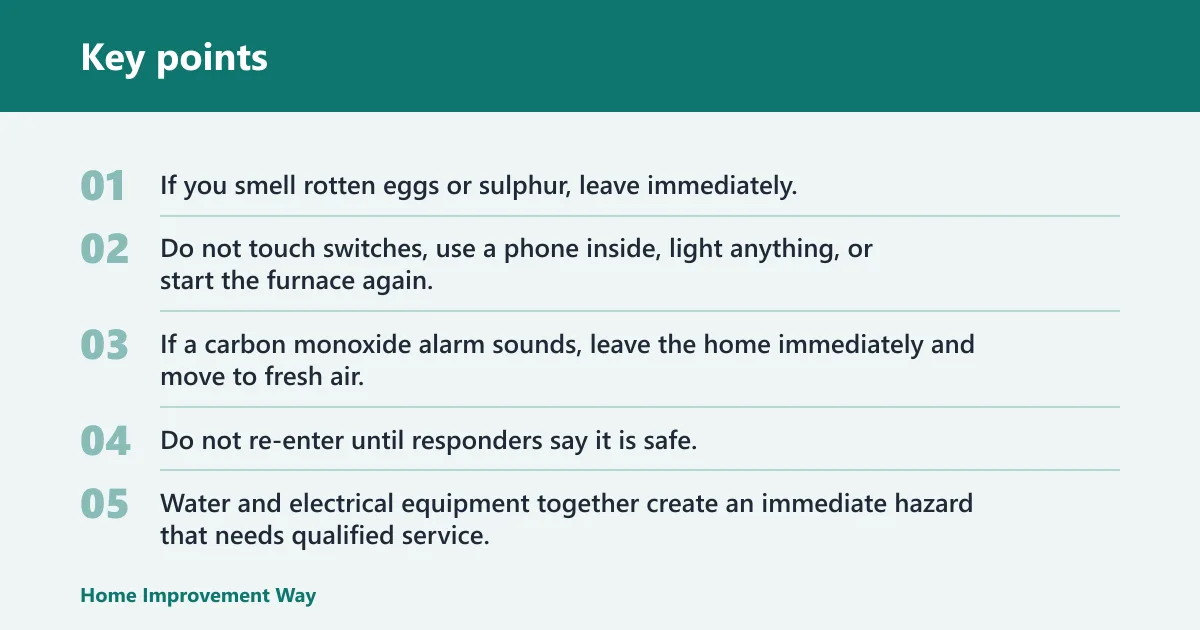


If you smell gas, hear a carbon monoxide alarm, see smoke or sparking, or find water near electrical equipment, stop troubleshooting and leave the home. A severe freeze warning makes a no-heat situation an immediate emergency, because prolonged sub-freezing temperatures can put your home at severe risk for frozen water pipes.
Gas smell or fuel leak signs
If you smell rotten eggs or sulphur, leave immediately. Do not touch switches, use a phone inside, light anything, or start the furnace again. Get emergency help from outside the home.
Carbon monoxide alarm
If a carbon monoxide alarm sounds, leave the home immediately and move to fresh air. Call 911 or your local fire department. Do not re-enter until responders say it is safe.
Water near electrical equipment
If you see water around the furnace, nearby wiring, or the electrical panel, stop using the furnace and do not investigate further. Water and electrical equipment together create an immediate hazard that needs qualified service.
What should I do first when my furnace stops working in freezing weather?
Begin with the safest basic checks: thermostat, furnace power switch, breaker, and the visible filter. If any hazard signs are present, skip those checks and leave. If the home is under a freeze warning, protect pipes while you work through the first hour.
-
Check the thermostat. Set it to HEAT and make sure the setpoint is above room temperature. If the display is blank or weak, check the battery status before you assume the furnace failed.
-
Confirm furnace power. Find the emergency power switch near the appliance and make sure it is ON. This wall switch can be bumped OFF by mistake during cleaning or storage.
-
Check the breaker once. If the breaker is tripped, restore it once and watch for immediate failure. If it trips again after being restored, stop resetting it and arrange qualified service.
-
Inspect the filter. Only check the filter if it is homeowner-accessible. Replace it if it is clearly clogged, and match the correct size and airflow direction.
-
Look outside for blockage. From outside only, check the intake and exhaust terminations for snow, drifting snow, freezing rain, or icing. Do not dismantle venting.
Furnace outage checklist
Use this as a fast owner check before you call for repair. It separates safe checks from stop points, so you do not keep troubleshooting after a hazard shows up.
| Check | What to look for | What to do next |
|---|---|---|
| Thermostat | Set to HEAT, setpoint above room temperature, battery status if display is blank or weak | Correct the setting or battery, then wait for a response |
| Emergency switch | Wall switch near furnace is ON | Turn it on if it was bumped OFF |
| Breaker | Tripped or off once | Reset once only; stop if it trips again |
| Filter | Clearly clogged, damaged, or installed wrong | Replace with the correct size and airflow direction |
| Outside vents | Snow, drifting snow, freezing rain, or icing at terminations | Clear safe visible blockage from outside only |
| Safety hazards | Gas smell, CO alarm, smoke, sparking, or water near electrical equipment | Leave immediately and get emergency help |
What the symptom means
The symptom tells you which branch to follow next. A furnace that does nothing, one that tries to start, one that runs but blows cold air, and one that shuts down again each point to different checks and different stop points.
No response at all
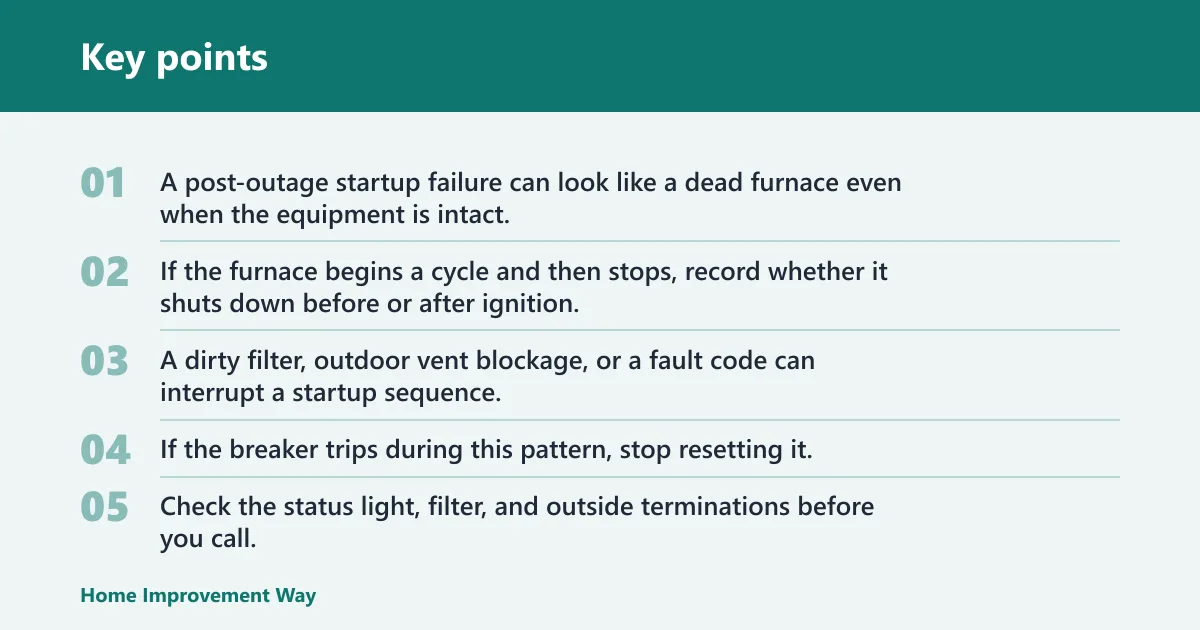
If the furnace is completely silent, the thermostat setting, furnace switch, breaker, or power loss are the most likely first checks. A post-outage startup failure can look like a dead furnace even when the equipment is intact.
Say your thermostat is set to HEAT with the setpoint at 70°F, the display looks normal, and the furnace still does nothing after a breaker reset. That points away from thermostat settings and toward a power, control, or safety issue that needs a technician.
Starts, then shuts down
If the furnace begins a cycle and then stops, record whether it shuts down before or after ignition. A dirty filter, outdoor vent blockage, or a fault code can interrupt a startup sequence. If the breaker trips during this pattern, stop resetting it.
Blows cold air
Cold air can mean the blower is running without heat, the furnace is trying to light and failing, or the system is in a shutdown state with the fan still moving air. Check the status light, filter, and outside terminations before you call.
Trips the breaker again
A recurring breaker trip is not a reset-and-try-again problem. One reset is enough. If it trips again after being restored, stop and schedule qualified service, because repeated tripping points to an electrical fault or failing component.
How do I keep my house from freezing if the heat goes out overnight?
Focus on rooms with plumbing first. Open cabinet doors under sinks near exterior walls, keep interior doors open so warmer air can move, and let faucets run at a tiny drip during a freeze warning. Those steps matter because exposed pipes can start freezing in 3 to 6 hours when temperatures drop below freezing.
-
Open pipe cabinets. Open cabinet doors under sinks near exterior walls so ambient warm air can circulate. This is one of the fastest ways to protect plumbing zones without adding heat sources.
-
Keep doors open. Leave interior doors open to help air move through the home. Close off unused rooms only if doing so does not trap plumbing in a colder space.
-
Set faucets to a drip. Keep faucets running at a tiny drip during a freeze warning. The goal is steady movement through exposed lines, not a full stream.
-
Hold indoor heat. Close blinds and curtains at night, and keep people in the smallest practical heated area. This buys time while you wait for repair.
Do not use a gas oven, outdoor propane burner, or charcoal grill indoors. That is unsafe even in a cold snap, and it creates a carbon monoxide risk. Use only safe household measures while you wait for service.
Picture a basement with a utility sink on an exterior wall and a kitchen line above an unheated crawlspace. Those are the first zones to protect. Open the sink cabinet, open nearby interior doors, and keep a tiny drip at vulnerable faucets while you document the outage.
When should you stop troubleshooting and call a technician?
Stop homeowner checks if you hit a hazard, if the breaker trips again, if outdoor vents are blocked by snow or icing and you cannot clear them safely from outside, or if the furnace still fails after a power outage has ended. A visible fault light or code is also a strong reason to stop guessing and record the pattern for repair.
Recurring breaker trips
If the breaker trips again after being restored, do not keep resetting it. That pattern can point to a motor, control, or electrical problem that needs qualified service.
Vent blockage from snow or icing
After snow, drifting snow, freezing rain, or icing, inspect exterior intake and exhaust terminations from outside only. If the blockage is heavy, unsafe to reach, or keeps returning, stop and call a technician rather than dismantling venting.
No-heat after a power failure
Power outage recovery can leave a furnace in a failed startup state even after utility power returns. Check the breaker once, confirm the thermostat and emergency switch, then record the outcome. If the unit still will not start, call for repair.
Error light points to a fault
If a status light or code is visible, record the exact colour and flash pattern. That detail can separate a simple lockout from an ignition, pressure, or sensor fault. Capture the make and model if you can see the label without opening the cabinet.
What to record before you call
Good notes speed up diagnosis. A technician-ready log should capture the symptom, the checks already done, and any weather or power event that came before the outage. Write it down before you forget the sequence.
| Field | What to write |
|---|---|
| Thermostat status | HEAT or not, setpoint, and whether the display was blank or weak |
| Breaker behavior | Tripped, reset once, tripped again, or stayed on |
| Filter condition | Clean, dusty, clogged, damaged, or replaced |
| Outside vent obstruction | Snow, drifting snow, freezing rain, icing, or clear |
| Error light pattern | Exact colour and flash pattern, or the code shown |
| Weather or power event | After power failure, after snow/icing event, or neither |
Suppose the furnace went out after a freezing rain event and the outside exhaust cap is partially iced over. Note the weather, the blockage, the exact light pattern, and whether the breaker stayed on. That combination can save time on the service call.
Frequently asked questions
When is a no-heat furnace problem an emergency?
It is an emergency if there is a gas smell, a carbon monoxide alarm, smoke, sparking, or water near electrical equipment. A severe freeze warning also turns a no-heat outage into an immediate emergency because frozen pipes can start quickly. Leave the home if any of those hazards are present.
What furnace checks are safe to do before calling for repair?
Safe checks are limited to thermostat settings, the furnace emergency switch, one breaker check, the homeowner-accessible filter, and a visual inspection of outside vent terminations from outside only. If the breaker trips again, if the vent is blocked in a way you cannot safely clear, or if any hazard appears, stop.
How do I tell if the problem is a thermostat, breaker, or furnace shutdown?
A dead display or low battery can point to the thermostat. A tripped breaker or interrupted power can stop the furnace completely. If the furnace tries to start, shows a fault light, or shuts down after a short run, the problem is more likely inside the furnace than at the thermostat.
Should I keep resetting the furnace if the breaker trips?
No. Reset the breaker once, then stop if it trips again. Repeated tripping points to a fault that needs qualified service. Continuing to reset it can make the problem harder to trace and may add electrical risk.
What should I do if I smell gas when the furnace stops working?
Leave the home immediately. Do not use switches, phones, flames, or anything that could spark. Get to fresh air and contact emergency help from outside. Do not restart the furnace or open the cabinet to investigate.
Can frozen vents or snow around the outside intake stop a furnace from running?
Yes. Snow, drifting snow, freezing rain, and icing can block the outside intake or exhaust and stop the furnace from running or staying on. Check from outside only. Do not dismantle venting. If the blockage is unsafe to clear or keeps coming back, call a technician.
Sponsored / affiliate links. As an Amazon Associate I earn from qualifying purchases. I may earn additional commission from eligible campaigns.
 Faryuan Bladeless Heater Fan, 25inch Heating & Cooling & Filter Combo Tower Fan 80° Oscillating with Remote, 9H Timer, 8 Speeds, Portable Quiet for Indoor, Bedroom, Home Office Room, White&Sliver
 YUCHENGTECH Ionizing Air Blower Static Eliminator Fan Desktop Ionizer Air Blower with Detachable Cord ESD Ionizer Electrostatic Discharge Fan 110V