How to Reset a Furnace After It Locks Out
Reset a furnace after lockout only once, and only after you identify the fuel type and the cause. If it locks out again, stop and call for service. Repeated resets can flood the burner, waste fuel, and damage ignition parts or the control board. This guide shows how to tell gas, oil, and electric furnaces apart, then reset each one safely.
What you’ll need
- Thermostat access
- Furnace switch or breaker access
- Owner’s manual or model label
- Flashlight for the control area
📊 wikiHow says if the furnace doesn’t light in 60 seconds, check fuses and breaker. Source: Wikihow.
What a furnace lockout means
A lockout is a safety shutdown. Most modern furnaces enter lockout after repeated ignition failure or another fault the control board will not ignore. Some units use a soft lockout and try again later. Others use a hard lockout and need a manual reset or a power interruption before they restart.
If the furnace lost flame at startup, the control board may have seen a bad signal from the igniter, flame sensor, pilot, or burner circuit. That usually means the problem is not the thermostat alone. A lockout after an hour of runtime points more toward overheating, airflow trouble, or an electrical fault than a simple ignition miss.
Which furnace type do you have?
Identify the furnace first. Gas, oil, and electric units reset differently, and the reset button may be in a different place or absent entirely. Use the nameplate and the burner area before you press anything.
Gas furnace signs
A gas furnace usually has an ignition control board, a gas valve, and either a hot surface igniter, spark ignition, or a pilot system on older equipment. Brass Tacks says the reset button is on the ignition control module. Some gas furnaces do not have a homeowner reset button and instead clear after a power cycle or a timed delay.
Oil furnace signs
An oil furnace has a burner primary control and a reset button that is often on the burner or nearby control area. HVAC Training Shop says the oil furnace reset button is usually located in the blower compartment, but location varies by model and may be on the burner primary control. If the burner ran out of oil, the system may also need bleeding.
Electric furnace signs
An electric furnace uses heating elements and a limit switch or thermal cutoff instead of a combustion burner. The same source says electric furnaces use a limit switch or thermal cutoff rather than an ignition control module. A trip here often points to overheating, blocked airflow, or an electrical fault rather than fuel supply.
Check the nameplate before you reset
Read the model label before you touch a reset button. The label tells you whether the unit is gas, oil, or electric and whether the reset is user-accessible. If the manual does not describe a homeowner reset, do not guess.
How do I restart a furnace after it shuts off?
Start with the thermostat and power, then use the correct reset path for the furnace type. Set the thermostat to heat, raise the setpoint above room temperature, and make sure the furnace switch or breaker is on. If the unit still will not start, use the reset method for that model only once.
- Set the thermostat to heat and raise the set temperature above room temperature.
- Turn the furnace off at the switch or breaker if the manual calls for a power reset.
- Wait the reset interval listed by the manufacturer, or allow the control board time to clear if the unit has no manual reset.
- Restore power and watch the startup sequence before you press anything else.
Say your thermostat is set to 68°F but the room is already 70°F. The furnace may look dead even though nothing is wrong with the burner. Raise the setpoint to 72°F before you decide the unit needs a reset.
How do I reset a gas furnace?
Gas furnaces often reset by power cycling, but not every model has a visible reset button. Look for the control board diagnostic light first. If the manual allows a reset, restore power and watch the light or ignition sequence. That light can point to a flame sensor, igniter, or pilot fault.
- Set the thermostat to heat and turn the setpoint above room temperature.
- Switch off furnace power at the furnace switch or breaker.
- Wait the manufacturer’s reset interval, or up to the control board’s own recovery delay if the unit has no manual button.
- Restore power and watch the diagnostic light and ignition attempt.
- If the furnace does not light and the control keeps faulting, stop after one reset and call for service.
A common first-timer mistake is pressing reset on a gas furnace more than once because the burner has not lit yet. That can keep feeding fuel into a problem that already caused lockout. If the unit still will not ignite after one reset, the fault is deeper than a temporary shutdown.
How do I reset an oil furnace?
Oil furnaces are the one place where the reset button gets the most misuse. Press it once only. If the unit ran out of oil or lost prime, the burner may need bleeding at the fuel pump, but that should follow the manufacturer’s procedure or a technician’s instructions. Do not keep pressing reset.
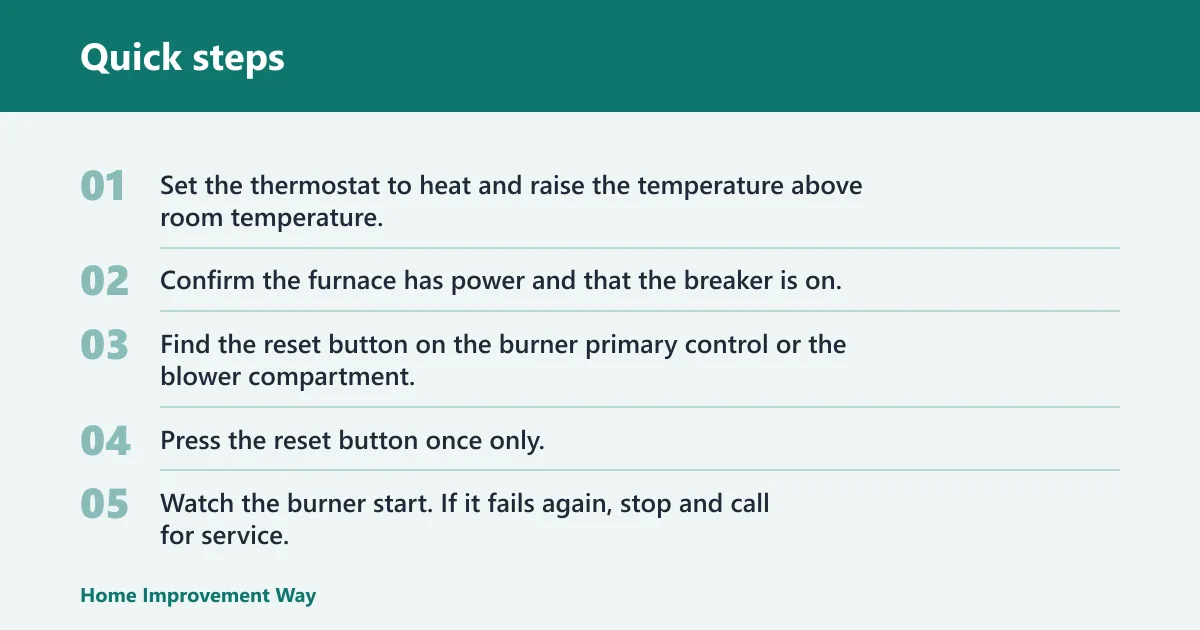
- Set the thermostat to heat and raise the temperature above room temperature.
- Confirm the furnace has power and that the breaker is on.
- Find the reset button on the burner primary control or the blower compartment, depending on the model.
- Press the reset button once only.
- Watch the burner start. If it fails again, stop and call for service.
wikiHow notes that some oil furnaces need bleeding after running out of oil. It also says the bleeder valve is generally on the side of the fuel pump, usually at the 4 or 8 o’clock position, and that a 3/8ths wrench, 1/4 in flexible tubing, and a container to catch oil are used for that process. Do not treat that as a generic reset step unless the manufacturer instructs it.
How do I restart an oil furnace after a lockout?
Restart an oil furnace after lockout by checking fuel supply first, then pressing reset once. If the tank ran dry, air in the line can keep the burner from lighting even after a reset. If the burner fails again, the issue may be fuel delivery, not the control button.
What the control light is telling you
Use the control board diagnostic light before and after the reset. Blink patterns can point to ignition failure, flame sensor trouble, limit trips, or another lockout cause. The light may keep the same fault after reset, which is useful because it tells you the problem did not clear.
- Open the access panel and locate the control board light.
- Read the blink pattern before you reset, if the unit shows one.
- Reset the furnace once.
- Check whether the same code returns or whether a new code appears.
- Stop if the code points to ignition, sensor, overheating, or a repeated safety trip.
Suppose the light flashes a fault during startup, the furnace tries again, and then locks out within a minute. That timing usually points toward ignition or flame sensing rather than a thermostat issue. If the unit runs for a while before shutting off, look harder at airflow and overheating.
Furnace lockout decision table
| Furnace type | What to check first | What a failed reset most likely means |
|---|---|---|
| Gas | Thermostat set to heat, power at the switch or breaker, and the control board diagnostic light | Ignition, flame sensing, pilot, gas valve, or control board fault |
| Oil | Fuel supply, burner primary control location, and whether the reset button was pressed only once | Fuel starvation, air in the line, burner fault, or a repeated lockout that needs service |
| Electric | Breaker position, thermostat settings, and whether the limit switch or thermal cutoff tripped | Overheating, airflow restriction, element fault, or an electrical issue |
| Stop and call a pro | Gas odor, repeated lockouts, or no ignition after one reset | Do not keep resetting; shut the unit down and get service |
Common mistakes
Do not press reset over and over. On oil furnaces, that can flood the burner and make the lockout worse. On gas furnaces, repeated resets can hide a flame-sensing or ignition fault that needs diagnosis.
Do not skip the thermostat check. A furnace set to cool, or a setpoint below room temperature, can look like a shutdown even when the furnace is fine. Also do not ignore gas odor. That is a stop point, not a restart cue.
Do not assume the same reset applies to every model. Some furnaces have a manual button, some clear after 30 minutes to an hour, and some need breaker power cycling instead of a button press. If the manual does not spell it out, stop.
Frequently asked questions
How do I reset a furnace after it locks out?
Set the thermostat to heat, confirm the power is on, and identify the furnace type before you touch any reset control. Then use the model’s allowed reset path once. If the furnace locks out again, leave it off and call for service.
What does hard lockout on a furnace mean?
Hard lockout means the control has stopped repeated restart attempts for safety. The unit usually will not recover until you reset it, power cycle it, or wait for a built-in recovery delay. If the lockout returns right away, the fault still exists.
Why does my furnace keep going into lockout mode?
Repeated lockouts usually mean the furnace keeps seeing the same fault. Common causes include ignition trouble, flame-sensor problems, fuel starvation on oil systems, overheating on electric systems, or a gas valve issue. The timing matters: quick shutdowns often point to ignition; later shutdowns often point to airflow or heat buildup.
How do I reset the furnace thermostat?
Set it to heat, raise the setpoint above room temperature, and make sure the batteries are good if the thermostat uses them. If the display is blank or the settings look wrong, check the thermostat breaker or replace the batteries before you reset the furnace itself.
Sponsored / affiliate links. As an Amazon Associate I earn from qualifying purchases. I may earn additional commission from eligible campaigns.