How to Relight a Furnace Pilot Light
To relight a furnace pilot light, first confirm your furnace has a standing pilot system and a pilot assembly near the burners. If you smell gas, see soot, or the pilot will not stay lit after a few tries, stop and call a technician. A bad relight can mean no heat, repeated gas buildup, or a fault that needs repair. This guide shows how to identify a standing pilot furnace, relight it safely, and spot warning signs that mean it is not a simple fix.
Do you have a standing pilot?
Many older gas furnaces use a standing pilot light, which is a small flame that stays on all the time. Newer gas furnaces often use hot-surface or intermittent ignition instead, and they have no pilot to relight. Confirm the furnace type before you touch the ignition area.
Look for the pilot flame and gas control valve
Open the furnace access panel for the normal user-access compartment and look near the burners for a small flame and a control marked OFF, PILOT, and ON. If you see a glow plug, hot-surface igniter, or no pilot assembly at all, you do not have a standing pilot system. Do not open any sealed burner compartment or other cover meant only for service access.
Stop if the system uses electronic ignition
If the furnace has electronic ignition, there is no pilot to light by hand. Do not keep cycling the control or bringing any flame close to the burner area. A reset or service call may be needed instead, especially if the unit locks out after failed starts.
What you’ll need
- Owner’s manual or model label
- Flashlight
- Long-reach lighter or match, if the model calls for one
- Basic tools for the access panel, if needed
- Dry hands and enough light to see the pilot area clearly
Turn the furnace off first, then set the gas control valve to OFF and wait at least 5 minutes before any ignition attempt. That wait gives any unburned gas time to clear from the burner compartment. If you smell gas at any point, stop and leave the area.
- Set the thermostat to the lowest setting and switch the furnace off.
- Turn the gas control valve to OFF and wait 5 minutes.
- Remove the furnace access panel so you can reach the burner compartment.
- Find the pilot opening, then turn the control to PILOT.
- Press and hold the pilot control, then use the approved ignition source at the pilot opening.
- Keep holding the control for 30 to 60 seconds, or for the time listed on the label, so the flame can stabilize.
- Release the control slowly and confirm the pilot stays lit.
- Turn the control to ON, reinstall the access panel, and restore power.
Picture a furnace with a clearly marked pilot door and a label that says hold for 45 seconds. If the flame lights but goes out the moment the knob is released, that is not a normal finish. A standing pilot should stay on after the control is released.
What should you do first?
Start with a gas odor check, then verify that the furnace truly has a standing pilot, and only then decide whether the access panel can come off cleanly and go back on. Those three checks prevent the two biggest mistakes: trying to light the wrong furnace and lighting near escaping gas.
Check for gas odor
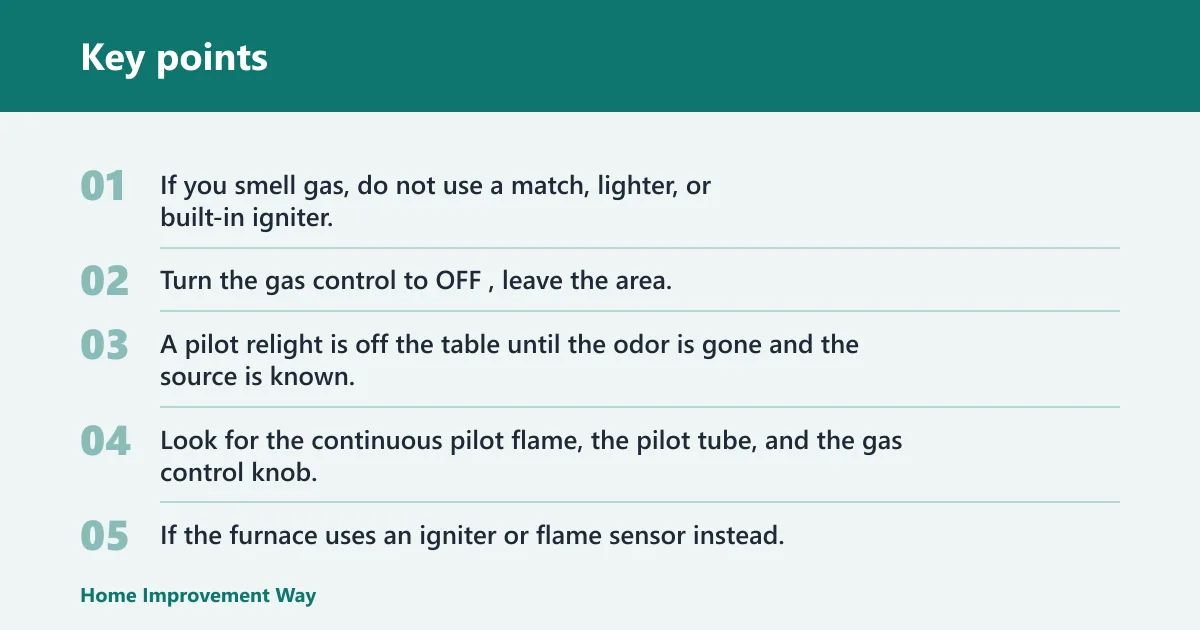
If you smell gas, do not use a match, lighter, or built-in igniter. Turn the gas control to OFF, leave the area, and follow the utility or emergency guidance for your home. A pilot relight is off the table until the odor is gone and the source is known.
Confirm the furnace has a standing pilot
Look for the continuous pilot flame, the pilot tube, and the gas control knob. If the furnace uses an igniter or flame sensor instead, it needs a different troubleshooting path. A flame sensor is common on newer systems and should not be confused with a thermocouple.
Confirm the access panel can be removed and reinstalled safely
The access panel must go back on before normal operation. Many furnaces use a safety interlock that blocks firing if the panel is left off. Reinstall it before normal operation so the interlock does not block firing. Keep the screws or fasteners together so the panel can be secured before you restore power.
What if the pilot will not stay lit?
A pilot that lights but will not stay lit often points to a thermocouple problem, a dirty pilot orifice, or a weak pilot flame. Repeated outages, soot, rust, delayed ignition, or a blower that never seems to catch up point beyond a simple relight and toward service. Delayed ignition means the burners light after a pause with a bang, pop, or whoosh instead of a smooth start. A blower that never seems to catch up can mean the furnace is not operating normally and needs inspection.
Check the thermocouple
The thermocouple detects flame on many older furnaces and tells the gas control valve the pilot is lit. If it is dirty, loose, bent away from the flame, or failing, the pilot may light and go out as soon as you release the control. Cleaning or replacement may be needed.
Look for a weak or dirty pilot flame
A healthy pilot flame is steady and should contact the thermocouple tip. A lazy yellow flame, soot around the opening, or a flame that barely reaches the sensor can mean the pilot orifice is clogged. That is a service issue if cleaning does not restore a stable flame.
Watch for repeated outages or lockout
Many furnaces enter a safety lockout after repeated failed ignition attempts. If you have already tried the labeled procedure and the furnace still will not hold a pilot, stop and let the system sit for the wait period in the manual. Persistent lockout needs diagnosis.
Say your furnace relights on the first attempt, then the pilot dies after 20 seconds when the knob is released. That usually points away from user error and toward a thermocouple, pilot flame, or gas control issue. Trying the same steps over and over can trigger lockout without fixing the cause.
Common mistakes
Most failed relights come from a few avoidable errors. Slow down at the control valve and at the access panel. If any step feels unclear, stop and read the label on the furnace door before trying again.
- Lighting with the gas still on: Set the valve to OFF before waiting and before any ignition attempt.
- Leaving the access panel off: Reinstall it before normal operation so the interlock does not block firing.
- Confusing a flame sensor with a thermocouple: Newer furnaces may have a flame sensor instead of a standing pilot setup.
- Trying again after repeated failures: Stop after the allowed attempts and wait for lockout to clear, or call a technician.
- Using an ignition source near escaping gas: Do not light anything if you smell gas.
Should you relight or call a pro?
| Yes/no check | What to look for | Action |
|---|---|---|
| 1. Gas smell? | No odor at the furnace or nearby | Yes can continue / No call now |
| 2. Standing pilot confirmed? | Small continuous flame and pilot assembly present | Yes continue / No stop |
| 3. Furnace type matches? | Older gas furnace, not electronic ignition | Yes continue / No stop |
| 4. Control marked OFF/PILOT/ON? | Gas control valve is identifiable | Yes continue / No call now |
| 5. Access panel removable? | Panel comes off and can be reinstalled fully | Yes continue / No call now |
| 6. Pilot opening visible? | You can reach the pilot area safely | Yes continue / No call now |
| 7. Flame stays lit on release? | Control released after 30 to 60 seconds | Yes safe to attempt relight / No continue |
| 8. Repeated outages? | It has gone out more than once recently | No continue only if first try / Yes call now |
| 9. Weak or lazy flame? | Pilot is small, yellow, or unstable | Yes call now |
| 10. Soot or rust present? | Burn marks, rust flakes, or soot nearby | Yes call now |
| 11. Vent or draft issue? | Blocked flue, strong downdraft, or poor venting | Yes call now |
| 12. Lockout after failed tries? | Furnace stops responding after several attempts | Try one more time then stop / If already repeated, call now |
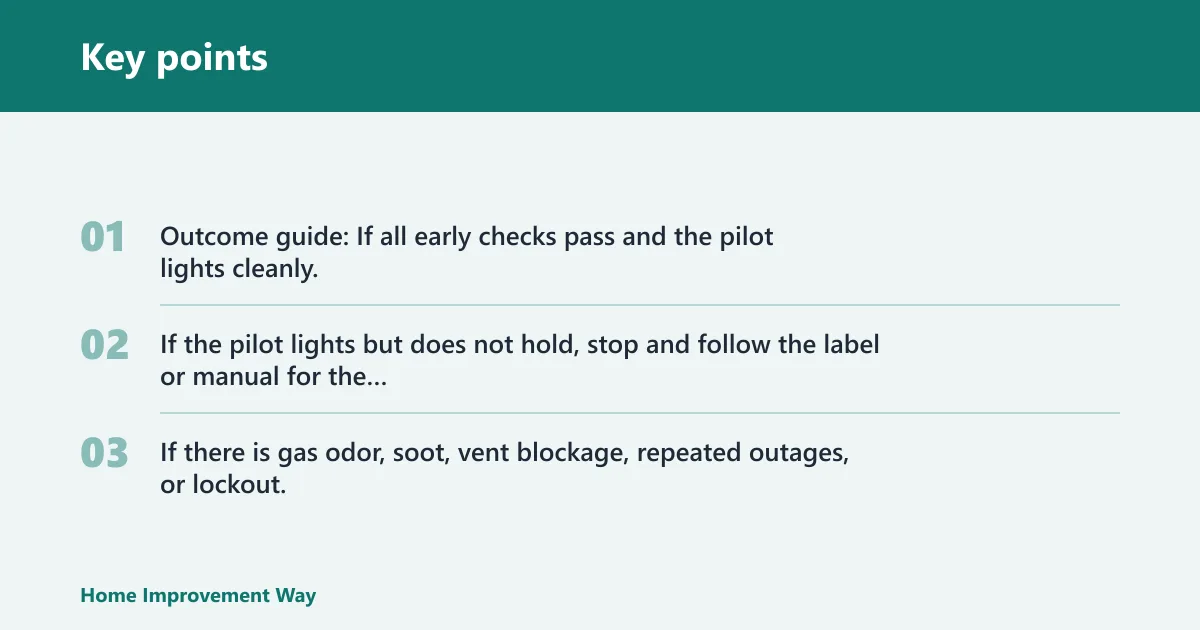
Outcome guide: If all early checks pass and the pilot lights cleanly, attempt the relight procedure once. If the pilot lights but does not hold, stop and follow the label or manual for the specific furnace; do not keep trying beyond the allowed procedure. If there is gas odor, soot, vent blockage, repeated outages, or lockout, call an HVAC technician now.
Frequently asked questions
How do I relight a furnace pilot light?
Turn the furnace off, set the gas control valve to OFF, wait 5 minutes, then turn to PILOT, light the pilot with the approved ignition source, hold the control for 30 to 60 seconds, and release it. Reinstall the access panel before switching the furnace back to ON.
How do I relight a gas furnace pilot light?
Use the same standing-pilot procedure only if your furnace has a pilot assembly and a control labeled OFF, PILOT, and ON. If the furnace uses electronic ignition, there is no pilot to relight by hand, so you need the model’s reset or service steps instead.
How do I know if my furnace has a pilot light or electronic ignition?
Open the access panel and look for a small continuous flame near the burners and a gas control knob with pilot markings. If you see a hot-surface igniter, spark igniter, or flame sensor without a pilot flame, the furnace uses electronic ignition and should not be relit like an older standing-pilot unit.
What should I do if the pilot light will not stay lit?
Stop after the allowed attempts and check the thermocouple area, the pilot flame quality, and the furnace label for a lockout note. If the flame is weak, the opening is dirty, or the furnace keeps shutting down, call a technician. Repeated failures usually mean a part or venting fault.
Is it safe to relight a furnace pilot light myself?
It can be safe on an older standing-pilot furnace if there is no gas odor, the control valve and pilot area are clearly labeled, and the access panel can be reinstalled correctly. If any of those checks fail, or if the furnace has soot, rust, or repeated outages, stop and get service.
How long should I wait before relighting a furnace pilot light?
Wait at least 5 minutes after turning the gas control valve to OFF. That pause lets unburned gas clear from the burner area. If you smell gas after waiting, do not try to relight; leave the area and have the system checked first.
Why does my furnace pilot light keep going out?
Common causes include a failing thermocouple, a dirty pilot orifice, weak pilot flame, draft issues, vent blockage, or repeated ignition failures that trigger lockout. A standing pilot that keeps dropping out is rarely fixed by repeated relighting alone and usually needs inspection or parts replacement.
When should I call an HVAC technician instead of relighting it myself?
Call now if you smell gas, see soot or rust near the burner area, notice delayed ignition, or have already had repeated pilot outages. A technician should also handle persistent lockout, suspected vent blockage, and any furnace that will not relight after the labeled procedure.
Sponsored / affiliate links. As an Amazon Associate I earn from qualifying purchases. I may earn additional commission from eligible campaigns.