Why Is My Furnace Not Igniting?
A gas furnace that won’t ignite usually has a failed ignition-stage part: thermostat call, airflow switch, igniter, gas valve, flame sensor, or control board. If you ignore it, you can lose heat and turn a small fault into a no-heat emergency. This guide matches each startup symptom to the most likely failure so you can narrow the cause safely.
This guide is part of our Furnace Troubleshooting: Fix Common Winter Heating Problems series.
How furnace ignition fails
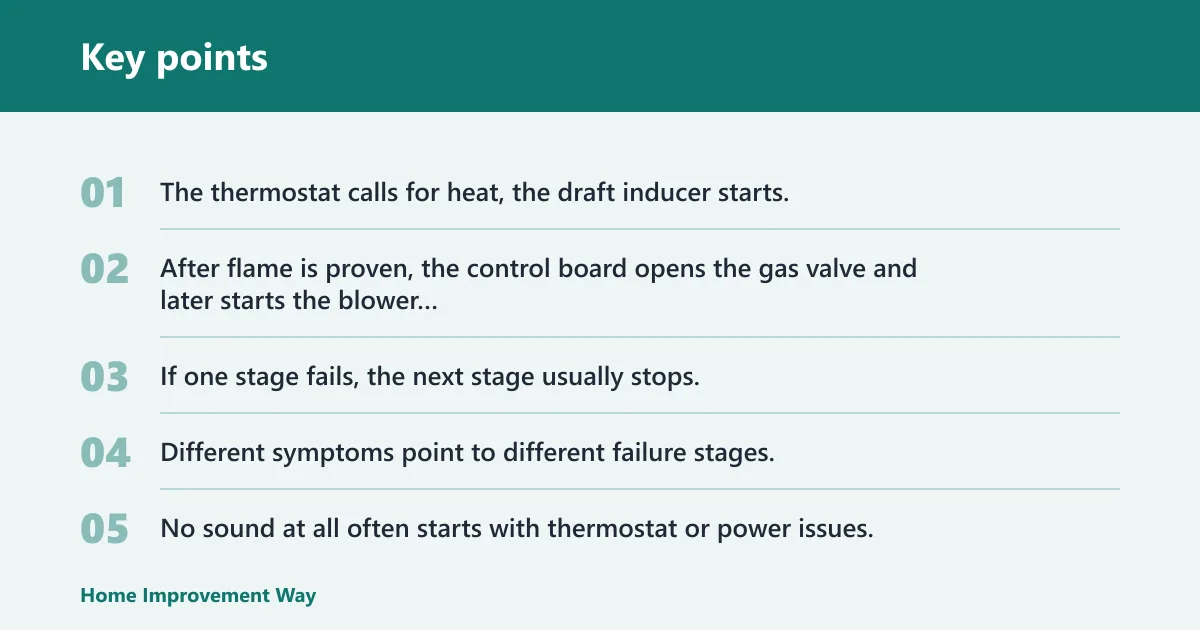

Furnace ignition follows a fixed sequence. The thermostat calls for heat, the draft inducer starts, the pressure switch proves airflow, and then the igniter or pilot lights the burners. After flame is proven, the control board opens the gas valve and later starts the blower after the heat exchanger warms. If one stage fails, the next stage usually stops.
Where the sequence can stop
Different symptoms point to different failure stages. No sound at all often starts with thermostat or power issues. An inducer that runs without a click usually points to a pressure switch or venting problem. A click with no flame suggests igniter, gas supply, or gas valve trouble. Flame that lights and then shuts off often points to the flame sensor or overheating protection.
Ignition failure versus no-heat after startup
Do not mix up ignition failure with a furnace that runs but does not heat. If the burners light and the blower runs, the ignition stage worked. The problem may be airflow restriction, a limit switch trip, or a heat output issue instead. That difference matters because the symptom tells you where to look first.
Igniting furnace not table
This table maps the startup symptom to the most likely failed stage and the safest first check. It is meant to help you narrow the problem without repeated resets or guessing.
| Symptom | Probable failed component | Safe homeowner check | Urgency level |
|---|---|---|---|
| No sound at all | Thermostat, power supply, control board | Set the thermostat to heat, raise the setpoint above room temperature, check thermostat batteries and the power path, then inspect the breaker, fuse, and furnace switch | Can wait briefly if no gas smell |
| Inducer runs but no click | Pressure switch, venting, draft inducer motor, control board | Check for blocked intake or exhaust, dirty filter, and any LED fault code | Call same day if it repeats |
| Click but no flame | Hot surface igniter, spark igniter, gas shutoff valve, gas valve | Verify the gas valve is open and no gas odor is present | Call same day |
| Flame lights then shuts off | Flame sensor, weak flame, limit switch, control board | Check for a dirty filter, blocked return, and repeated shutdown pattern | Call same day |
| Repeated lockout or blinking code | Control board, pressure switch, igniter, flame sensor | Read the LED flash pattern and stop repeated resets | Call same day |
| Gas odor and emergency stop | Gas leak or failed gas control | Shut off gas if safe, leave the area, and avoid switches or flame | Stop and call emergency help |
Why is my furnace not starting?
If the furnace never starts, begin with the thermostat and power path. Set the thermostat to heat and raise the setpoint above room temperature, because a unit may not call for heat unless it sees a demand. Then check thermostat batteries, obvious wiring issues, the breaker, the fuse, and the furnace power switch before you look deeper.
Thermostat checks
The thermostat should be in heat mode with the setpoint above room temperature. Weak batteries, loose wiring, or a reset issue can stop the 24-volt call for heat that begins the ignition sequence. If the display is blank, flashing, or changed settings on its own, fix that before assuming the furnace has failed.
Power checks
A tripped breaker may stop a furnace from igniting, and a blown fuse can do the same. A switched-off furnace disconnect or service switch can also leave the unit dead. If the thermostat is calling for heat but the furnace has no response, power loss is one of the first safe checks.
What to do first
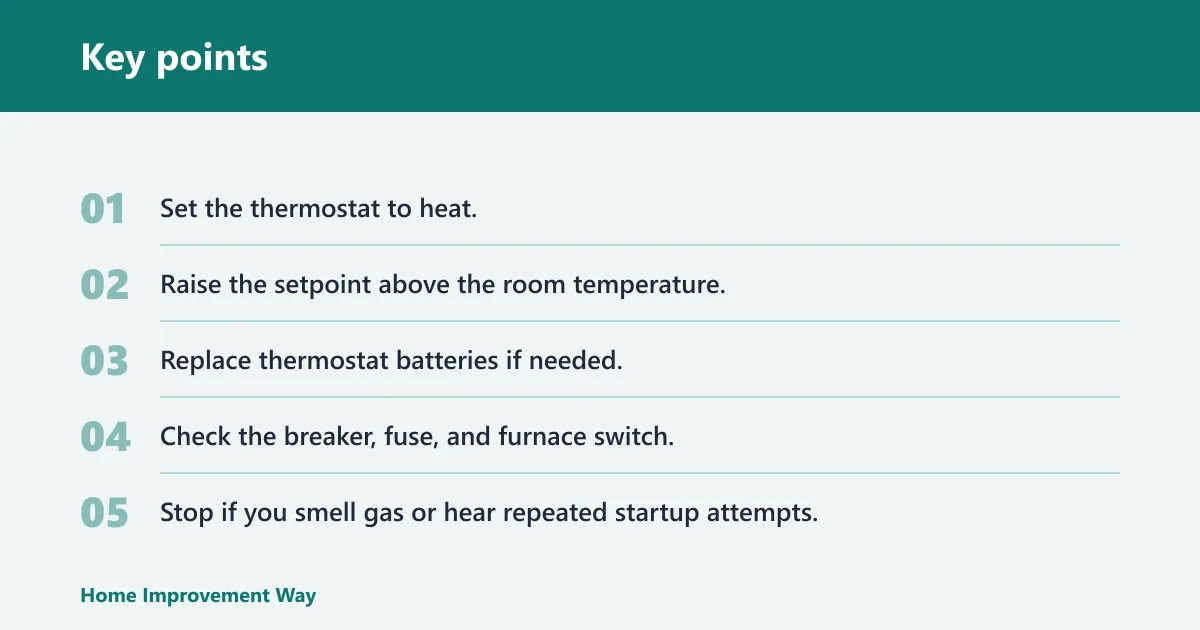
- Set the thermostat to heat.
- Raise the setpoint above the room temperature.
- Replace thermostat batteries if needed.
- Check the breaker, fuse, and furnace switch.
- Stop if you smell gas or hear repeated startup attempts.
Why is my furnace not igniting?
If the furnace starts its sequence but the burners never light, the gas path or igniter is usually the issue. Check that the gas shutoff valve is open and that no rotten egg odor is present. On electronic systems, the igniter should glow or spark before the gas valve opens. On older units, a pilot light may be the ignition source instead.
Gas supply and shutoff valve
The gas shutoff valve must be open for gas flow to the burners. If it is closed, the furnace may try to start without ever lighting. A rotten egg odor is an emergency warning of a possible gas leak, and you should stop at once if you notice it.
Hot surface igniter and spark ignition
A hot surface igniter is a fragile ceramic element. It must glow before the gas valve opens, and a cracked or weak igniter may fail to get hot enough to light the burners. Spark ignition systems can fail in a similar way. Either fault can produce a click or warm-up sound with no flame.
Older furnaces with a pilot light
Older gas furnaces may use a pilot light instead of electronic ignition. If the pilot is out, the burners will not light. Follow the manufacturer’s lighting instructions exactly; do not relight without checking the manual, especially if you have repeated shutdowns or any gas odor.
Common homeowner example
Say your thermostat is set to 72, the room is 68, and you hear a click but see no flame. That points away from the thermostat and toward the igniter, gas supply, or gas valve. If the furnace cabinet also smells like gas, stop and leave the area instead of trying again.
Why does it light then stop?
If the burners light and then shut down within seconds, the flame is usually not being proven or the furnace is protecting itself from heat or airflow problems. The main suspects are the flame sensor, the limit switch, clogged filters, or a control board that has entered lockout after repeated failed attempts.
Flame sensor problems
The flame sensor is a metal rod that sits in the burner flame. Its job is to prove the flame to the control board. Oxidation buildup on the sensor can block that signal, so the burners light briefly and then shut off. A dirty or failed flame sensor is a common cause of this pattern.
Limit switch shutdown
The limit switch is overheat protection. If airflow is restricted, the furnace can overheat and shut the burners off while the blower continues or starts later. A clogged air filter is a common airflow restriction, and one competitor recommends changing the filter every 1-3 months.
Control board lockout
The control board monitors the startup sequence and stores LED fault codes. Repeated ignition failures can end in lockout mode. Each blink pattern corresponds to a specific fault code, so do not keep resetting the furnace without reading the code first.
What not to do
Do not force parts, hold the gas valve open, or keep relighting a furnace that keeps shutting down. Do not guess at a fault after several failed starts. Repeated resets can hide the real problem and may leave you waiting on a furnace that is trying to protect itself.
High-efficiency furnace checks
High-efficiency gas furnaces add a few more points of failure before ignition. The draft inducer motor starts first and creates the airflow needed for the pressure switch to close. If the pressure switch does not close, the control board will not continue to ignition. Condensate drains, blocked venting, or a weak inducer can interrupt that chain.
Draft inducer motor
The draft inducer motor makes a whooshing startup sound before ignition. It clears combustion gases and supports pressure switch closure. If it never starts, starts slowly, or sounds strained, the furnace may stop before any flame attempt.
Pressure switch and venting
The pressure switch confirms draft and airflow. On many high-efficiency furnaces, ignition will not continue unless the switch closes. A blocked intake or exhaust, a venting fault, or a problem with the inducer can keep that switch open.
Airflow and condensate issues
A clogged filter can also create airflow-related safety shutdowns. On a high-efficiency unit, condensate drain problems may add another blockage point. If the furnace tries to start, stops, and then flashes a code, treat it as a fault that needs diagnosis rather than a normal reset issue.
Why is my furnace not working?
If the furnace is not working at all, use the symptom to sort the stage, not just the part. No sound usually means thermostat, power, or control board trouble. A startup sound with no flame points to ignition or gas supply. A flame that appears and then dies points to flame proving, airflow, or heat protection.
Safe to wait, shut off, or call same day
- Safe to wait briefly: no sound, no gas odor, and a clear thermostat or power issue you can correct.
- Shut off and stop: gas odor, repeated failed starts, or any sign of a leak.
- Call same day: inducer-only startup, click-no-flame, flame-then-shutdown, or a blinking fault code.
Common first-timer mistake
A common first-timer mistake is treating every no-heat problem as an ignition fault. If the burners light and the blower runs, the furnace may be heating poorly because of airflow or limit-switch trouble instead. That is a different repair path from a furnace that never lights at all.
Why is my furnace not lighting?
If the furnace is not lighting, focus on the gas supply, igniter, and ignition type. Make sure the gas shutoff valve is open, then check whether the system uses a hot surface igniter, spark ignition, or a standing pilot. A furnace that clicks but never lights is often failing before flame establishment.
Igniter types
Hot surface igniters are fragile ceramic elements that glow before gas opens. Spark systems create an ignition spark instead. Both depend on a working control board and a correct gas supply. A weak igniter can look normal at a glance but still fail under heat demand.
Old pilot systems
Older gas furnaces may use a pilot light. If the pilot is out, burners will not light. Follow the unit’s lighting instructions exactly, and stop if the pilot will not stay lit. That can indicate a thermocouple, gas valve, or draft problem.
Frequently asked questions
Why is the furnace not igniting?
The furnace usually is not getting through one startup step. A pressure switch that will not close, a weak hot surface igniter, a closed gas valve, or a flame sensor that cannot prove flame can stop ignition. Repeated resets can push the board into lockout mode.
Why is my furnace not heating?
A furnace may be starting but still not heating if it is shutting down on flame-sense, airflow, or limit-switch problems. The blower may run later while burners stay off, which is not the same as a dead furnace. Read the symptom carefully before assuming ignition failure.
Why won’t my furnace ignite?
Check the gas shutoff valve, the igniter type, and any fault code first. If you smell rotten eggs, stop immediately. If the furnace is a high-efficiency model, the draft inducer and pressure switch can block ignition before the burners ever receive gas.
Why is my gas furnace not igniting?
Gas furnaces fail to ignite for several common reasons: thermostat call failure, bad igniter, gas supply issue, pressure switch fault, flame sensor buildup, or control board lockout. The symptom pattern tells you which stage failed. That is safer than swapping parts at random.
Sponsored / affiliate links. As an Amazon Associate I earn from qualifying purchases. I may earn additional commission from eligible campaigns.