Smart Thermostat vs Programmable Thermostat: Which Is Worth It?
A smart thermostat is worth it if your schedule changes, you want phone control, or your HVAC setup supports learning features. A programmable thermostat is usually enough for steady routines and a lower upfront price. Pick the wrong type, and you can waste energy, lose comfort, or buy a thermostat your wiring and HVAC type cannot fully use. This guide compares cost, savings, compatibility, and which option fits common household routines.
This guide is part of our Heaters: types, safety, and installation series.
| Decision factor | Smart thermostat | Programmable thermostat | Winner |
|---|---|---|---|
| Upfront cost | Score: 2/5. Choose this if app control, alerts, and automation matter more than price. | Score: 5/5. Choose this if you want the cheaper wall control and do not need internet features. | Programmable thermostat |
| Wiring complexity | Score: 2/5. Choose this if you already have a compatible 24V setup and likely a C-wire or adapter path. | Score: 4/5. Choose this if you want fewer setup variables and a simpler replacement. | Programmable thermostat |
| Remote access | Score: 5/5. Choose this if you want phone control, usage alerts, and assistant integration. | Score: 1/5. Choose this only if remote access does not matter to your household. | Smart thermostat |
| Scheduling flexibility | Score: 5/5. Choose this if you want learning or adaptive schedules, occupancy features, and geofencing. | Score: 3/5. Choose this if fixed 7-day, 5-2, or 5-1-1 scheduling is enough. | Smart thermostat |
| Energy-saving potential | Score: 4/5. Choose this if your routine changes enough for automation to reduce wasted heating. | Score: 3/5. Choose this if you will actually program setbacks and keep using them. | Smart thermostat |
| Compatibility risk | Score: 2/5. Choose this only after confirming HVAC type, voltage, and available wiring. | Score: 4/5. Choose this if your system is basic and you want fewer compatibility checks. | Programmable thermostat |
| Maintenance | Score: 3/5. Choose this if you are fine with app updates, network setup, and possible cloud-dependent features. | Score: 5/5. Choose this if you want a simple display and no internet service to maintain. | Programmable thermostat |
| Best-fit household | Score: 4/5. Choose this for changing schedules, frequent travel, or smart home users. | Score: 5/5. Choose this for steady routines, renters, seniors, or low-tech households. | Programmable thermostat |
What each thermostat does
Smart thermostat wins for flexibility and data, while programmable thermostat wins for simplicity and lower risk. The real trade-off is automation versus predictability: one reacts to changing routines, the other depends on you setting the schedule and leaving it alone.
Smart thermostat
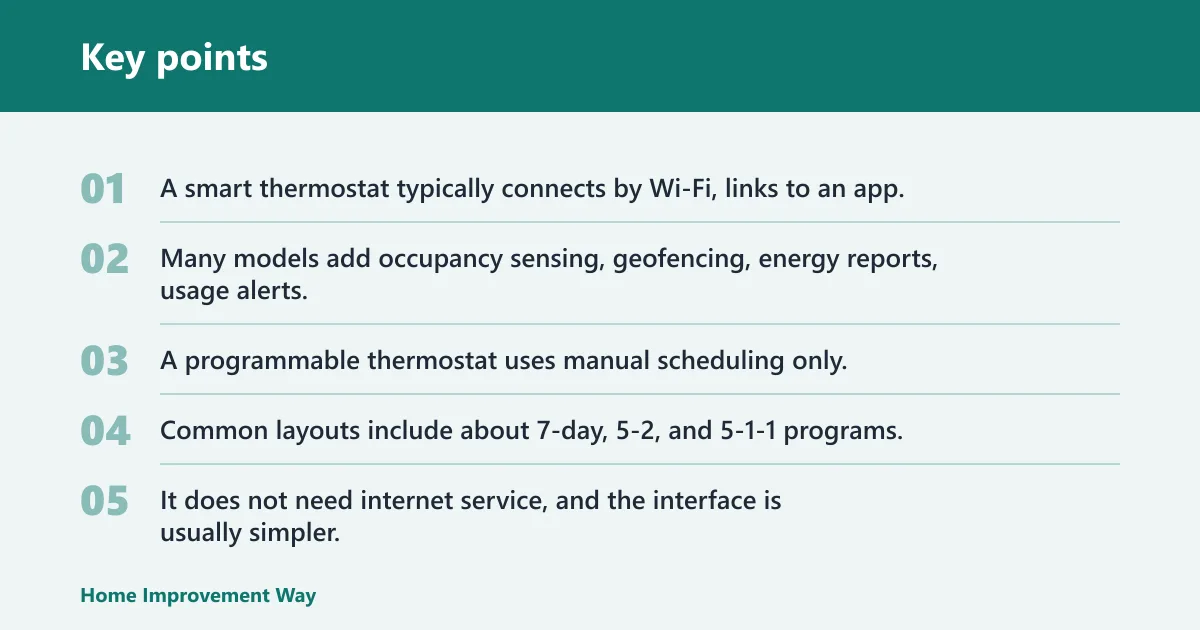
A smart thermostat typically connects by Wi‑Fi, links to an app, and may learn or adapt to your habits. Many models add occupancy sensing, geofencing, energy reports, usage alerts, and assistant integration, so you can change settings away from home and review how often the system runs.
Programmable thermostat
A programmable thermostat uses manual scheduling only. Common layouts include about 7-day, 5-2, and 5-1-1 programs, plus basic setback scheduling, temperature hold, and vacation mode on some models. It does not need internet service, and the interface is usually simpler.
What to compare before you buy
Start with the HVAC system, then check wiring, then judge whether the schedule in your house is stable enough for a programmable model. A smart thermostat is not an automatic upgrade if no one uses the extra features, and a programmable unit is not a downgrade if the routine is steady.
For context, thermostat families extend beyond home Wi‑Fi wall controls. Temperature switches can control and monitor temperatures up to 650 °C without auxiliary energy; electronic thermostats use RTD temperature probes and thermocouples, regulate temperature via binary output, and some are available as safety devices according to DIN EN 14597. Mechanical systems are described as very robust against vibration and EMC interference, and variants exist for wall mounting and behind-panel mounting.
Upfront cost, wiring, and installation
Programmable thermostat usually wins here because it is cheaper up front and easier to replace without adding network setup or accessory hardware. Smart thermostat can cost more once you account for a C-wire adapter, an add-a-wire kit, or professional installation if the wiring does not fit the new base plate.
Remote access, scheduling, and savings
Smart thermostat wins when your routine changes, because app control, occupancy sensing, and geofencing can reduce unnecessary heating between comings and goings. Programmable thermostat can still save energy, but only if you actually set the schedule and do not leave the system on a long temperature hold.
Compatibility risk and best-fit household
Programmable thermostat is the safer choice when the household wants a straightforward display, no internet requirement, and fewer failure points. Smart thermostat works best when the home has compatible 24V wiring, the HVAC system type is supported, and the people using it will keep the extra features active.
How much can a smart thermostat actually save on heating bills?
It can save money, but the range depends on climate, heating system type, and how often the schedule changes. A smart thermostat can trim wasted heating when it automatically drops the setpoint during empty hours; a programmable thermostat can do the same if the schedule is accurate and consistently used.
Heating savings versus cooling savings
Heating savings usually matter more in cold climates because long setbacks create more run time to avoid. Cooling savings can happen too, but the benefit often shrinks when comfort overrides are frequent or when the home is occupied most of the day.
Why behavior can erase the benefit
Say your house runs a morning setback, then someone keeps tapping the hold button every evening because the home feels chilly. In that case, the thermostat never stays in setback long enough to matter, and the bill reduction can disappear even if the device is “smart.”
Some utilities offer rebates for eligible thermostats, but the timing can matter. Check whether the rebate requires a specific model, proof of installation, or a purchase window. Also factor in subscription fees for premium features, plus the cost of an adapter if the existing wiring is short on power.
Do you need a C-wire for a smart thermostat?
Often, yes. Many smart thermostats need a C-wire because they run on 24V power and a steady return path for continuous operation. If the existing cable does not provide that conductor, you may need an adapter, an add-a-wire kit, or a model designed to work without a C-wire.
Why 24V power matters
Most residential HVAC controls use low-voltage wiring, and the thermostat has to power its electronics without interfering with the heating or cooling call. A smart thermostat draws more power than a basic manual or programmable model, so missing power can lead to flaky Wi‑Fi, blank screens, or short cycling.
Adapter and add-a-wire options
Some manufacturers sell a C-wire adapter that pulls power from the equipment side. Others offer add-a-wire solutions that repurpose existing conductors. These can work, but they add parts, setup steps, and another compatibility point to verify before purchase.
How to check before you buy
- Turn off HVAC power at the breaker.
- Remove the old thermostat faceplate and label each wire.
- Confirm that the system is 24V low voltage, not line voltage, before buying or installing.
- Check whether a C-wire is present and connected.
- Use the manufacturer compatibility checker before you order.
What heating systems work with smart thermostats?

Smart thermostat works best with common low-voltage HVAC systems that match its relay and power requirements. Forced-air furnaces and many heat pumps are the easiest fit, while boilers, baseboard heat, multi-stage systems, and zone systems need a closer look before you buy.
Forced-air furnaces and heat pumps
Forced-air furnace setups are often straightforward if the thermostat wiring matches the control terminals. Heat pumps need special attention because the thermostat has to manage compressor and reversing-valve functions correctly, and not every model supports every heat pump configuration.
Suppose a two-story home uses a heat pump with auxiliary heat and a smart thermostat that supports the equipment on paper. If the wiring is incomplete or the staging is wrong, the system can call for backup heat too often and erase the savings you expected.
Boilers, baseboard, and line-voltage heat
Boiler systems can work if the thermostat supports the control method used by the boiler. Baseboard and electric resistance heat often use line-voltage controls, which many smart thermostats do not support. That is one of the most common places where a “smart” upgrade turns into a compatibility miss.
Multi-stage and zone systems
Multi-stage furnaces and multi-zone systems need the thermostat to match the equipment stages and zone board logic. If your home has multiple heating stages or several zones, verify that the thermostat supports those terminals and control sequences before you remove the old unit.
What features matter most besides Wi‑Fi and scheduling?
Remote control alone is not the main question. The features that matter most are occupancy sensing, geofencing, energy reports, usage alerts, smart home integration, and clear compatibility support for your HVAC system type. Without those, a smart thermostat can act like a pricey programmable thermostat with extra setup.
Comfort and automation features
Learning or adaptive scheduling helps when people arrive and leave at different times. Occupancy and geofencing features can lower the setpoint when nobody is home, then recover before the house fills back up. That is useful only when the household routine changes enough for the automation to matter.
Data features and alerts
Energy reports and usage alerts can reveal short cycling, long recovery times, or unusually long heat calls. That makes them useful when you want to spot heating waste or a system problem early. They are less useful if no one reviews them.
Choose smart thermostat if… / Choose programmable thermostat if…

Choose smart thermostat if your schedule changes, you want app control, or you plan to use learning, occupancy, and energy-report features. Choose programmable thermostat if your routine is stable, your priority is a lower purchase price, or you want a simpler device that does not depend on Wi‑Fi or extra power hardware.
Choose smart thermostat if…
- You leave home at different times from day to day.
- You want remote adjustments, alerts, or assistant integration.
- Your HVAC system is compatible and you have a clear C-wire or adapter path.
- You will use the data and automation often enough to justify the extra setup.
Choose programmable thermostat if…
- Your household follows a repeatable 7-day, 5-2, or 5-1-1 pattern.
- You want the cheaper replacement with fewer compatibility questions.
- You live in a rental, assist someone who prefers a simple interface, or do not want cloud features.
- Your current system is older, basic, or more likely to need a straightforward swap.


Thermostat installation checks
Before you swap either thermostat, check the wiring, verify the voltage, and confirm the system type. That matters more than brand features because a device that looks modern can still fail on a boiler, line-voltage baseboard, or multi-stage setup it does not support.
Wire labeling and voltage checks
Label every conductor before removing the old thermostat. Then confirm whether the system is 24V control or line voltage. That one check prevents most bad purchases and most unsafe installs.
Using a compatibility checker
Compatibility checkers are useful, but they are only as good as the information you enter. Match the wire letters, note whether the system is a heat pump, and confirm whether you have auxiliary heat or multiple stages. If the checker flags uncertainty, treat that as a real warning.
When to call a pro
Call a pro when the wiring is unlabeled, the system is multi-stage or zoned and you are not sure how the terminals map, or the thermostat base requires an adapter you do not want to troubleshoot. Older boilers and specialty systems are especially worth that caution.
Frequently asked questions
Is a smart thermostat worth it over a programmable thermostat?
It is worth it when you will use automation, remote access, alerts, or learning features often enough to offset the higher purchase price and setup effort. If your routine is stable and you mostly want a lower-cost temperature controller, programmable thermostat usually gives enough value.
When is a programmable thermostat the better choice?
It is the better choice when you want lower upfront cost, simple scheduling, and fewer installation questions. It also makes sense for renters, older homes with basic wiring, and households that keep a steady schedule without needing phone control.
Can I install a smart thermostat myself?
Yes, if the wiring is clearly labeled, the system is 24V, and the compatibility checker confirms the model. If you see unlabeled wires, a missing C-wire, a heat pump you do not fully understand, or a zoned system, professional help is the safer path.
Sponsored / affiliate links. As an Amazon Associate I earn from qualifying purchases. I may earn additional commission from eligible campaigns.