Electric vs Gas Heat: Operating Cost, Comfort, and Installation
Electric heat often costs less to install when you are comparing simple resistance equipment, while gas heat can cost less to run in many cold-climate homes. Comfort comes down to how the system moves heat, how often it cycles, and how outdoor temperature affects output. Choose the wrong fuel, and you can lock in high bills, oversized equipment, or a system that feels drafty or slow. This guide compares install cost, operating cost, and daily comfort so you can choose by home type and utility setup.
This guide is part of our Heaters: types, safety, and installation series.
Electric vs gas heat at a glance
| Factor | Electric | gas heat | Winner |
|---|---|---|---|
| Install cost | Lower for electric resistance equipment; higher for ducted heat pumps | Gas furnace commonly about $3,800 to $10,000+ before major duct or service work | Electric for resistance; tie for heat pump vs gas in many retrofits |
| Monthly operating cost | Resistance heat has the highest operating cost; heat pumps are usually much lower | Can be lower in some regions, especially where gas is cheap and electricity is expensive | gas heat in some regions; heat pump vs gas depends on rates |
| Comfort consistency | Resistance heat gives steady delivered heat; heat pumps vary by outdoor temperature and defrost cycle | Forced-air output can feel warm quickly, but cycling and duct losses still matter | Depends on system type; tie for many homes |
| Retrofit difficulty | Can be simpler if you already have electric service and no ducts are needed | Can rise fast if gas service, venting, or combustion-air work is missing | Electric in no-gas homes; gas in homes with gas already at the meter |
| Service-upgrade risk | Panel upgrades may be needed for some all-electric builds | Gas service hookup may require main extension, trenching, meter fees, easements, and inspections | Tie; each has its own risk |
Install cost is not the same as total cost
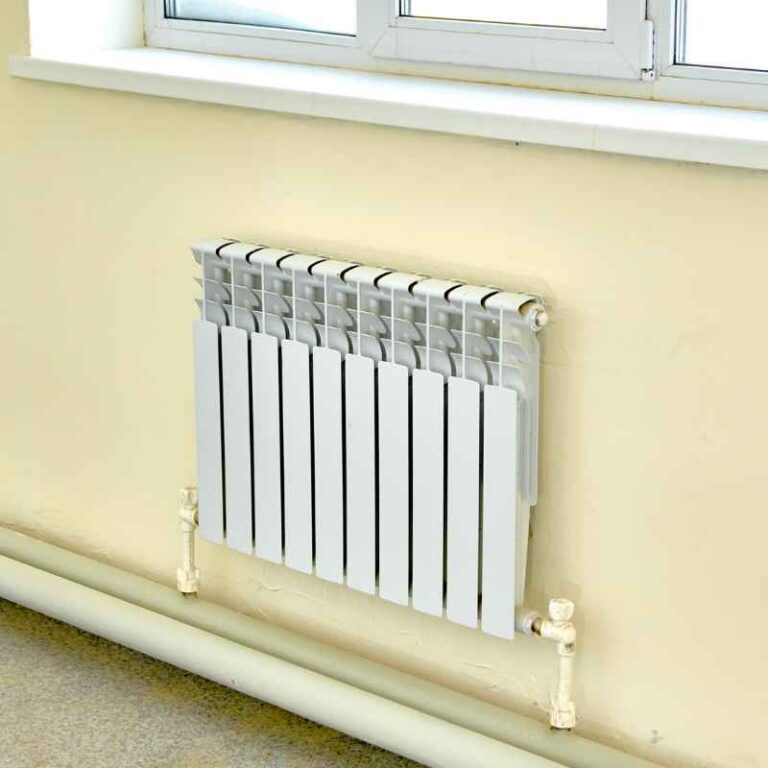
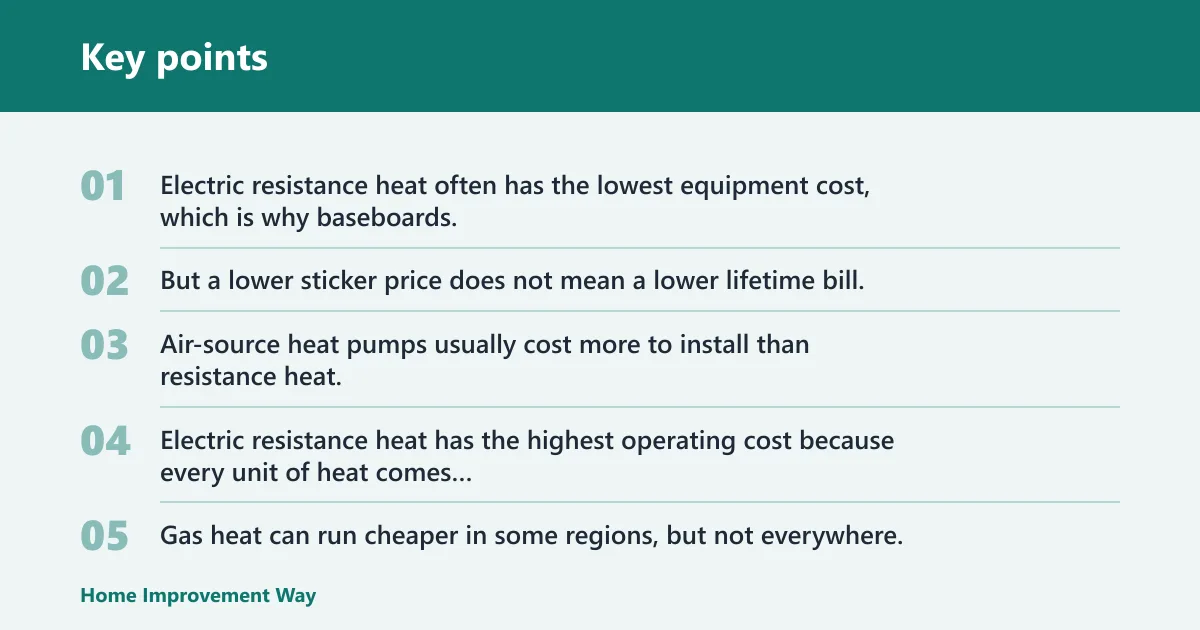
Electric resistance heat often has the lowest equipment cost, which is why baseboards, electric furnaces, and strip heat can look inexpensive at first. But a lower sticker price does not mean a lower lifetime bill. Air-source heat pumps usually cost more to install than resistance heat, yet they often use much less electricity.
Operating cost depends on the fuel you are buying
Electric resistance heat has the highest operating cost because every unit of heat comes from electricity. Gas heat can run cheaper in some regions, but not everywhere. The gap depends on local electricity and gas rates, equipment efficiency, and whether the home needs backup heat or duct repairs.
Comfort depends on delivery, cycling, and outdoor conditions
Comfort is not only about air temperature. Forced-air gas heat can feel strong when the burner runs, while resistance heat delivers steady output without combustion. Heat pumps feel different again: they may supply milder air and cycle more, especially in colder weather, unless a cold-climate model is sized and controlled for the house.
Is electric heat cheaper than gas heat to run?
Electric resistance heat is usually more expensive to run than gas heat, but a heat pump is different from resistance heat and can cut operating cost a lot. The winner depends on your local electricity rate, your gas rate, and how efficient the system is. In some homes, gas wins; in others, a heat pump does.
Electric resistance heat
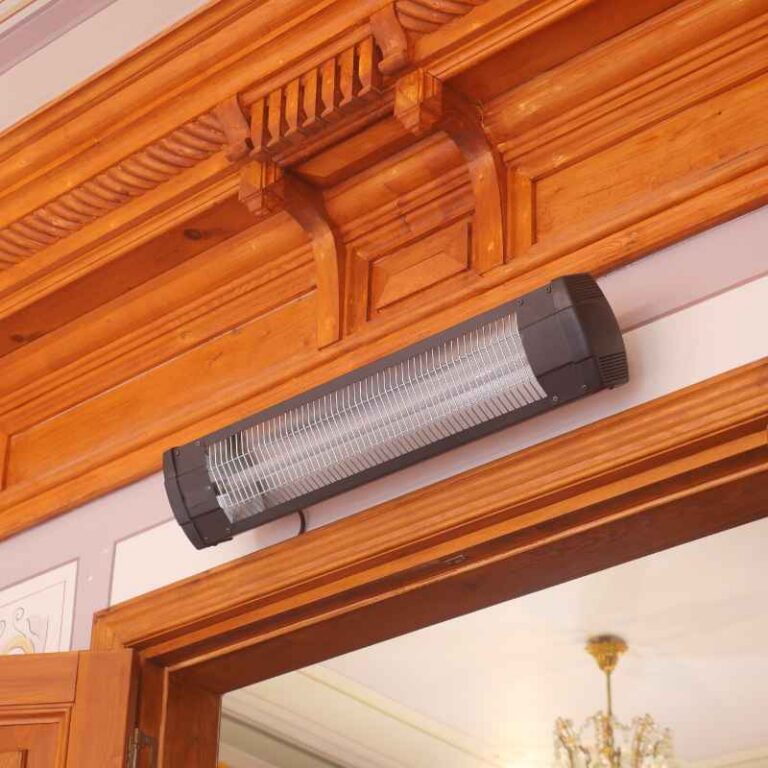
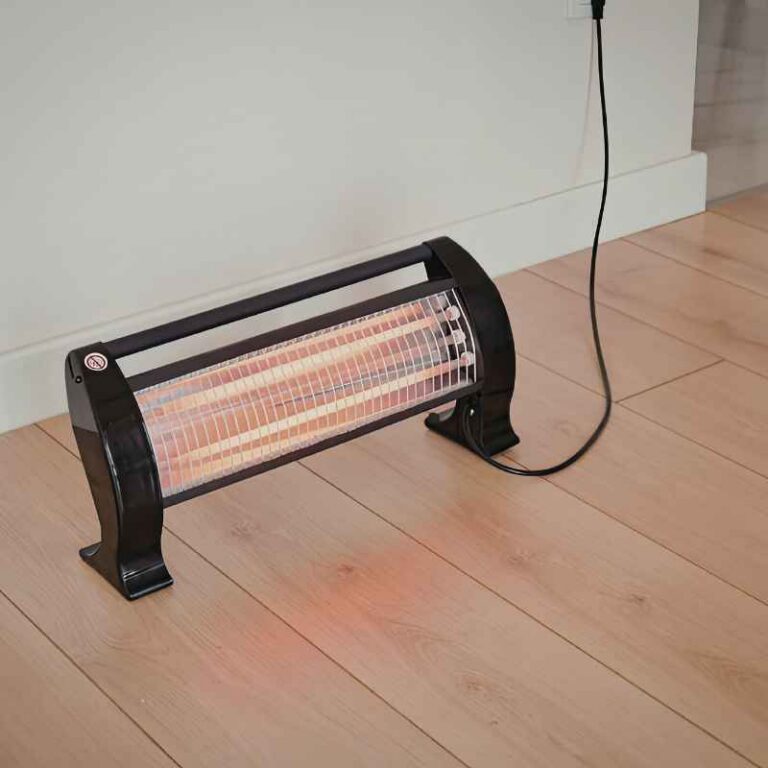
Baseboards, electric furnaces, and strip heat are simple electrically, but they are the highest operating-cost option. That matters most in cold climates or in homes with long heating seasons, where small rate differences become big annual bills.
Air-source heat pumps
An air-source heat pump uses electricity too, but it moves heat instead of creating it the way resistance heat does. That is why it typically costs much less to run. Ducted and ductless versions both exist, and both can beat resistance heat on monthly cost by a wide margin.
How local rates change the winner
In January 2026, electricity prices varied widely by state, with Washington among the lower-cost states and California among the higher-cost states; Florida and Texas were in the middle of the range. The cited U.S. average was about 17.45¢/kWh. EIA projected Henry Hub natural gas at about $3.76 per MMBtu in 2026, which is why the cheaper fuel changes by region.
Pick Comfort’s quoted annual operating-cost table ranges from $500 to $3,000, which is a good reminder that heating bills can vary sharply by system and climate. A home in a low-electricity-price area may lean one way; a home with cheap gas and high electric rates may lean the other.
Which feels more comfortable day to day?
Comfort usually comes down to how the system moves heat, not just what the thermostat reads. Gas furnaces and resistance heat can feel quicker and more forceful through ducts, while heat pumps tend to run longer and steadier. Backup heat also changes comfort because it affects supply-air temperature during cold snaps.
Warm-air cycling and temperature swings
Gas furnaces and electric furnaces both use forced air, so you may notice short bursts of warmer air followed by cooler periods between cycles. That can feel comfortable if the ducts are well designed and the equipment is properly sized. It can also feel uneven if the system short-cycles or the ducts leak.
Heat pump output in mild weather
An air-source heat pump often feels steadier in mild weather because it can run for longer periods at lower output. That helps indoor temperature stability. The tradeoff is that supply air may not feel as hot as a gas furnace, even though the house is still being heated effectively.
Cold-climate performance and backup heat
Cold-climate heat pumps are built to hold capacity in freezing weather, so they can reduce or even eliminate backup-heat use in many regions. Standard heat pumps may lean on strip heat or a gas furnace more often as outdoor temperatures fall. That backup behavior affects both comfort and cost.
Say your 1,800-square-foot home has a ducted heat pump in a mild winter market. The system may run longer with fewer sharp temperature swings, which many people find more even than a furnace that blasts hot air and shuts off. In a colder climate, the same home may need backup heat more often, changing both comfort and bills.
What does it cost to install electric heat vs gas heat?
Electric resistance heat is usually the cheapest to buy and install, while gas furnaces and heat pumps can cost more up front. The real answer depends on ducts, venting, and utility access. If you need new ductwork, gas service, or a panel upgrade, those line items can matter more than the equipment itself.
Gas furnace installed cost
Gas furnace installed cost commonly ranges from $3,800 to $10,000+ in new construction. Efficiency and sizing affect the total, and high-efficiency condensing furnaces can cost more than standard-efficiency models. A gas furnace also needs proper venting and combustion-air planning.
Electric resistance equipment cost
Electric resistance heat usually has the lowest equipment cost. That is why baseboards and simple electric furnaces can look attractive in a quote. The catch is that the cheapest equipment often has the highest operating cost over time.
Heat pump install cost
A ducted heat pump commonly costs about $8,000 to $15,000 installed. That is higher than resistance heat, but it often drops your monthly energy use. Ductless systems can fit homes where ducts are missing or poorly suited to a retrofit.
Suppose a home needs a gas furnace and new ductwork. The furnace itself may fall in the $3,800 to $10,000+ range, and ductwork can add $6,000 to $15,000+ when it is not already included. In that case, the “cheap” gas option may stop being cheap very quickly.
Heating decision matrix
| Decision factor | Electric | gas heat | Winner |
|---|---|---|---|
| Install cost | Lowest for resistance heat; higher for ducted heat pumps | Higher if gas service, venting, or ducts are missing | Electric |
| Monthly operating cost | Resistance heat is highest; heat pumps are much lower | Can be lower where gas rates beat local electric rates | gas heat in gas-favorable regions; heat pump otherwise |
| Comfort consistency | Steady with resistance; variable with heat pumps in very cold weather | Strong warm-air delivery, but still depends on duct design and cycling | Tie |
| Retrofit difficulty | Lower when no gas is available and electrical capacity is adequate | Higher when gas service hookup is missing or ducts must be added | Electric |
| Service-upgrade risk | Panel upgrades may be needed for some all-electric builds | Gas main extension, trenching, meter fees, easements, and restoration may be needed | Tie |
Gas furnace scorecard
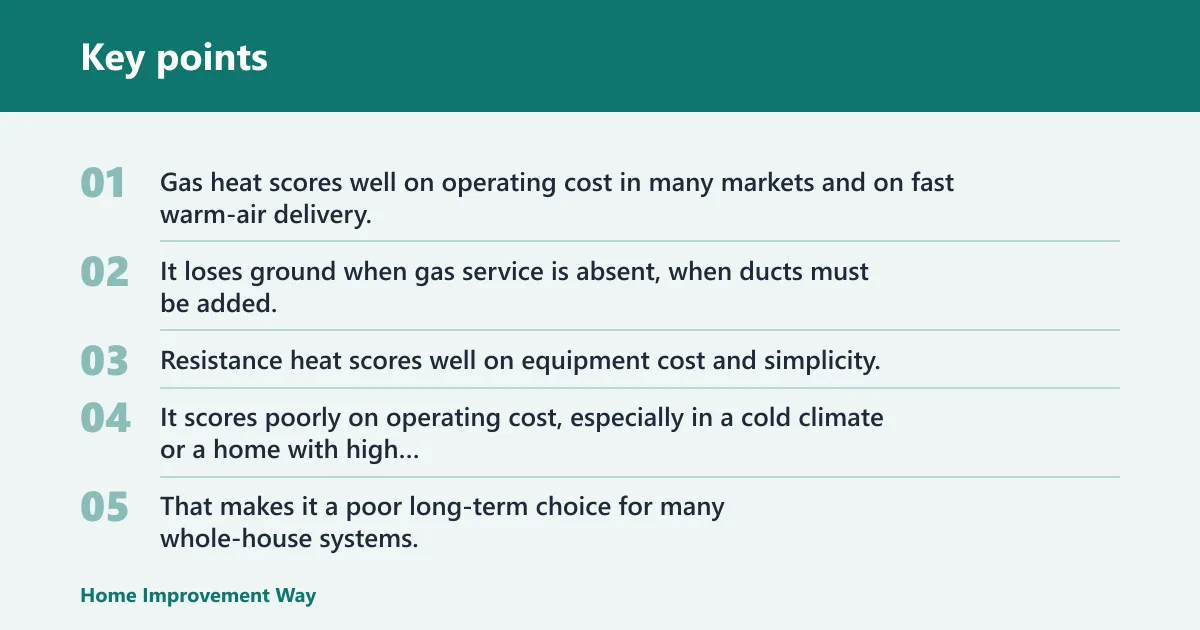
Gas heat scores well on operating cost in many markets and on fast warm-air delivery. It loses ground when gas service is absent, when ducts must be added, or when the home needs venting and combustion-air work that complicates the retrofit.
Electric resistance scorecard
Resistance heat scores well on equipment cost and simplicity. It scores poorly on operating cost, especially in a cold climate or a home with high electric rates. That makes it a poor long-term choice for many whole-house systems.
Heat pump scorecard
A heat pump sits between the two extremes. It usually costs more to install than resistance heat but much less to run. In many homes, especially where gas is unavailable, it is the most balanced option.
Dual-fuel note
A dual-fuel system pairs a heat pump with a gas furnace. That can be worth it in cold regions where the heat pump handles most hours and the furnace takes over at lower temperatures. It also adds equipment cost and control complexity, so it should solve a real comfort or cost problem, not just add options.
Do you need a panel upgrade?
Some all-electric installs do need a panel upgrade, especially if you choose resistance heat or add a large heat pump to an older service. New circuits, higher breaker load, or insufficient spare capacity can push the project into service work before the heating equipment can even be connected.
All-electric load risk
Electric resistance heat draws a lot of power, so it raises panel demand fast. A heat pump usually needs less, but the total house load still matters. If the electrical service is already tight, the project may need a panel or service upgrade.
When new circuits or service changes show up
Panel changes are more likely when you are converting from gas to electric heat, adding backup strip heat, or finishing an addition. The quote should spell out whether the system can run on the existing service or whether a new feeder, meter work, or panel replacement is needed.
Why this matters more for resistance heat
Resistance heat can be simple equipment, but it can stress an undersized service. That is one reason the installed price for “electric heat” can rise after the first walkthrough. A heat pump may avoid some of that load, yet it still deserves a service check before the job starts.
Choose Electric if… / Choose gas heat if…
Choose electric if you do not have gas at the lot, if ductless or low-cost resistance heat fits the project, or if you want a heat pump to cut operating cost without adding gas infrastructure. Choose gas heat if gas is already at the meter, the duct system is sound, and local gas rates make it cheaper to run than electric options.
Homes with gas already at the meter
If gas is already at the meter, gas heat can be easier to justify because the biggest hookup hurdles are already avoided. It makes the most sense when ducts are in place, the furnace can be vented properly, and your local gas rate undercuts electric heating costs.
Homes without gas service
If the home is not served by gas, electric often wins on practicality because gas service hookup may require main extension, trenching, meter fees, easements, and inspections. In that setting, a heat pump is often the better long-term electric choice than resistance heat.
Cold-climate homes
In cold climates, a cold-climate heat pump is often a strong electric option because it is designed to hold capacity in freezing weather. If the climate is severe enough that backup heat will run often, dual-fuel can make sense, but only if the added cost and controls are justified by the load profile.
A common mistake is pricing a slim electric resistance upgrade against a high-efficiency gas furnace without checking panel capacity, venting requirements, or the cost of adding a gas line. That comparison misses the line items that often decide the project. The better question is which system fits the home you already have.
Frequently asked questions
Which is more comfortable: electric heat or gas heat?
Comfort depends on delivery type as much as fuel. Electric resistance heat feels steady, gas furnaces feel more forceful through warm air bursts, and heat pumps often feel milder but more even. Good duct design and correct sizing matter more than many homeowners expect.
Do I need a panel upgrade for electric heat?
Sometimes. Some all-electric builds need a panel upgrade, especially with resistance heat or a larger heat pump. The breaker size, spare capacity, and overall house load decide the answer, so the electrical service should be checked before the equipment is ordered.
How much does ductwork change the total cost?
A lot. If ducts are not already included, gas furnace plus ductwork can add $6,000 to $15,000+ to the project. Layout complexity, attic or crawlspace access, and whether the duct path is simple or tight all change the quote.
Can a dual-fuel system be worth it?
Yes, in the right climate and rate structure. A dual-fuel system combines a heat pump and a gas furnace, so the heat pump can handle mild weather and the furnace can take over when temperatures drop. The downside is higher equipment cost and more control complexity.
Sponsored / affiliate links. As an Amazon Associate I earn from qualifying purchases. I may earn additional commission from eligible campaigns.