Boiler vs Furnace: What’s the Difference and Which to Buy
Choose a boiler if your home already has radiators or hydronic tubing; choose a furnace if you already have ductwork; if you have neither, compare full retrofit cost before buying. Picking the wrong system can mean paying for new distribution equipment, not just a new heater. This guide compares heat delivery, room comfort, retrofit cost, and fuel fit so you can choose the right system for your house.
| Decision factor | Boiler | furnace | Winner |
|---|---|---|---|
| Heat-delivery medium | Heats water or steam and sends that heat through piping | Heats air and moves it through ducts and vents | Tie |
| Best existing distribution | Radiators, baseboards, hydronic tubing, some domestic hot water setups | Existing ductwork with a blower and supply/return vents | Tie |
| Retrofit burden in a ducted home | High if the house lacks piping and emitters | Low if ducts are already sound | furnace |
| Retrofit burden in a radiator home | Low if piping and emitters are already there | High if ducts must be added | Boiler |
| Cooling integration | Usually separate from air conditioning | Often pairs with air conditioning in the same duct system | furnace |
| Comfort character | Heat from emitters feels steadier, with less air movement | Rooms change temperature faster, with more air circulation | Depends on the house |
| Maintenance focus | Pressure-safety components, pumps, valves, expansion components, piping controls | Blower, burner or electric heat section, duct condition, filters, vents | Tie |
Boiler vs furnace: the core trade-off


The main choice is not heat source first. It is heat delivery. A boiler heats water or steam for hydronic distribution, while a furnace heats air for forced-air distribution. That difference decides whether radiators, baseboards, or ducts drive the project.
Water or steam versus heated air
Boilers work by heating a fluid in a closed vessel. That fluid may be used for central heating, and the system can also support domestic hot water in some homes. Furnaces heat air, push it through ductwork, and depend on blower performance and duct condition.
What each system needs inside the house
A boiler needs piping, emitters, and pressure-safety components. A furnace needs ducts, vents, and a blower. If your home lacks the matching distribution system, the appliance is only part of the cost.
How boilers and furnaces work
Boilers and furnaces both turn fuel or electricity into indoor heat, but they do it through different delivery networks. That network is what you live with every day. It also affects comfort, maintenance, and retrofit complexity.
Boilers, radiators, and baseboards
A boiler is a closed vessel in which fluid is heated. Carrier describes a boiler as an HVAC heating system that uses water or steam, and engineering references describe boiler safety with pressure control devices. In a typical hydronic setup, hot water or steam moves to radiators or baseboards, which then warm rooms by convection and radiation.
Boiler heat sources can include wood, coal, oil, or natural gas. Electric steam boilers use resistance or immersion heating elements. A steam boiler is the boiler-derived version that makes steam instead of hot water, and it is less common in modern residential installs. (en.wikipedia.org)
Furnaces, ducts, vents, and blowers
A furnace heats air for forced-air distribution. The air travels through ducts and vents, and the blower is part of what moves it. Furnaces commonly run on natural gas or electricity, though other fuel options exist in some homes.
Forced-air heating uses air as the heat-transfer medium. It can support filtration and cooling integration, which is why a furnace often pairs with an air conditioner. That same duct network can also spread dust or lose performance if the ducts are leaky, undersized, or poorly balanced.
Where steam systems fit
Steam systems are boiler systems, but they use steam rather than hot water. They are a legacy style in many older homes. The right question is not whether steam is “better,” but whether the piping, vents, and radiators are already in place and in usable condition.

Which system fits your home?
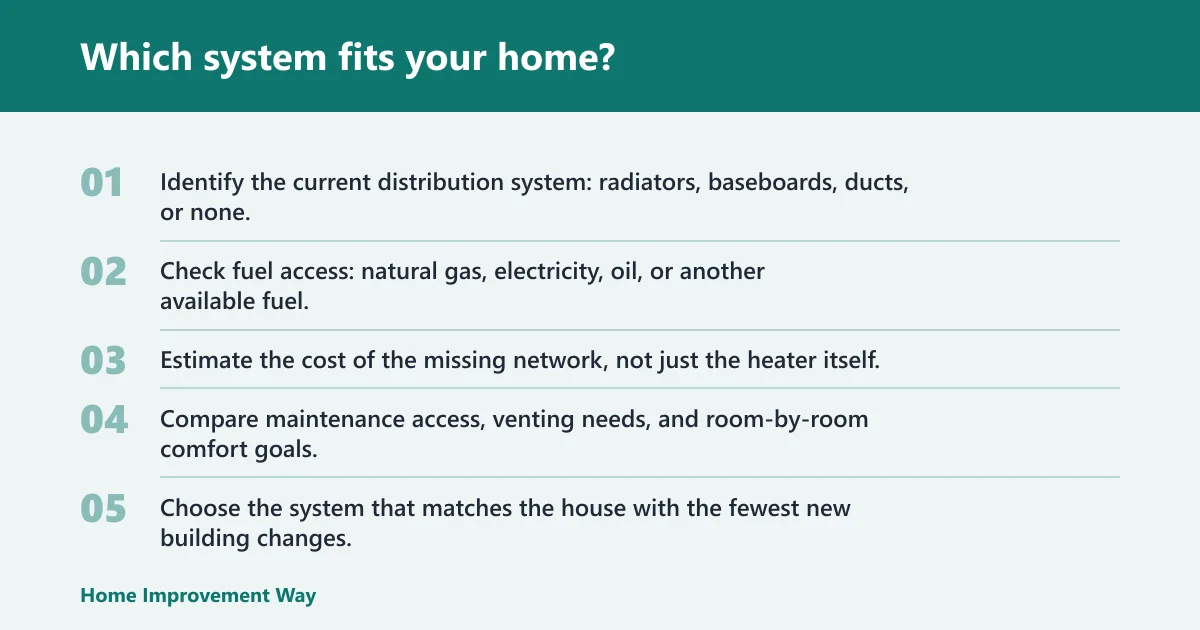
The best choice usually follows the house. If the building already has radiators or hydronic piping, a boiler often fits with less disruption. If it already has ducts, a furnace usually makes more sense. If neither distribution system exists, the retrofit cost can dominate the decision.
Homes with radiators or hydronic piping
Boiler systems are the natural fit here. Radiators and baseboards are common terminal units for boiler systems, and hydronic heat often gives steadier room temperatures. Replacing a boiler in that setting is usually a piping and controls job, not a whole-house distribution rebuild.
Homes with ductwork already in place
A furnace usually wins when sound ducts already exist. You avoid adding hydronic piping or emitters, and you keep the path for AC and filtration integration. A furnace replacement can still get expensive if the ductwork is damaged, undersized, or poorly sealed, because the ducts are part of the heating system.
Homes with no distribution system yet
If the home has neither ducts nor hydronic piping, the decision becomes a retrofit comparison. A boiler means adding pipes, emitters, and controls. A furnace means adding ducts, vents, returns, and a blower. That is why the existing layout matters more than the label on the heating unit.
- Identify the current distribution system: radiators, baseboards, ducts, or none.
- Check fuel access: natural gas, electricity, oil, or another available fuel.
- Estimate the cost of the missing network, not just the heater itself.
- Compare maintenance access, venting needs, and room-by-room comfort goals.
- Choose the system that matches the house with the fewest new building changes.
Boiler vs furnace comfort, response time, and air quality
Comfort is not only about temperature. It also includes how quickly rooms warm up, how much air moves, and whether each room stays close to the setpoint. Boilers and furnaces create different comfort patterns because they move heat differently.
Even heat versus fast heat-up
Hydronic heat usually feels steadier because hot water or steam continues to radiate and convect heat from the emitters. Forced-air heat usually changes room temperature faster because warmed air can be moved quickly through ducts. That speed can help in homes with intermittent schedules.
Humidity and air movement
Forced-air systems move more air, which can make a room feel drier if the air is already dry. Boilers do not depend on moving a large volume of air to deliver heat, so they usually create less drafty movement. Neither system should be judged by comfort alone without looking at house layout and duct or piping condition.
Room-by-room control and zoning
Both systems can be zoned, but the method differs. Hydronic systems use valves, pumps, and control strategies to direct hot water to specific areas. Forced-air systems use dampers and duct balancing. Poor zoning in either system can erase the comfort benefit people expect.
What do the install and retrofit costs look like?
Like-for-like replacement is often the least disruptive path. The expensive part is usually converting the delivery system, not replacing the appliance itself. If you are switching from one heat type to the other, expect the project to include more than a heater swap.
Replacement in a like-for-like setup
A boiler replacement in an existing hydronic home can stay focused on the boiler, controls, and any worn pumps or valves. A furnace replacement in an existing ducted home can stay focused on the furnace, blower section, venting, and service connections. In both cases, system condition sets the final scope.
Converting from boiler to furnace
This is usually a ductwork project. You need supply ducts, return air paths, a blower, vents, and space for routing. If the house already has radiator piping but no ducts, replacing only the boiler with a furnace is usually the wrong move because the real constraint is distribution, not combustion.
Converting from furnace to boiler
This is usually a piping project. You need hydronic piping, emitters such as radiators or baseboards, and controls to move heat through the home. If the house already has good ducts and AC integration, a furnace-to-boiler conversion can add cost without solving a comfort problem you actually have.
Decision matrix and retrofit-complexity score
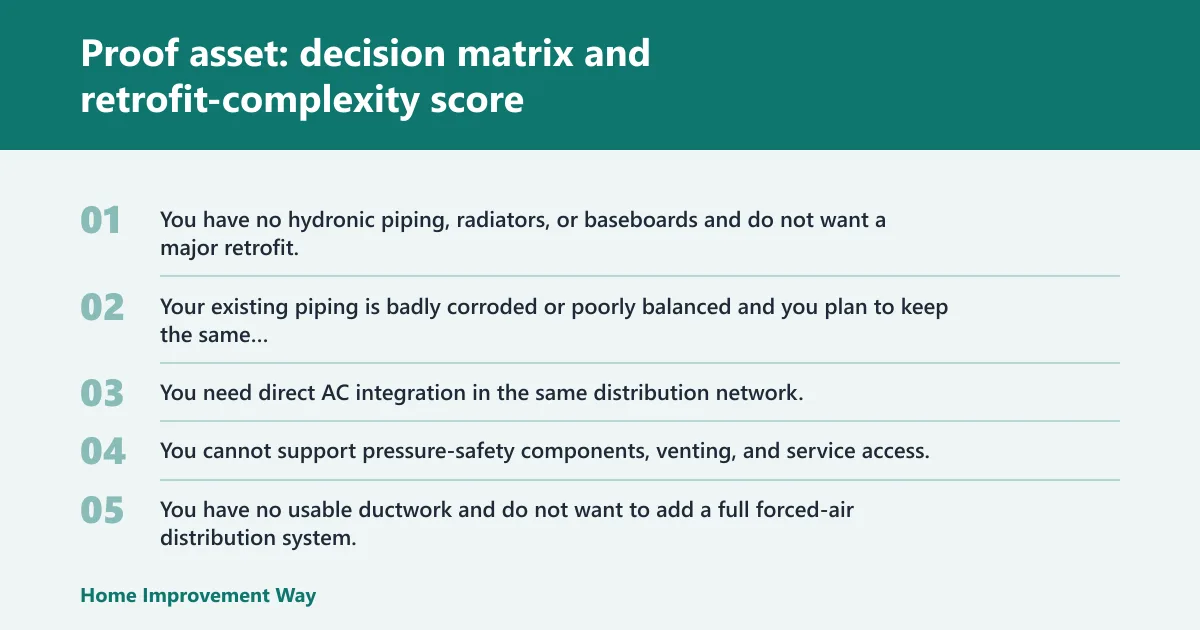
Use this matrix to match the home, the distribution system, and the fuel supply before choosing equipment. The retrofit-complexity score can be used as a practical scale from low to high, with lower numbers indicating simpler replacements and higher numbers indicating more extensive distribution work.
| Home type | Existing distribution system | Fuel availability | Best choice | Retrofit-complexity score |
|---|---|---|---|---|
| Older home with cast-iron radiators | Hydronic piping already in place | Natural gas available | Boiler | 1 |
| Home with baseboards and no AC | Hydronic piping already in place | Electric service strong, gas unavailable | Boiler with electric resistance heating if operating cost is acceptable | 2 |
| Subdivision home with ducts and central AC | Ductwork, vents, blower path already in place | Natural gas available | furnace | 1 |
| Home with ducts that need sealing and balancing | Ductwork exists but condition is poor | Natural gas or electricity available | furnace after duct repair | 3 |
| Home with neither ducts nor hydronic piping | No usable distribution system | Any fuel available | Depends on full retrofit budget | 5 |
Do not buy if: boiler
- You have no hydronic piping, radiators, or baseboards and do not want a major retrofit.
- Your existing piping is badly corroded or poorly balanced and you plan to keep the same layout without repairs.
- You need direct AC integration in the same distribution network.
- You cannot support pressure-safety components, venting, and service access.
Do not buy if: furnace
- You have no usable ductwork and do not want to add a full forced-air distribution system.
- Your ducts are leaking, undersized, or badly laid out and you will not correct them.
- You want the quietest possible heat delivery and dislike air movement.
- You rely on hydronic emitters that already cover the house well.
Which fuel fits each system?
Both systems can use natural gas, oil, or electricity, but the fuel choice affects venting, operating cost, and equipment design. Fuel access can make the decision for you. In many homes, natural gas is the default comparison fuel because it is common for both boilers and furnaces.
Natural gas
Natural gas is common for both boilers and furnaces. It still requires venting and combustion safety considerations, so the gas line alone is not enough. If gas is available and the house already has the right distribution system, it is often the simplest fuel path.
Electric resistance heating
Electric resistance heating can power boilers or furnaces. It is often easier to install where gas is unavailable, but operating cost can differ sharply from gas depending on local rates. That makes the equipment choice only one part of the bill.
Oil and other fuels
Boiler heat sources can include oil, wood, and coal, and some furnaces also use oil or electricity. These fuels can make sense where gas is unavailable or where the existing system already uses them. The practical question is fuel supply, storage, service access, and venting, not just equipment type.
Venting and combustion safety
Any combustion-based boiler or furnace needs safe venting and proper combustion setup. Boilers are pressure vessels generally made of steel, and engineering references list a pressure control device as a boiler safety component. Furnaces also need safe exhaust handling, and both systems should be sized and serviced correctly.
Choose boiler if… / Choose furnace if…
Choose a boiler if the home already has radiators, baseboards, or hydronic piping, or if you want steadier heat and are prepared to keep a water-based distribution system. Choose a furnace if the home already has ductwork, you want to pair heating with AC, or you need a faster-response forced-air system.
Choose boiler if…
- Your home already has radiators or baseboards.
- You want hydronic heat with less dependence on air movement.
- Your existing piping is in good shape and easier to keep than replace.
- You do not need to build a duct system from scratch.
Choose furnace if…
- Your home already has ducts, vents, and a workable blower path.
- You want heating that can integrate with air conditioning and filtration.
- You care more about quick temperature changes than the feel of radiant heat.
- Your ductwork is sound or can be repaired without a major rebuild.
Cases where neither is the first upgrade to buy
If the real problem is leaky ducts, failed radiator piping, poor insulation, or an undersized electrical service, fix that first. A new boiler or furnace cannot fully solve distribution losses. A common first-timer mistake is buying a new heating appliance before checking whether the house’s delivery system is the actual bottleneck.
Frequently asked questions
What is the difference between a boiler and a furnace?
A boiler heats water or steam and sends that heat through piping to radiators, baseboards, or other hydronic terminals. A furnace heats air and moves it through ducts and vents with a blower. The real difference is the heat-delivery system inside the house.
Is a boiler or furnace better for my house?
The better system is the one that matches your existing distribution. Choose a boiler for radiators or hydronic piping. Choose a furnace for ducted homes, especially if you want AC integration. If you have neither system, compare the full retrofit cost before deciding.
Are boilers more efficient than furnaces?
Not automatically. Efficiency depends on the equipment, the controls, distribution losses, and the fuel cost in your area. A well-maintained boiler can outperform a poor ducted system, but a good furnace can also be very efficient. Compare the whole setup, not the appliance label alone.
Can a boiler heat a whole house?
Yes. A boiler can heat a whole house when it is paired with the right hydronic distribution, such as radiators, baseboards, or other piping-based emitters. In some homes, the boiler also supports domestic hot water. The limiting factor is usually distribution, not boiler capability.
Does a furnace use air while a boiler uses water?
Yes. A furnace uses air as the heat-transfer medium, while a boiler usually uses water or steam. That is why furnaces depend on ducts, vents, and a blower, while boilers depend on piping, pumps or valves, and pressure-safety components.
Can I switch from a boiler to a furnace?
You can, but the job is usually bigger than replacing the heater. A boiler-to-furnace switch often means adding ductwork, vents, returns, and blower space. If the home already has working radiators or baseboards, keeping the boiler path is often simpler and cheaper.
Sponsored / affiliate links. As an Amazon Associate I earn from qualifying purchases. I may earn additional commission from eligible campaigns.