Signs Your Furnace Needs Repair vs Replacement
If your furnace is under 12 to 15 years old and the repair is minor, fix it; if it is older, needs repeated repairs, or has heat-exchanger or carbon-monoxide concerns, replacement is usually the safer call. Choosing the wrong path can raise fuel bills, add service calls, and leave a damaged heat exchanger or venting fault in place. This guide turns common furnace symptoms into a repair-or-replace decision based on age, cost, and risk.
| Decision factor | Signs your furnace needs repair | replacement | Winner |
|---|---|---|---|
| Up-front cost | Best when the fix is a thermostat, sensor, filter, ignitor, or similar modest part. | Higher initial cost, but it can stop repeat service calls on an aging unit. | Signs your furnace needs repair |
| Age fit | Best on newer furnaces, especially before the system reaches the 15 to 20 year range. | Best when the furnace is already in the later part of its lifespan. | replacement |
| Safety risk | Acceptable only when the problem is clearly minor and not tied to combustion or venting. | Preferred when there is a cracked heat exchanger, yellow flame, soot, or carbon monoxide concern. | replacement |
| Efficiency and bills | Makes sense if efficiency has not clearly dropped and the issue is not driving major fuel waste. | Better when an older furnace is wasting fuel, especially if bills have climbed 10-15% or more over consecutive seasons. | replacement |
| Recurrence | Works when the problem is isolated and the furnace has been reliable otherwise. | Better when you are seeing multiple repairs in one season or over several winters. | replacement |
Repair vs replacement at a glance
The decision comes down to four things: age, repair cost, recurrence, and safety. A furnace with a fixable fault and plenty of life left belongs in repair territory, while an older unit with repeated failures, poor efficiency, or combustion concerns often moves toward replacement.
Use the table above as the first screen. If the symptom points to a cheap control issue or a dirty filter, inspect first and repair as needed. If the problem is tied to a cracked heat exchanger, recurring shutdowns, or a repair quote near half the cost of a new unit, replacement starts to make more sense.
Repair, replace, or Inspect first
This matrix gives you a practical starting point before you approve a major service call. It separates symptoms that often turn out to be simple repairs from symptoms that usually deserve replacement or immediate inspection.
| Symptom | Likely cause | Safety risk | Age threshold | Typical fixability | Action |
|---|---|---|---|---|---|
| Yellow flame | Incomplete combustion, dirty burners, venting problem, or gas supply issue | High | Any age | Sometimes repairable, but must be checked quickly | Inspect first; if heat exchanger or combustion problem is confirmed, replace |
| Short cycling | Restricted airflow, thermostat issue, or overheating | Moderate | More concerning on older furnaces | Often repairable if the cause is a filter, blower, or thermostat fault | Inspect first; repair if the cause is simple, replace if recurring on an older unit |
| Noisy blower | Worn motor bearings, damaged belt, loose parts | Low to moderate | More likely after many years of use | Repairable, but labor and parts can be expensive | Compare repair quote against remaining life; replace if the motor is near failure |
| Weak airflow | Dirty filter, duct restriction, failing blower motor, closed registers | Low to moderate | Any age | Often fixable if the problem is filtration or duct-related | Inspect first; repair if airflow issue is isolated |
| Rising bills | Efficiency loss, short cycling, worn components, or duct leakage | Low | Older furnaces more likely | Sometimes fixable, but may reflect age-related inefficiency | Compare AFUE and age; replace if fuel waste is persistent |
| Cracked heat exchanger | Metal fatigue and repeated heating stress | High | Usually later-life furnaces | Poor value; repair is often labor-heavy | Replace |
| Thermostat error | Bad wiring, bad sensor, bad settings, weak batteries | Low | Any age | Usually easy to repair | Inspect first; do not replace the furnace before checking the thermostat |
| Dirty filter | Airflow restriction | Low | Any age | Easy to fix | Repair the airflow issue first |
| Uneven heating | Duct imbalance, weak blower, filter restriction, oversized system | Low to moderate | Any age | Sometimes fixable outside the furnace itself | Inspect first; do not assume furnace replacement |
| Repeated breakdowns | Aging controls, worn parts, failing blower, recurring ignition faults | Moderate | Often 15 years and older | Poor value when repairs keep stacking up | Replace if this is happening over one season or several winters |
Is your furnace still in the repair zone?
A furnace is still in the repair zone when the problem is isolated, the unit is not near the end of its life, and the quote is modest compared with replacement. The average furnace lifespan is 15 to 20 years, so a 10-year-old unit with a faulty ignitor is usually a repair candidate, while a 17-year-old furnace with another major failure may not be.
Older systems need more frequent and more expensive repairs. Neglected units can fail earlier, which is why age alone does not decide the answer, but it does change the odds.
Age matters, but not by itself
A 15-year-old furnace is not automatically disposable. If the issue is a thermostat fault, dirty filter, or a failed sensor, repair is usually the practical move because those fixes do not erase much remaining service life.
Picture a 14-year-old gas furnace that shuts off early because the filter is clogged. If a filter change restores normal operation, replacement would be a poor use of money. The same furnace with a cracked heat exchanger is a different case entirely.
Recurrence changes the math
One repair in a season is not the same as three. Multiple repairs over one heating season or over several winters suggest the furnace is moving out of steady-service territory and into high-maintenance territory.
A common first-timer mistake is treating each service call as separate. The real question is whether the furnace is becoming a pattern of problems that will keep returning.
Which symptoms point to replacement?
Replacement becomes more likely when the problem is tied to combustion safety, a major wear component, or a repeat failure that is expensive to chase. A newer furnace with a cheap part failure usually stays repairable; an older furnace with a major safety fault usually does not.
Cracked heat exchanger
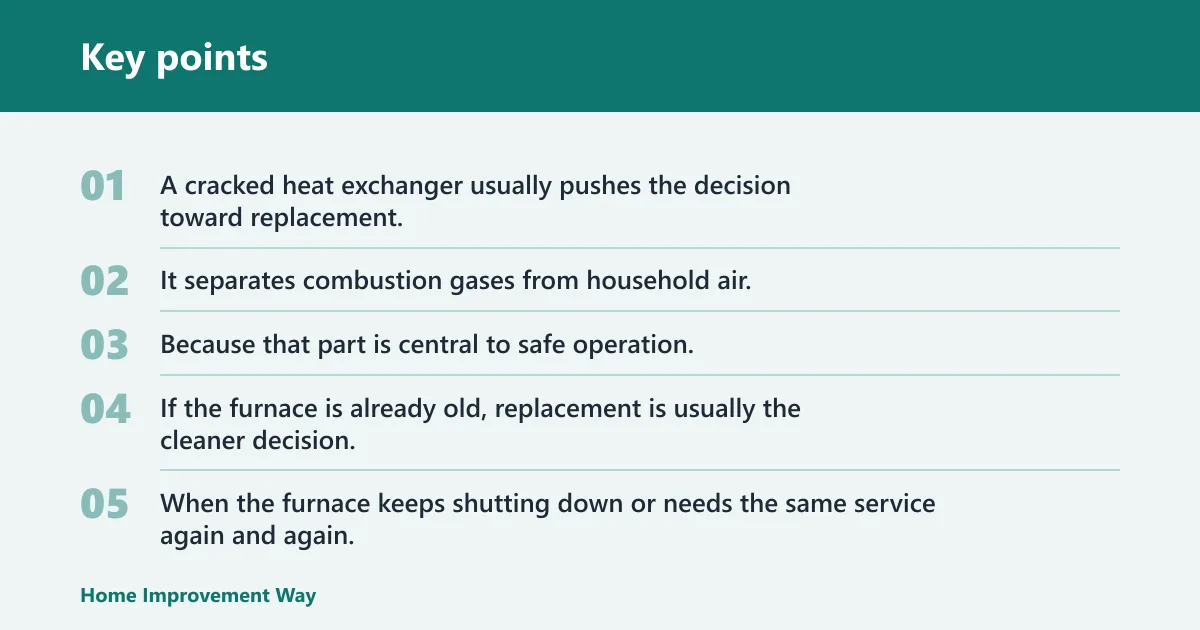
A cracked heat exchanger usually pushes the decision toward replacement. It separates combustion gases from household air, so damage there is not a small comfort issue; it can create a safety problem and often comes with high labor cost.
Because that part is central to safe operation, repairing it is often poor value even if a technician can confirm the crack. If the furnace is already old, replacement is usually the cleaner decision.
Repeated shutdowns and recurring failures
When the furnace keeps shutting down or needs the same service again and again, the repair bill can outrun the useful life left in the unit. That is especially true if the failure pattern includes ignition problems, blower issues, or control board faults.
Repeated breakdowns matter even when each one is minor. The total cost and lost reliability can justify replacement before the next cold snap.
Major blower motor wear
Blower motor wear can cause weak airflow, uneven heating, and unusual noise. Because blower repairs often carry higher labor cost, they can move an older furnace closer to the replacement column, especially if airflow problems have been building for a while.
If the blower is also contributing to short cycling or noisy operation, the issue is no longer just comfort. It is affecting how the whole system runs.
What do noises, airflow, and bills mean?
Strange noises, weak airflow, and rising bills are warning signs, but they do not all mean the furnace itself is failing. Banging, rattling, squealing, or grinding can point to ignition trouble, loose parts, duct vibration, or blower wear, while poor airflow can come from a dirty filter, closed registers, or duct restrictions.
Noises: banging, squealing, grinding, rattling
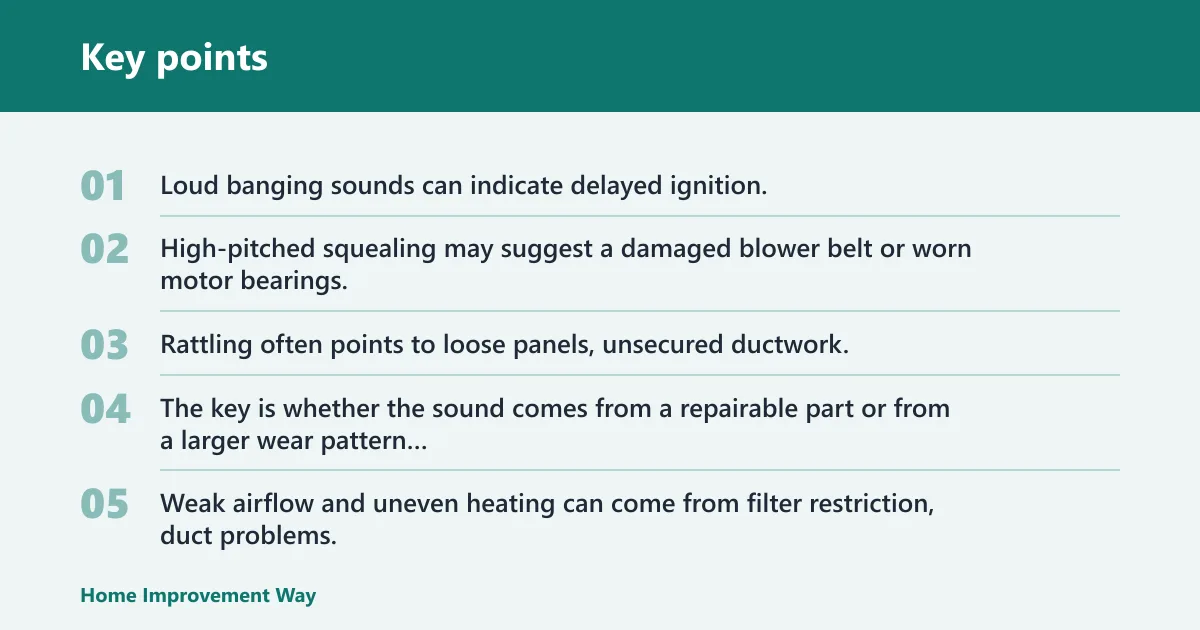
Loud banging sounds can indicate delayed ignition. High-pitched squealing may suggest a damaged blower belt or worn motor bearings. Rattling often points to loose panels, unsecured ductwork, or a failing component that is vibrating under load.
Noise alone does not force replacement. The key is whether the sound comes from a repairable part or from a larger wear pattern on an aging furnace.
Weak airflow and cold spots
Weak airflow and uneven heating can come from filter restriction, duct problems, or a tired blower motor. That is why airflow issues should be checked before anyone decides the furnace has failed.
Suppose a furnace is heating only two rooms well while the rest of the home stays cool. A dirty filter or blocked return can create that symptom without requiring a new furnace. If the blower motor is worn and the fix quote is high, the answer can change.
Rising energy bills
If energy bills climb 10-15% or more over consecutive seasons, efficiency may have declined. That drop can reflect age, short cycling, duct losses, or an older furnace that is still working but wasting fuel.
AFUE helps here. Older furnaces are often around 70-80% AFUE, while modern high-efficiency units are often in the mid-90% AFUE range. If fuel waste is a recurring problem and the furnace is already aging, replacement can reduce operating cost more than another repair would.
How do safety flags change the decision?
Safety flags push the decision away from waiting. A yellow or flickering flame, soot, odors, rust around the cabinet, or suspected carbon monoxide risk should trigger immediate inspection, because these signs can point to incomplete combustion, venting trouble, or heat-exchanger damage.
Yellow flame and combustion warning signs
A healthy gas furnace flame should burn blue. A yellow or flickering flame can indicate incomplete combustion and carbon monoxide risk, which makes it a safety issue rather than a simple comfort problem.
That does not mean every yellow flame automatically means a new furnace. It does mean you should stop treating the symptom as cosmetic and get a professional diagnosis before the system runs again.
Soot, odor, and rust
Dust, dry air, soot, or odors can accompany furnace problems and may point to filtration or combustion issues. Rust or corrosion around the cabinet, burners, or venting can also indicate trouble that is moving beyond routine maintenance.
If several of these symptoms appear together, the furnace may have both comfort and safety problems. That combination usually favors inspection first and replacement if the underlying fault is serious.
When do repair costs tip the scale?
The 50% rule says repair is usually not worth it when it exceeds half of replacement cost. It is a decision threshold, not a hard cutoff, but it becomes more persuasive on older furnaces, especially if the unit has already needed other repairs.
Use the quote in context. If replacement is $8,000 and repair is $3,900, the repair is near half the new system cost. At that point, the choice is not only about today’s fix; it is about how much life and reliability you are buying.
Apply the quote to the real horizon
Remaining homeownership horizon matters. If you plan to move soon, a smaller repair can make sense even on an aging furnace. If you expect to stay for years, a replacement can be easier to justify because it spreads the cost over more seasons.
Think about the next three to five winters, not just the next week. A furnace that will likely need another expensive repair before then is a poor candidate for one more large bill.
Check lookalikes before approving replacement
Thermostat faults, dirty filters, duct problems, and sensor issues can mimic furnace failure. That is why a good diagnosis should start with the basics before anyone signs off on a major replacement quote.
Many replacement decisions become clearer after these checks. A simple control issue can look like a dead furnace until the thermostat, airflow, and wiring are verified.
Choose Signs your furnace needs repair if… / Choose replacement if…
Choose Signs your furnace needs repair if the furnace is younger than about 12 to 15 years, the symptom traces to a thermostat, filter, sensor, or another modest part, and the quote is well below half the cost of replacement. Choose replacement if the furnace is near the end of its lifespan, has repeated failures, or shows a combustion or heat-exchanger safety issue.
If the answer changes after diagnosis, follow the diagnosis. A newer furnace with a cheap fix stays in repair territory. An older furnace with a cracked heat exchanger, recurring shutdowns, or a major blower repair usually belongs in replacement territory.
Frequently asked questions
What are the signs my furnace needs repair instead of replacement?
A furnace usually belongs in the repair category when the problem is isolated, the unit is still well within its expected life, and the fix is modest. Common examples include thermostat faults, dirty filters, sensor problems, or a single worn part on a furnace that has not been breaking down repeatedly.
How do I know when furnace repair is no longer worth it?
Repair stops making sense when the quote is close to half the replacement cost, the furnace is already old, or failures keep coming back. If the system has needed several repairs in one season or over several winters, you are often paying for short-term relief instead of long-term value.
Is a 15-year-old furnace worth repairing?
Sometimes, yes. A 15-year-old furnace can still be worth repairing if the issue is minor, the blower and heat exchanger are sound, and the repair is far below the cost of replacement. If the same furnace has a major safety fault or another expensive failure, replacement becomes more reasonable.
What furnace problems are safety issues that mean replacement?
A cracked heat exchanger is one of the clearest replacement triggers. A yellow or flickering flame, soot, strong odor, or suspected carbon monoxide issue also deserves immediate inspection and may end in replacement if the problem involves combustion or venting rather than a simple part failure.
How much should furnace repair cost before I replace it?
A common rule of thumb is the 50% rule: if repair cost is more than half of replacement cost, replacement often makes more sense. That threshold matters even more when the furnace is old, because the next repair may not be far behind.
What does short cycling mean on a furnace?
Short cycling means the furnace turns on, runs briefly, and shuts down before warming the home. It can come from restricted airflow, thermostat issues, or overheating, and it becomes more concerning when it keeps happening on an older furnace.
Sponsored / affiliate links. As an Amazon Associate I earn from qualifying purchases. I may earn additional commission from eligible campaigns.