What Size Furnace Do You Need for Your Home?
A furnace size is the heating output your home needs, usually found with a Manual J load calculation; as a rough check, many homes land around 30 to 60 BTU per square foot, but climate, insulation, windows, and ceiling height can shift that range sharply. If the unit is too big or too small, you can waste fuel, short-cycle, or miss steady comfort. This guide shows how to compare your home conditions, estimate needed BTUs, and sanity-check an HVAC quote.
What furnace size means
BTU or BTU/h is a common way to refer to heating capacity, and BTU/h means British Thermal Units per hour. On a quote, the number on the label often shows input BTUs, not the heat that reaches your rooms. That difference matters because efficiency changes how much useful heat you get from the same fuel input.
Input BTUs vs output heat
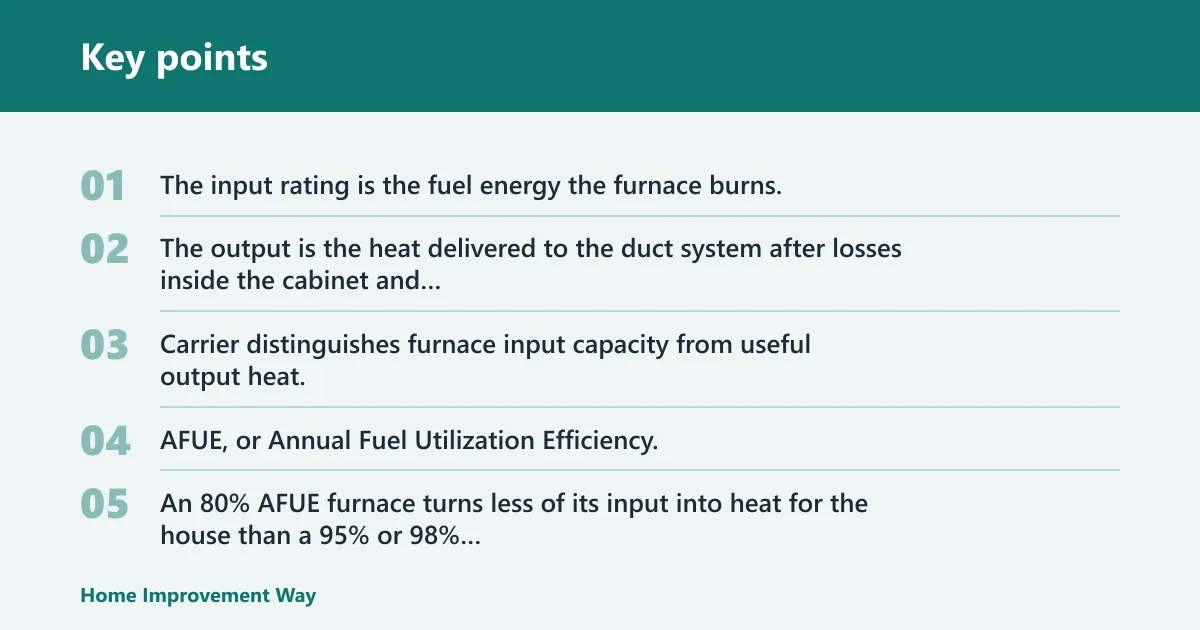
The input rating is the fuel energy the furnace burns. The output is the heat delivered to the duct system after losses inside the cabinet and venting path. Carrier distinguishes furnace input capacity from useful output heat, and that split is why two furnaces with the same input rating can warm a home differently.
AFUE, or Annual Fuel Utilization Efficiency, tells you how much of the input becomes usable heat over a typical season. An 80% AFUE furnace turns less of its input into heat for the house than a 95% or 98% furnace. So a larger input number does not always mean the same delivered heat.
Why the label matters
When you compare quotes, ask whether the quoted BTU figure is input or output. If the contractor gives only the input rating, you still need the AFUE to estimate usable heat. That keeps you from comparing numbers that look similar on paper but deliver very different heat in the house.
Square footage and BTU range
Square footage is the starting point, not the answer. Bob Vila says the average 2,000-square-foot home needs between 80,000 and 115,000 BTUs, and the same source gives 30 to 60 BTUs per square foot as a U.S. average range. Climate, insulation, windows, and ceiling height can shift that range sharply.
Quick size bands by home size
The table below is a sanity-check tool, not a replacement for a Manual J calculation. Use it to spot a quote that is far outside a plausible range before you approve the job.
| Home condition | Approximate BTU range | What it suggests |
|---|---|---|
| 100 to 200 square feet | 4,000 to 8,000 BTUs | Small room load, not a whole-house furnace size |
| 800 to 900 square feet | 30,000 to 45,000 BTUs | Common for smaller homes or tightly built spaces |
| 1,500 square feet | 45,000 to 90,000 BTUs | Wide range because climate and construction matter |
| 2,000 square feet | 80,000 to 115,000 BTUs | Matches the cited average range for many homes |
The same source notes that homes in Zones 1 through 3 might not need a furnace at all, while Zone 7 homes may require up to 60 BTUs per square foot. That is why the same floor area can point to very different equipment sizes.
Why the same house can need more or less heat
Two homes with the same square footage can differ in attic insulation, air sealing, window area, duct losses, and ceiling height. A compact, well-insulated home with good windows can need far less heat than an older home with leaky ducts and tall ceilings. That is why square footage alone is not enough.
What changes the load?
Several house details change the heating load. Climate zone is one of the biggest drivers, but insulation, windows, and ceiling height also matter. The same source recommends using the lower BTU range for newer, well-insulated homes, which is a useful guardrail when you compare quotes.
Climate zone
The same source gives 30 to 35 BTUs per square foot for Zone 1 homes and up to 60 BTUs per square foot for Zone 7 homes. Warmer climates need less heat. Colder climates need more. That spread is large enough to move a home from a mid-size furnace to a much larger one.
Insulation and air sealing
Older homes with thinner attic insulation, leaky rim joists, and drafty air sealing usually need more heating capacity than newer homes with better shells. The difference shows up in the load calculation because heat leaves the house faster when the envelope is weaker. Better insulation generally lowers the BTU need.
Windows and ceiling height
Window count and window quality change heat loss. Single-pane windows lose more heat than double-pane units, and large window area can raise the load even if the floor area stays the same. Ceiling height matters too. The common 8-foot baseline changes when you add vaulted or taller spaces, which increases the amount of air you must heat.
Suppose a 1,600-square-foot house in a colder zone has tall ceilings over the living room and several older windows on one side. Another 1,600-square-foot house in the same town has updated insulation, fewer windows, and standard ceilings. Those homes do not need the same furnace size, even though the square footage matches.
Does ductwork change furnace size?
Yes. Ductwork can change the required furnace size, especially when ducts run through attics, crawlspaces, or other unconditioned areas. Heat can be lost before it reaches the registers, and a system with poor return air can move less heat than the furnace label suggests. That can make a correctly sized furnace feel undersized.
Ducts in attics and crawlspaces
Ducts outside conditioned space lose more heat than ducts inside the heated envelope. A furnace feeding long attic runs may need a different load approach than one with short ducts inside the house. The equipment size may still be correct on paper, but delivered heat can drop if the duct system is weak.
When duct problems mimic undersizing
A house with leaky supply ducts or restricted returns may heat unevenly even when the furnace size is reasonable. Rooms far from the equipment can stay cool while the furnace runs longer. Before you assume the furnace is too small, ask the contractor to inspect the duct layout, leakage, and static pressure.
How AFUE changes useful heat
AFUE changes how much heat you get from the same input BTU rating. An 80% AFUE furnace delivers less usable heat than a 90%, 95%, or 98% unit with the same input size. That means the quoted BTU number by itself does not tell you how much heat reaches the home.
Input rating vs delivered output
A 100,000 BTU input furnace at 80% AFUE delivers roughly 80,000 BTUs of usable heat. At 95% AFUE, the same input rating delivers about 95,000 BTUs. The fuel use also changes, which is why efficiency affects both sizing decisions and operating cost.
That does not mean you can size solely from AFUE. It means the same input rating produces different output heat, so the quote must show both the furnace input and the efficiency rating. Otherwise, you cannot compare one unit to another in a meaningful way.
Manual J worksheet
Manual J is the professional heat-loss method used to size a furnace. It looks at the house room by room or as a whole-home load, and it accounts for insulation, windows, climate, and ductwork. Carrier uses Manual J-style load calculations and warns against sizing by square footage alone.
House details to collect
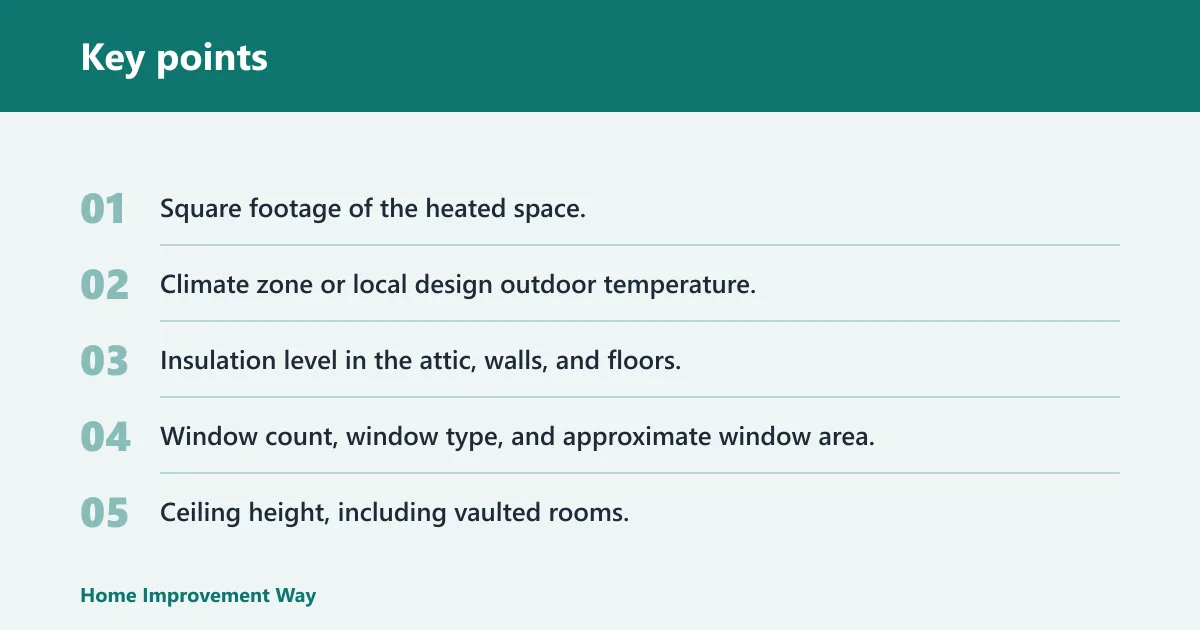
Bring these details to the installer before you approve a quote:
- Square footage of the heated space.
- Climate zone or local design outdoor temperature.
- Insulation level in the attic, walls, and floors.
- Window count, window type, and approximate window area.
- Ceiling height, including vaulted rooms.
- Duct location: inside conditioned space, attic, or crawlspace.
- AFUE of the quoted furnace.
- Whether the quoted BTU number is input or output.
Text-only furnace sizing sanity-check worksheet
Use this quick worksheet to estimate a BTU range before you sign. Start with square footage, then adjust up or down for the rest of the house.
| House detail | Lower-load direction | Higher-load direction |
|---|---|---|
| Square footage | Smaller home, lower base BTU need | Larger home, higher base BTU need |
| Climate zone | Warmer zone, fewer BTUs per square foot | Colder zone, more BTUs per square foot |
| Insulation quality | Newer, better insulated, tighter shell | Older, weaker insulation, more air leakage |
| Ceiling height | Standard 8-foot ceilings | Tall or vaulted spaces |
| Window area and type | Fewer windows, double-pane, modest glass area | More windows, single-pane, large glass area |
| Duct location | Ducts inside conditioned space | Ducts in attic or crawlspace |
| AFUE | Higher AFUE gives more useful output from the same input | Lower AFUE gives less useful output from the same input |
After you note those items, compare your rough BTU range with the quote. If the quoted furnace is far above your expected range, ask why. If it is far below, ask how the system will meet peak load on the coldest design day.
How do you sanity-check a furnace quote?
Ask for the Manual J result, the design outdoor temperature, the duct assumptions, the AFUE, and whether the quoted size is input or output. Those questions help you compare the quote against the actual load instead of guessing from square footage or copying the old furnace. A replacement should not automatically match the previous unit.
Questions to ask the contractor
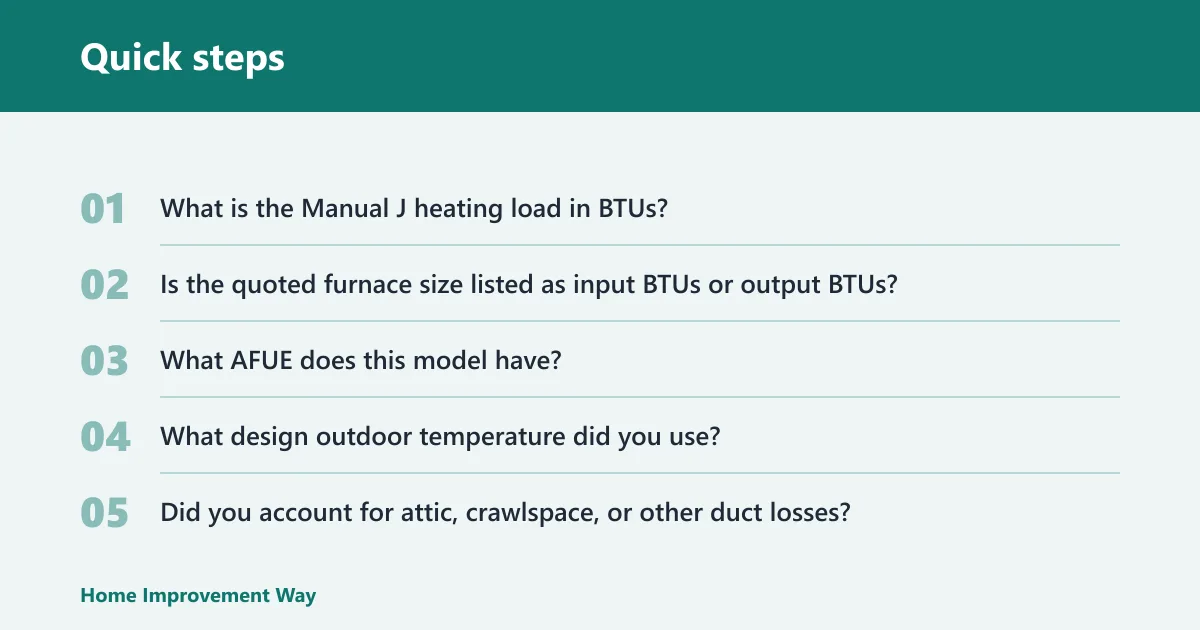
- What is the Manual J heating load in BTUs?
- Is the quoted furnace size listed as input BTUs or output BTUs?
- What AFUE does this model have?
- What design outdoor temperature did you use?
- Did you account for attic, crawlspace, or other duct losses?
- Did you factor in ceiling height, window area, and insulation level?
Red flags in an oversized quote
An oversized furnace may short cycle, which means it turns on and off too often before the home reaches steady comfort. That can create uneven heating, louder operation, and faster wear. If a quote jumps to a much larger unit “just to be safe,” ask for the load calculation that supports it.
When a smaller unit may be right
A smaller furnace can be the right answer when the home is tight, the ducts are efficient, and the climate is mild. The same source notes that homes in Zones 1 through 3 might not need a furnace at all. In those cases, a lower BTU range may fit the house better than a large replacement copied from the old label.
A common first-timer mistake is approving the same size as the old furnace without checking whether the old unit was oversized from the start. If the previous furnace short-cycled or never held even temperatures, the old label is a weak reference point. Use the house load, not the old cabinet size, as the guide.
Frequently asked questions
What size furnace do I need for my home?
The right size depends on your home’s heating load, not square footage alone. Many homes fall somewhere around 30 to 60 BTUs per square foot, but climate, insulation, windows, ceiling height, and duct losses can move the number a lot. A Manual J calculation is the best final check.
How to size furnace for house
Start with square footage, then adjust for climate, insulation, windows, ceiling height, and duct location. Use the result only as a range, not a final answer. Then compare that range with the quoted BTU input and the AFUE so you know how much useful heat the furnace should deliver.
What size gas furnace do I need?
A gas furnace should be sized to the home’s heat loss, usually in BTUs or BTU/h. The right gas furnace may be smaller in a mild climate and larger in a colder one. Ask for the Manual J load, the quoted input BTUs, and the AFUE before you approve the model.
What size furnace do I need calculator?
An online calculator can give you a rough estimate, but it cannot replace a full Manual J calculation. Use the calculator only to get a sanity-check range, then verify the quote with the contractor. If the result is far off from the proposed furnace, ask for the load details.
Sponsored / affiliate links. As an Amazon Associate I earn from qualifying purchases. I may earn additional commission from eligible campaigns.
 ROVSUN 18000 BTU Mini Split AC/Heating System with Inverter, 20 SEER2 Energy Saving 230V Ductless Split-System Air Conditioner with Pre-Charged Condenser, Heat Pump, Remote Control & Installation Kit
 Garvee 14,000 BTU Portable Air Conditioner for Room Up to 750 Sq.Ft, 4 in-1 AC Unit with Cooling, Fan, Dehumidifier & Sleep Mode, Remote Control & Window Kit Included for Home, Office, Apartment,White