Can You Run a Space Heater on a Generator?
Yes, if the heater’s wattage stays below your generator’s continuous rating. A 1,500-watt space heater often needs at least a 2,000-watt running generator, plus extra room for other loads. If you miss the mark, the breaker trips, the generator overloads, or the heater takes power from more urgent items. Here’s how to size the generator, estimate runtime, and choose a lower-wattage heating plan when the numbers do not work.
Fast answer: Check the space heater wattage label, add up the heater plus any other loads, then size the generator for the total and leave a 20% to 25% margin above that continuous load. For a typical 1,500W heater, that usually points to a 3,000W to 3,500W-class generator if you also want room for a fan motor, refrigerator, or chargers. Continuous output matters more than surge watts for a steady resistive load like a space heater. U.S. Department of Energy CPSC ASHRAE
Matching generator wattage to the heater’s continuous draw


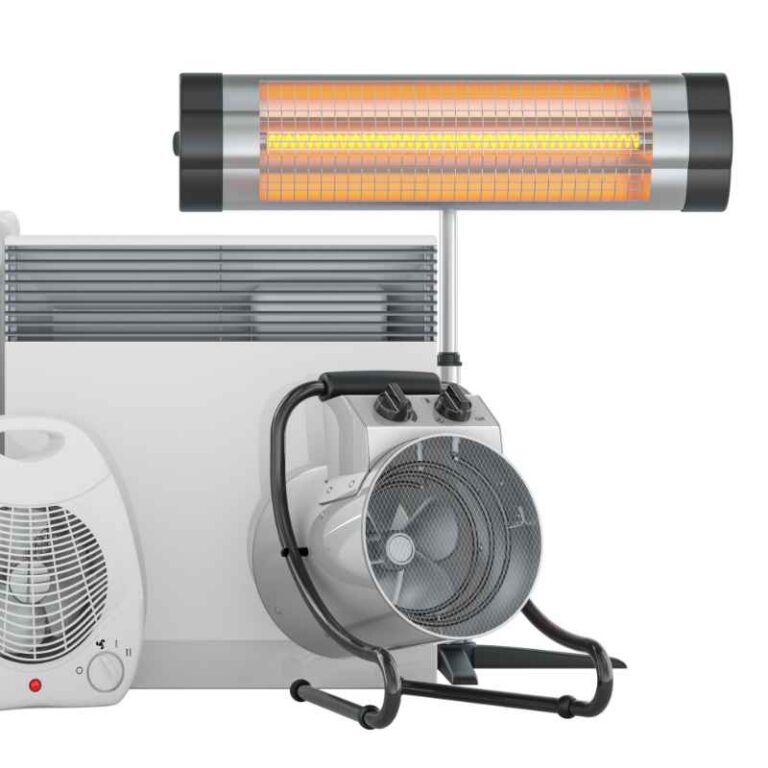
Yes, for some setups. The key question is not startup, it is whether the generator can carry the heater’s continuous draw and still leave room for the fan motor and any other essentials. A 750W heater is much easier to power than a 1,500W heater. Portable generators should be used outdoors and far from doors, windows, and vents because carbon monoxide can build up quickly. U.S. Department of Energy CPSC
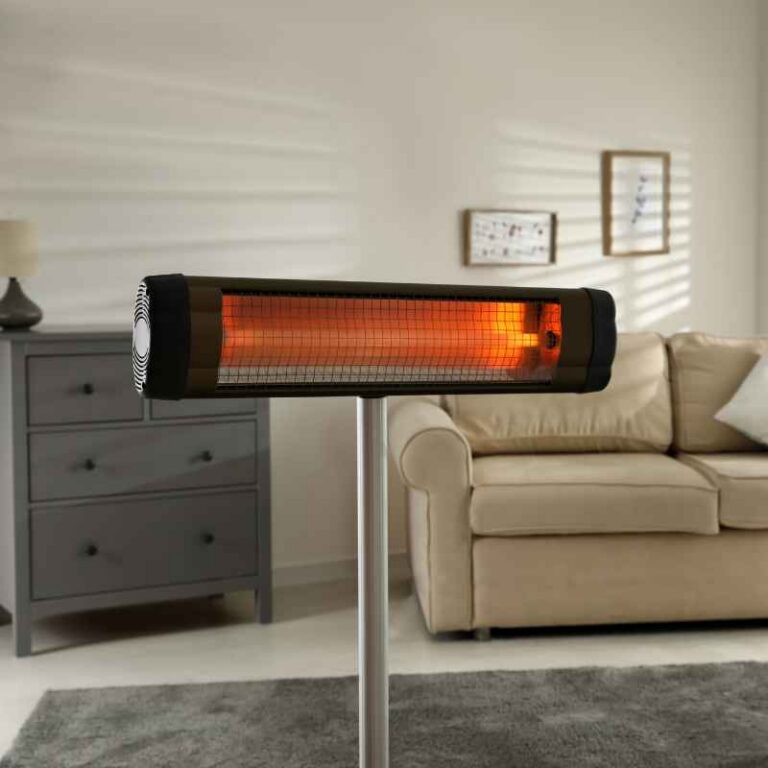
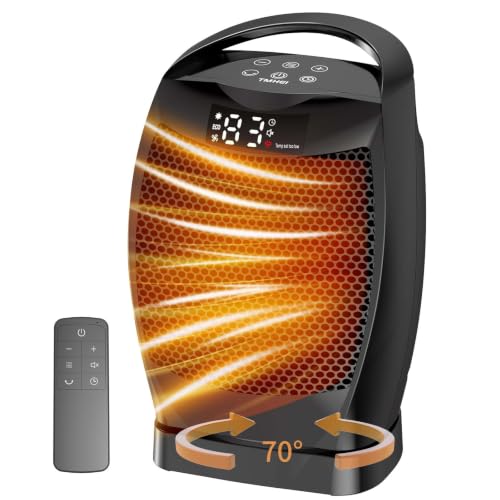
Most residential space heaters draw about 1,000-1,500W during normal operation. Many full-size plug-in heaters are around 1,500W on high, while common lower settings are around 750W. A space heater is usually a large, mostly steady electrical load, so the generator must handle sustained output, not a brief surge. A standard 120-volt, 1,500-watt heater draws about 12.5 amps, which is why cord and circuit limits matter so much. NFPA OSHA
Thermostat control can reduce average energy use over time. That matters a lot in a cold room, where the heater may run nearly nonstop, and less in a small room that warms quickly and cycles off often.
Space heater wattage and settings
Space heater labels usually tell you more than the model name does. A low setting may be around 750W, while the high setting on many plug-in heaters is around 1,500W. Some units have intermediate options, and some small electric heaters can sit below those common numbers.
That setting choice changes both generator sizing and runtime. A heater on low may be usable on a much smaller generator than the same heater on high, especially if the generator still needs to support a refrigerator, lights, or a charger.
How the settings change the load
A 500W heater is the easiest case. A 750W setting still leaves useful room on many portable generators. A 1,000W heater starts to matter more, because the generator has to stay comfortably above that level. A 1,500W heater is the common tipping point where headroom becomes important.
Some heaters also cycle on and off with a built-in thermostat. That does not change the label wattage, but it can reduce average draw after the room warms up. In a drafty room, though, cycling may be weak or rare.
Heater generator decision table
This table turns the sizing question into a practical call. It separates minimum practical size from what is merely technically possible, because a generator that can start a heater is not always one you should load that hard. For a more exact check, add the heater wattage and the other simultaneous loads, then target a generator continuous rating that exceeds that total by 20% to 25%. U.S. Department of Energy Generator sizing guide
| Heater wattage | Minimum practical generator size | Overload risk | Likely runtime band | Room suitability |
|---|---|---|---|---|
| 500W | 2,000W-class, if the model’s continuous rating leaves headroom | Low, unless the generator is already carrying other loads | Longer than the 750W row on the same fuel supply; exact hours vary by tank size and load | Bedroom use is realistic; living room use is possible; whole-house heating is not |
| 750W | 2,000W-class inverter or similar unit with a continuous rating above the heater draw | Low to moderate, depending on other loads | Often a practical overnight option on a small fuel tank if the heater cycles | Bedroom use is the best fit; living room use is possible with a targeted plan |
| 1,000W | 3,000W-class for comfortable margin; some 2,000W-class units can carry it if the continuous rating is high enough | Moderate on a small generator, lower on a larger one | Shorter than the 750W case; a 2,000Wh solar generator can barely last two hours | Bedroom or small living room with a narrow heat plan |
| 1,500W | 3,000W to 3,500W-class for a practical setup; check the continuous rating, not just surge watts | Moderate to high on smaller units | A Yeti 1500X can run a 1,500W space heater for about an hour; a 3.5-gallon tank can burn through an 8-12 hour window in a refrigerator-plus-heater bundle | Bedroom or one-room heating; not a whole-house attempt |
| 2,000W | 5,000W-class for a realistic margin; many smaller generators will be too tight | High on anything undersized | Short unless the generator is large and the heater cycles often | Living room only in a narrow plan; whole-house heating is a poor match |
What generator size do you need?
The answer depends on continuous watts, not surge watts alone. Surge watts help with brief startup events, but a space heater is mostly a steady load. That means the generator has to hold the heater’s running draw without sitting at the edge of its limit. Generator manuals typically list both starting and running watts because continuous output is the number that matters for long loads. Honda generators U.S. Department of Energy
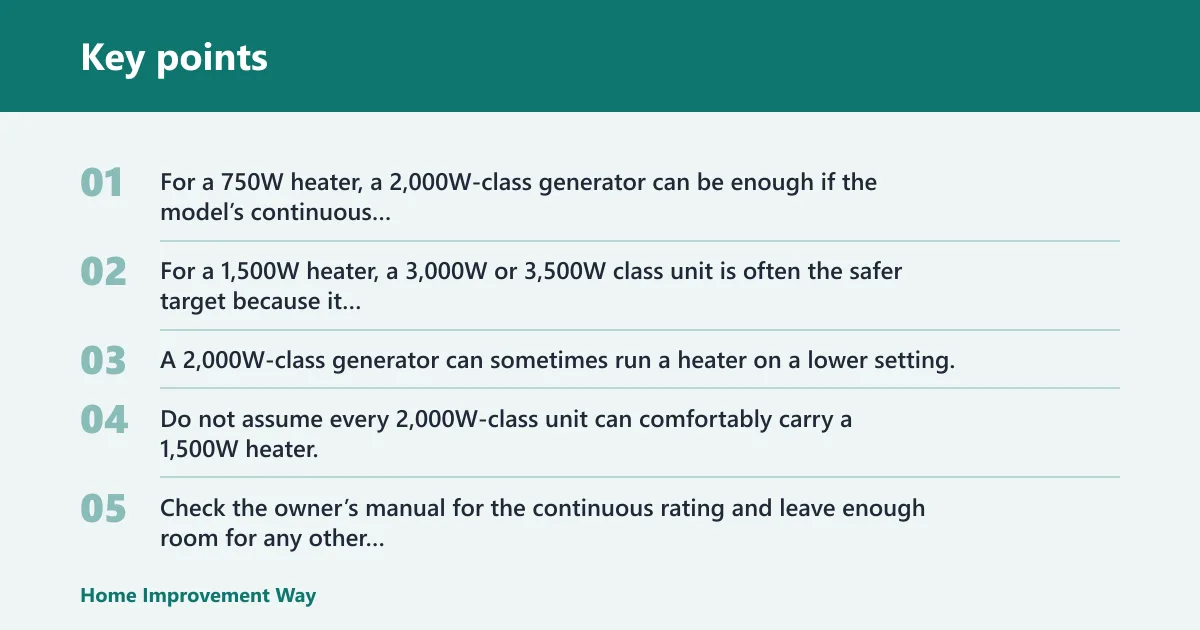
For a 750W heater, a 2,000W-class generator can be enough if the model’s continuous rating is truly above the heater load and you are not adding much else.
2,000W-class generators
A 2,000W-class generator can sometimes run a heater on a lower setting, depending on the model’s continuous output. Do not assume every 2,000W-class unit can comfortably carry a 1,500W heater. Check the owner’s manual for the continuous rating and leave enough room for any other load you want to keep on.
3,000W and 3,500W classes
These are the practical middle ground for outage planning. They can handle a heater more comfortably, especially at 750W or 1,000W, and they give you room for a refrigerator or a charger without pushing the generator into a hard limit. A 3500W conventional or 5000W inverter generator can run a refrigerator plus a 1,500W heater.
5,000W-class units
These are the better fit when you want one room heated and still need other essentials online. In severe cold, the combined bundle can sit at about 50% load, and that same bundle on a 3.5-gallon tank can burn through an 8-12 hour window. That is much closer to an actual outage plan than a bare-minimum sizing guess.
Say your heater has a 1,500W high setting and a 750W low setting. If your generator is a 2,000W-class unit with limited continuous output, the low setting may be the workable choice, while the high setting may crowd out everything else you need to power.
How long will it run?
Runtime depends on usable fuel and average load, not just the heater label. A space heater running near full output shortens runtime because it keeps the generator near a heavy, steady draw. If the thermostat cycles the heater off after the room warms, the average load drops and runtime improves. A practical estimate is: runtime hours ≈ usable watt-hours or fuel-derived watt-hours divided by the heater’s average watts, then reduced further for inverter and conversion losses. U.S. Department of Energy inverter efficiency overview
That is why fuel estimates change so much between a cold, drafty room and a small insulated bedroom. The first room can keep the heater near full draw for long stretches. The second may let the heater rest often.
Inverter generators and fuel use
Inverter generators usually do better at light loads because they can throttle the engine to the demand. That helps fuel economy when the heater is on low or cycling. They also make cleaner power for electronics, which matters if you are also running chargers or a modem. Portable inverter generators are also commonly recommended for sensitive electronics because they regulate voltage and frequency more tightly than many conventional units. Consumer Reports generator guide U.S. Department of Energy
Once the heater load gets heavy, though, the fuel advantage shrinks. At that point, the size of the fuel tank and the generator’s continuous rating matter more than the generator label style.
Can a solar generator run a heater?
Sometimes, but battery systems run out fast under resistive heat. A solar generator needs enough continuous inverter output and enough battery capacity in watt-hours to keep up. A solar generator with at least 2,000W continuous output can run a 1,500W space heater, but runtime is usually short.
A battery system’s runtime math is straightforward: usable battery watt-hours × inverter efficiency ÷ heater watts. For example, a 2,000Wh battery that is not fully usable may deliver well under 2,000Wh to the heater after inverter losses, which is why 1,500W heat can drain a “2,000Wh” unit far faster than many people expect. Goal Zero Yeti 1500X NREL
If you are sizing a battery unit, do not stop at inverter output. The battery capacity has to cover the load after inverter losses and reserve, or the run time falls off quickly.
Can you run a space heater on an extension cord from a generator?
You can, but the cord has to be sized for the load and length. Long extension cords can create voltage-drop risk, which may make a heater run poorly or trip protection. Gauge and length both matter, and the heater manual and generator manual should be your first check. For a 1,500W heater on 120V power, a heavy-gauge cord is typically required, and shorter is safer than longer. CPSC extension cord safety OSHA extension cord guidance
Use the shortest practical cord that the manuals allow, and make sure it is rated for the heater’s draw. A thin or overly long cord can waste power as heat and reduce the heater’s effectiveness. Do not guess with a heavy load like this. Also keep the heater itself clear of curtains, bedding, furniture, and other combustibles, and never plug a space heater into a daisy-chained power strip or another extension cord. NFPA CPSC
Use a dry outdoor setup for the generator, follow the manufacturer’s GFCI or neutral-bonding instructions, and keep the cord path as simple as possible between the generator and the heater. U.S. Department of Energy CPSC
How to choose the safer outage plan
- Read the heater label and note the exact wattage on each setting.
- Check the generator’s continuous rating in the owner’s manual, not just the surge number.
- Leave headroom for a refrigerator, lights, chargers, or the heater fan motor.
- If the heater is 1,500W and the generator is small, use the low setting or choose a smaller heating plan.
- Heat one room first, seal drafts, and add blankets before trying to heat the whole home.
- If you need a long extension cord, confirm gauge, length, and load rating before use.
A common first-timer mistake is treating the heater’s wattage like a fixed promise. In practice, thermostat cycling changes the average draw, so a room that warms up may become easier to support than the same room at startup. For the most reliable outage plan, keep the generator outdoors, place it well away from the home, and use a single, correctly rated cord to the heater rather than a chain of cords or adapters. U.S. Department of Energy CPSC
Frequently asked questions
Can you run a space heater on a generator?
Yes, if the generator’s continuous output is high enough for the heater’s wattage and you leave room for other loads. A 750W heater is much easier to support than a 1,500W heater. Check the heater label and the generator manual before you plug anything in. Also make sure the generator is outdoors, dry, and far from occupied spaces because carbon monoxide poisoning is a major hazard. U.S. Department of Energy CPSC
Can you run a portable heater on a generator?
Usually yes, but portable heaters vary a lot in wattage. The generator must cover the running load, not just a brief startup moment. If the heater includes fan or control electronics, leave a little extra capacity so the generator is not operating at the edge of its continuous limit. space heaters U.S. Department of Energy
Can you run a space heater on a portable generator?
Yes, if the portable generator’s continuous output is above the heater draw with headroom. Continuous rating matters more than surge watts. For corded setups, keep the cord short, heavy-gauge, and dedicated to the heater rather than shared through a strip or adapter. OSHA CPSC
How long can you run a space heater on a generator?
It depends on fuel capacity, load, and thermostat cycling. A heavy steady load shortens runtime, while cycling can stretch it once the room warms. For battery systems, runtime math is battery watt-hours times inverter efficiency divided by heater watts, so a 1,500W heater drains battery capacity quickly. For fuel generators, the manual’s fuel chart and the actual load are the best guide. NREL U.S. Department of Energy
What size generator do I need to run a space heater?
Use this formula: heater watts + other simultaneous loads = minimum running load, then choose a generator with a continuous rating at least 20% to 25% above that total. For a 750W heater, a 2,000W-class unit may be enough. If you also need a refrigerator or other essentials, a 5,000W-class generator is safer. U.S. Department of Energy Generator sizing guide
Can you run a space heater on a solar generator?
Yes, but only if the inverter output and battery capacity are large enough. A solar generator with at least 2,000W continuous output can run a 1,500W space heater, but runtime is short because resistive heat drains battery capacity quickly. For long outages, fuel generators are usually the better fit. If you do use battery power, a smaller wattage heater setting and a tightly sealed room will help extend runtime. Goal Zero Yeti 1500X NREL
Sponsored / affiliate links. As an Amazon Associate I earn from qualifying purchases. I may earn additional commission from eligible campaigns.
 Faryuan Bladeless Heater Fan, 25inch Heating & Cooling & Filter Combo Tower Fan 80° Oscillating with Remote, 9H Timer, 8 Speeds, Portable Quiet for Indoor, Bedroom, Home Office Room, White&Sliver
 AZEUS Portable AC and Heater Unit, 420W 110V Compact Air Conditioner for Tent RV Truck Cabin and Small Room, 1400W Cooling, 800W Heating, Remote Control, Dehumidifier, Sleep Timer, Champagne