How Many Watts Does a Space Heater Use?
A typical space heater uses about 1,500 watts on high and around 750 to 1,000 watts on a lower setting, and a common rule of thumb is to treat the nameplate wattage as the real load. If you ignore that number, you can trip a breaker, overload a circuit, or pay more for heat than you expected. This guide shows how to turn watts into amps, kWh, and monthly cost, plus what those numbers mean for a 15-amp or 20-amp circuit.
Why 1500 watts is the standard space heater rating


Most residential space heaters draw about 1,000 to 1,500 watts while operating, and many home plug-in models are rated for 1,500 watts at max power. Some models run lower or higher depending on type and settings, but for a 120V household heater, 1,500 watts is the number to check first.
Watts are instantaneous power draw. That is the number on the label that tells you how hard the heater pulls from the circuit right now. If the heater has a thermostat, it can cycle off after the room warms up, but the maximum rated input stays the same.
Why 1,500 watts is the common high setting
Many residential plug-in models are built for standard 120V household circuits, and 1,500 watts is the usual ceiling for that setup. At 120 volts, a 1,500-watt heater draws 12.5 amps, which leaves little margin on a 15-amp circuit once other loads are present.
How many watts does a space heater use on low?
Low settings often use around 750 watts, though some heaters use 1,000 watts or another lower step depending on the model. A heater’s low setting is not fixed across the category. It depends on how the manufacturer wired the element, fan, and controls.
That is why you should check the label or manual instead of assuming “low” always means half power. Some heaters offer one low step. Others have multiple heat levels. The maximum input does not change, but the actual draw on low can vary a lot by design.
Space heater wattage cheat sheet
This table turns common heater settings into amps, kWh, and sample hourly cost. The cost examples use the three electricity rates shown, so you can compare them with your own utility bill.
| Setting | Amps at 120V | kWh per hour | Cost per hour at 12¢ | Cost per hour at 18¢ | Cost per hour at 25¢ |
|---|---|---|---|---|---|
| 500W | 4.17A | 0.5 | $0.06 | $0.09 | $0.13 |
| 750W | 6.25A | 0.75 | $0.09 | $0.14 | $0.19 |
| 1,000W | 8.33A | 1.0 | $0.12 | $0.18 | $0.25 |
| 1,500W | 12.5A | 1.5 | $0.18 | $0.27 | $0.38 |
If you want the short version: 500W, 750W, and 1,000W fit under the 12-amp continuous-load mark on a 15-amp circuit. A 1,500-watt heater does not. That does not mean it will always trip a breaker, but it does mean you should be careful about what else is running on that circuit.
| Setting | Fits a 15-amp circuit with 80% margin? | Why |
|---|---|---|
| 500W | Yes | Draws 4.17 amps, below the 12-amp continuous-load guideline |
| 750W | Yes | Draws 6.25 amps, below the 12-amp continuous-load guideline |
| 1,000W | Yes | Draws 8.33 amps, below the 12-amp continuous-load guideline |
| 1,500W | No | Draws 12.5 amps, above the 12-amp continuous-load guideline |
How do watts turn into kWh and cost?
Use watts × hours ÷ 1,000 = kWh. That is the number utilities bill you for. Then multiply the kWh by your electricity rate. A heater that pulls 1,500 watts for one hour uses 1.5 kWh. At 12¢ per kWh, that hour costs $0.18.
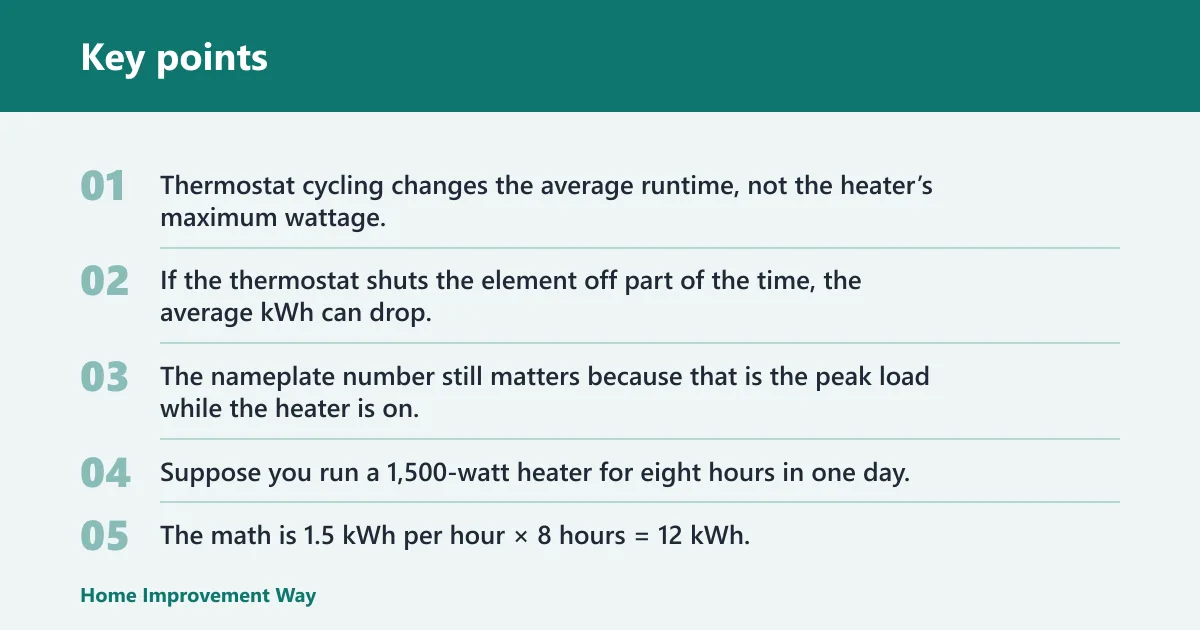
Thermostat cycling changes the average runtime, not the heater’s maximum wattage. If the thermostat shuts the element off part of the time, the average kWh can drop. The nameplate number still matters because that is the peak load while the heater is on.
Suppose you run a 1,500-watt heater for eight hours in one day. The math is 1.5 kWh per hour × 8 hours = 12 kWh. At an average rate of $0.163 per kWh, that 8-hour use costs about $1.96 per day. Your own bill can be higher or lower because electricity rate varies by location. (Familyhandyman)
A common first-timer mistake is to estimate cost from the heater’s “warmth” instead of its label. Two 1,500-watt heaters can feel different in a room, but they use the same electricity while they are on. The bill tracks wattage and runtime, not how hot the air feels at the vent.
How much does it cost to run a 1,500-watt space heater?
At full output, a 1,500-watt space heater uses 1.5 kWh per hour. That is $0.18 per hour at 12¢ per kWh, $0.27 per hour at 18¢ per kWh, and $0.38 per hour at 25¢ per kWh. Daily and monthly totals depend on how long it actually cycles.
Will a space heater overload a 15-amp circuit?
That is why the heater may be too much for a circuit that is already carrying lights, a TV, a computer, or anything else with steady draw.
Watts to amps is simple: watts ÷ volts = amps. At 120 volts, 500 watts is 4.17 amps, 750 watts is 6.25 amps, 1,000 watts is 8.33 amps, and 1,500 watts is 12.5 amps. Those numbers matter because heaters are a high continuous draw, not a brief startup surge.
What else is on the circuit matters just as much as the heater itself. If the breaker also feeds a lamp, a computer, or another appliance, you have less margin. A 20-amp circuit gives more room, but you still need to count the total load.
How many watts space checklist
- Find the heater’s nameplate watts.
- Divide watts by 120 to get amps.
- Keep continuous load at or below 12 amps on a 15-amp circuit.
- Account for everything already running on that circuit.
- Use a different circuit if the total load is too close to the limit.
Do different heater types use different wattage?
Yes, but the wattage spread is usually wider by model and setting than by heater style alone. Ceramic fan-forced heaters, radiant or quartz heaters, oil-filled radiators, and infrared or personal heaters can all land in similar wattage ranges. The big difference is how they deliver heat, not how electricity is counted.
Ceramic fan-forced heaters
Ceramic fan-forced heaters are often sold with low and high settings in the common 750-to-1,500-watt range. The fan moves air across the heating element, so the room can feel warmer quickly. The electrical math still follows the nameplate wattage.
Radiant and quartz heaters
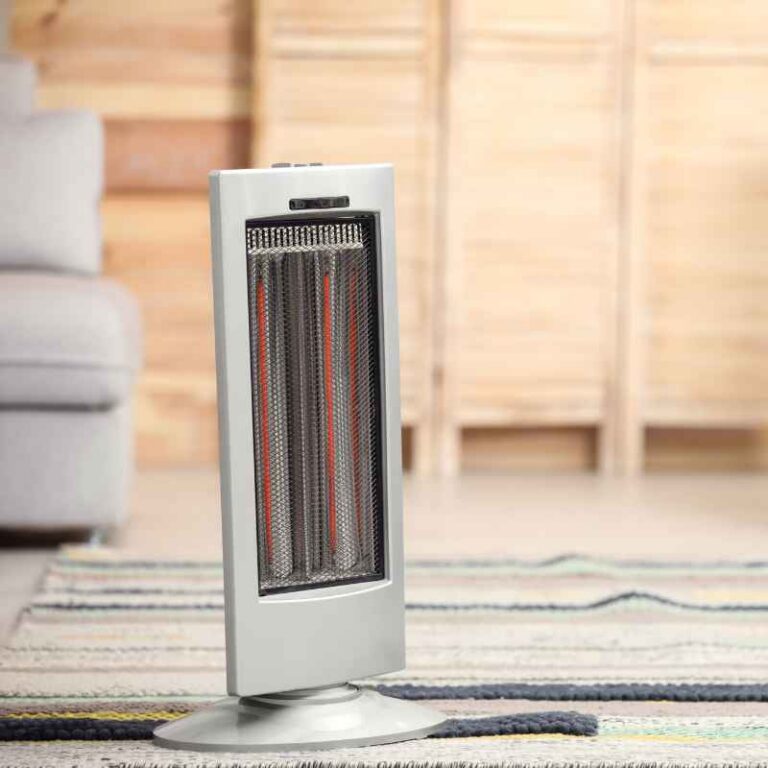
Radiant and quartz heaters are aimed at direct, line-of-sight warmth. They may be better for a person or a small nearby area than for heating an entire room. Their wattage varies by model, so check the label instead of guessing from the heater style.
Oil-filled radiators and infrared/personal heaters
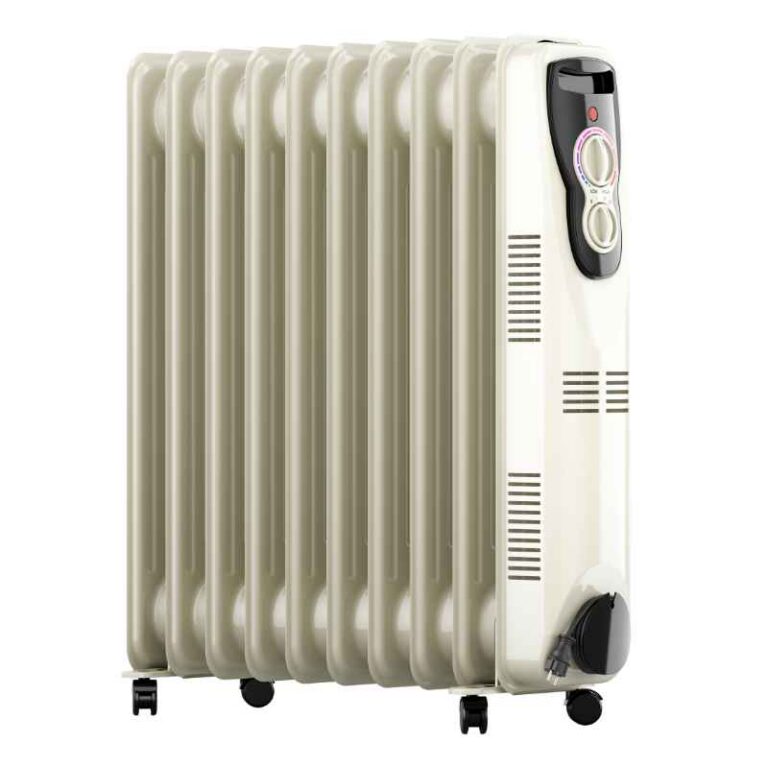
Oil-filled radiators can use similar input power to other plug-in heaters, but they store heat in the fluid inside the unit and often cycle differently. Infrared and personal heaters are also model-dependent. At the same wattage, the electric use is the same; the heat delivery is what changes.
Say your office heater is a 1,500-watt ceramic unit and your bedroom heater is a 750-watt radiant unit. The first one uses twice the power while it is on. The second one may feel fine at a shorter distance, but its lower wattage means lower hourly electricity use.
How can you check the actual draw?
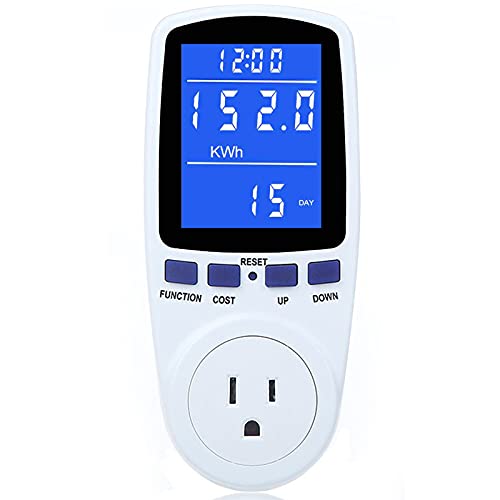
Read the rating label first. That tells you the maximum input and often the voltage. If the heater has multiple settings, the label or manual may list each mode. A plug-in watt meter can then show the actual draw for each setting under real use.
- Check the manufacturer’s listing or the heater label for the rated input.
- Plug the heater into a watt meter if the meter is rated for the load.
- Cycle through low, medium, and high settings one at a time.
- Note the watt reading for each setting.
- Use the highest stable reading as your planning number unless the manual says otherwise.
That check is useful because thermostat cycling can hide the peak. A heater may average less over time, but the watt meter will still show the active draw when the element is on. That gives you a better number for circuit planning and cost estimates than a guess based on room comfort alone.
Frequently asked questions
How many watts does a space heater use?
Most residential space heaters use about 1,000 to 1,500 watts during operation, and many home plug-in models are rated for 1,500 watts at max power. The exact figure depends on the model and setting, so the label is the number to trust when you plan for load and cost.
How much electricity does a space heater use?
Electricity use depends on wattage and runtime. A 1,500-watt heater uses 1.5 kWh per hour while it is running. If thermostat cycling reduces runtime, the average use can be lower, but the peak draw still matters for the circuit and the bill estimate.
How do I calculate space-heater electricity use in kWh?
Use watts × hours ÷ 1,000 = kWh. For example, 1,500 watts for one hour equals 1.5 kWh. Multiply that by your local electricity rate to estimate cost. This is the cleanest way to turn heater wattage into a bill estimate.
Will a space heater fit on a 15-amp circuit?
Some will, some will not. Lower settings like 500W, 750W, and 1,000W fit more comfortably, especially if the circuit already powers other loads.
How many watts does a portable heater use?
Most portable plug-in heaters fall into the same general range as other home space heaters, about 1,000 to 1,500 watts during operation. Some models can be lower or higher depending on type and settings, so “portable” does not mean low wattage. Check the model label before you plug it in.
Sponsored / affiliate links. As an Amazon Associate I earn from qualifying purchases. I may earn additional commission from eligible campaigns.
 AZEUS Portable AC and Heater Unit, 420W 110V Compact Air Conditioner for Tent RV Truck Cabin and Small Room, 1400W Cooling, 800W Heating, Remote Control, Dehumidifier, Sleep Timer, ChampagneMEGAWISE Portable Air Conditioner and Heater, 420W 110V Compact AC Unit with Remote Control, 1400W Cooling Capacity, 800W Heating, Dehumidifier, Fan, Sleep Timer, Champagne