How Long Do Space Heaters Last?
Most space heaters last about 5 to 10 years. Replace them sooner if cords, controls, or the heating element fail, or if the unit lacks modern safety features. Ignoring wear can raise fire risk, trip breakers, or leave you replacing a heater after it has already failed. This guide explains lifespan by heater type, warning signs, cleaning and inspection triggers, and when repair no longer makes sense.
How long do space heaters last?
Most space heaters often last about 5 to 10 years, though the actual lifespan can vary with heater type, build quality, maintenance, and how many hours it is used. A bedroom backup heater used a few months a year can last longer than a desk heater that runs for long stretches every day.
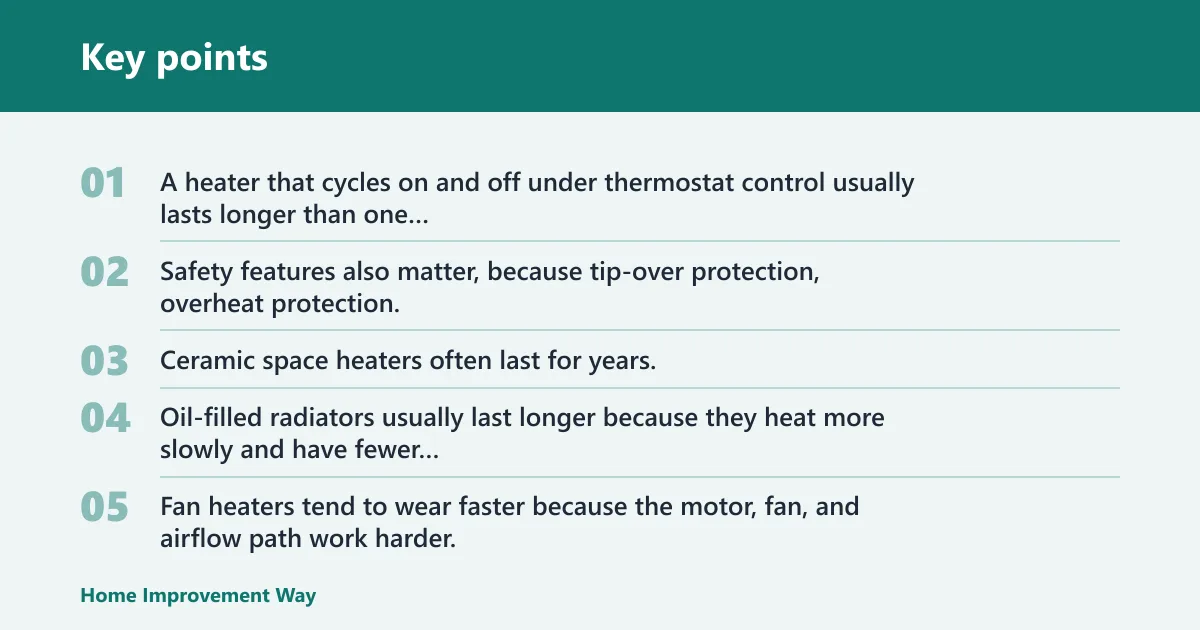
What matters most is wear pattern. A heater that cycles on and off under thermostat control usually lasts longer than one that runs continuously at maximum output. Safety features also matter, because tip-over protection, overheat protection, and shutoff controls can prevent damage from a single bad event.
Typical lifespan by heater type
Ceramic space heaters often last for years, especially when they are used for desks or small rooms and cleaned often. Oil-filled radiators usually last longer because they heat more slowly and have fewer moving parts. Fan heaters tend to wear faster because the motor, fan, and airflow path work harder.
That does not mean every ceramic heater is short-lived or every oil-filled radiator is durable by default. The heating pattern, thermostat behavior, cord condition, and dust buildup can change the timeline more than the label on the box.
Why usage patterns change the answer
A heater used only as a seasonal backup may last noticeably longer than the same model used every day. Long runtime hours add wear to switches, thermostats, fans, and internal wiring. Frequent starts and stops also add stress, especially if the heater is switched on at full power each time.
Thermostat control helps here. It cycles the heater on and off instead of running continuously, which can reduce wear and energy use. A heater that holds temperature with short cycles usually faces less stress than one that stays hot for hours without interruption.
What a normal aging heater looks like
An aging heater may warm a room a little more slowly, make more fan noise, or need occasional dust cleaning. That alone does not mean it is unsafe. The concern starts when performance changes come with smells, unstable temperature control, frequent shutoffs, or visible damage.
Say your ceramic heater still turns on, but it takes longer to warm a small office and the fan sounds rough. Cleaning the intake and checking for dust may solve it if the cord, plug, and controls still look sound. If the noise persists, the motor may be wearing out.
Ceramic, oil-filled, and fan heaters
Ceramic heaters, oil-filled radiators, and fan heaters all heat small spaces, but they age differently. Ceramic units are common portable heaters with fan-assisted heat and are often budget friendly. Oil-filled radiators are slower but steady. Fan heaters are compact, yet their moving parts can wear sooner.
Ceramic heaters: fast heat, moderate lifespan
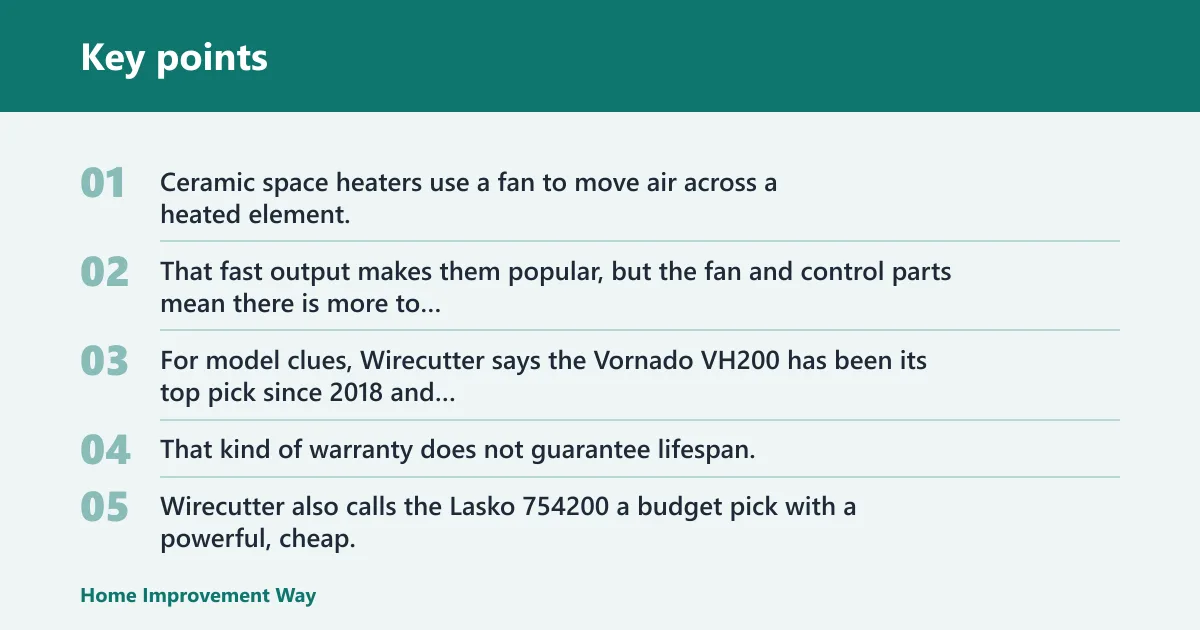
Ceramic space heaters use a fan to move air across a heated element, so they warm a desk area or small room quickly. That fast output makes them popular, but the fan and control parts mean there is more to wear than in a passive radiant unit.
For model clues, Wirecutter says the Vornado VH200 has been its top pick since 2018 and gives it a five-year warranty. That kind of warranty does not guarantee lifespan, but it is one sign the maker expects meaningful service life. Wirecutter also calls the Lasko 754200 a budget pick with a powerful, cheap, reliable design and a narrow stream of hot air.
Oil-filled radiators: slower heat, longer runtimes
Oil-filled radiators are a space heater subtype that warms a room more slowly, then holds a steadier temperature for longer runtimes. They are often used in bedrooms or other spaces where quiet, even heat matters more than quick warmup. Because they have no exposed glowing element, they often age well when used within limits.
Wirecutter recommends the De’Longhi TRD40615E as the best oil-filled radiator. That kind of recommendation points to a format suited to longer sessions, but it still needs clean fins, sound controls, and a stable thermostat. A radiator that starts clicking loudly or cycling erratically needs attention.
Fan heaters: compact build, higher wear risk
Fan heaters are simple and compact, which makes them easy to move from room to room. The tradeoff is higher wear on the fan motor, bearings, switches, and intake path. If dust collects around the fan, airflow drops and internal temperature rises, which can shorten lifespan.
The Vornado AVH10 is listed with 1500W power and includes overheat protection, tip-over protection, and stay-cool housing. Business Insider says it reached 70 degrees within an hour in testing of 30 space heater models. Those features matter because a high-output fan heater needs reliable shutoffs to stay in safe working order.
What shortens a heater’s life?
Dust buildup, blocked airflow, heavy runtime, and worn electrical parts shorten heater life fast. Dust blocks grilles and fan paths, which traps heat inside the unit. A heater with loose plugs, a cracked cord, or failing controls should be treated as a safety problem, not just a comfort issue.
Dust buildup and blocked airflow
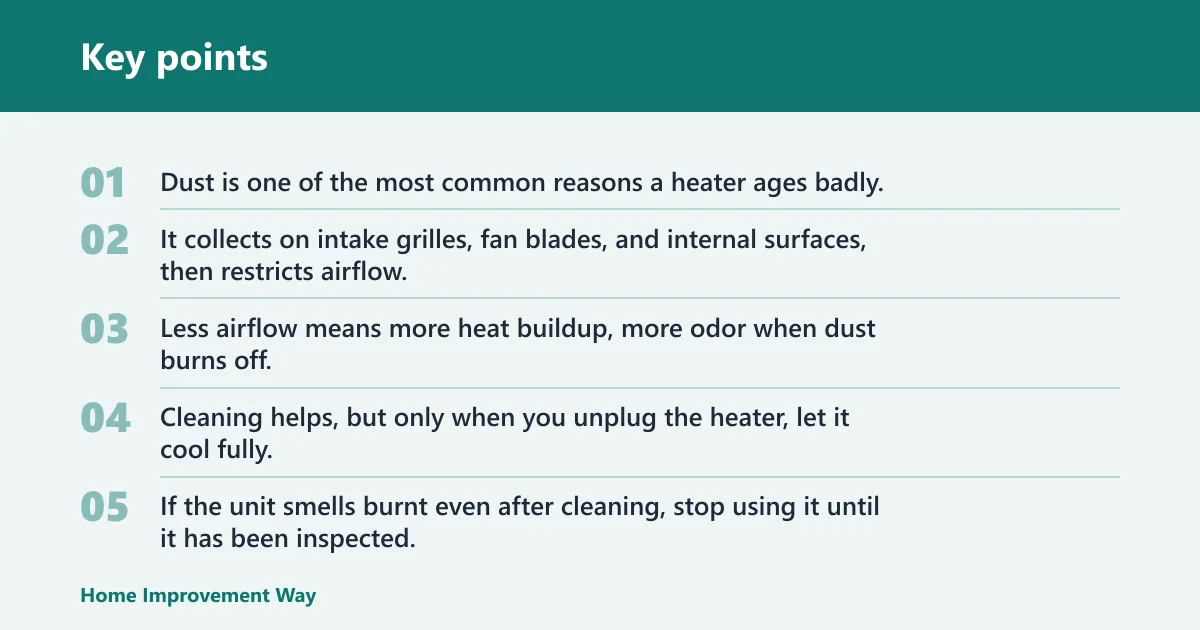
Dust is one of the most common reasons a heater ages badly. It collects on intake grilles, fan blades, and internal surfaces, then restricts airflow. Less airflow means more heat buildup, more odor when dust burns off, and more stress on the motor and safety controls.
Cleaning helps, but only when you unplug the heater, let it cool fully, and remove dust from the grille and exterior on a regular schedule. If the unit smells burnt even after cleaning, stop using it until it has been inspected.
Thermostat cycling and runtime hours
Thermostat control affects lifespan because it limits how long the heater runs continuously. More cycling usually means less total heat stress, though rapid on-off behavior can also signal a failing thermostat. A heater that never seems to settle to a steady temperature may be wearing out.
Frequent use matters too. A supplemental heater that runs for a few evening hours each week will usually last longer than one used all day in a drafty room. Usage intensity changes wear on the heating element, the fan, and the control board or switch set.
Cord, plug, switch, and control wear
Electrical wear is a major end-of-life clue. A cord that feels brittle, a plug that is discolored, a switch that sticks, or a dial that behaves unpredictably can all point to internal failure. These parts are not cosmetic. They affect safe operation.
Thermostat failure is especially important. If the heater keeps running when it should shut off, or shuts off too soon and then cycles wildly, the control system may be failing. That is a strong reason to stop using the heater and replace it if repair is not straightforward.
How can you tell a heater is wearing out?
A heater is wearing out when it no longer heats consistently, makes new sounds, or shows new smells. Safety problems matter even more than reduced comfort. If the cord, plug, housing, or shutoff behavior changes, treat the heater as failing until proven otherwise.
Weak heat, new noise, or burning smell
Weak heat can point to a failing element, clogged airflow path, or thermostat trouble. New rattling, buzzing, or grinding often means the fan motor or internal mounting parts are wearing. A burning smell is more serious, especially if it does not clear after dust removal and cooldown.
For example, if a portable heater in a roughly 10-by-12-foot bedroom still powers on but the airflow is weak and it starts smelling hot within minutes, that is a sign of a possible problem. That is not a normal aging pattern. Stop using it, unplug it, and inspect the intake, plug, and cord before deciding whether repair is even possible.
Frequent shutoffs or uneven temperature control
Repeated shutoffs can mean overheating, a failing thermostat, or a blocked intake. Uneven temperature control can mean the heater is cycling badly or no longer sensing room temperature correctly. Either one can make the unit uncomfortable to use and can signal a part near failure.
Countdown timers on some models can be useful, but they are not a fix for faulty controls. If a heater shuts off unexpectedly without timer settings or overload conditions, stop using it until the cause is known.
Damage to the cord, plug, or housing
Visible damage is a replacement trigger. Cracks in the housing, melted spots near the plug, exposed conductors, or a loose strain relief at the cord entry all justify stopping use. Internal parts can fail after exterior damage, and those failures are not predictable.
Do not keep running a heater with a damaged cord or a failed safety shutoff. Tip-over protection, overheat protection, and cool-to-the-touch housing are meant to reduce risk, but they cannot compensate for compromised wiring or broken controls.
Replacement checklist
Use this checklist when you are deciding whether to clean, inspect, repair, or replace. Age matters, but runtime pattern and warning signs matter more. A younger heater with bad wiring can be less safe than an older one that is clean, stable, and still controls temperature normally.
| Heater type and age | Runtime pattern | Warning signs | Likely failure point | Action |
|---|---|---|---|---|
| Ceramic heater, under 5 years | Seasonal or light supplemental use | Dust, mild fan noise, slower warmup | Blocked airflow or dirty fan path | Clean, inspect grille and cord, then retest |
| Ceramic heater, 5 to 8 years | Frequent desk or small-room use | Burning smell, uneven heat, sticky switch | Fan motor, switch, or thermostat wear | Replace if cleaning does not clear the problem |
| Oil-filled radiator, under 8 years | Long bedroom runtimes | Clicking grows louder, control drift, shutoff issues | Thermostat or control failure | Inspect controls; replace if shutoff is unreliable |
| Oil-filled radiator, 8 to 12 years | Heavy seasonal use | Leaks, cracked housing, or scorch marks | Tank seal or electrical fault | Stop using and replace |
| Fan heater, under 5 years | Daily spot heating | Rattling, weak airflow, cord warmth | Fan motor, plug, or cord stress | Clean first; replace if noise or heat persists |
| Fan heater, 5 years or more | High daily runtime | Frequent shutoffs, burned odor, unstable output | Thermostat or internal wiring failure | Replace rather than repair if safety controls are affected |
Which safety features matter most?
Safety shutoff features are not extras. Tip-over protection, overheat protection, cool-to-the-touch housing, and countdown timers reduce risk when a heater is bumped, blocked, or left on too long. A thermostat also matters because it controls runtime and lowers constant heat stress.
Tip-over and overheat protection
Tip-over protection should shut the heater off if it falls. Overheat protection should stop operation before internal temperatures get unsafe. If either feature no longer works, the heater should not stay in service. That is a replacement-level fault, not a comfort issue.
Cool-touch housings and timers
Cool-to-the-touch housing lowers the chance of burns when you move the heater or brush past it. Countdown timers can help prevent unattended runtime by turning the unit off after a set period. These features are useful, but they do not excuse leaving a heater running when no one is around.
Model-specific durability clues
Look for warranty length, physical layout, and control design as durability clues. The same source gives the Vornado VH200 a five-year warranty, which is a useful sign of expected service life. The Lasko 754200 is a compact budget pick with a narrow stream of hot air, which can be fine for spot heating but not a reason to expect long heavy-duty service.
When should you replace a space heater instead of repairing it?
Replace a space heater when the problem affects safety shutoff, the cord or plug, the switch, or the thermostat. Cleaning is enough only when dust or blockage is the obvious cause and the heater otherwise behaves normally. If the heater smells, makes new noise, or loses heat output after cleaning, replacement is the safer choice.
When a simple cleaning is enough
If the heater is underpowered only because the grille is dusty or the intake is blocked, a careful cleaning may restore normal operation. Do not open a heater unless the manufacturer allows it and you know exactly what you are doing. Unplug it first and let it cool fully.
When a part failure is not worth repairing
A failed fan motor, burned switch, unstable thermostat, or damaged cord often costs more to fix than the heater is worth. Parts availability matters too. If the unit is older and the repair requires opening the housing for electrical work, replacement is usually the better call.
When the heater is no longer safe to use
Stop using the heater now if it has a burned smell that returns, a cracked cord, a loose plug, a failed tip-over switch, or a housing that is discolored from heat. Also stop using it if the unit trips breakers repeatedly or will not shut off properly. Do not leave any space heater unattended.
A common first-timer mistake is assuming a heater that still turns on is safe. If a unit in a living room keeps heating but the plug feels hot and the thermostat hunts up and down, that is a warning sign, not a minor annoyance. Replace it.
Frequently asked questions
How long do electric space heaters last?
Electric space heaters usually fall into the same 5 to 10 year range, though oil-filled radiators often last longer than fan-driven units. The thermostat, cord, and fan or control parts often set the real limit. Clean, occasional use usually extends service life more than nonstop operation.
How long do portable heaters last?
Portable heaters often last about 5 to 10 years, but portability itself is not the issue. Moving the unit often can stress the cord, plug, and housing, especially if it is stored with the cord wrapped tightly. Good storage and light use can help it last longer.
How long do oil space heaters last?
Oil-filled radiators often last longer than many fan heaters because they have fewer moving parts and heat more slowly. The thermostat and power controls still wear out, though. If the unit leaks, clicks oddly, or fails to hold temperature, replacement is usually safer than repair.
How can I tell if a space heater is wearing out?
Look for weaker heat, new noise, a burning smell, frequent shutoffs, or unstable temperature control. Also check the cord, plug, and housing for damage. If the heater needs constant resetting or cleaning no longer helps, the problem is likely more than surface dust.
Sponsored / affiliate links. As an Amazon Associate I earn from qualifying purchases. I may earn additional commission from eligible campaigns.