Can a Space Heater Heat a Whole House?
No: a typical portable electric space heater can warm one room, not an entire house, unless the home is tiny and you run multiple units on dedicated circuits. Push it past that point, and electric bills climb, breakers may trip, and fire risk rises. This guide explains what one heater can handle, what multiple heaters actually cost, and when you need a different heat source.
How a space heater performs in practice
Usually, no. A space heater is a room-level heat source, not a true whole-house system. Most plug-in electric space heaters top out at 1,500 watts, which is about 5,100 BTU per hour and about 12.5 amps. That is enough for a small, enclosed area, not a full home with multiple rooms and heat loss.
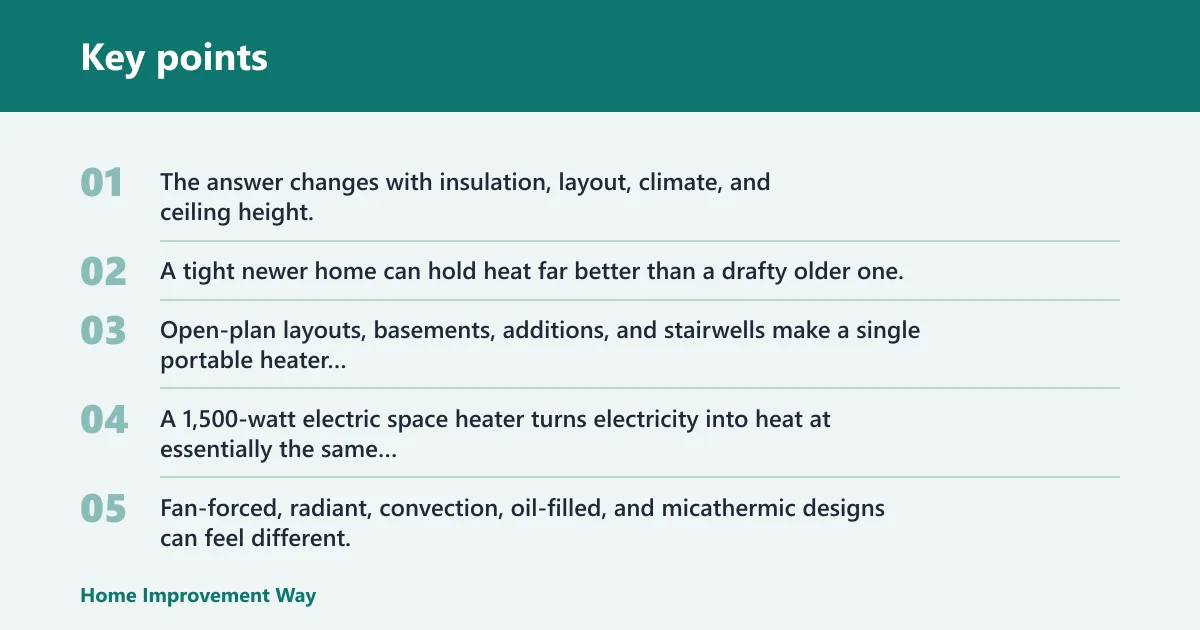
The answer changes with insulation, layout, climate, and ceiling height. A tight newer home can hold heat far better than a drafty older one. Closed doors help. Open-plan layouts, basements, additions, and stairwells make a single portable heater fall behind fast.
How much heat one 1,500-watt heater provides
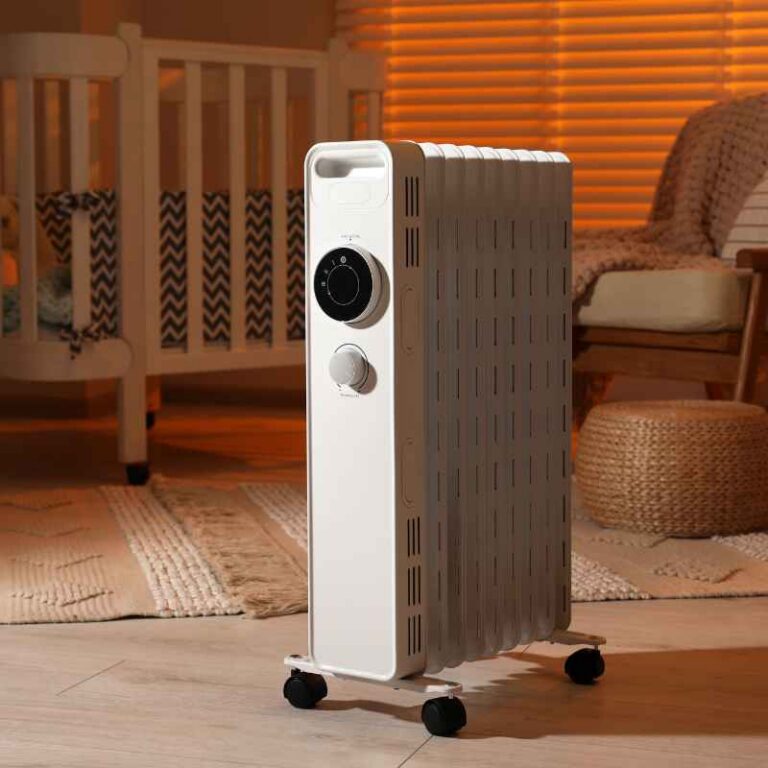
A 1,500-watt electric space heater turns electricity into heat at essentially the same rate across models, so wattage matters more than heater style. Fan-forced, radiant, convection, oil-filled, and micathermic designs can feel different, but the electrical input sets the output limit.
At 18 cents per kWh, a 1,500-watt heater costs about 27 cents an hour. That sounds modest until you multiply it by several rooms and many hours. At 8 hours a day, the same heater is about $65 a month at that electricity rate, though thermostat cycling can lower or raise the real-world total.
What room size a 1,500-watt heater can realistically cover
Room size varies a lot. A 1,500-watt heater can warm a room of around 150 to 250 square feet. A different reference places the range much wider, from roughly 140 sq ft in drafty older space to about 460 sq ft in newer space.
Those differences are not a contradiction. They reflect insulation quality, ceiling height, temperature difference, window area, and air leakage. A heater that works in a small, tight bedroom may underperform in a large family room with vaulted ceilings and open hallways.
Why electric resistance heat is alike across models
Electric resistance heat is the same basic process in nearly every plug-in space heater. The unit uses electrical resistance to turn electricity into heat. Because of that, the main sizing question is not the brand or cabinet shape. It is how many watts you can safely supply and how much heat the room loses.
That is also why bigger claims should be treated carefully. If a room needs more heat than one 1,500-watt unit can deliver, a fancier heater does not change the physics.
Whole-house feasibility table
Use this table as a practical check, not a promise. It shows what common home situations mean for heater count, comfort, and whether portable heat is a short-term fix or the wrong tool.
| Home scenario | Example square footage | Insulation quality | 1,500-watt heaters required | Likely comfort level | Use case |
|---|---|---|---|---|---|
| Single closed bedroom | 120 to 200 sq ft | Current-code or 2000s construction | 1 | Often comfortable if doors stay closed | Temporary emergency fix |
| Small apartment with separate rooms | 500 to 800 sq ft | 1980s/1990s home or similar | 2 to 4 | Mixed; warm in occupied rooms, uneven elsewhere | Limited short-term use |
| Open-plan main floor | 900 to 1,400 sq ft | Good insulation but open layout | 4 to 6+ | Hard to keep evenly warm | Usually the wrong tool |
| Older house with drafts | 1,200 to 1,800 sq ft | Drafty pre-1970 home | 6+ and still limited | Poor; cold spots remain | Wrong tool for whole-house heating |
| Basement plus upper floors | 1,500 to 2,500 sq ft | Varies by level and air leakage | 6+ with uneven results | Uneven; lower level may still feel cold | Temporary emergency fix only |
In practice, the heater count grows faster than the comfort gain. A house with closed doors and modest heat loss may let one or two units handle the occupied rooms. An open plan or drafty home can demand so many heaters that the electric load, outlet count, and operating cost stop making sense.
Can you heat a house with space heaters?
You can sometimes heat a house with space heaters room by room, but that is not the same as replacing central heat. The setup may work in a tiny, very tight home, or in a short emergency when you only need one occupied room and have generator or inverter power available. For daily whole-home heating, it usually falls apart on cost, circuit limits, and uneven comfort.
Room-by-room heating in closed spaces
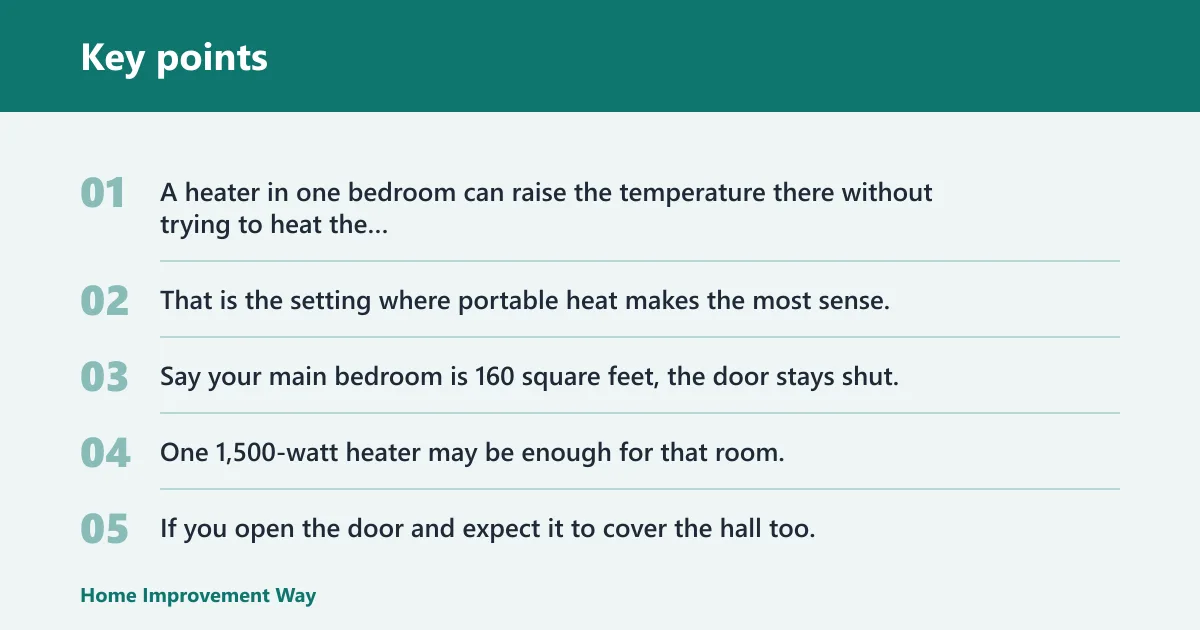
Closed doors make a big difference. A heater in one bedroom can raise the temperature there without trying to heat the kitchen, hallway, and upstairs landing at the same time. That is the setting where portable heat makes the most sense.
Say your main bedroom is 160 square feet, the door stays shut, and the home is reasonably tight. One 1,500-watt heater may be enough for that room. If you open the door and expect it to cover the hall too, the same heater has to fight a much larger heat-loss path.
Why open floor plans and additions are hard to cover
Open floor plans spread heat thin. Stairwells pull warm air upward. Additions often have different insulation, different window quality, and separate drafts. Basements can also stay cold because concrete and air leakage keep pulling heat away.
A common first-timer mistake is putting one heater in the center of a large open living area and expecting the whole floor to warm evenly. The nearby seating area may improve, while the far side of the room, hall, or loft stays cool.
Why multiple heaters quickly stop being practical
Multiple heaters raise the power draw, which is where the plan starts to break down. A 1,500-watt heater draws 12.5 amps. Several units can push a branch circuit or a whole home toward limits fast, especially if other appliances are running at the same time.
They also increase clutter, noise, and outlet demand. The more rooms you try to cover, the more likely you are to run into a circuit that trips, a cord that should not be there, or a room that still never feels truly warm.
What makes a space heater work better or worse?
Insulation, ceiling height, and air leakage matter as much as wattage. A current-code or 2000s construction home usually holds heat better than an 1980s/1990s home, and much better than a drafty pre-1970 home. That is why two houses with the same square footage can need very different heater setups.
Insulation level and home age
Current-code homes generally lose less heat through walls, ceilings, and windows. Homes from the 1980s and 1990s can land in the middle, depending on upgrades. Drafty older homes may leak enough air that a portable heater cannot keep up in anything beyond a small room.
This is where square footage alone misleads people. A 140-square-foot room in a leaky old house can be harder to heat than a much larger room in a newer, tighter home.
Ceiling height, drafts, and temperature difference
Higher ceilings mean more air to warm. Drafts pull heated air away before it settles where you want it. The colder it is outside, the larger the gap the heater has to bridge, and the harder it works to hold a steady indoor temperature.
If a room has big windows or a leaky exterior door, the heater may run almost constantly. That is where a thermostat matters.
Thermostats and runtime control
A thermostat cycles the heater off once the target temperature is reached. That reduces wasted runtime and improves comfort, especially in bedrooms and offices where the room temperature should stay steady. It also gives you more control over cost than a heater that simply runs until you shut it off.
Still, a thermostat does not make a small heater capable of heating a whole home. It only helps the heater stop when the room reaches the set point.
When space heaters are the right temporary fix
Space heaters make sense as backup heat, not as a long-term whole-house answer. They are useful when a furnace fails, when one room needs heat while the rest of the house can stay cool, or during a power outage if you have generator or inverter power for an electric unit. They are also a reasonable stopgap while you wait for repairs or a permanent upgrade.
Power outages and emergency backup heat
If the main heating system is down, one or two heaters can protect a small occupied area until service is restored. In that case, the goal is to keep people warm in one or two rooms, not to recreate normal whole-house comfort.
Keep the scope tight. Heat the room you are using, close the door, and avoid trying to spread the heat through the entire house.
One occupied room vs. the whole house
If only one bedroom, office, or family room needs warmth, a portable heater can be a useful tool. If every room needs heat all day, the heater is the wrong tool. That is the line where a temporary fix becomes a daily operating problem.
Are space heaters safe for whole-house heating?
They are safer when used correctly, but they are not a safe whole-house substitute for a permanent heating system. Tip-over shutoff and overheat protection reduce risk. They do not make it reasonable to run multiple heaters around the clock in every room. Safe placement, proper outlets, and load management still matter.
Tip-over shutoff, overheat protection, and safe placement
Look for tip-over shutoff and overheat protection on any indoor electric model. Tip-over shutoff turns the heater off if it is knocked over. Overheat protection shuts the heater off if internal parts get too hot. Those are important safeguards, but they are backup features, not permission to place a heater anywhere.
Keep a heater at least 3 feet from bedding, curtains, furniture and other combustibles. Do not put it where blankets, paper, or clothing can fall onto it.
Outlet, cord, and clearance concerns
Most plug-in electric heaters draw a lot of current for a single appliance. A 12.5-amp load can be fine on its own, yet still become a problem if you add other devices to the same circuit. Heavy-duty extension cords are not a fix for poor placement or overloaded outlets.
Use a wall outlet directly when possible. Avoid daisy-chaining power strips. If the heater causes lights to dim, a breaker to trip, or a plug to feel warm, stop using that setup.
When carbon monoxide alarms are needed
Carbon monoxide alarms are needed for fuel-burning heaters indoors. They should be installed outside sleeping areas and on every level of the home where combustion appliances are used, and you should follow local code. Electric resistance heaters do not create carbon monoxide, so the alarm rule is different for them.
That distinction matters. Do not treat an electric space heater the same as a kerosene, propane, or other fuel-burning heater.
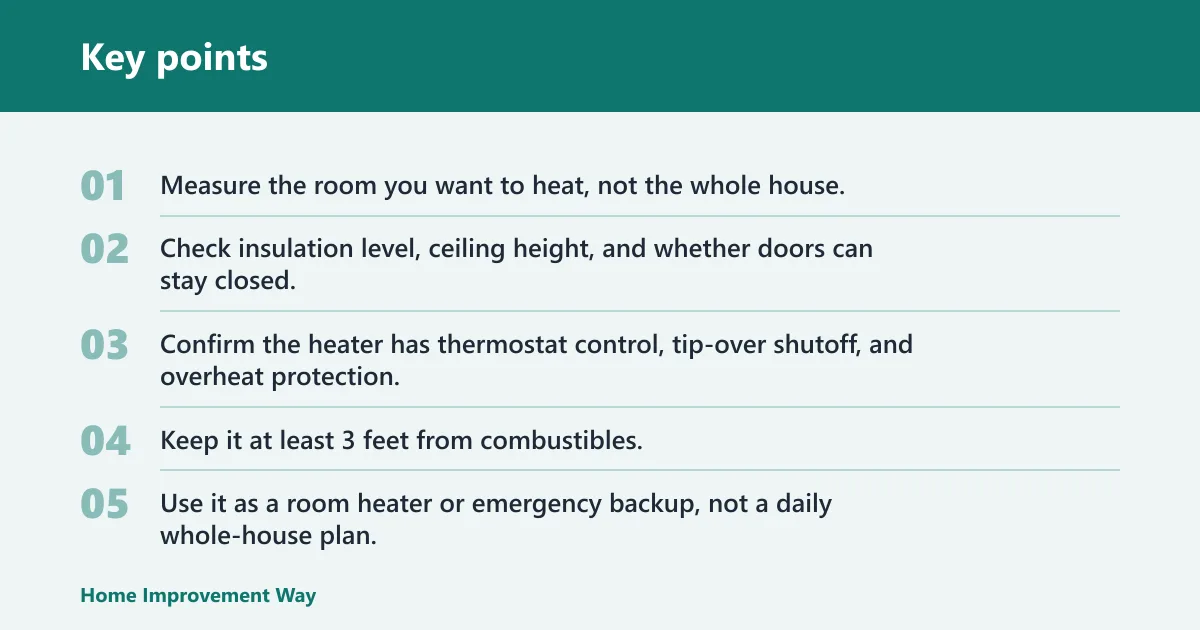
- Measure the room you want to heat, not the whole house.
- Check insulation level, ceiling height, and whether doors can stay closed.
- Confirm the heater has thermostat control, tip-over shutoff, and overheat protection.
- Keep it at least 3 feet from combustibles.
- Use it as a room heater or emergency backup, not a daily whole-house plan.
Frequently asked questions
Can a space heater heat a whole house?
Usually no. A single portable electric heater is built for one room or zone, not a full home. In a tiny, tight space it may help more than expected, but most houses need far more heat than one 1,500-watt unit can provide.
How many space heaters would it take to heat a house?
It depends on square footage, insulation, ceiling height, and layout. A small, closed home might need two or three for specific rooms. A larger or draftier house could need so many that the idea becomes impractical and expensive.
How many watts does a space heater use?
Most plug-in electric space heaters top out at 1,500 watts. That is about 5,100 BTU per hour and about 12.5 amps. Some smaller models use less, but the common maximum for a standard plug-in unit is 1,500 watts.
What size room can a 1,500 watt space heater heat?
It varies by conditions. Around 150 to 250 square feet, while another says up to 150 square feet. A newer tight space may be able to use the full output more effectively, but a drafty older room may be closer to 140 sq ft.
Are space heaters cheaper than running central heat?
Sometimes for one room, yes. For several rooms, often no. A 1,500-watt heater costs about 27 cents an hour at 18 cents per kWh, and about $65 a month at 8 hours a day, though thermostat cycling can change the real-world cost. Multiply that by several heaters and the cost rises fast.
When does a space heater make sense instead of a furnace?
Use one when you need backup heat in a single occupied room, such as during a furnace outage or in a temporary work area. It makes sense for short-term, targeted heating. It does not make sense as a daily replacement for whole-house heating.
Sponsored / affiliate links. As an Amazon Associate I earn from qualifying purchases. I may earn additional commission from eligible campaigns.