Should You Crack a Window When Using a Fireplace?
Yes, cracking a window can help a wood fireplace draft in a tight house by easing negative pressure, but treat it as a test first. This advice is for wood-burning fireplaces, not direct-vent gas fireplaces. If smoke is still spilling into the room or you suspect carbon monoxide is entering the living space, stop using the fireplace immediately and ventilate the room. Bad drafting can fill the room with smoke, soot, and carbon monoxide, and ignoring it can make venting issues worse. This guide explains when a cracked window helps, how to tell draft trouble from blockage, and when chimney service or make-up air is the real fix.
Should you crack a window?
Cracking a nearby window is worth trying when a wood-burning fireplace smokes into a closed-up house at startup. It can supply make-up air right away and help confirm whether negative pressure is part of the problem. If smoke clears quickly, the fireplace may need more replacement air. If it does not, look to the chimney, damper, or blockage instead.
When a nearby window helps right away
A window crack is most useful when the room is tight and exhaust appliances are running. A range hood, bathroom fan, clothes dryer, whole-house fan, or an atmospherically vented furnace or water heater can pull air out of the house and make the fireplace compete for it. In that case, the crack is a fast diagnostic step, not a final fix.
When window cracking is only a temporary test
Use the open window as a short-term safety aid if smoke puffs into the room during lighting and then clears once the chimney warms. That pattern often points to weak startup draft plus limited make-up air. It does not mean you should leave the window open every time without checking for a cold flue, a blocked flue, or a pressure problem.
When to stop relying on it
Stop using window cracking as the main fix if smoke still backs up after 5 to 10 minutes, if the problem repeats on calm days, or if it only happens when you close doors and windows. At that point, the fireplace likely needs chimney cleaning, draft correction, or another air-supply solution discussed during inspection.
Why smoke comes back into the room from my fireplace?
Smoke comes back into the room when the fireplace cannot move air up the chimney fast enough. Common causes include a cold flue at startup, negative pressure in a tight house, or a downdraft from wind. A blocked or narrowed flue can do the same thing. The symptom is the same, but the fix is different.
Cold flue startup and weak draft
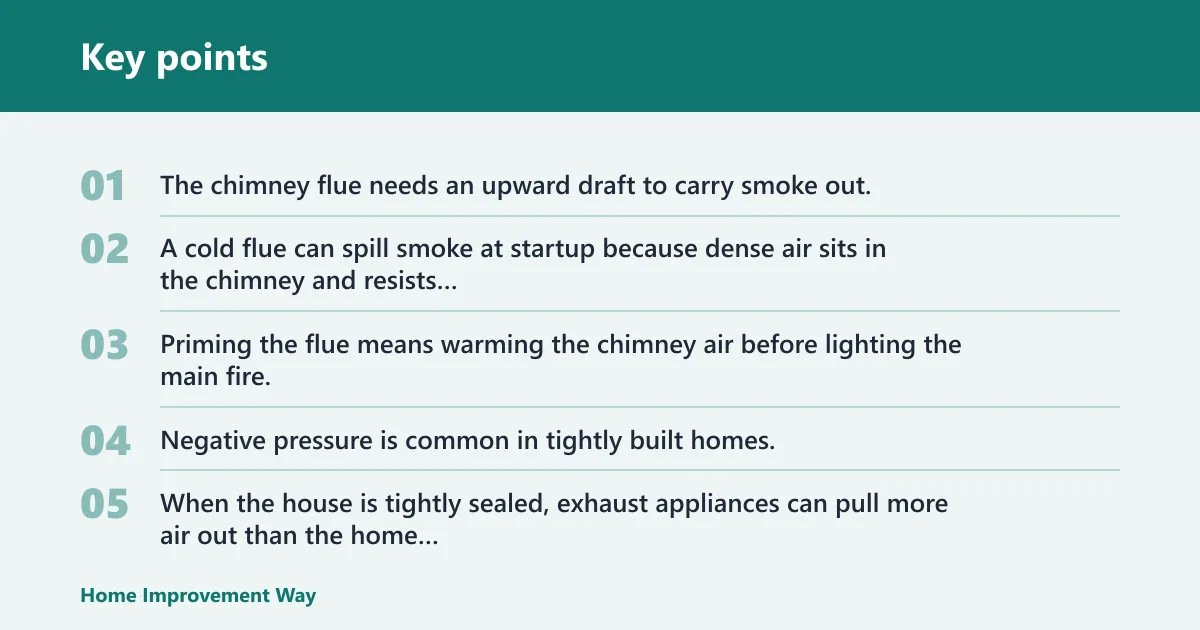
The chimney flue needs an upward draft to carry smoke out. A cold flue can spill smoke at startup because dense air sits in the chimney and resists that upward movement. Priming the flue means warming the chimney air before lighting the main fire, which can help the draft start sooner.
Negative pressure from a tight house
Negative pressure is common in tightly built homes. When the house is tightly sealed, exhaust appliances can pull more air out than the home takes in, so the fireplace loses the air it needs. Smoke then takes the easier path and comes back into the room. Cracking a window may confirm that pressure imbalance.
Wind-driven downdrafts and roofline effects
Wind over the chimney can create a downdraft that pushes smoke back down. This often shows up on gusty days, and roofline interference can make it worse. A cap can help reduce some wind effects, but it cannot cure a blocked flue or a strong house pressure problem.
Open the damper first
The damper should be fully open before you light a wood fire. It is the metal plate in the throat of the fireplace, just above the firebox. A partly open damper can still choke the draft while letting some smoke through, so confirm it is all the way open before you judge anything else.
Where the damper is located
Look in the throat above the firebox. That is where the damper sits in a typical wood fireplace. If it is only partly open, the flue opening is restricted and smoke has less room to move upward. That can make even a small fire smoke badly at startup.
Quick checks before you light the fire
Before lighting, confirm the damper is open, clear the firebox of ash that could interfere with airflow, and make sure no obvious blockage is visible from below. Then shut off nearby exhaust fans. These quick checks remove the most common avoidable causes before you start testing the window or calling for service.
What a cracked window changes
Cracking a window a few inches can provide make-up air in a tight house. That extra air can reduce negative pressure and give the chimney the inlet it needs to send smoke upward. If the smoke clears immediately, the issue is likely air balance. If it does not, the problem is probably elsewhere.
How much to open the window in practical terms
Start with one nearby window cracked a few inches, not a wide-open room. A small opening is enough to test whether replacement air changes the draft. If smoke improves right away, you can open it a bit more during the test. If there is no change after a few minutes, the chimney itself needs attention.
What it means if smoke clears immediately
If smoke clears as soon as the window opens, the fireplace is telling you that the house needs more make-up air. That may be a temporary test result or a sign that the home needs a long-term air source. Do not assume the chimney is fine forever. Pressure can still change when fans, dryers, or weather conditions change.
When a cracked window should not be the long-term answer
A cracked window is a short-term aid, not a permanent operating plan for most homes. If the fireplace depends on it every time, you need a better fix: chimney cleaning or draft correction, and in some homes an air-supply solution discussed during inspection. Otherwise, the same smoke problem will keep returning whenever the house is closed up.
If smoke comes back into the room, do this in order
- Confirm the damper is fully open and seated in the open position.
- Stop nearby exhaust fans, including the range hood, bath fans, whole-house fan, and clothes dryer.
- Crack one nearby window a few inches to provide make-up air.
- Watch whether smoke clears immediately or keeps spilling into the room.
- Check whether the problem happens only on cold startup or only on windy days.
- Look for obvious blockage indicators, such as debris or animal nesting signs.
- Call a chimney sweep if smoke persists, the flue seems restricted, or the problem keeps returning.
Is the problem draft, blockage, or pressure?
You can separate the likely cause by watching when the smoke appears and what changes help. If a cracked window solves it fast, negative pressure is a strong suspect. If the smoke problem stays even with extra air, look harder at the flue, creosote, nests, or liner issues. If it mainly happens on gusty days, wind is likely involved.
| Symptom pattern | Likely cause | What to check next |
|---|---|---|
| Smoke clears when a nearby window is cracked | Negative pressure or limited make-up air | Exhaust fans, tight house conditions, need for dedicated combustion air |
| Smoke spills mainly during the first few minutes | Cold flue startup and weak draft | Priming the flue, damper position, chimney warming |
| Smoke persists even with a cracked window | Blockage or heavy creosote | Full chimney inspection and cleaning |
| Smoke shows up only on windy days | Downdraft or roofline interference | Cap design, chimney height, exterior wind exposure |
| Smoke improves after fans or dryer stop | House pressure imbalance | Balance exhaust use with make-up air |
Symptom patterns that point to negative pressure
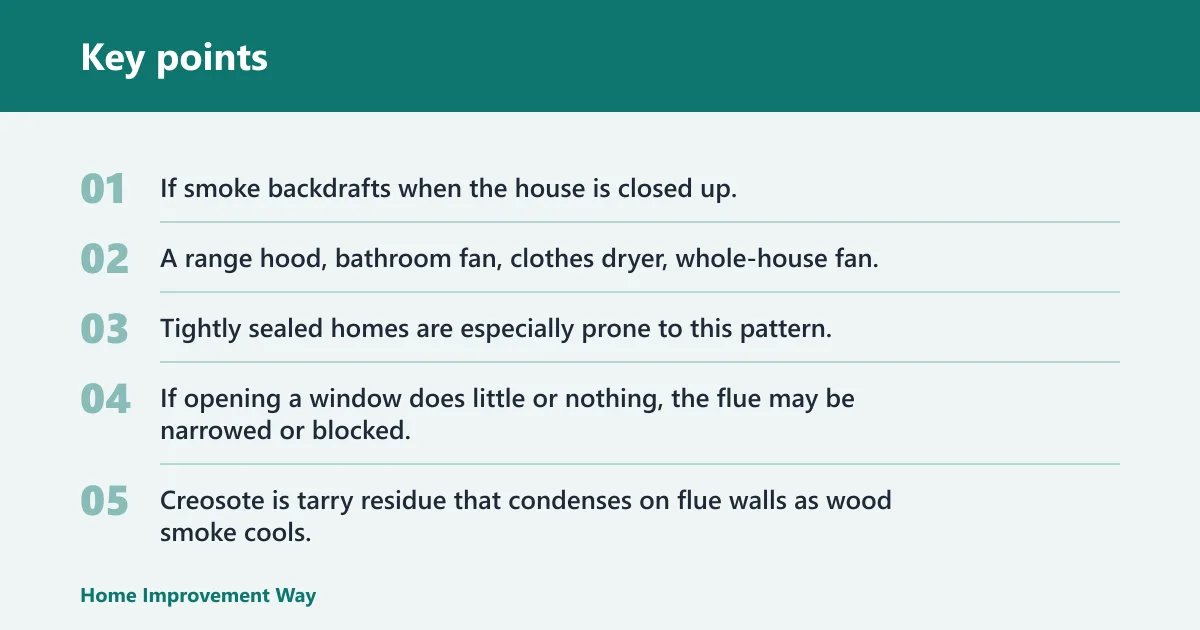
If smoke backdrafts when the house is closed up, and then improves as soon as you open a window a few inches, pressure is probably the issue. A range hood, bathroom fan, clothes dryer, whole-house fan, or an atmospherically vented furnace or water heater can contribute to that imbalance. Tightly sealed homes are especially prone to this pattern.
Symptom patterns that point to blockage or creosote
If opening a window does little or nothing, the flue may be narrowed or blocked. Creosote is tarry residue that condenses on flue walls as wood smoke cools. A heavy glaze of creosote can both shrink the opening and fuel a chimney fire. Leaves, twigs, liner debris, and animal nests can also block the chimney.
When windy days point to downdraft
When the problem appears mostly on gusty days, wind over the chimney is a likely suspect. Roofline interference can steer air across the cap and push smoke back down the flue. A chimney cap helps with rain, debris, and animals, and it can reduce some wind effects, but it will not fix a weak draft by itself.
Say your fireplace lights cleanly on calm evenings but smokes every time a strong northwest wind hits the roofline. That pattern points away from a simple startup issue and toward a downdraft problem. The chimney may need a cap change, a height review, or a sweep to rule out narrowing inside the flue.
When a chimney sweep is the next step
If smoke persists after the damper, fans, and window test have all been checked, a chimney sweep is a sensible next step. Professional sweeping and inspection can clear blockages, remove heavy creosote, and diagnose debris, nests, and liner issues. If the problem keeps repeating, a full-length inspection matters more than another round of guesswork.
Signs of creosote, debris, or nests
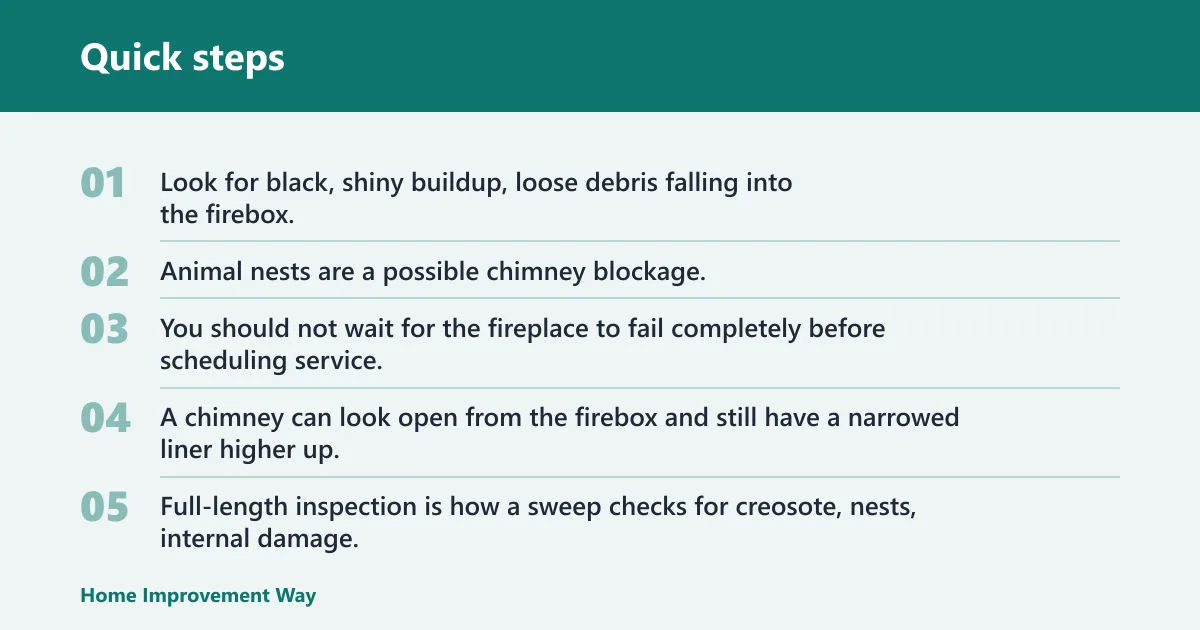
Look for black, shiny buildup, loose debris falling into the firebox, or signs that animals have nested in the flue. Animal nests are a possible chimney blockage, and even a partial obstruction can disturb draft. You should not wait for the fireplace to fail completely before scheduling service.
Why full-length inspection matters
A chimney can look open from the firebox and still have a narrowed liner higher up. Full-length inspection is how a sweep checks for creosote, nests, internal damage, and blockages that are not visible from below. That is also how liner problems get found before they become a larger venting issue.
What a sweep can diagnose beyond cleaning
Cleaning alone is only part of the job. A sweep can identify whether the chimney cap is the wrong style for the site, whether the liner is damaged, or whether the flue opening is too restricted for safe draft. That diagnosis matters when smoke problems continue after the easy fixes.
What to do long term
If the fireplace only works with a cracked window, the long-term fix is usually more than a cracked window. A tighter home may need a broader air-supply solution so the fireplace gets steady make-up air. If the chimney is dirty, blocked, or misbehaving in wind, service or draft correction comes first.
Make-up air and tighter homes
Modern homes can be tight enough that combustion appliances struggle to get replacement air. In that case, a dedicated combustion-air source or another air-supply solution may be discussed during the chimney inspection, but existing masonry fireplaces do not always accept a simple outside-air retrofit. It gives the fireplace the air it needs without depending on weather or whether someone remembers to open a window.
Cap and draft fixes that can help
A well-designed chimney cap can help keep rain, debris, and animals out, and it may reduce some crosswind problems. But it does not fix a blocked flue, heavy creosote, or strong negative pressure. If the chimney still smokes after cleaning and air testing, draft correction may be needed at the chimney or roofline.
When to add a dedicated combustion-air source
If the fireplace consistently smokes only when the home is closed up, or only when exhaust appliances run, a dedicated combustion-air source is worth discussing during the chimney inspection. That is especially true when the window test works every time but the problem returns as soon as the window closes. At that point, the house needs a lasting air path.
Picture a small living room with a tight envelope, a running bath fan, and a wood fire that puffs smoke whenever the door to the hall is shut. Opening a nearby window makes the smoke stop in seconds. That points to make-up air, not a mysterious fireplace defect.
Frequently asked questions
Should you crack a window when using a fireplace?
Cracking a window can help a wood fireplace in a tight house by giving it make-up air, but use it as a test first. If smoke still spills after 5 to 10 minutes, the real issue is more likely a cold flue, negative pressure, or blockage than a lack of fresh air alone.
How much should I open a window when using a fireplace?
Open one nearby window a few inches to start. That is enough to test whether added make-up air changes the draft. If smoke clears immediately, the house likely needs more replacement air. If there is no change, stop using the window as the main fix and check the chimney.
What causes negative pressure in a house with a fireplace?
Negative pressure happens when the house exhausts more air than it brings in. Range hoods, bathroom fans, clothes dryers, whole-house fans, and atmospherically vented furnaces or water heaters can all contribute. Tight homes are more likely to show the problem because there is less natural leakage to replace the lost air.
How do I know if the chimney is blocked or the house is under negative pressure?
If a cracked window clears the smoke quickly, pressure is the leading suspect. If the smoke keeps backing up even with a window open, look for creosote, debris, nests, or liner problems. Windy-day smoke points toward downdraft, while repeated startup smoke points toward a cold flue.
Will opening a window help fireplace smoke?
Yes, if the problem is make-up air or negative pressure. Opening a window a few inches can let the chimney draft start moving in the right direction. It will not fix a blocked flue, heavy creosote, or a strong downdraft, so treat the result as a clue, not a cure.
What if smoke comes back into the room only on windy days?
That pattern often points to downdraft from wind or roofline interference. A chimney cap can help reduce some wind-driven problems and keep rain, debris, and animals out, but it cannot overcome a blocked flue or a severe pressure issue. A chimney sweep can check the cap, flue, and liner together.
Sponsored / affiliate links. As an Amazon Associate I earn from qualifying purchases. I may earn additional commission from eligible campaigns.