At What Temperature Does a Heat Pump Stop Working?
A heat pump does not have one fixed stop temperature; many air-source models can keep heating below 0°F, though output can drop as outdoor temperatures fall and auxiliary heat may take over. The U.S. Department of Energy notes that modern cold-climate heat pumps can work efficiently in very low temperatures, while ENERGY STAR says many cold-climate models are designed to keep delivering heat in subfreezing weather. DOE Energy Saver and ENERGY STAR heat pumps support the core point: the question is usually not whether the system can run, but whether it can still meet the home’s load. This guide explains the line between failure and capacity loss, and when backup heat makes sense by climate and system type.
Heat pumps still run but lose efficiency in cold
A heat pump usually does not stop at one exact outdoor temperature. The real question is whether the unit can still deliver enough heat for the house. The Department of Energy explains that air-source heat pumps transfer heat from outdoor air and can keep working in cold weather, while performance depends on the model and conditions. DOE Energy Saver Many modern systems keep heating below freezing, and some can still heat below 0°F, but output falls as the outdoor temperature drops. In cold-climate product listings, ENERGY STAR recognizes models designed for low-ambient performance, with efficiency and capacity tracked separately from simple on/off operation. ENERGY STAR heat pumps
What “stop working” usually means in practice
Homeowners often use “stop working” to mean “the house is getting cold.” That is different from a true mechanical failure. A system can run, defrost normally, and still fall behind the home’s heat loss on a cold, windy day.
True failure is a different problem: the outdoor unit will not start, the indoor air handler does not move air, the breaker trips, or the system blows cool air because of a fault. Capacity loss is more common than a hard shutdown.
Why capacity loss matters more than a hard stop
Air-source heat pumps move heat instead of creating it. As outdoor temperature falls, there is less heat to move, so efficiency drops. That is why a unit may still be operating but no longer keep up without backup heat.
HSPF2 is the heating-season performance factor used to compare heat pumps; it measures seasonal heating efficiency, not the amount of heat the equipment can deliver at a single outdoor temperature. Higher HSPF2 generally points to better seasonal efficiency, though installation, controls, and maintenance still matter. ENERGY STAR heat pumps
Why heat pumps struggle in cold weather
Cold weather does not automatically mean failure. It means the unit has less heat to collect outside, and the compressor has to work harder to move it indoors. DOE says modern cold-climate models are designed to maintain useful heating at lower outdoor temperatures than older equipment, but the exact performance curve depends on the system. DOE Energy Saver
What changes around 32°F
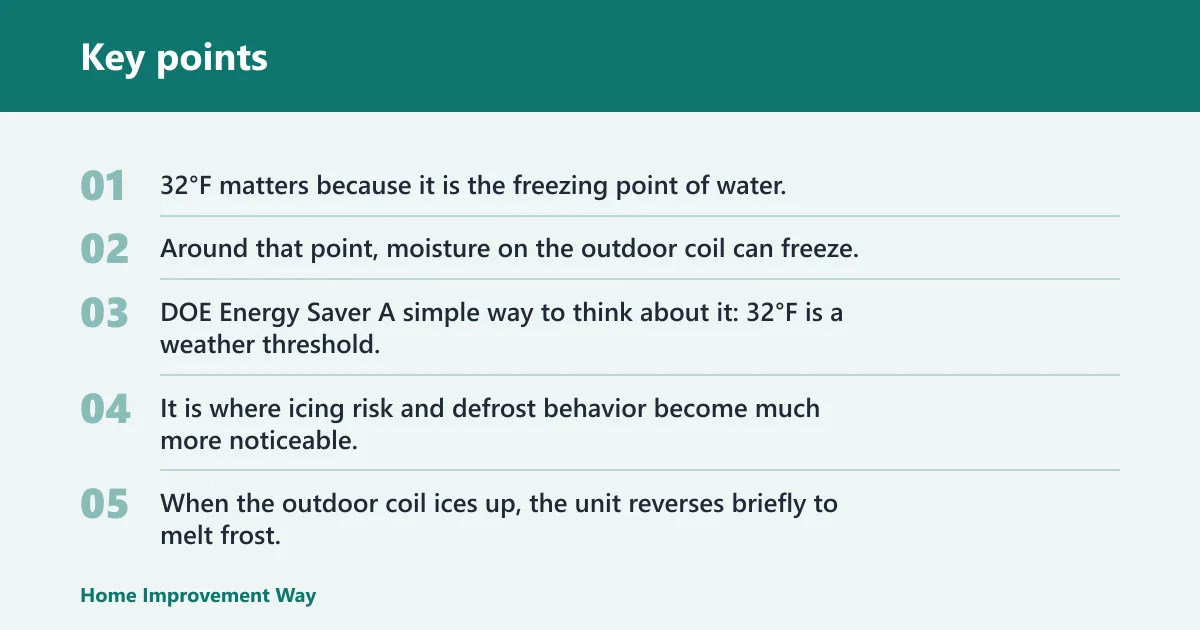
32°F matters because it is the freezing point of water. Around that point, moisture on the outdoor coil can freeze, and defrost cycles become more frequent; DOE notes that air-source heat pumps may need defrosting in cold, humid conditions, which temporarily reduces delivered heat. DOE Energy Saver
A simple way to think about it: 32°F is a weather threshold, not a shutdown threshold. It is where icing risk and defrost behavior become much more noticeable, and where a system that seems weak may simply be clearing frost.
How icing and defrost cycles affect output
When the outdoor coil ices up, the unit reverses briefly to melt frost. During that cycle, it is not adding heat to the home the normal way. Short, repeated defrost cycles can make a pump feel underpowered long before it has actually failed.
Wind can make this worse by stripping heat from the outdoor unit and adding frost load. Dirty coils, blocked airflow, and poor refrigerant charge can also reduce output. Those are service issues, not reasons to assume the temperature has crossed a universal cutoff.
At what temperature heat decision table
This table gives a practical decision point, not a fixed shutdown temperature. A standard heat pump may still run in every band listed here, but the house may need more backup heat as the temperature falls.
| Outdoor temperature band | What a typical standard heat pump is likely doing | Homeowner action to take |
|---|---|---|
| 32°F to 20°F | Usually still heating, but capacity and efficiency are starting to fall; defrost cycles may appear more often. | Keep the thermostat steady. Check filters, supply registers, and the outdoor unit for snow or ice. |
| 20°F to 5°F | Output often starts to lag the heating load in standard systems, especially in older or smaller units. | Watch for longer run times, cooler supply air, or indoor temperature drift. Be ready to call for backup heat if the home cannot recover. |
| 5°F to 0°F | Many standard units are near their practical limit; some can still heat, but auxiliary heat is more likely to take over. | Use backup heat if the home falls behind. If the system struggles badly, schedule service before assuming the compressor has failed. |
| Below 0°F | Performance varies sharply by model. Some modern units still heat, while many traditional systems lose enough capacity that backup heat does most of the work. | Expect a bigger split by system type. Cold-climate equipment may still perform well; standard units may need dual-fuel or electric backup. |
Say your 2,000-square-foot home has a standard air-source heat pump and the outdoor temperature drops from 28°F to 10°F overnight. If the thermostat holds steady at 70°F and the unit runs longer, that is normal capacity loss. If the indoor temperature keeps sliding, auxiliary heat should step in.
Heat pump types compared
Different systems handle cold weather differently. The temperature at which one house needs backup heat may be far lower than another house with a different unit, duct system, or fuel setup.
| System type | Cold-weather behavior | Best use case |
|---|---|---|
| Standard heat pump | Can heat below freezing, but efficiency drops as outdoor temperature falls. Many traditional systems lose much of their useful output near 0°F. | Mild and moderate winters, or homes with reliable backup heat. |
| Cold-climate heat pump | Designed for low ambient temperatures. DOE and ENERGY STAR identify cold-climate units as models built to maintain useful heating at much lower outdoor temperatures than standard systems; on certain models, manufacturers may rate full heating capacity down to 5°F, but capacity and efficiency still need to be read separately. DOE Energy Saver ENERGY STAR heat pumps | Cold-winter regions where low-temperature heating matters for most of the season. |
| Dual-fuel system | Uses the heat pump when conditions are favorable, then switches to a gas furnace when heat pump efficiency declines. | Very cold climates, or homes that already have gas service and want a clear backup plan. |
Why variable-speed compressors matter
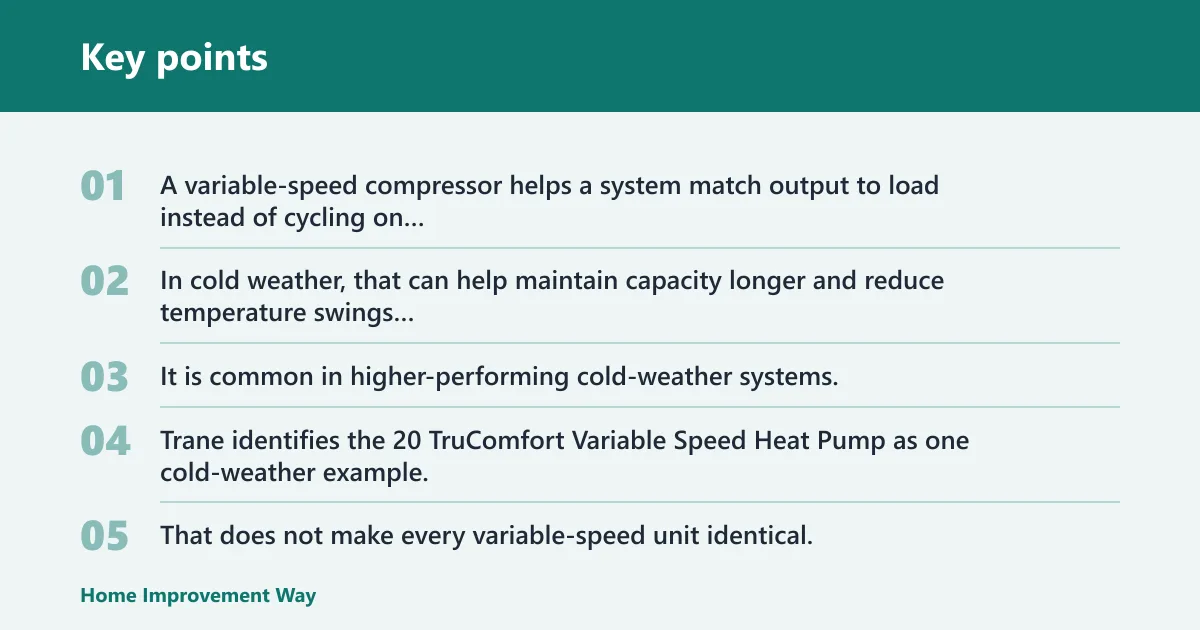
A variable-speed compressor helps a system match output to load instead of cycling on and off at one speed. In cold weather, that can help maintain capacity longer and reduce temperature swings inside the home. It is common in higher-performing cold-weather systems.
Trane identifies the 20 TruComfort Variable Speed Heat Pump as one cold-weather example, and says that model can heat at temperatures as low as 5°F. That does not make every variable-speed unit identical, but it shows the direction of better cold-weather design.
What cold-climate heat pumps change
Cold-climate heat pumps are built for low ambient temperatures. DOE says these systems are designed to deliver efficient heating at low outdoor temperatures, and many are certified or rated specifically for cold climates rather than generic winter use. DOE Energy Saver Some are specified to hold strong performance much lower than standard units, and some can provide 100% of rated heating capacity at very low temperatures on certain models. Trane says that level can extend down to 5°F on certain models.
That is why a cold-climate unit can be a better fit in harsh winters. It does not remove the need for backup heat in every case, but it shifts the practical cutoff lower than a standard system.
When should you use emergency heat?
Emergency heat is backup heating mode for a heat pump system. It bypasses the outdoor heat pump section and relies on the backup heat source instead. It is useful when the outdoor unit is struggling or has failed, but it should not be your normal operating mode. DOE describes emergency/auxiliary heat as a temporary backup function for situations when the heat pump cannot keep up or is out of service. DOE Energy Saver
What emergency heat does
On many systems, emergency heat means electric resistance strips or another backup heat source is doing the work. That can keep the house warm, but it is usually more expensive to run than the heat pump itself. Use it for backup, not as a default setting.
When it makes sense to switch it
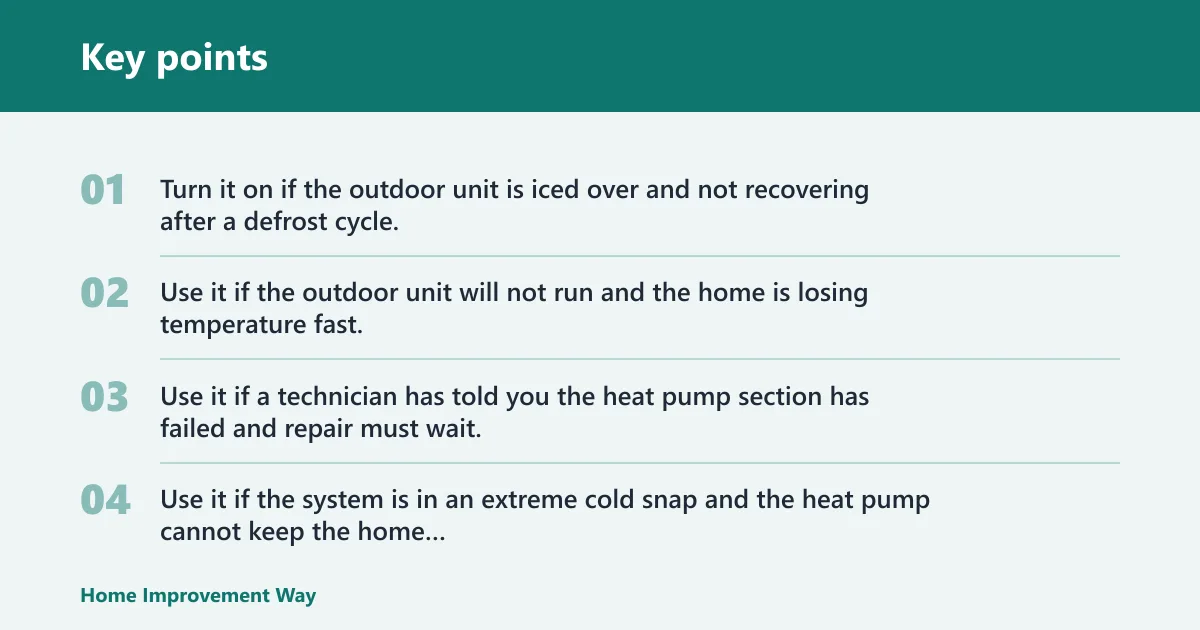
- Turn it on if the outdoor unit is iced over and not recovering after a defrost cycle.
- Use it if the outdoor unit will not run and the home is losing temperature fast.
- Use it if a technician has told you the heat pump section has failed and repair must wait.
- Use it if the system is in an extreme cold snap and the heat pump cannot keep the home warm enough on its own.
When to call for service instead
If the unit is blowing cool air, tripping a breaker, making grinding noises, or icing up repeatedly, emergency heat is only a temporary fix. Those symptoms point to a problem that needs service. Do not assume the weather alone explains a complete loss of heating.
Suppose a cold-climate system in a northern climate is set for 70°F indoors, but the house keeps drifting to 66°F while the outdoor temperature sits at 2°F. If the unit runs steadily and defrosts, it may simply be at its limit. If the outdoor fan stops or the breaker trips, that is service territory.
Heat pump performance by climate
Your climate should guide the system choice. The same heat pump that works well in a mild winter may need constant backup heat in a subzero region. That does not mean the equipment is defective; it means the match to the climate is off.
Mild-winter climates
In places that spend much of the winter above freezing, a standard air-source heat pump often works well. Many homeowners will rarely need backup heat except during an unusual cold snap.
Cold-winter climates
In colder regions, a cold-climate heat pump is often the better fit. Modern heat pumps can keep heating even in very cold climates, and Minnesota field testing showed winter heat pumps reduced energy use by 35% to 50%. That result is consistent with utility and laboratory-backed cold-climate work showing meaningful winter savings when the equipment is sized and applied correctly. NREL Minnesota cold-climate heat pump field study
Subzero climates
Below 0°F, the split between systems becomes more important. SBPHA/C says newer heat pumps are effective down to 0°F, and DOE notes that cold-climate systems can continue providing heat below freezing and, on some models, well below 0°F. Even so, many homes in subzero climates benefit from dual-fuel or other backup heat so the heat pump does not have to do all the work. DOE Energy Saver
The same source says most traditional heat pumps won’t operate much below 0°F. That is one reason the 0°F benchmark appears so often in homeowner advice. It is not a universal cutoff, but it is a practical line for deciding when backup heat becomes much more likely.
Switchover logic by system type and climate band
This table adds a practical rule set for when to rely on the heat pump, when to allow auxiliary heat, and when to consider a different system design. It is a decision aid, not a manufacturer limit chart.
| System type | Mild winter above 32°F | Cold winter 32°F to 0°F | Subzero below 0°F |
|---|---|---|---|
| Standard air-source heat pump | Usually heat pump only; auxiliary heat should be rare. | Heat pump first, auxiliary heat when the house falls behind. | Expect frequent auxiliary heat and possible comfort loss; service if performance is sharply worse than normal. |
| Cold-climate heat pump | Heat pump only in most cases. | Heat pump should carry a larger share of the load; auxiliary heat should be intermittent. | May still heat effectively, but backup heat can become important during the coldest hours or biggest loads. |
| Dual-fuel system | Heat pump usually handles the load by itself. | Switch point depends on controls, fuel prices, and design temperature. | Furnace usually carries the load while the heat pump may be locked out or used only when conditions improve. |
Quick checklist: normal operation, defrost, undersizing, or fault?
Use this checklist when the house feels colder than expected. The goal is to separate ordinary cold-weather behavior from a real problem.
- Probably normal cold-weather operation: the system runs longer, supply air feels less warm than usual, and the indoor temperature still holds steady.
- Likely defrost behavior: the outdoor unit stops heating briefly, then resumes, especially in damp or icy weather.
- Possible undersizing: the heat pump runs nearly nonstop, backup heat comes on often, and the house cannot recover after a temperature setback.
- Likely fault: the breaker trips, the outdoor fan will not run, the unit makes unusual noises, or ice keeps returning after defrost.
Frequently asked questions
What temperature does a heat pump stop working?
There is no single temperature where every heat pump stops. Many modern units can still heat below 0°F, but a standard system may lose enough capacity that it no longer keeps up with the house. The real threshold is when output falls below the home’s heating load. DOE and ENERGY STAR both emphasize that cold-climate performance depends on the model and the match to the house. DOE Energy Saver ENERGY STAR heat pumps
What temperature will a heat pump not work?
That depends on the model, maintenance, and climate. Many traditional units lose efficiency below freezing, and some won’t operate much below 0°F, while cold-climate models can keep heating lower than that. A heat pump may still run even when it can no longer heat the home well.
Why do heat pumps not work in cold weather?
They do work in cold weather, but they work less efficiently as outdoor temperatures drop. Around 32°F, icing and defrost cycles become more common, and the unit has less outside heat to move indoors. That is why capacity, not just operation, becomes the issue.
At what temperature does a heat pump stop working in Celsius?
There is no fixed Celsius cutoff either. As a rough guide, 0°F is about -18°C, and 32°F is 0°C. Standard systems may need backup heat as temperatures fall below freezing, while cold-climate models can keep heating well below that depending on design.
When should I use emergency heat on a heat pump?
Use emergency heat when the outdoor unit is failing, iced over, or unable to keep the house warm enough during severe cold. It is backup heat, not normal heat-pump operation. If you need it often, the system may be undersized, poorly maintained, or not suited to your climate.
Should I use a furnace instead of a heat pump in extreme cold?
In extreme cold, a furnace can make sense as backup or in a dual-fuel setup, especially if your climate regularly dips below 0°F. That does not mean a heat pump is wrong for the job. It means the system should fit the winter design temperature and the home’s load.
Sponsored / affiliate links. As an Amazon Associate I earn from qualifying purchases. I may earn additional commission from eligible campaigns.