Why Is My Heat Pump Covered in Ice?
Ice on a heat pump can mean the unit is not defrosting, airflow is blocked, or the refrigerant charge is wrong; if the ice returns within about 30 to 60 minutes after defrost, call for service. Letting it continue can drive power use higher, strain the compressor, and leave the home without heat. This guide shows how the ice pattern, refreeze timing, and defrost behavior point to the most likely fault.
What the ice pattern means
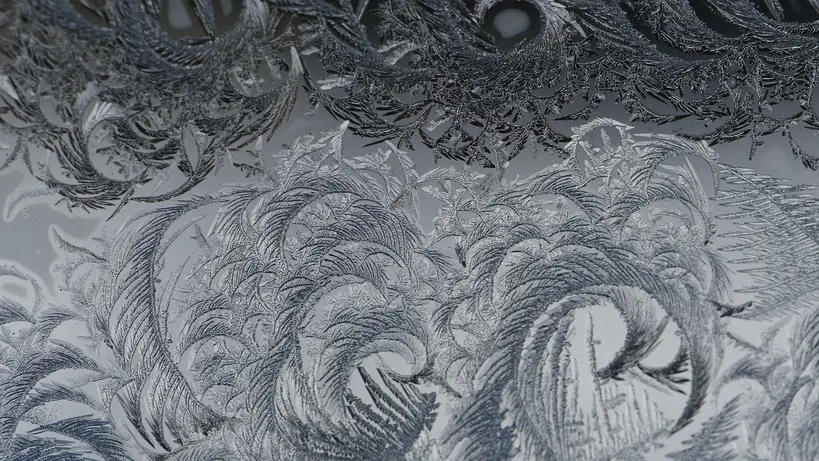


The location of the ice tells you more than the fact that it is there. A thin coating of frost can be normal on a cold morning, but thick ice, coil-wide ice, or refreezing at the base points to trouble. Start by asking where the frost forms, how fast it returns, and whether the unit can clear itself.
Frost on the coil versus ice on the cabinet base
Frost on the outdoor evaporator coil is common in heating mode because the coil is pulling heat from cold outdoor air. When temperatures are low and humidity is high, frost can form faster. If that frost turns into a heavy blanket or spreads across the whole coil, airflow and heat transfer drop, and the unit needs attention.
Ice on the cabinet base points to a different set of problems. It can come from defrost water that does not drain away, meltwater that refreezes, or ice that falls from the coil and builds up below. Base refreeze is often a sign that the unit is trying to defrost but is not clearing water properly.
Top-side icing, fan grille icing, and coil-wide freeze-up
Ice on the top edge or fan grille often means snow, debris, or a blocked fan path is part of the problem. Ice at the grille can also point to an outdoor fan motor issue if the fan is not moving as it should. Coil-wide freeze-up is more serious because it usually means the unit cannot move enough air across the coil or cannot defrost on schedule.
Suppose the coil has a light frost line after a cold, damp night, but the unit clears it in the next defrost cycle. That can be normal. Suppose the same unit comes back with a thick white shell over the coil an hour later. That pattern is not normal and needs service.
What repeated refreezing after defrost usually suggests
If the unit defrosts and then about 30 to 60 minutes later it is iced over again, the problem is usually not just one isolated patch of frost. Repeated refreezing after defrost often points to a failed defrost control board, bad sensors, low refrigerant, or airflow restriction that is still present. The return time matters because fast refreeze is a warning sign, not a cosmetic issue.
Heat pump ice matrix
This matrix gives a fast read on what to check first, how urgent the issue is, and when you should stop DIY. It uses the ice pattern itself to narrow the likely fault before you call for service.
| Ice pattern | Most likely cause | Immediate homeowner check | Urgency level | When to stop DIY |
|---|---|---|---|---|
| Light frost on the coil | Normal frost in cold, damp weather | Watch for a defrost cycle, listen for brief sound changes, check that water drains | Watchful | Stop if frost turns to thick ice or returns within 30 to 60 minutes |
| Coil-wide ice | Blocked airflow, low refrigerant, or failed defrost control | Check filter, snow, leaves, and outdoor clearance | Urgent | Stop if the coil is hard-frozen or the home is losing heat |
| Base refreeze | Drainage problem or incomplete defrost | Look for standing water, packed snow, or ice under the unit | Urgent | Stop if ice returns after every defrost or water cannot drain |
| Fan grille icing | Debris, snow blockage, or outdoor fan motor trouble | Check for leaves, ice, or anything touching the fan area | Urgent | Stop if you hear grinding, scraping, or repeated clicking |
| Repeated icing after defrost | Defrost board, sensor, refrigerant, or reversing valve fault | Confirm the unit actually enters defrost and clears water | High | Stop; this usually needs licensed HVAC diagnosis |
Is it normal frost or a freeze-up?
A healthy heat pump should periodically enter a defrost cycle, and that cycle should melt outdoor frost automatically. A normal cycle can show steam and water draining, and the outdoor fan should stop during defrost. The cycle often lasts 5–15 minutes. Thick ice, no melting, or rapid refreeze is the line where normal ends.
How a healthy defrost cycle looks and sounds
During defrost, the unit may change sound as the fan stops and the system shifts. Steam can rise from the outdoor coil as ice melts. That can look dramatic, but it is expected. What matters is whether the frost clears and the water drains away instead of freezing again on the cabinet or coil.
Picture a unit that runs in 28°F weather with damp air. A light frost forms overnight, the fan stops, steam rises for a few minutes, and water drips away. That is a normal pattern. If the same unit stays encased in ice after the cycle ends, the defrost process is not doing its job.
When steam is normal and when it is not
Steam during defrost is usually normal because ice is melting on a cold surface. Heavy vapor by itself is not the problem. The warning sign is steam with no real thaw, or steam followed by a fresh layer of ice in a short time. That often means the system is not detecting or clearing the frost correctly.
How long to wait before you call it stuck
A normal defrost cycle lasts 5–15 minutes. If the unit sits iced over much longer than that without melting, or if it never seems to enter defrost at all, treat it as a fault. One or two cold mornings are not enough to call failure, but repeated stuck cycles are.
Why isn’t my heat pump defrosting?
When a heat pump keeps icing up, the defrost system is one of the first places to look. Faulty sensors can stop the unit from detecting ice buildup, and a defrost control board can prevent defrost cycles from starting. Low refrigerant can also cause ice in unusual patterns, and reversing valve trouble can block normal mode changes.
Defrost control board or sensor failure
The control board decides when defrost starts and stops. If it fails, the unit may stay in heating mode while the coil keeps icing. Faulty sensors can give the board the wrong signal, so the system never sees the frost problem. Testing these parts usually requires HVAC tools and is not a homeowner repair.
Reversing valve problems that can block defrost
The reversing valve switches the system between heating and cooling. If it sticks or fails, the heat pump may not shift properly for defrost. That can leave the outdoor coil frozen even when the rest of the unit seems to run. This is typically a professional repair, not a DIY fix.
Low refrigerant or a leak that changes system pressure
Low refrigerant can cause ice in unusual patterns, often with a coil that frosts unevenly or freezes more than expected. A leak is not solved by clearing ice. It needs licensed HVAC diagnosis because the system pressure problem can keep returning and can damage the compressor if ignored.
What should you check first?
Start with the checks that are safe and likely to matter: snow, debris, filter condition, and outdoor clearance. These simple issues can worsen freezing by restricting airflow. If the unit still keeps icing after those checks, stop there and move to service rather than opening panels or trying to force a thaw.
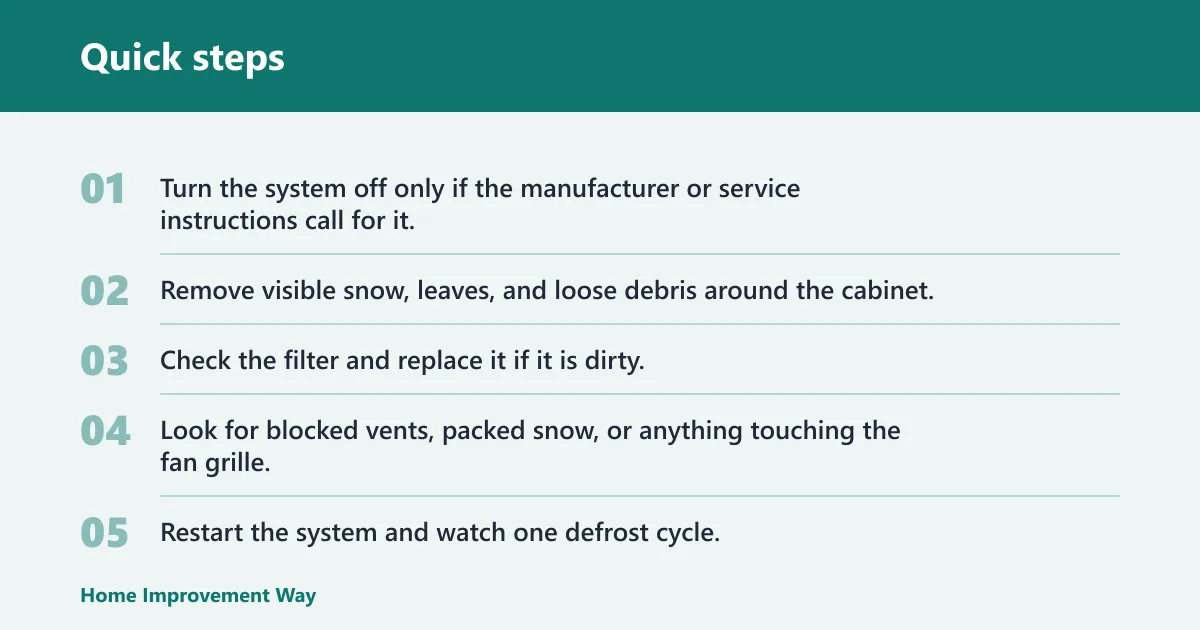
Clear snow, leaves, and other debris from the unit
Blocked airflow from dirty filters or debris can worsen freezing. Clear snow, leaves, mulch, and windblown trash from around the cabinet. Make sure the top and sides have the clearance the manufacturer calls for. Do not pack snow against the unit, even if the area around it is wet or slushy.
Check the air filter and return airflow indoors
A clogged filter can reduce airflow through the system and make icing worse outside. Check whether the indoor return is blocked by furniture, rugs, or closed vents. Weak indoor airflow can go hand in hand with a coil that freezes faster than it should.
Look for blocked fan movement or unusual noise
The outdoor fan should stop during defrost, but outside of defrost it should move without scraping, grinding, or clicking. If you hear a metal-on-metal sound, stop the unit and call for service. A damaged fan motor or something caught in the blades can make the icing problem worse.
Confirm the outdoor unit has proper clearance
Windblown debris and snow can collect against the cabinet if the unit sits too close to a wall, fence, or hedge. That matters even more in cold, damp weather. Near-freezing temperatures and humidity can trigger icing, so the unit needs open space to breathe and to shed meltwater.
- Turn the system off only if the manufacturer or service instructions call for it.
- Remove visible snow, leaves, and loose debris around the cabinet.
- Check the filter and replace it if it is dirty.
- Look for blocked vents, packed snow, or anything touching the fan grille.
- Restart the system and watch one defrost cycle.
- Stop DIY if the ice returns fast, the unit sounds wrong, or heat output drops.
When should you use backup heat?
Auxiliary heat or emergency heat can keep the home comfortable while service is arranged. Use it only per the equipment instructions. It is a temporary comfort measure, not a fix for a frozen outdoor unit. If the heat pump cannot keep up, backup heat may prevent cold indoor conditions while you wait.
When auxiliary heat can keep the home comfortable
Auxiliary heat can help during severe icing or when the outdoor unit is off for service. It is useful if indoor temperature is falling and the heat pump is not delivering warm air. It should not be used as a long-term substitute for a heat pump that is repeatedly freezing.
When emergency heat is the safer short-term choice
Emergency heat is the right temporary choice when the outdoor unit is iced over and the system is not heating well. It may be safer to use that setting than to keep running a unit that is already straining. Check the equipment instructions so you know when and how to use it correctly.
What not to expect from backup heat alone
Backup heat will not clear ice from the outdoor coil or solve a defrost fault. It can keep the house livable, but the underlying issue still needs diagnosis. If you rely on auxiliary heat while the outdoor unit keeps icing, service should be scheduled quickly.
When to call for service
Call an HVAC technician if the ice returns soon after a defrost cycle, the unit blows cool air, or it stops heating well. Grinding, scraping, repeated clicking, or no defrost at all are also strong warning signs. Suspected refrigerant leaks and electrical faults should stop DIY immediately.
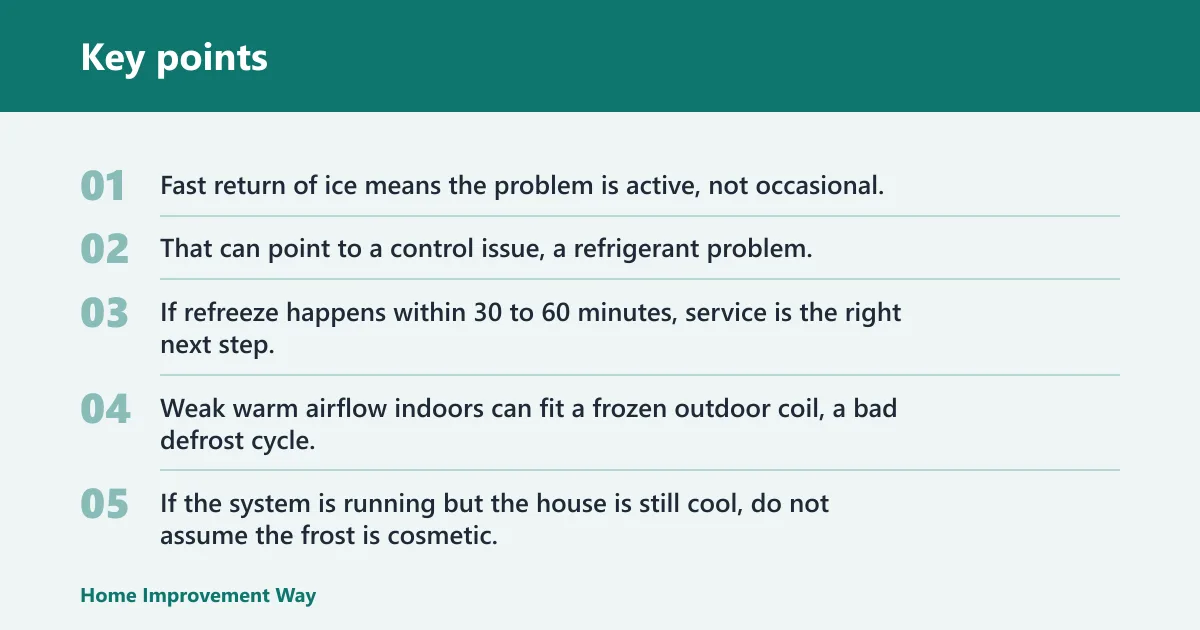
Ice returns soon after a defrost cycle
Fast return of ice means the problem is active, not occasional. That can point to a control issue, a refrigerant problem, or poor airflow that keeps forcing the coil below safe operating conditions. If refreeze happens within 30 to 60 minutes, service is the right next step.
The unit blows cool air or stops heating well
Weak warm airflow indoors can fit a frozen outdoor coil, a bad defrost cycle, or low refrigerant. If the system is running but the house is still cool, do not assume the frost is cosmetic. That symptom means the heat pump is not transferring heat the way it should.
You hear grinding, scraping, or repeated clicking
Noise changes matter. Grinding or scraping can mean the fan is obstructed or the motor is failing. Repeated clicking can mean a control problem or electrical issue. Those sounds are not part of normal frost and should stop the DIY process.
You suspect a refrigerant leak or electrical fault
Low refrigerant can cause ice in unusual patterns, but finding and fixing a leak is not a homeowner task. Electrical faults around the defrost board, sensors, or fan motor also need a pro. These are not problems to chase with panel removal or improvised thawing.
Frequently asked questions
Why is my heat pump covered in ice?
Ice usually means the unit is not defrosting correctly, airflow is restricted, or the refrigerant charge is off. A thin coating of frost can be normal in cold, damp weather, but thick ice or fast refreeze is a warning sign that needs a closer look.
Why is my heat pump covered in frost?
Frost forms when the outdoor coil gets cold enough to pull moisture out of the air. That can happen in heating mode, especially near freezing with high humidity. The key question is whether the frost clears in a normal defrost cycle or keeps building into ice.
Is my heat pump frozen or just frosty?
Light, even frost can be normal. Thick ice more than 1/4 inch, coil-wide freeze-up, or ice that returns soon after defrost points to a fault. If the fan stops during defrost and water drains, that is a good sign. If not, call for service.
Why isn’t my heat pump defrosting: a failed defrost control board
A failed defrost control board, faulty sensor, refrigerant issue, or reversing valve problem can stop defrost from working. A blocked fan path or dirty filter can make the icing worse, too. If the unit does not clear ice in about 5 to 15 minutes, it likely needs diagnosis.
What should I do if my heat pump is covered in ice?
Clear snow and debris, check the filter, and look for blocked fan movement. Then watch whether the unit enters defrost, makes steam, and drains water. If ice returns within 30 to 60 minutes, or the system loses heat, stop DIY and arrange service.
Why does my heat pump have ice on it?
Cold, damp weather can cause frost, but ice that builds up on the coil, base, or fan grille usually points to a system problem. The most common patterns are airflow restriction, defrost trouble, or low refrigerant. The location of the ice usually tells you which one to suspect first.
Sponsored / affiliate links. As an Amazon Associate I earn from qualifying purchases. I may earn additional commission from eligible campaigns.
 Faryuan Bladeless Fan, 25inch Heating & Cooling & Filter Combo Tower Fan 80° Oscillating with Remote, 9H Timer, 8 Speeds, Portable Quiet for Indoor, Bedroom, Home Office Room(Grey & Red)
 Faryuan Bladeless Heater Fan, 25inch Heating & Cooling & Filter Combo Tower Fan 80° Oscillating with Remote, 9H Timer, 8 Speeds, Portable Quiet for Indoor, Bedroom, Home Office Room, White&Sliver