Why Is My High-Efficiency Furnace Leaking Water?
A high-efficiency furnace often leaks water from normal condensate drainage, but a puddle that grows, appears near the cabinet, or shows during heat calls usually points to a clogged drain, failed trap, condensate pump issue, or cracked component. Ignoring it can stop the furnace, soak flooring, and lead to corrosion or mold. This guide shows how to trace the leak by path, operating mode, and part behavior so you can tell normal condensation from a real failure.
This guide is part of our Furnace Troubleshooting: Fix Common Winter Heating Problems series.
Normal condensate versus abnormal water leaks
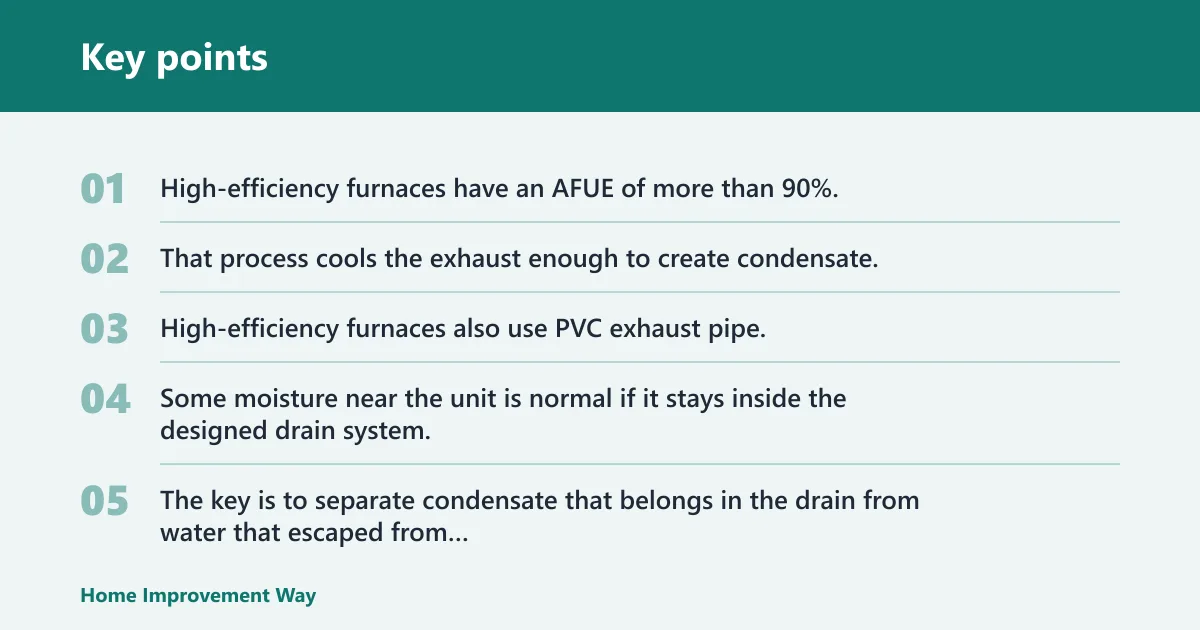


High-efficiency furnaces have an AFUE of more than 90%, and that efficiency comes from extracting extra heat from combustion gases. That process cools the exhaust enough to create condensate, which the unit sends away through a drain path. High-efficiency furnaces also use PVC exhaust pipe, so water can appear in the vent path if pitch, joints, or routing are wrong.
Some moisture near the unit is normal if it stays inside the designed drain system. Water on the floor is not. The key is to separate condensate that belongs in the drain from water that escaped from the exhaust pipe, condensate drain line, condensate pump, humidifier, or a shared drain with the evaporator coil.
What water is normal and what is not
Normal operation can produce condensate that moves through a specifically designed drain pipe. A leak becomes a problem when water shows up under the cabinet, at the vent pipe, around drain tubing, or anywhere it can pool on the floor. A gurgling sound can also point to a blocked condensate drain line.
Leak troubleshooting matrix
| Symptom | Likely source | What to inspect | Urgency | Homeowner-safe next step | Call now red flags |
|---|---|---|---|---|---|
| Leak only during heating | Condensate drain line, vent path, humidifier, heat exchanger | Water at the exhaust pipe, loose drain tubing, humidifier feed, puddle under the cabinet | Moderate to high | Turn off the thermostat, inspect visible tubing, and clear the filter if it looks dirty | Burning smell, repeated shutdowns, or water near electrical parts |
| Leak only during cooling | Evaporator coil drain, shared drain line backflow | AC condensate pan, shared drain line, floor near the furnace during summer operation | Moderate | Check whether the AC and furnace share a drain line and look for backup at the coil drain | Active overflow or water reaching wiring, control board, or motor parts |
| Water at the vent pipe | Exhaust pipe condensation, poor pitch, crack, loose joint | PVC exhaust slope, fittings, exterior marks, drip points | High | Stop the system and inspect for obvious sagging or disconnected pipe sections | Combustion odor, visible cracks, or flue gas concerns |
| Water under the cabinet | Blocked drain line, broken condensate pump, cracked pan, humidifier leak | Drain tube outlet, pump reservoir, humidifier water line, cabinet base | High | Shut off the thermostat and check for a loose drain connection or overflowing pump | Standing water near the cabinet or electrical components |
| Gurgling drain sounds | Blocked condensate drain line | Trap, tubing, drain outlet, signs of slow drainage | Moderate | Inspect the trap and visible tubing for slime, kinks, or a disconnected fitting | Water backing up into the furnace or repeated lockouts |
| Repeated condensate pump cycling | Stuck float switch, failing pump, blocked discharge line | Pump reservoir, float movement, discharge hose, power supply | High | Look for a stuck float or overflow, then stop the system if the pump keeps running | Overflow, electrical sparking, or water climbing toward wiring |
| Leak after filter restriction | Airflow restriction, icing, water carryover, condensate backflow | Air filter, cabinet frost or ice, drain line, shared drain line | Moderate to high | Replace the clogged filter and let the system thaw before further checks | Ice on the coil, shutdowns, or water near the blower compartment |
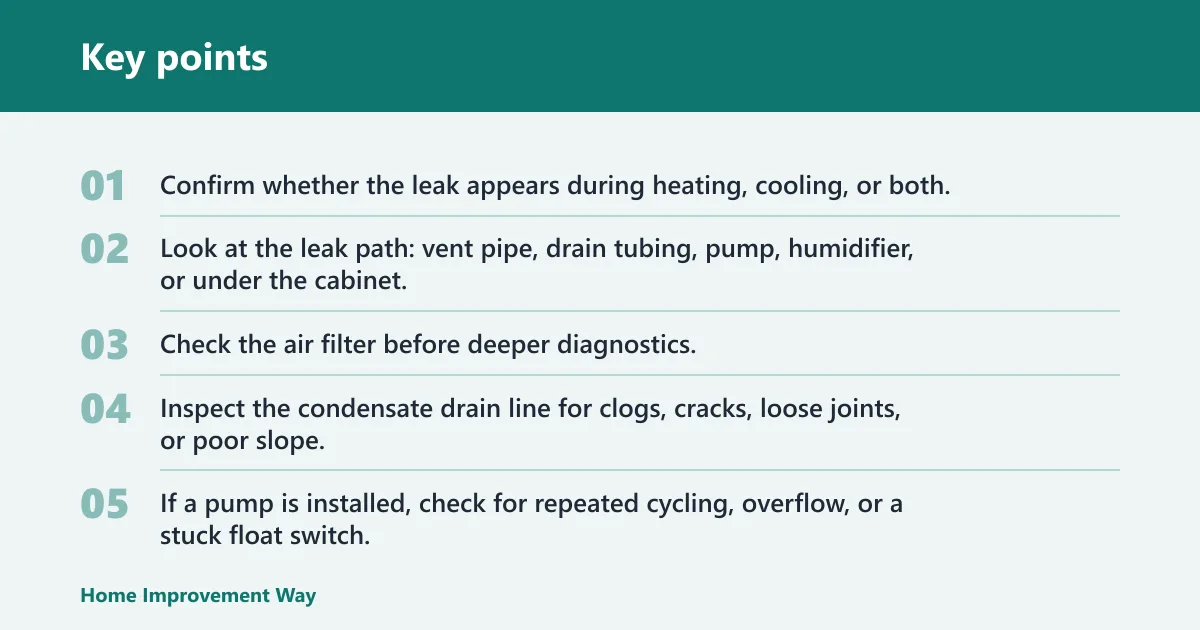
- Confirm whether the leak appears during heating, cooling, or both.
- Look at the leak path: vent pipe, drain tubing, pump, humidifier, or under the cabinet.
- Check the air filter before deeper diagnostics.
- Inspect the condensate drain line for clogs, cracks, loose joints, or poor slope.
- If a pump is installed, check for repeated cycling, overflow, or a stuck float switch.
- If the furnace and AC share a drain, look for backflow from the evaporator coil side.
- Stop checking and call for service if you see electrical risk, combustion odor, or signs of exchanger trouble.
Why is my furnace leaking water during heating?
If water appears only during heat calls, the most likely sources are the condensate drain line, the exhaust pipe, the humidifier, or a more serious heat exchanger problem. A high-efficiency furnace makes condensate during normal operation, but water should move away through the drain system instead of collecting under the unit or dripping from the vent path.
Leak at the vent pipe
High-efficiency furnaces use PVC venting, so condensation can form in the exhaust pipe if the pitch is wrong, a joint is loose, or a crack lets water escape. Water at the vent pipe is a strong clue that the leak may be in the flue path rather than only at the floor drain.
Water under the cabinet
Pooling water by the furnace may be noticed under the unit when the condensate drain line is blocked, disconnected, or cracked. It can also happen if a condensate pump cannot move water away. If the floor around the cabinet is wet, stop and inspect visible tubing before the water reaches wiring or the blower compartment.
Gurgling drain sounds
A gurgling or bubbling sound may suggest a blocked condensate drain line. That noise often means water is trying to move through a restricted trap or tube, then backing up. A common first-timer mistake is to assume the sound is normal because the furnace still runs; a partial blockage can still overflow later.
Say your furnace runs for 15 minutes on a cold morning and you hear water gurgling near the base cabinet, then find a small puddle at the front edge. That pattern points more toward a drain restriction than a random spill, especially if the leak stays tied to heating cycles.
Why does my furnace leak when the AC runs?
If the leak shows up during cooling, the furnace may not be the only source. Some leaks happen because the furnace and AC share a single drain line, and a problem at the evaporator coil can send water back toward the furnace cabinet. That is different from a heating-only condensate issue.
When the evaporator coil and furnace share drainage, a clogged or poorly sloped line can let water back up and appear near the furnace. This is one of the main reasons a homeowner should note whether the leak happens in summer, winter, or both. The timing helps separate a furnace-side fault from AC condensate backflow.
Summer-only water near the furnace
Water near the furnace in cooling season often points to the coil drain pan, shared drain line, or condensate pump. If the furnace stays dry during heating but leaks when the AC runs, focus on the shared drainage path first. A furnace cabinet can be the visible low point even when the source is upstream.
What parts usually cause the leak?
The most common causes are the condensate drain line, condensate pump, humidifier, air filter, and, less often, the heat exchanger. Start with the visible drainage parts first. Save the heat exchanger for the cases where symptoms suggest combustion trouble or a service technician needs to inspect the unit.
Condensate drain line
The condensate drain line carries condensate away from the furnace, and it can clog, crack, or disconnect. A clogged condensate drain line is a common leak cause, and a blocked drain line can cause water to rise and leak around the furnace. If the tubing is brittle, kinked, or slime-coated, it needs attention.
Condensate pump
A condensate pump moves water through the drain line when gravity drainage is unavailable. A failed condensate pump can cause water to seep from the furnace, and a stuck float switch can keep it cycling or allow the reservoir to overflow. Repeated pump cycling is not normal and should be checked right away.
Humidifier
A leaky humidifier can be mistaken for a furnace leak. Check the water line, seal, and water panel if one is installed near the furnace. Even when the furnace itself is dry, a humidifier leak can run along the cabinet and look like a drain failure.
Air filter and airflow issues
Could a clogged filter make my furnace leak water? Yes. A filthy air filter can limit air supply and cause the furnace to overheat, and restricted airflow can also contribute to icing or moisture issues. Check the filter before deeper diagnostics, especially if the leak started after a long period without a change.
Heat exchanger
A damaged heat exchanger is a less frequent but serious problem. It can affect efficiency and safety, and it should not be treated like a routine drain issue. If the leak comes with combustion odor, soot, repeated shutdowns, or signs that point to exchanger damage, stop troubleshooting and call for service.
When should you stop checking and call now?
Stop checking and call now if water is near electrical parts, the leak is actively pooling, the furnace shuts down repeatedly, or you suspect combustion or exchanger damage. Water and electricity do not belong together, and standing water can damage controls before the source is found. A service call is also the right move if the leak keeps returning after basic checks.
Electrical risk and active pooling
If water is spreading under the cabinet or toward wiring, do not keep opening panels. Shut off the thermostat, avoid standing in pooled water, and wait for professional service. The same caution applies if the condensate pump is overflowing or the floor is slick around the unit.
Suspected combustion or exchanger damage
Any sign of a cracked heat exchanger, flue gas odor, soot, or unusual burner behavior should be treated as urgent. These are not normal condensate problems. They need a technician who can inspect the combustion side, not just the drain path.
Repeated overflow or shutdowns
If the furnace keeps leaking water after you clear the filter or empty the pump, the fault is likely deeper in the drainage system. Repeated shutdowns mean the unit may be protecting itself from overflow, overheating, or a blocked drain. That is the point to stop guessing and schedule service.
Most repeat leaks come from drain buildup, poor pitch, or neglected airflow parts. Preventive care is simple and practical: flush the condensate line, clean the trap, check the pump, and replace the filter on schedule. These steps help keep condensate moving where it belongs.
Flush the condensate line
Annual condensate line flushing helps prevent clogs from slime and debris. A clean line is less likely to back up into the furnace cabinet or the exhaust path. If the line has a low spot or poor slope, correct it so water does not sit and collect.
Clean the trap and check the pump
Trap cleaning matters because a partially blocked trap can slow drainage and create gurgling. If a condensate pump is installed, check that the float moves freely and that the discharge line is not kinked. A float-switch test belongs in routine maintenance, not after an overflow.
Inspect filter changes and drain pitch
A clean filter reduces the chance of icing and moisture problems tied to restricted airflow. Keep an eye on drain pitch too, especially if the furnace sits in a basement, attic, or closet where tubing may sag over time. Those installations are more likely to develop drainage issues when support clips loosen.
Suppose your furnace is in an attic and the leak only shows up during summer cooling. In that case, the first place to look is the shared drain line and coil drain path, not the gas train. The location and season matter more than the size of the puddle.
Frequently asked questions
Why is my high efficiency furnace leaking water?
A high-efficiency furnace can leak because its normal condensate cannot drain away, or because a humidifier, pump, or shared drain line is failing. Start by checking where the water appears and whether it happens during heating, cooling, or both. That pattern often points to the right component faster than random parts swapping.
Why is my furnace leaking water?
On a high-efficiency unit, the most common answer is a blocked condensate drain line, but the leak may also come from the exhaust pipe, humidifier, or condensate pump. If the leak only happens when the AC runs, check for shared drain backflow before focusing on the furnace itself.
Why does my furnace keep leaking water?
Repeated leaks usually mean the underlying problem was not removed. Common causes include a clogged drain, poor drain pitch, a stuck float switch, or an airflow problem that keeps leading to icing or moisture carryover. If basic checks do not stop the leak, the unit needs service.
Is it normal for your furnace to leak water?
It is normal for a high-efficiency furnace to create condensate, but not normal for water to pool on the floor or drip from the cabinet. Water should stay in the designed drain path. Once it escapes that path, the leak needs diagnosis.
Can a condensate pump cause water around the furnace?
Yes. A condensate pump can fail, lose power, or stick on a bad float switch, and that can let water overflow around the furnace. Repeated cycling is a warning sign, especially if the pump reservoir is full or the discharge line is blocked.
Could a clogged filter make my furnace leak water?
Yes. A clogged filter can reduce airflow, contribute to overheating, and help create icing or moisture issues that show up as water near the furnace. Replace the filter before opening up the drain system, because a bad filter can be the first fault in the chain.
Sponsored / affiliate links. As an Amazon Associate I earn from qualifying purchases. I may earn additional commission from eligible campaigns.