What Does a Furnace Draft Inducer Motor Do?
This guide is part of our Furnace Troubleshooting: Fix Common Winter Heating Problems series.
A furnace draft inducer motor starts before ignition to pull combustion gases through the vent and create the pressure proof the control board needs; if that proof never arrives, the furnace shuts down. Ignoring it can leave you with repeated lockouts, startup noise, or unsafe venting. This guide explains what the inducer does, how it confirms venting, and how to separate inducer failure from lookalike startup problems.
| Component | What it does | When it runs | Common homeowner confusion |
|---|---|---|---|
| Draft inducer | Pulls flue gases through the heat exchanger and vent path | At the start of a heat call and through much of the burner cycle | Often mistaken for the indoor blower because both can make startup noise |
| Indoor blower | Moves heated air through the ducts and rooms | After ignition and heat exchanger warm-up | Sometimes blamed when the furnace hums before burners light |
| Pressure switch | Proves the inducer has created the expected draft | Before ignition is allowed | Can look like an inducer problem when the real issue is venting, tubing, or condensate |
Draft inducer motor location and function

- Measures voltage, current, resistance, and continuity
- Backlit LCD with data hold and kickstand
- Built-in double ceramic fuse protection
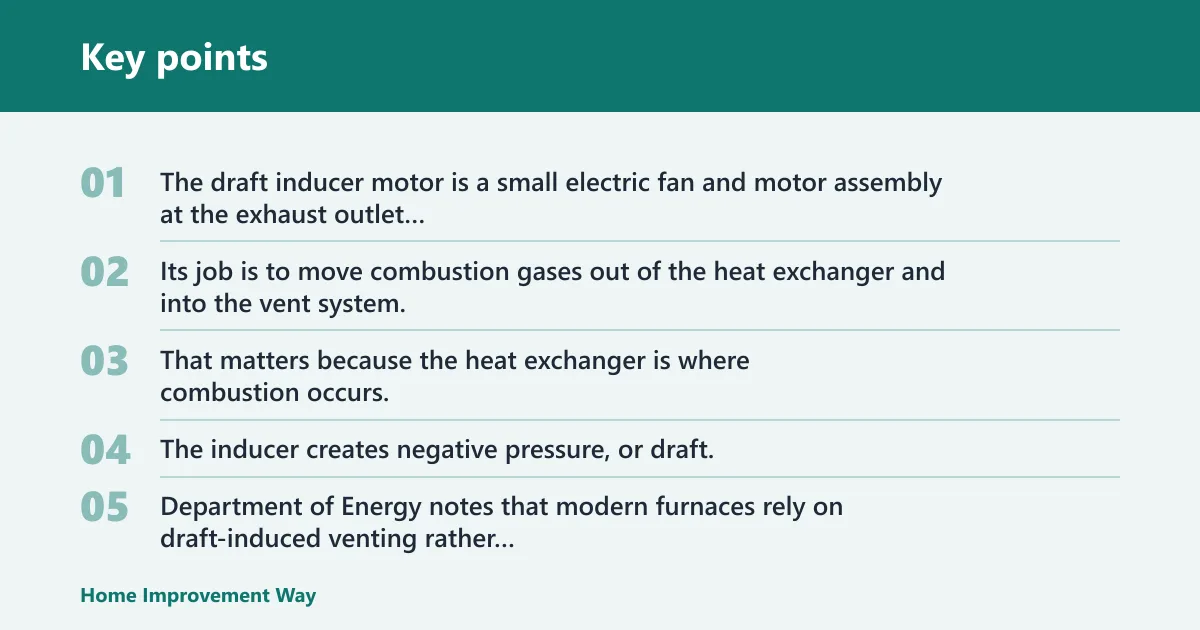
The draft inducer motor is a small electric fan and motor assembly at the exhaust outlet or top of the furnace. Its job is to move combustion gases out of the heat exchanger and into the vent system, so the furnace can burn gas under controlled conditions.
That matters because the heat exchanger is where combustion occurs. The inducer creates negative pressure, or draft, so the furnace can prove that exhaust has a clear path before it allows ignition to continue. The U.S. Department of Energy notes that modern furnaces rely on draft-induced venting rather than a simple open flue, and safety controls are designed around that forced draft sequence.
On an induced-draft furnace, this part is built into the safety chain. Many furnaces use this powered venting approach instead of the older natural draft method that relied on rising hot gases and chimney pull. Natural-draft systems depend more on buoyancy and chimney conditions, while induced-draft furnaces use a fan to actively establish draft before ignition, which is why the control logic is more exacting and more fault-sensitive.
Where it sits on the furnace
Look near the exhaust outlet or the top section of the cabinet. The draft inducer assembly may include the motor, fan or wheel, electrical box, gasket, and mounting hardware. In many models, the assembly is a compact housing attached to the vent side of the furnace.
The indoor blower is the separate part that moves warm air through the ducts after heat is made. The inducer handles combustion exhaust before flame starts.
How it proves venting
When the inducer runs, it must move enough air to create the pressure change the furnace expects. The pressure switch then verifies that draft is actually present. If the switch does not close, the control board stops the sequence. The inducer starts first, then the pressure switch must prove draft before the ignition sequence advances.
That check is the furnace’s first safety gate. It keeps ignition from starting if the vent is blocked, the inducer is weak, or another part of the vent path is not right.
How does the inducer fit the startup sequence?
The startup order is fixed: thermostat call for heat, inducer starts first, pressure switch closes, ignition follows. The draft inducer motor spins up before flame appears, and it often keeps running during the heating cycle to keep exhaust moving safely out of the heat exchanger. On many furnaces, that pre-ignition pressure-proving step takes only a brief pause, but timing varies by model, control board, and vent conditions.
Most draft inducers run before and during furnace operation. If that order breaks, the furnace control board will usually stop the cycle and show a fault code. Timing that stretches, shortens, or repeats on every call is often the clue technicians use to decide whether the issue is vent restriction, weak draft, or a failing safety component.
Step-by-step sequence
- The thermostat calls for heat.
- The furnace control board starts the inducer motor.
- The pressure switch checks for proper draft.
- The control board allows ignition only after the switch proves airflow.
- The igniter and gas valve follow.
- The burners light and the furnace continues the cycle.
Say your thermostat calls for heat and you hear a soft whir at the top of the furnace, then a pause, then ignition. That is normal timing. If the whir continues and the furnace never lights, the problem may be draft, the pressure switch, the igniter, or the board.
Why does my furnace hum before the burners light?
A short hum before ignition can be normal because the inducer motor starts first and may sound like a low hum or whir. What matters is timing and outcome: a normal sound is brief, then the pressure switch closes and ignition follows. A stalled or weak inducer hums without reaching full spin. On a service call, technicians usually confirm the sequence first, then check whether the hum is accompanied by pressure-switch lockout, delayed ignition, or a fault code.
If the hum is louder than usual, lasts without any change, or ends with no ignition, treat it as a fault clue rather than a normal startup sound. A hum that becomes a squeal, grind, or repeated buzz is more consistent with a failing bearing, rubbing wheel, or motor that cannot overcome resistance. Humming alone does not prove the motor is bad, though it can point that way.
Normal startup hum versus abnormal humming
A normal startup hum is brief and followed by the rest of the sequence. Abnormal humming often means the motor is trying to start but cannot get the wheel moving, or the assembly is rubbing, binding, or struggling against airflow resistance.
Noise by itself is not enough to blame the inducer. A blocked vent, a condensate drain problem, or a bad pressure switch can keep the furnace from moving past the same point in the sequence. The pattern is usually a brief run, a pause, and then lockout when the pressure switch never closes.
What a stalled or weak inducer sounds like
A stalled inducer may hum, buzz, or growl without a clean spin-up. A failing bearing can add grinding, squealing, or rattling. Those sounds point to mechanical trouble, but they do not rule out vent blockage or electrical issues.
Picture a furnace that hums for several seconds, then shuts down before ignition. If the vent cap is clear and the pressure switch still will not close, the inducer, its wiring, or the switch itself may be the next thing a technician checks.
Inducer symptom-to-cause map
| Symptom | Likely cause | What the homeowner can safely check | What a technician tests next | Urgency level |
|---|---|---|---|---|
| Humming with no spin | Stalled motor, worn bearing, seized wheel, weak capacitor if used, or electrical fault | Listen for whether the hum starts at the top of the furnace and whether it stops on its own; check for blocked vent terminations from outside | Motor current draw, voltage to the inducer, wheel freedom, mounting condition, and board output | High if repeated; do not keep resetting |
| Rattling at startup | Loose housing, damaged wheel, debris, or worn mounting hardware | Listen for rattling only during the first seconds of startup; inspect exterior vent cap if accessible from outside | Assembly balance, fasteners, wheel condition, and gasket fit | Medium to high |
| Pressure-switch lockout | Inducer not creating enough draft, vent blockage, drain issue, pressure switch failure, or tubing problem | Confirm whether the inducer starts first and whether the vent outlet outside is blocked by snow, nests, or debris | Pressure reading with a manometer, tubing condition, inducer airflow, drain/trap condition, and switch operation | High |
| No ignition after inducer start | Switch not closing, igniter fault, control board fault, or venting problem | Note whether the inducer runs and then stops, or keeps running without flame; check whether any fault code is present | Igniter continuity, board fault code, switch closure, gas valve command, and flame sequence timing | High |
| Squealing or grinding from the top of the furnace | Motor bearing wear, wheel rubbing, or loose housing | Stop repeated restarts and note whether the sound changes with each attempt | Mechanical drag, wheel alignment, bearing condition, and housing clearance | High if persistent |
| Short cycling before ignition | Pressure switch not proven, board lockout, weak draft, or intermittent electrical fault | Watch whether the furnace starts the same way every time and stops before flame | Fault history, switch operation, board output, and vent/airflow checks | High |
| Blocked intake or condensate trap case | Outdoor intake blockage, clogged condensate trap, or trapped water in the drain path | Check for snow, leaves, ice, nests, or visible standing water in accessible drain tubing | Trap condition, drain slope, condensate restriction, and pressure-proving performance | High on high-efficiency furnaces |
Do not keep pressing reset over and over. Repeated resets can hide the pattern and keep the furnace cycling against the same fault. A single reset may let you observe the sequence once more, but repeated retries are a bad trade when the furnace is already locking out.
What does the pressure switch do?
The pressure switch confirms that the inducer is actually moving air. If draft is weak or absent, the switch stays open and blocks ignition. That is why a furnace can have a running inducer and still refuse to light.
The switch can fail independently of the inducer. A bad switch, cracked tubing, or blocked port can create the same no-ignite result even when the motor sounds normal. Technicians commonly check this with a manometer or by verifying the switch changes state at the expected draft level; that is a technician-only test because it involves live equipment and calibrated readings.
How it confirms draft
The switch senses the pressure change created by the inducer. Once that pressure meets the expected range, the switch closes and tells the furnace it is safe to keep going. This is how the board knows the vent path is open enough for combustion gases to move out.
Why it can block ignition
If the switch does not close, the control board should not allow the burners to light. That shutdown protects the heat exchanger, the venting system, and the home. Most modern furnaces will not fire if the inducer motor fails or if the switch never sees proper draft.
Why the switch may fail even if the inducer runs
A switch can age, stick, or lose calibration. Its tubing can also crack, fill with moisture, or clog. In those cases, the inducer may be doing its job while the furnace still reports a draft fault.
When is the inducer not the real problem?
Do not stop at the inducer if the symptoms do not fit. A blocked vent or intake, a condensate drain or trap issue, a furnace igniter not glowing, or a control board problem can produce the same start-and-stop pattern. The indoor blower is also often blamed by mistake, even though it starts later and serves a different purpose.
Blocked vent or intake
Blocked outdoor terminations are a common homeowner check. Snow, leaves, animal nests, or debris can keep the furnace from proving draft. If the vent cannot breathe, the pressure switch will not close, and ignition should not continue.
Condensate drain or trap issues
High-efficiency furnaces route condensate through a trap and drain path that can restrict draft if clogged or full. That can cause pressure-switch lockout even when the motor itself is still running. On condensing furnaces, a technician will often inspect the trap and tubing early because a water backup can mimic a bad inducer or switch.
Igniter or control board faults
If the inducer runs and the pressure switch closes, but there is still no flame, the next suspects are often the igniter, gas valve control, or board. The board starts the sequence in order and may stop it at any point if a safety check fails. A furnace that begins the sequence but never heats is often better described as a furnace runs but does not heat case than as a pure inducer failure.
When the indoor blower gets blamed
The indoor blower moves heated air through the house after ignition. It does not create combustion draft. If the furnace hums before burners light, the part making that noise is usually the inducer, not the blower.
A common first-timer mistake is to assume any startup noise means the same part is failing. A better check is the order of events: inducer first, then pressure proof, then ignition. If the order is wrong, the fault is upstream of the indoor blower.
Repair or replace: what older furnaces need
Replacement is not universal. Draft inducer motors are sold as complete assemblies or motor-only parts, and the right choice depends on the furnace model and the failure point. Many assemblies include the motor, fan, electrical box, and metal sleeve, but not every furnace accepts the same layout.
For older furnaces, repair versus replacement should factor in age, parts availability, and whether the unit already has repeated venting or ignition problems. If the furnace is old enough to rely on natural draft, conversion is not a simple parts swap; it is a different design entirely. A trained technician will usually identify whether the issue is the motor, wheel, housing, gasket, or a pressure-proving problem before recommending a replacement.
What to check before replacing parts
- Confirm the furnace model number before ordering anything.
- Compare the symptom to the sequence: inducer, switch, igniter, board.
- Check whether the outdoor vent termination is blocked.
- Look for repeated lockouts, not just one noisy start.
- Ask whether the replacement is assembly-only or motor-only for that model.
Parts pricing varies widely by model. A replacement can be modest on one furnace and expensive on another, and assembly pricing can change more than motor-only pricing. A technician can usually tell you whether the wheel, housing, gasket, or motor has to be replaced together.
Frequently asked questions
What does a furnace draft inducer motor do?
It starts the furnace’s venting sequence before ignition. The motor and fan pull combustion gases out of the heat exchanger and send them outside, then help create the draft the pressure switch needs to prove safe airflow. Without that proof, most modern furnaces will not fire.
What does a draft inducer motor do on a furnace?
On a furnace, the inducer moves exhaust gases out of the combustion area and into the vent. It is part of the safety chain, not the room-air heating path. The furnace uses it to confirm that venting is clear before flame starts and while the burner cycle is running.
What is a draft inducer on a furnace?
It is the powered fan assembly that sits near the exhaust outlet or top of the furnace. Its job is to pull flue gases through the heat exchanger and establish draft. On induced-draft furnaces, the control board depends on it to verify venting before ignition continues.
How does a draft inducer motor work?
When the thermostat calls for heat, the control board powers the inducer first. The fan spins, the pressure in the vent path changes, and the pressure switch checks that movement. If the draft is strong enough, the switch closes and the board moves on to ignition.
Why won’t my furnace ignite if the inducer runs?
The inducer running does not guarantee the furnace has proven draft. The pressure switch still has to close, and a blocked vent, drain issue, faulty switch, bad igniter, or control board problem can stop ignition after the inducer starts. That is why the full sequence matters, not just the motor sound.
Sponsored / affiliate links. As an Amazon Associate I earn from qualifying purchases. I may earn additional commission from eligible campaigns.
 YUCHENGTECH Ionizing Air Blower Static Eliminator Fan Desktop Ionizer Air Blower with Detachable Cord ESD Ionizer Electrostatic Discharge Fan 110V
 Faryuan Bladeless Fan, 25inch Heating & Cooling & Filter Combo Tower Fan 80° Oscillating with Remote, 9H Timer, 8 Speeds, Portable Quiet for Indoor, Bedroom, Home Office Room(Grey & Red)