Is a MERV 13 Filter Too Restrictive for a Furnace?
A MERV 13 filter is often fine in a furnace with a variable-speed blower and a properly sized filter cabinet, though it may be too restrictive in some older or undersized systems; if return static pressure gets too high, airflow can drop. Skip that check, and you can get weak heating, coil icing on heat pumps, higher energy use, and nuisance shutdowns. This guide shows how to judge MERV 13 by furnace setup, filter size, and static-pressure readings.
MERV 13 and furnace airflow


MERV stands for Minimum Efficiency Reporting Value, and it is the rating used in ASHRAE Standard 52.2 for particles roughly from 0.3 to 10 microns. Higher numbers capture more particles. That helps with fine dust and smoke, but it can also raise airflow resistance if the furnace and filter cabinet are not sized for it.
MERV 13 is often the EPA-recommended minimum for higher filtration needs. EPA also says most furnaces and HVAC systems can accommodate a MERV 13 filter without equipment problems, but that still depends on the filter slot, blower capacity, return path, and how fast the filter loads with dust.
How MERV 13 compares with MERV 11
MERV 11 is a common middle step when MERV 13 feels too restrictive. MERV 11 must capture at least 20% of 0.30-1.0 micron particles, while MERV 13 must capture at least 50% in that same band, at least 85% of 1.0-3.0 micron particles, and at least 90% of 3.0-10.0 micron particles. That is a clear jump in fine-particle capture, and it can matter for smoke or heavy outdoor pollution. (EPA)
Why higher filtration can raise pressure drop
Filter pressure drop is airflow resistance, measured in inches of water column. Higher MERV often means more resistance to airflow, and Bob Vila notes that higher-rated filters usually need more frequent changes. Pressure drop also rises as dust builds up on the media, so a filter that looks fine on day one can become a real restriction weeks later.
Can your furnace handle MERV 13?
The answer depends less on the rating alone and more on the whole return side of the system. A furnace with a blower fan that can overcome the filter resistance, enough cabinet depth, and a clean return path may handle MERV 13 well. A smaller cabinet, a 1-inch slot, or a weak blower can tip the balance the other way.
1-inch filter slots
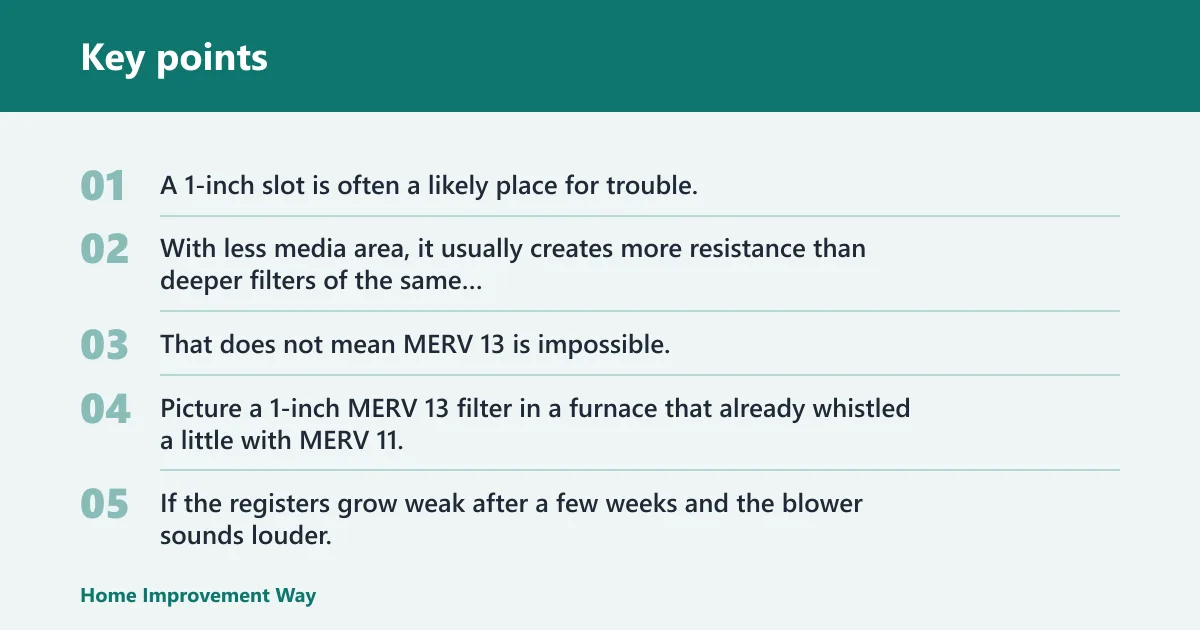
A 1-inch slot is often a likely place for trouble. With less media area, it usually creates more resistance than deeper filters of the same rating. That does not mean MERV 13 is impossible, but it does mean the furnace is more sensitive to dust loading, poor pleat spacing, and a return duct that is already borderline.
Picture a 1-inch MERV 13 filter in a furnace that already whistled a little with MERV 11. If the registers grow weak after a few weeks and the blower sounds louder, the filter may be part of the problem, but the cabinet and return path deserve equal attention.
2-inch and 4-inch filter slots
Deeper filters usually have lower pressure drop because they offer more pleat count and surface area for the same rating. The DOE Building America Solution Center says pressure drop can be greatly reduced by filter design, and a deeper filter of the same rating has less pressure drop. That is why many systems do better with a 2-inch or 4-inch filter than with a 1-inch version of the same MERV.
Symptoms that suggest the blower is struggling
Listen for whistling at the return grille or filter rack. Watch for weak registers, short cycling, or a furnace that runs longer but moves less air. On some systems, overheated equipment or a safety shutdown can appear after a filter change. Those symptoms do not prove the filter is the only issue, but they do show the blower is fighting resistance.
MERV 13 filter basics
A MERV 13 filter is the point where many homes start getting meaningful fine-particle removal without moving into specialty equipment. It is often the practical floor for homes that want more smoke and small-particle control than MERV 11 can provide. That said, the furnace still has to move enough air through it.
Particle capture numbers that matter
MERV 13 must capture at least 50% of 0.30-1.0 micron particles, at least 85% of 1.0-3.0 micron particles, and at least 90% of 3.0-10.0 micron particles. Those bands matter because furnace filters are judged on particles between 0.3 and 10 microns, not on a single number. If you are comparing filters, those capture thresholds are more useful than the label alone.
Why EPA guidance gets mentioned often
EPA says to choose a filter with at least a MERV 13 rating, or as high as the system can accommodate. That is a useful starting point, not a final answer. The system still needs a static-pressure check if airflow symptoms show up after the upgrade.
Where HEPA fits instead
HEPA is separate from the MERV scale. It is commonly rated at 99.97% capture at 0.30 microns and is often used in portable air cleaners, not as a furnace filter category. If a home needs much more smoke control than the furnace can deliver, portable air cleaners may be the better supplement.
Filter size and pressure drop
Filter depth changes the restriction story more than many homeowners expect. A 4-inch filter can often give you lower pressure drop than a 1-inch filter at the same MERV rating, because the larger media area spreads the load. That is why the filter cabinet matters as much as the label on the box.
What dust loading does over time
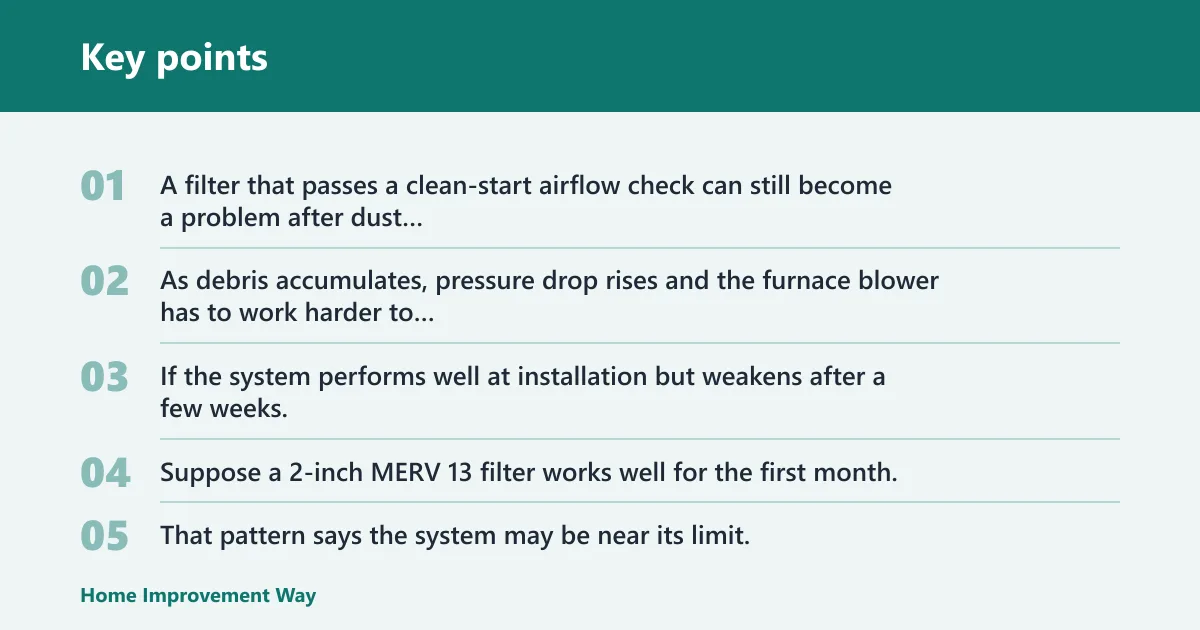
A filter that passes a clean-start airflow check can still become a problem after dust loading. As debris accumulates, pressure drop rises and the furnace blower has to work harder to maintain airflow. If the system performs well at installation but weakens after a few weeks, that points to a filter-loading issue, a dirty return path, or both.
Suppose a 2-inch MERV 13 filter works well for the first month, then the bedrooms feel starved for air and the furnace starts short cycling. That pattern says the system may be near its limit, or the return side may be dirtier than expected. A faster change interval or a lower-MERV compromise may be the next step.
Why pleat count matters
Pleat count increases usable surface area. More area usually lowers pressure drop for the same nominal rating, which is why two filters with the same MERV number can behave differently in the furnace. The cabinet design, not just the printed rating, helps decide whether airflow stays acceptable after installation.
| Filter slot depth | Current filter rating | Symptom pattern | Likely risk level | Next step |
|---|---|---|---|---|
| 1-inch | MERV 11 | Noisy return grille, but heat runs normally | Moderate | Check fit, pleat spacing, and total static pressure after upgrade |
| 1-inch | MERV 13 | Weak registers, whistling, longer run times after dust loading | High | Consider MERV 11 or a deeper cabinet; measure static pressure |
| 2-inch | MERV 13 | Normal airflow when clean, then airflow drops after a few weeks | Moderate | Shorten replacement interval and inspect return duct cleanliness |
| 4-inch | MERV 13 | Quiet operation, even supply airflow, stable run times | Low | Keep monitoring filter loading and total static pressure |
| Any depth | Any upgrade from MERV 11 to MERV 13 | System works clean, then fails after dust loading | Borderline | Measure total static pressure and inspect blower, returns, and cabinet size |
Note: When symptoms appear after a filter change, measure total static pressure instead of guessing. After a filter upgrade, total static pressure should be no more than 0.4 or 0.5 inch of water, depending on equipment and layout.
Can a furnace use MERV 11 instead?
MERV 11 is often the smarter compromise when a system cannot support MERV 13 without airflow penalties. It captures less fine particulate than MERV 13, but it can preserve more airflow in a restrictive cabinet or older furnace. If the equipment is borderline, that tradeoff may be the better one.
When MERV 11 is the safer compromise
Choose MERV 11 when a 1-inch filter slot, small return grille, or weak blower already pushes static pressure close to the limit. It is also a strong fallback when the furnace works fine with a clean filter but starts to struggle as soon as dust builds up. In those cases, more filtration is not worth the airflow loss.
Which homes may still need more filtration?
Homes with wildfire smoke exposure, allergy concerns, or unusually dusty outdoor conditions may still need MERV 13 if the system can support it. If the furnace cannot, add portable air cleaners in occupied rooms rather than forcing the furnace filter to do all the work. That keeps the heating system from becoming the bottleneck.
When to change the cabinet or filter format
If the furnace needs MERV 13 but chokes on a 1-inch slot, changing the cabinet or moving to a deeper filter format can be more effective than lowering the rating forever. A 2-inch or 4-inch filter often gives the blower a better chance of maintaining airflow while still raising particle capture.
Can your system pass the static-pressure check?
A static-pressure check is the closest thing to proof. If a MERV 13 upgrade seems borderline, measure total static pressure after the filter is installed and the system is running normally. That tells you whether the furnace blower is overcoming the resistance or pushing the system past its limit.
When to measure total static pressure
Measure after the new filter has been in place long enough to show real operating conditions, not just a fresh, clean start. If the furnace works with a clean filter but airflow fades after a few weeks, measure again. That helps separate a temporary restriction from a broader sizing or duct issue.
What readings are too high
A common upper bound for concern is 0.4 or 0.5 inch of water for total static pressure, depending on the equipment and layout. If the reading is near or above that range, the furnace may not have enough breathing room for a higher-MERV filter. At that point, a technician should inspect the blower, filter rack, return ducts, and cabinet size.
- Confirm the filter depth and current MERV rating.
- Check whether the furnace runs normally with a clean filter.
- Watch for whistling, weak registers, long run times, or short cycling after dust loading.
- Measure total static pressure with the filter in place.
- Compare the reading with the equipment’s acceptable range and adjust the filter choice or cabinet design if needed.
Can MERV 13 work in wildfire season?
Yes, if the furnace can handle the extra resistance. Temporary use during wildfire smoke season is often reasonable when the system has room for it, but the same filter may be too much year-round if the return side is already tight. The deciding factor is still airflow, not the season.
Temporary use versus year-round use
A higher-MERV filter can make sense for smoky weeks even if the furnace would be happier with MERV 11 the rest of the year. The key is whether the system can maintain airflow when the filter starts loading fast. If not, use MERV 11 in the furnace and handle smoke control with portable air cleaners.
What to watch if the filter loads fast
Fast loading means the filter pressure drop is rising sooner than expected. If the return grille gets noisy, the furnace cycles more often, or supply air weakens, the filter may be reaching its limit too quickly. Swap it sooner, and do not assume the cabinet can handle a more restrictive filter just because it started out fine.
How to decide between furnace filtration and portable air cleaners
Use the furnace for whole-house filtration only if it can pass the static-pressure check with the chosen filter. Use portable air cleaners when the furnace needs MERV 11 or lower to breathe properly. That split keeps the heating system safe while still improving indoor air where people spend time.
Frequently asked questions
Is a MERV 13 filter too restrictive for my furnace?
Not always. A MERV 13 filter is often fine in a furnace with enough blower capacity and a deeper filter cabinet, but it can be too restrictive in a 1-inch slot or an older system. Total static pressure is the best check when airflow symptoms appear.
Will a MERV 13 filter reduce airflow in a furnace?
It can. Higher MERV often means more resistance to airflow, especially in a small filter slot or a system with a dusty return path. If airflow drops, look for whistling, weak registers, or longer run times, then measure total static pressure instead of guessing.
What MERV rating is safe for a residential furnace?
The safest rating is the highest one your specific system can handle without excessive static pressure. EPA says to choose at least MERV 13, or as high as the system can accommodate, but many homes land on MERV 11 when the furnace or cabinet is more restrictive.
How do I know if my furnace can handle MERV 13?
Check the filter depth first, then watch the system after installation. If a clean MERV 13 filter causes no airflow problems and total static pressure stays within the acceptable range, the furnace can likely handle it. If symptoms show up after dust loading, the system may be borderline.
Does filter thickness affect how restrictive a MERV 13 is?
Yes. Deeper filters usually have less pressure drop than 1-inch filters of the same rating because they have more surface area and pleat count. A 2-inch or 4-inch MERV 13 filter is often easier on airflow than a 1-inch version.
What happens if the filter gets dirty too fast?
Pressure drop rises, airflow falls, and the furnace may become noisy, weak, or short-cycle. Fast loading can mean the filter is undersized, the return path is dirty, or the cabinet is too small. In that case, measure static pressure and consider a less restrictive filter.
Sponsored / affiliate links. As an Amazon Associate I earn from qualifying purchases. I may earn additional commission from eligible campaigns.
 ROVSUN 18000 BTU Mini Split AC/Heating System with Inverter, 20 SEER2 Energy Saving 230V Ductless Split-System Air Conditioner with Pre-Charged Condenser, Heat Pump, Remote Control & Installation Kit
 Faryuan Bladeless Fan, 25inch Heating & Cooling & Filter Combo Tower Fan 80° Oscillating with Remote, 9H Timer, 8 Speeds, Portable Quiet for Indoor, Bedroom, Home Office Room(Grey & Red)