How to Tell If a Furnace Igniter Is Bad
A bad furnace igniter often shows up when the blower starts and the inducer runs, but no glow or spark appears within about 30 to 90 seconds, or the burner lights and then drops out on repeated tries. If you guess wrong, you can replace the wrong part, miss a gas or draft problem, and leave the furnace locked out. This guide maps the startup sequence so you can tell igniter failure from flame sensor, gas supply, draft, and control-board faults.
This guide is part of our Furnace Troubleshooting: Fix Common Winter Heating Problems series.
How the furnace startup sequence tells you what failed
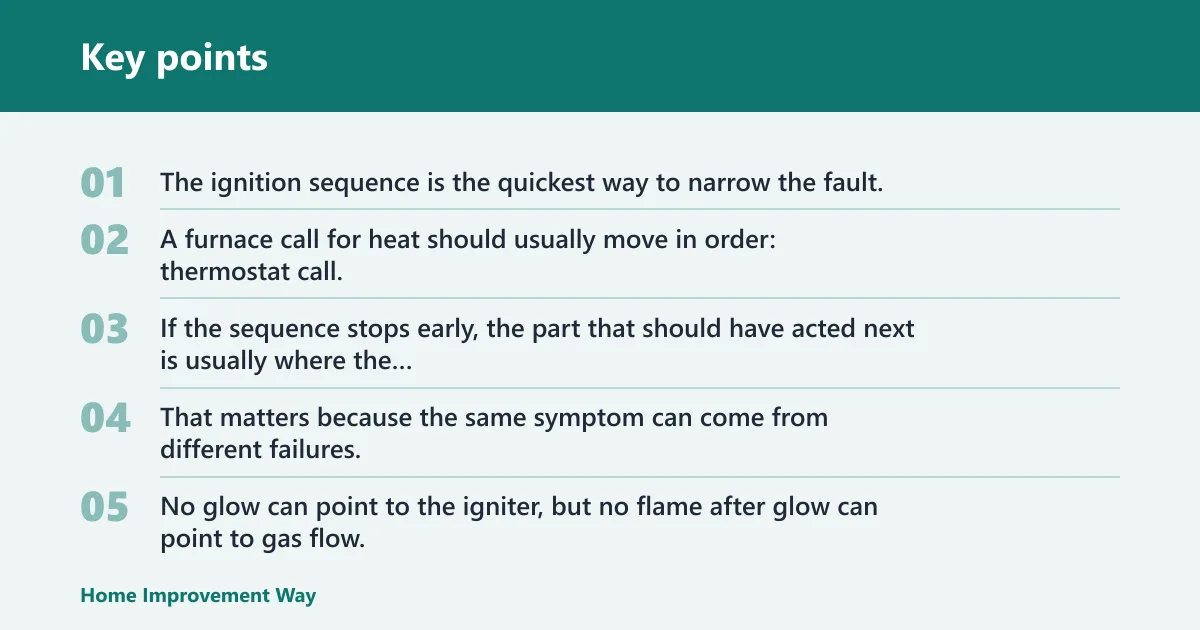


The ignition sequence is the quickest way to narrow the fault. A furnace call for heat should usually move in order: thermostat call, induced draft blower starts, pressure switch proves draft, igniter warms or sparks, gas valve opens, and flame is proven. If the sequence stops early, the part that should have acted next is usually where the problem sits.
That matters because the same symptom can come from different failures. No glow can point to the igniter, but no flame after glow can point to gas flow, and lights-then-dies often points to flame sensing. A control board can also stop the cycle after repeated failed tries or after it reads a bad safety signal.
Where the furnace startup stops
| Observation | Likely cause | Safe homeowner check | When to call a pro |
|---|---|---|---|
| No inducer starts | Thermostat call issue, power loss, or control-board fault | Set heat mode, raise setpoint, check breaker and furnace switch | If power is present but the sequence never begins |
| Inducer runs, but sequence stops before ignition | Pressure switch does not close, or venting/drain issue blocks draft | Check the flue for blockage, inspect the pressure-switch hose for kinks, and look for condensate drain trouble | If the inducer sounds weak or the switch never proves |
| Glow appears, but no flame | Gas valve not opening, gas interruption, or weak gas supply | Check other gas appliances in the home and make sure the gas shutoff valve is open | If gas supply is suspect or the valve may be failing |
| Spark appears, but no flame | Gas is not reaching the burners, or spark ignition path is weak | Confirm the gas shutoff is open and listen for the valve click | If there is no gas smell, no flame, and repeated retries continue |
| Burner lights, then shuts off in a few seconds | Flame sensor signal is weak, dirty, or poorly grounded | Inspect the flame sensor tip for dirt or corrosion | If cleaning does not stop the lights-then-dies pattern |
| Repeated retries, then lockout | Control board has counted failed ignition tries | Read the diagnostic LED and record the blink pattern | If the furnace locks out after repeated attempts |
| Visible crack on igniter | Hot surface igniter damage | Inspect the ceramic base and element for cracks without touching the hot part | Replace the igniter; cracked parts do not recover |
| No diagnostic light | Control board has no power, or board failure | Check furnace switch, breaker, and service door position | If power is present and the board still shows no LED |
Use the table before you replace anything. It tells you where the sequence stops, which is more useful than guessing from the final symptom alone. That is the simplest way to separate an igniter fault from a flame sensor, gas, draft, or board issue.
Is the igniter glowing or sparking?
Hot surface igniters and spark igniters fail in different ways. A hot surface igniter, or HSI, uses a ceramic mounting base and a silicon carbide or silicon nitride element. It should glow red hot when voltage is applied. A spark igniter should produce a visible spark, not a glow.
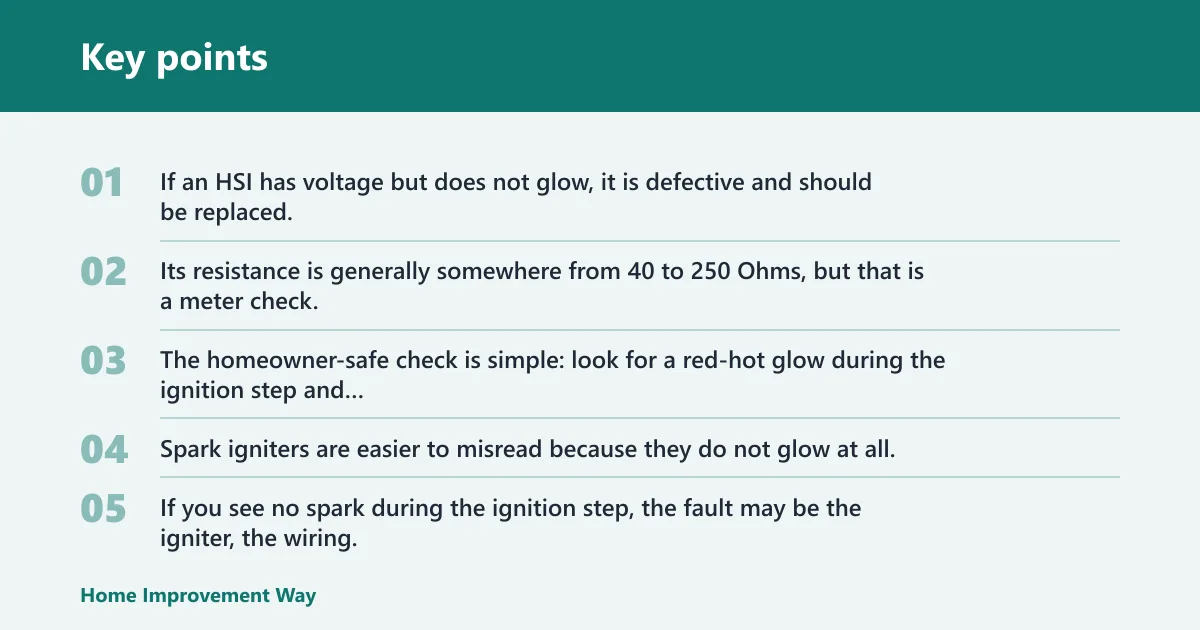
If an HSI has voltage but does not glow, it is defective and should be replaced. Its resistance is generally somewhere from 40 to 250 Ohms, but that is a meter check, not a visual one. The homeowner-safe check is simple: look for a red-hot glow during the ignition step and look for cracks in the ceramic insulator.
Spark igniters are easier to misread because they do not glow at all. If you see no spark during the ignition step, the fault may be the igniter, the wiring, or the control board. If you see spark but no flame, stop blaming the igniter too quickly and move to gas flow.
Say your furnace has a side access panel with a viewing port, and the inducer starts normally. If there is no red glow from the HSI after the pressure switch closes, that supports an igniter problem. If there is glow and then no flame, the next suspect is usually gas delivery or valve operation.
Is the flame sensor the real problem?
Yes, especially when the burner lights and then goes out after a few seconds. A flame sensor detects flame by flame rectification, and that signal is measured in microamps. It is very sensitive to cleanliness and grounding issues, so a coated flame sensor can prevent the furnace from sensing flame even when ignition itself is fine.
Common flame rectification failures include a dirty or damaged flame sensor and a broken or loose wire connection. A furnace can keep a burner lit for only about 8 to 10 seconds before checking flame sense, so a bad reading can make the furnace shut the burners off almost immediately.
Repeated retries point in the same direction. If the furnace lights, shuts off, and tries again, the control board is likely seeing poor flame sense and trying to recover. After repeated failed tries, the board can lock out the system, which is not a repair; it is a safety stop.
A common first-timer mistake is replacing the igniter because the furnace “tries to light” and then dies. That symptom is much more consistent with flame sensing than with ignition failure. The igniter already did its job if the burner lit at all.
Could gas, draft, or lockout be the cause?
Yes. If the inducer does not create proper draft, the pressure switch may not close and the furnace will not continue to ignition. If gas never reaches the burners, the igniter can glow or spark all day and the burner still will not light. If the board sees repeated failures, it may enter lockout mode.
Pressure switch and induced draft blower problems
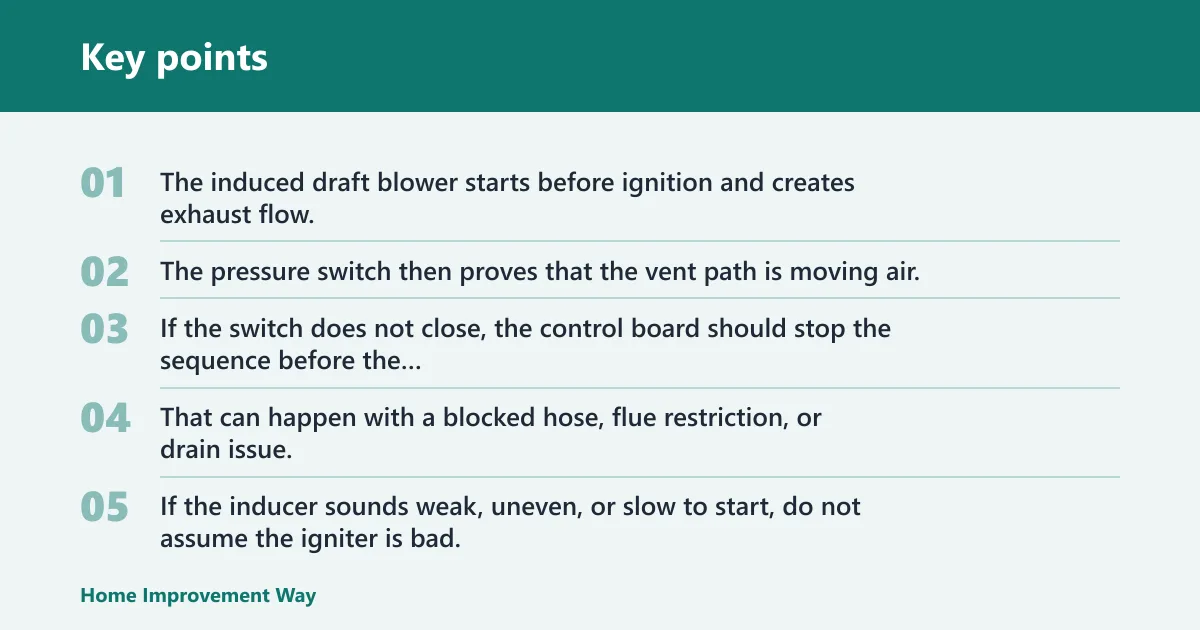
The induced draft blower starts before ignition and creates exhaust flow. The pressure switch then proves that the vent path is moving air. If the switch does not close, the control board should stop the sequence before the igniter matters. That can happen with a blocked hose, flue restriction, or drain issue.
If the inducer sounds weak, uneven, or slow to start, do not assume the igniter is bad. The furnace is already telling you the problem is earlier in the sequence. A blocked vent or weak inducer can make ignition impossible.
Gas valve or gas supply interruption
When the igniter glows or sparks but no burner lights, gas delivery moves near the top of the list. That can mean a closed gas shutoff, gas supply interruption, or a gas valve that never opens during the trial for ignition. Gas-related faults can mimic a bad igniter because both end with no flame.
Check other gas appliances in the home. If they do not work, the issue may be outside the furnace itself. If gas supply is suspect, call a pro rather than trying to force the furnace through repeated starts.
Control board codes and lockout mode
The control board manages the sequence and reads the flame signal. Many boards show a diagnostic LED or error code, and that code can separate an ignition fault from a pressure-switch fault or flame-sense fault. If the furnace has locked out after repeated failed attempts, the board is protecting the system from endless retries.
Some furnace lockouts reset after an hour, while others require power to be broken. A furnace can also lock out after three ignition retries. Repeated resets are not a fix if the same fault keeps returning.
Safe checks before you replace an igniter
Start with the checks that do not require opening the gas train or probing live parts. Confirm the thermostat is calling for heat, the furnace has power, and the filter and vents are not obviously blocked. Then watch the startup sequence instead of jumping straight to parts replacement.
- Set the thermostat to heat and raise the setpoint above room temperature.
- Make sure the furnace switch and breaker are on.
- Watch the furnace from the access panel window, if present.
- Note whether the inducer starts, the pressure switch proves, and the igniter glows or sparks.
- Look for the diagnostic LED and record any blink pattern.
- Inspect the igniter only for visible cracks, loose wires, or obvious damage.
If you can see a cracked ceramic base, that is a strong sign the hot surface igniter is done. If the furnace gets to ignition but the burner shuts off after a few seconds, do not keep replacing igniters. That is the wrong symptom pattern for an igniter failure.
Suppose the furnace is a two-stage gas unit and the blower runs while the burners never light, yet the inducer can be heard starting. If the viewing port never shows glow or spark, the next safe step is a meter-based check or a technician visit, not repeated resets.
Frequently asked questions
Can a dirty flame sensor look like a bad igniter?
Yes. A dirty flame sensor can make the furnace light and then shut off after a few seconds, which many people mistake for an igniter problem. The difference is timing: a bad igniter prevents flame from starting, while a dirty flame sensor lets flame appear and then drops it out.
When should I call an HVAC technician for ignition problems?
Call a technician if the furnace has no diagnostic light, locks out after repeated retries, shows gas supply concerns, has a weak inducer, or has a cracked igniter. Call sooner if you smell gas, suspect a pressure-switch problem, or cannot tell where the sequence stops.
Sponsored / affiliate links. As an Amazon Associate I earn from qualifying purchases. I may earn additional commission from eligible campaigns.