What Does a Furnace Limit Switch Do and Why Does It Trip?
A furnace limit switch is a safety sensor that shuts the burners off if the heat exchanger overheats. If it trips once, check the filter, supply registers, and return grilles, then run the furnace again. If it trips again, leave the furnace off and call for service. Ignoring it can crack a heat exchanger, damage the blower, or leave you without heat. This guide explains what the switch does, why it trips, how to read the trip pattern, and when to shut the system down.
How limit switches monitor heat and trigger burner shutdown
A furnace limit switch watches temperature near the heat exchanger and stops the burners when supply-air temperature gets too high. It is a safety control, not a comfort control. On many furnaces, the main limit is auto-resetting, while a secondary or rollout device may need manual reset after a serious fault. OEM installation manuals from Carrier, Trane, and Lennox describe the limit circuit as a protective shutoff tied to the furnace’s maximum temperature and safety sequence.
The switch is usually mounted on the plenum or near the heat exchanger, where it can react to overheating quickly. In some furnace designs, the same control package also manages blower operation, so a “limit” problem can affect more than burner shutdown.
Where it sits in the furnace
The switch monitors temperatures around the heat exchanger, where heat transfer has to stay within design range. If that area overheats, the switch opens the safety circuit and stops the burners. That keeps metal parts from seeing damaging temperatures and keeps the furnace from pushing unsafe heat into the system.
Auto-reset and manual-reset behavior
Modern furnaces often have an auto-reset main limit and a manual-reset rollout or secondary limit. A high-limit switch commonly opens on over-temperature and then closes again after the cabinet cools, usually below the trip point. A rollout switch is different: it points to flame or venting danger and should not be repeatedly reset. Utility and extension resources consistently treat rollout trips as a do-not-ignore fault because flame rollout can indicate blocked venting, burner problems, or heat exchanger failure.
How does a furnace limit switch work?
The control opens when temperature rises too far and closes again after the furnace cools back down. In a typical high-limit setup, the trip range is often between 160 and 200 degrees Fahrenheit, and the reset threshold is usually 30 to 50 degrees below the trip point. That pattern tells you the furnace is protecting itself from excess heat, and it matches the temperature-rise logic used in OEM setup instructions and ACCA guidance on furnace airflow.
When the switch opens, the gas circuit is interrupted and the burners shut off. Some furnaces keep the blower running after a limit trip to cool the heat exchanger faster. That detail matters, because a running blower after burner shutdown does not always mean the blower is the problem; it can be the furnace doing its safety job.
How combo fan-limit controls differ
Some furnaces use fan-limit controls with adjustable fan-on and fan-off ranges. Those controls can manage blower timing as well as temperature protection. A simple limit switch only protects against overheating, while a combo control may also decide when the blower starts and stops during a heat cycle.
What a trip pattern can tell you
The pattern matters as much as the trip itself. A single high-limit trip often points to airflow restriction, but a rollout trip points to a more serious combustion or venting problem. If the furnace shuts the burners off early, then comes back on after cooling, you are likely dealing with an overheating pattern that needs a closer look.
Short cycling with warm-but-not-heating air
Suppose the burners start, the supply air gets hot, and the furnace shuts off before the house warms up. That often means the limit is opening on high temperature, then closing again after cooldown. Dirty filters are the most common cause of repeated limit trips, so start with the filter, then check the registers and return grilles. If you are trying to sort out why a furnace keeps shutting off after a few minutes, this is the symptom pattern that matters most.
A switch that resets and trips again quickly
A limit that resets and trips again in a short time is a warning sign, not a nuisance to keep clearing. That pattern can come from a dirty filter, closed or blocked supply registers, blocked return grilles, a failing blower motor, duct restriction, or a dirty coil. It can also mean the furnace is running hotter than design allows.
What should you check first?
Start with the easiest airflow checks: the filter, supply registers, and return grilles. A dirty filter, blocked returns, and closed supply registers are common airflow causes of overheating. Those checks are safe, fast, and often explain why a furnace limit switch keeps opening.
- Replace a dirty filter, or confirm the filter size and MERV rating match the furnace design.
- Open every supply register you can find.
- Clear furniture, boxes, rugs, and storage from return grilles.
- Look for dust buildup, a dirty coil, or crushed duct runs near the furnace.
- If the furnace keeps tripping after those checks, leave it off and schedule service.
Picture a home where two return grilles are blocked by storage bins and about half the supply registers are shut. That can raise static pressure, reduce airflow, and push the furnace into a limit trip even though the burner is working normally. Opening the airflow path may solve it; if it does not, the problem is deeper.
How do I know if the limit switch is bad or if airflow is the problem?
A bad switch is possible, but airflow problems are more common. If the furnace trips after a few minutes of heating, then resets after cooling, restricted airflow is usually the first suspect. If the furnace never shows signs of overheating yet the circuit stays open, the switch or control wiring may be at fault. A simple decision rule helps: repeated heat-cycle shutdowns point to airflow or overfiring; an open circuit with no true overheat pattern points more toward the switch, wiring, or board.
What temperature rise tells a technician
Temperature rise is one of the clearest ways to separate an airflow issue from a control problem. A technician should measure temperature rise and compare it with the manufacturer’s allowable range. If the rise is too high, the furnace is not moving enough air or is producing too much heat for the system design. ACCA and OEM setup documents treat this as a core diagnostic step, not a guess.
A technician should also measure manifold gas pressure during diagnosis. Overfiring can cause nuisance limit trips, and that is not something you can confirm by eye. If the heat exchanger, blower, and filter all look acceptable, gas pressure and combustion behavior move higher on the list.
Can I reset a furnace limit switch myself?
Only a main high-limit that is designed to auto-reset should be left to reset itself, and even then the furnace should not be cycled repeatedly. A manual-reset rollout or secondary safety should not be reset as a homeowner repair. If a manual-reset switch trips, shut the furnace off and call for service because repeated resets can hide a dangerous combustion or venting fault.
How do I replace a limit switch on a furnace?
Replacement is usually not a homeowner task because the furnace must be de-energized, the correct part matched exactly, and the reason for the trip diagnosed first. If the switch is replaced without fixing airflow, wiring, overfiring, or venting problems, the new part may trip again. In any rollout or persistent overheating case, shut off power and gas and have a qualified technician handle it.
What is the difference between a bad switch and a bad airflow problem?
Airflow problems usually create a repeatable pattern: the furnace starts normally, heats up, then shuts down on limit after several minutes and restarts after cooling. A bad switch or wiring fault can open the circuit even when temperatures are not excessive. The deciding factor is whether the furnace is truly overheating or whether the safety circuit is falsely opening.
If the blower is weak, the filter is dirty, or returns are blocked, the furnace is probably reacting correctly. If airflow is clear and the furnace still opens the limit circuit, the switch, control board, wiring, or harness connections move up the list. That is why temperature rise, continuity checks, and visual inspection all matter together.
Limit switch troubleshooting matrix
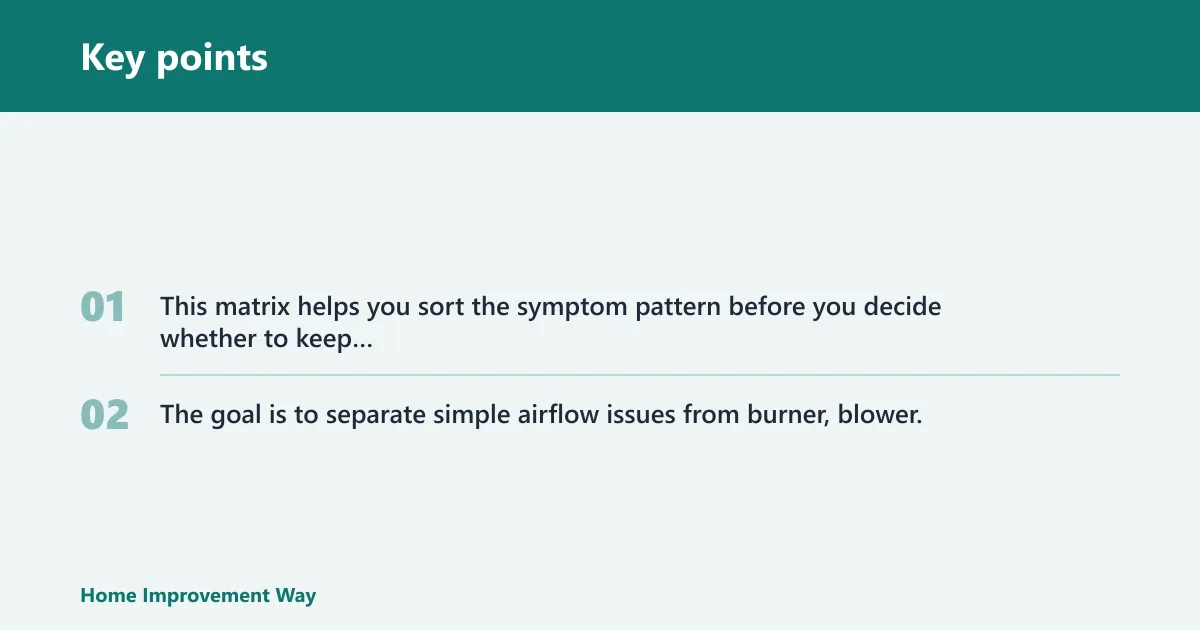
This matrix helps you sort the symptom pattern before you decide whether to keep troubleshooting. The goal is not to guess the failed part. The goal is to separate simple airflow issues from burner, blower, or venting faults that need a technician.
| Symptom pattern | Likely cause | Safe homeowner check | Pro-level diagnostic test | What the trip pattern usually means | Urgency |
|---|---|---|---|---|---|
| Auto-reset high-limit trips during heat call, then restarts after cooling | Restricted airflow, dirty filter, blocked returns, closed supply registers, dirty coil, blower speed issue | Replace or inspect the filter; make sure supply registers are open; clear return grilles | Measure temperature rise and verify airflow against the furnace design range | The furnace is usually overheating during normal operation, then recovering when the heat source shuts off | High if the pattern repeats; leave off until checked if it keeps cycling |
| Manual-reset rollout trips | Flame rollout, venting failure, burner problem, blocked heat exchanger area, serious combustion fault | Shut the furnace off; look for soot, odor, or visible flame rollout without opening panels further | Combustion analysis, vent inspection, heat exchanger and burner check | Do not keep resetting; this pattern points to unsafe flame behavior or venting failure | Immediate shutdown; do not keep resetting |
| Blower running after a trip | Normal cooldown behavior on some furnaces, or control board response after an overheat event | Check whether burners are off and supply air is cooling; do not reset a rollout switch | Confirm control sequence and limit state with a meter and furnace diagram | Do not assume the blower is bad; it may be cooling the furnace after a legitimate overheat trip | Moderate if only high-limit related; high if accompanied by odor, soot, or repeated cycling |
| No-heat with an open limit | Persistent overheat, failed limit switch, open rollout device, control board fault, or bad airflow path | Check the filter, registers, and returns; stop if the furnace keeps opening the circuit | Measure temperature rise, check manifold gas pressure, verify blower performance, inspect for hidden restriction | Either the furnace is genuinely running too hot, or the safety circuit is being opened by a control or wiring fault | High; if it will not stay running, call for service |
| High-limit trips even with a clean filter and open registers | Overfiring, weak blower performance, dirty coil, duct restriction, or incorrect setup | Confirm all vents are open and note how long it runs before shutdown | Check temperature rise, manifold gas pressure, blower performance, and total external static pressure | The furnace may be making too much heat for the air being moved | High; repeated trips can damage the heat exchanger |
| Limit circuit open, but no real overheating pattern | Control-board or wiring fault, loose connector, damaged harness, or failing switch | Inspect visible wiring only if power is off; do not bypass the switch | Continuity check, voltage verification, board output test, and harness inspection | The furnace may be tripping falsely rather than overheating | High if the furnace will not heat reliably |
When a technician needs to step
Call for service when the trip returns after a clean filter and open registers, when the furnace will not stay on, or when you see soot, smell gas, or hear a rollout event. A rollout switch trip is a serious fault, and repeated reset attempts can make the situation worse. Leave the furnace off in that case.
If a furnace has a clean filter, open registers, and clear return grilles but still opens the high-limit after about 8 to 10 minutes, That points away from simple homeowner maintenance and toward blower performance, duct restriction, dirty coils, overfiring, or a limit control problem. Those are technician-level checks.
Repeated trips matter because they are not only inconvenient. Heat exchanger stress builds over time, and the furnace is telling you that something in the heat path is wrong. The longer it runs hot, the more likely you are to create a bigger repair than the original airflow fault.
What a technician checks next
A technician will usually verify temperature rise, inspect airflow path, check manifold gas pressure, and look for signs of poor combustion or a failing blower. Hidden problems inside the ductwork, on the coil, or on the control board can make the limit open even when the obvious parts look fine.
Do not bypass, jumper, or hold closed any limit or rollout switch. That removes the furnace’s safety protection and can hide the very condition that is overheating the system. If the furnace is shutting down to protect itself, the correct fix is to find why it is too hot.
Frequently asked questions
What does a furnace limit switch do?
A furnace limit switch shuts the burners off when the furnace gets too hot. It protects the heat exchanger and surrounding components from overheating. On many furnaces, the main limit resets after the cabinet cools, but a rollout device may require manual reset and a service call.
How do I check the limit switch on a furnace?
Start with safe visible checks: the filter, supply registers, and return grilles. If those are fine and the furnace still trips, stop there and call a technician. Testing the switch itself and checking temperature rise, airflow, and control signals requires the right tools and a safe diagnosis process.
Why does my furnace limit switch keep tripping?
Repeated trips usually mean the furnace is overheating because airflow is restricted. Dirty filters are the most common cause, followed by blocked returns, closed supply registers, dirty coils, duct restriction, or blower problems. Overfiring and control faults can also push the furnace past its safe temperature limit.
What is the difference between a high limit switch and a rollout switch?
A high-limit switch responds to excess heat in normal furnace operation and often resets automatically after cooling. A rollout switch is a manual-reset safety control that signals serious flame or venting trouble. If a rollout switch trips, do not keep resetting it; shut the furnace down and call for service.
How much does a furnace limit switch replacement cost?
The part itself is often less expensive than the underlying fault, so replacement cost varies with access, labor, and what caused the trip. A simple switch swap may be modest, but if the real issue is airflow, blower performance, or combustion, the repair cost can rise with the diagnostic work.
Should a furnace keep running after a limit trip?
Sometimes the blower will keep running after a high-limit trip to cool the furnace down. That can be normal. What is not normal is repeated shutdowns, rollout trips, or a furnace that cannot stay on long enough to heat the home. Those patterns mean the underlying problem still needs attention.
Sponsored / affiliate links. As an Amazon Associate I earn from qualifying purchases. I may earn additional commission from eligible campaigns.
 YUCHENGTECH Ionizing Air Blower Static Eliminator Fan Desktop Ionizer Air Blower with Detachable Cord ESD Ionizer Electrostatic Discharge Fan 110V
 ROVSUN 18000 BTU Mini Split AC/Heating System with Inverter, 20 SEER2 Energy Saving 230V Ductless Split-System Air Conditioner with Pre-Charged Condenser, Heat Pump, Remote Control & Installation Kit