Can You Leave an Electric Fireplace on Overnight?
You can usually leave an electric fireplace on overnight in flame-only mode, but heater mode is only reasonable if the exact model manual allows unattended use and the setup is safe. Follow the manual first. For heat-producing operation, keep clearances, a cool outlet, an intact cord, and a working timer or shutoff.
Can you leave it on overnight?
Yes, sometimes, but the answer depends on the mode and the manual. Flame-only use is usually much lower risk because it uses LEDs and little heat. Heater mode is a high-wattage appliance, so overnight use should follow the exact manufacturer instructions and basic fire-safety guidance.
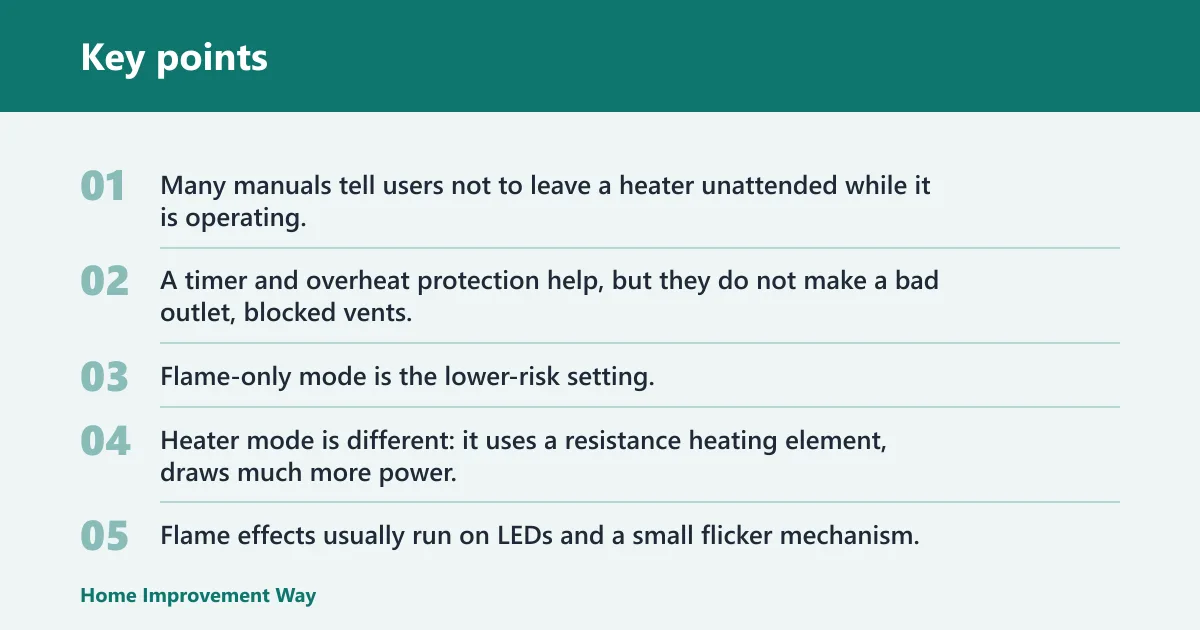
That difference matters at bedtime. Many manuals tell users not to leave a heater unattended while it is operating, and sleeping generally counts as unattended use. A timer and overheat protection help, but they do not make a bad outlet, blocked vents, or a damaged cord safe.
Flame-only mode vs. heater mode
Flame-only mode is the lower-risk setting, and it is the setting most likely to be acceptable overnight when the unit is in good condition. Heater mode is different: it uses a resistance heating element, draws much more power, and needs more caution because heat, airflow, and electrical load all matter.
Flame effects usually run on LEDs and a small flicker mechanism, so they produce very little heat. By contrast, heater mode can cycle on and off to hold a room temperature, but thermostat cycling does not fix poor clearance, dust-clogged vents, a warm plug, or a circuit that is already loaded.
Electric fireplace checklist table
Use this table as a quick go/no-go check before you sleep. If one item fails in the last column, do not leave the unit on overnight. Follow the manual first, then use the 3-foot rule only as the common heater-safety standard used in portable-heater guidance when applicable.
| Overnight outcome | Check | What to look for | Why it matters |
|---|---|---|---|
| Safe to leave on flame-only | Mode | Flame-only is selected; heater is off. | LED flame effects draw very little power and make little to no heat. |
| Safe to leave on flame-only | Outlet and cord | Wall outlet and plug stay cool; no scorch marks, looseness, or damage. | Heat at the plug or faceplate points to resistance, arcing, or overload. |
| Safe to leave on flame-only | Clearance | Bedding, curtains, and furniture follow the manual; if the manual does not specify, keep at least 3 feet away from combustibles. | CPSC and NFPA home fire guidance use a 3-foot clearance rule for heaters and combustible materials. |
| Safe only with timer or thermostat and strict conditions | Timer | Automatic shutoff is set, and the model supports unattended operation in the manual. | Timer ranges vary by model, so the built-in shutoff must match the exact manual. |
| Safe only with timer or thermostat and strict conditions | Thermostat | Heat setting is modest, airflow is clear, and the room does not need continuous heat. | Thermostat cycling reduces run time, but it does not remove heater-mode risk. |
| Safe only with timer or thermostat and strict conditions | Unit condition | The fireplace is clean, vents are open, and the cord jacket is intact. | Dust, lint, or damage can trigger overheat protection or create a failure point. |
| Do not leave on overnight | Outlet heat | Plug, faceplate, or receptacle feels hot or smells burnt. | That suggests the circuit or connection is stressed and should not run unattended. |
| Do not leave on overnight | Cord type | An extension cord or power strip is in use. | Electrical safety guidance warns against using extension cords or power strips with high-wattage heaters. |
| Do not leave on overnight | Blocked vents | Intake or outlet openings are blocked by dust, fabric, or furniture. | Blocked airflow can trip thermal cutoff or overheat the unit. |
| Do not leave on overnight | Nearby combustibles | Paper, blankets, rugs, or décor are too close to the front or sides. | Combustible items near heat output raise the fire risk fast. |
| Do not leave on overnight | Manual wording | The manual says not to leave the unit unattended while operating. | Manual instructions control the model, even if the fireplace has a timer. |
What happens if you leave it on all night?
If a unit is left on all night in heater mode, the main risks are blocked airflow, a hot plug or faceplate, and a circuit that is already carrying too much load. Those are the failure cases that turn an ordinary appliance into a problem while everyone is asleep.
Flame-only mode is a different story. It is far less demanding, but it still needs a sound cord, an undamaged outlet, and enough clearance that the unit can breathe and the nearby area stays free of combustibles.
Blocked intake or outlet openings
Dust, pet hair, bedding, or a rug edge can block the intake or outlet. When that happens, the unit may run hotter than intended and the thermal cutoff may shut it down. Many modern units include overheat protection, but that is a backup, not a plan.
Suppose a portable fireplace sits beside a bed and the blanket edge slips against the lower intake. The heater may keep trying to cycle, then shut down after it senses excess heat. That shutdown is a warning sign, not proof that overnight use is fine.
Hot plug, cord, or faceplate
Touch the plug and the outlet faceplate before bed. They should feel normal, not warm or hot. If the cord jacket is cracked, the plug prongs are loose, or the receptacle looks darkened, stop using it until an electrician checks the outlet and the unit is repaired or replaced.
A common first-timer mistake is plugging a high-wattage heater into a tired outlet with a loose fit. The unit may still turn on, but heat at the connection points means resistance and stress, which are poor signs for unattended use.
Electric fireplace heaters can draw a lot of power. If the same circuit also feeds a TV, game console, lamp, or space heater, the breaker may trip or the wiring may run hotter than it should. A dedicated wall outlet is the better choice when the manual allows overnight use.
Do not use extension cords or power strips. Electrical safety guidance warns against them for high-wattage heating appliances, and that advice matters even more for a heater that may cycle on and off through the night.
Do electric fireplaces have automatic shutoff?
Many do, but the details vary by model. Automatic shutoff timers are common, and some units also include overheat protection that cuts power if the intake is blocked. The exact timer range and unattended-use permission must come from the manufacturer manual.
That said, a timer is not enough by itself. It helps with unattended operation, but it does not fix a hot outlet, a damaged cord, or a manual that says not to leave the fireplace running while unattended.
Timer range and model limits
Check the exact model before you trust the timer. Timer ranges vary widely, so the only reliable rule is the one in the manual. A timer that is built into the fireplace and approved by the manufacturer can help with overnight use, but the appliance still has to pass the outlet, clearance, and cord checks.
Do not assume that one model’s overnight timer setting applies to another. A built-in shutoff is useful only when the manual allows the fireplace to run unattended.
Overheat protection and thermal cutoff
Overheat protection is a key safety feature on many modern units. If airflow is blocked or internal temperature rises too far, the thermal cutoff shuts the unit down. That feature helps prevent damage, but it also tells you something is wrong with airflow, placement, or both.
Cool-touch glass or exterior panels can reduce burn risk, and many premium models use them. Even so, cool-to-the-touch surfaces do not make heater mode risk-free when the unit is left unattended.
Why a timer is not enough by itself
A timer only controls run time. It does not inspect the cord, verify the outlet, or clear lint from the intake. If the manual says not to leave the unit unattended, the timer does not override that warning.
Follow the exact model wording. If the manual is silent on unattended use, treat sleeping as unattended use and default to a safer setting or switch the unit off.
What to check before sleeping
Before you go to bed, check the unit the same way you would check a small space heater. Look at the outlet, the clearance, the vents, the cord, and the manual. If any part looks questionable, turn the heater off and use flame-only mode or shut the unit down completely.
- Feel the outlet and plug. Warm is a warning; hot means stop.
- Check clearance. Follow the manual first; if it does not specify a distance, use 3 feet away from bedding, curtains, and furniture for heater safety.
- Inspect the cord. No cuts, kinks, crushed spots, or taped repairs.
- Clear the vents. Intake and outlet openings must stay open.
- Read the manual line about unattended use. Follow the exact model wording.
- Confirm a smoke alarm is working. Put one in the room or nearby.
A smoke alarm is a basic overnight fire precaution. It is not a substitute for good placement, but it adds an important layer if a heater fails, overheats, or trips a breaker while you are asleep.
Say your bedroom fireplace is on flame-only and sits 4 feet from the curtain. The plug is cool, the cord is intact, and the unit manual allows flame-only operation. That is a very different setup from a heater aimed at a blanket pile two feet away.
Suppose you have a secondhand unit in a kids’ room and the outlet faceplate feels warm after an hour on heat. Even with a timer, that is a do-not-leave-it-on case until the outlet and cord are checked.
Frequently asked questions
Can you leave an electric fireplace on overnight?
Usually yes in flame-only mode, if the unit is in good condition and the outlet stays cool. For heater mode, the answer depends on the manual, the timer, clearance, and cord and outlet condition. If the manual warns against unattended use, follow that warning and shut it down.
Can you leave an electric fireplace on all night?
Flame-only mode may be acceptable overnight on many models. Heater mode is a different decision. If the unit has a timer, overheat protection, clear vents, and a cool outlet, some models are built for overnight use, but only when the manual allows it and the room setup is right.
What happens if you leave an electric fireplace on all night?
If the unit is blocked, overloaded, or damaged, it can overheat, trip a breaker, or heat the plug and faceplate. Most modern units have some protection, but that does not remove the risk of a bad outlet, poor clearance, or a cord that should be replaced.
Can you leave an electric fireplace heater on all night?
Only if the exact model manual allows unattended use and the setup passes every check. That means no extension cord, no hot outlet, no blocked intake, and no combustibles nearby. If any of those fail, do not let the heater run while you sleep.
Should you use an extension cord with an electric fireplace?
No. Electrical safety guidance warns against extension cords and power strips with high-wattage heaters, and that is sound advice for an electric fireplace in heater mode. Use a dedicated wall outlet whenever possible, and stop using the unit if the plug or outlet faceplate feels warm or shows discoloration.
Sponsored / affiliate links. As an Amazon Associate I earn from qualifying purchases. I may earn additional commission from eligible campaigns.
 AZEUS Portable AC and Heater Unit, 420W 110V Compact Air Conditioner for Tent RV Truck Cabin and Small Room, 1400W Cooling, 800W Heating, Remote Control, Dehumidifier, Sleep Timer, ChampagneMEGAWISE Portable Air Conditioner and Heater, 420W 110V Compact AC Unit with Remote Control, 1400W Cooling Capacity, 800W Heating, Dehumidifier, Fan, Sleep Timer, Champagne