Why Does My Gas Fireplace Click but Not Light?
A gas fireplace that clicks but will not light usually points to one of three faults: no gas supply, a failed igniter or electrode, or a dead pilot or dirty sensor. The click pattern narrows the cause fast. Ignoring it can waste fuel, leave the room cold, and lead to repeated failed starts that need a service call. This guide maps the clicking sequence to the most likely fault and shows the checks you can do first.
This guide is part of our Space Heaters, Fireplaces and Winter Humidity Guide series.
What the click usually means
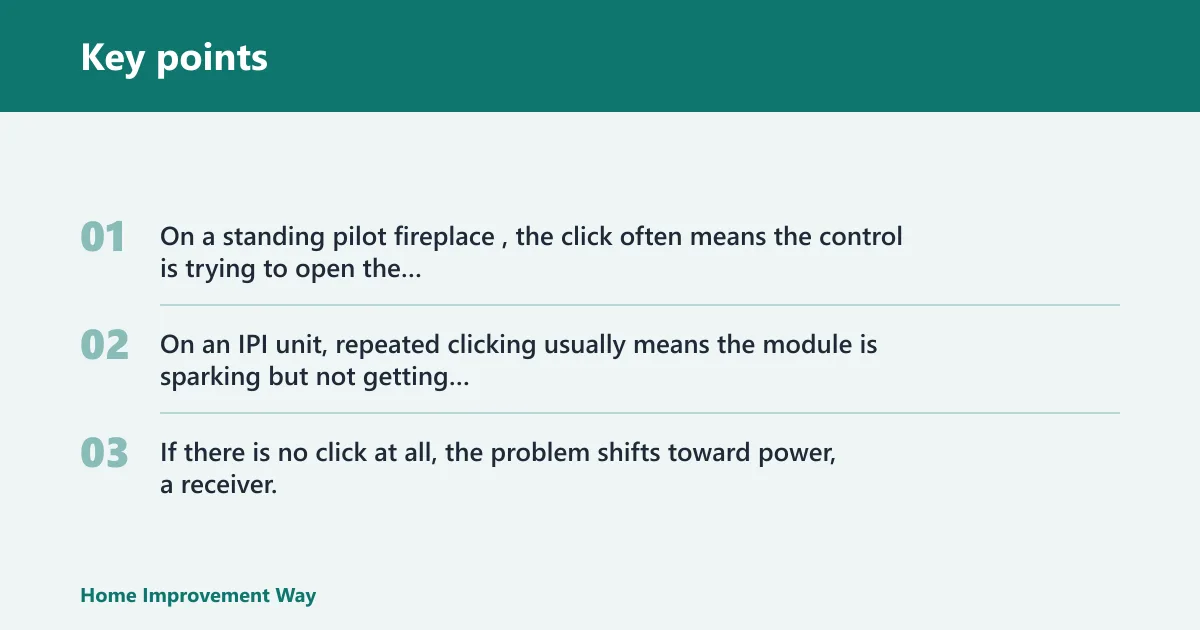
The sound matters. On a standing pilot fireplace, the click often means the control is trying to open the valve or asking the pilot chain to prove heat. On an IPI unit, repeated clicking usually means the module is sparking but not getting ignition. If there is no click at all, the problem shifts toward power, a receiver, or the call-for-heat signal.
What you’ll need before you start
- Flashlight
- Owner’s manual or model tag
- Fresh batteries for the remote or receiver pack
- Soft brush or vacuum with a brush attachment
- Dry microfiber cloth
- Simple notepad for sound and flame notes
Why does my gas fireplace click but not light?
The click usually points to the ignition type and where the start sequence stops. A standing pilot system keeps a small flame lit around the clock, so a click without ignition often means the pilot chain, thermocouple, or thermopile is not doing its job. An IPI fireplace clicks rapidly during startup when the module is sparking but no flame is proving out.
Standing pilot systems
Look for an OFF / PILOT / ON knob. If the pilot stays lit continuously, the fireplace uses a standing pilot millivolt setup. When the pilot lights but goes out after you release the knob, the thermocouple is the first likely suspect. A thermocouple heated by the pilot flame keeps the pilot gas valve open.
IPI ignition systems
If the unit has no OFF / PILOT / ON knob and you hear rapid clicking, it may be electronic ignition. In that case, the module, electrode, flame sensor, or gas supply can be in the way. A dirty flame sensor can stop the module from recognizing the flame, so the system keeps trying.
When the click points to no gas flow
If the sound is present but there is no flame at all, check the manual shutoff valve and any upstream gas shutoff first. The valve must be open for ignition. A closed gas supply can look like an ignition failure from the front of the fireplace.
What should I check first when my gas fireplace won’t ignite?
Start with the safest checks that do not require tools or gas adjustments. Confirm the gas supply is open, confirm the remote or wall switch has power, and confirm the fireplace has a call for heat. If there is a smell of gas, stop immediately and leave the area.
- Check the manual shutoff valve and any upstream gas shutoff.
- Replace the remote batteries and receiver batteries if the unit has them.
- Verify the wall switch or remote is actually calling for heat.
- Look for power to the receiver or ignition module.
- Try a normal start sequence once, then wait for the result.
A common first-timer mistake is assuming the clicking itself proves the fireplace is getting gas. It does not. A dead receiver battery can block the call-for-heat signal, and a closed shutoff can leave the igniter clicking into a no-flow condition.
Why does my pilot light light but go out when I release the knob?
That pattern usually points to the thermocouple on a standing pilot fireplace. The pilot flame must heat the thermocouple long enough to keep the valve open. Wait 30 to 60 seconds after lighting before releasing the knob. If it still dies right away, the thermocouple or its connection is the likely failure point.
Check the pilot assembly
Inspect the pilot hood and pilot orifice for dust or debris after seasonal inactivity. A weak pilot flame may not fully engulf the sensor. A healthy thermocouple output is roughly 25 to 30 millivolts, and a thermocouple below about 15 to 18 millivolts may not keep the valve open.
When thermopile output matters
On millivolt systems, the thermopile powers the main burner valve. Healthy thermopile output is 500 to 750 millivolts with the fireplace off. Thermopile output much below 300 under load can prevent the main burner from coming on, even if the pilot stays lit.
What does rapid clicking with no flame mean on a gas fireplace?
Rapid clicking with no flame usually means an IPI system is sparking but not lighting. That points to the ignition module, the pilot assembly, a dirty flame sensor, or a gas-supply issue. If there is no flame after a normal start sequence, stop after one attempt and move to the next check instead of repeating the cycle.
- Confirm the gas shutoff is open.
- Open the access panel and inspect the pilot hood for dust or debris.
- Check the flame sensor for buildup if the manual allows simple cleaning.
- Replace remote or receiver batteries if present.
- Try one start cycle only, then pause and listen.
Say your IPI fireplace clicks rapidly for about 10 to 15 seconds, shows no flame, and then stops. That pattern fits a spark-without-ignition problem more than a standing pilot failure. If the same unit later lights but the flame is weak or short, a gas supply or pilot assembly issue moves higher on the list.
Gas fireplace troubleshooting matrix
| Ignition type | Sound pattern | Visible flame behavior | Likely cause | Safe homeowner check | Stop-call threshold |
|---|---|---|---|---|---|
| Standing pilot | Single click or weak attempt | Pilot will not stay lit | Thermocouple issue, dirty pilot hood, low pilot flame | Check the knob position, wait 30 to 60 seconds before release, inspect for dust at the pilot hood | Gas odor, soot, delayed ignition, or pilot still will not hold after a normal relight |
| IPI | Rapid clicking with no flame | No flame appears | Ignition module, flame sensor, pilot assembly, or gas supply issue | Check shutoff valve, batteries, and receiver power; inspect for debris | No ignition after one cycle, gas odor, or repeated lockout |
| Standing pilot | Click, then flame goes out at start | Pilot lights, main burner does not start | Thermopile output too low under load | Verify the pilot stays strong and the main control is receiving a call for heat | Flame rollout, unusual soot, or delayed ignition |
| IPI | No click at all | No spark, no flame | No power, bad receiver battery pack, failed control signal | Check wall switch, remote, batteries, and receiver power | Any gas smell, carbon monoxide alarm, or visible venting trouble |
| Any type | Clicking plus boom or whoosh | Delayed flame start | Delayed ignition with gas buildup | Shut the unit down and do not restart | Immediate service call |
Common mistakes to avoid
Do not keep pressing the start control after repeated failed attempts. Do not bypass a safety control or hold a valve open to “help” the flame catch. Do not ignore a carbon monoxide alarm, a lingering gas smell, soot, or a boom at startup. Those are stop-use warnings, not nuisance symptoms.
Suppose the fireplace clicks and then makes a brief whoosh before the flame appears. That delayed ignition is not something to keep retrying. Shut the unit down and schedule qualified service, because the issue can point to unsafe gas buildup or venting trouble.
If that didn’t work, try this next
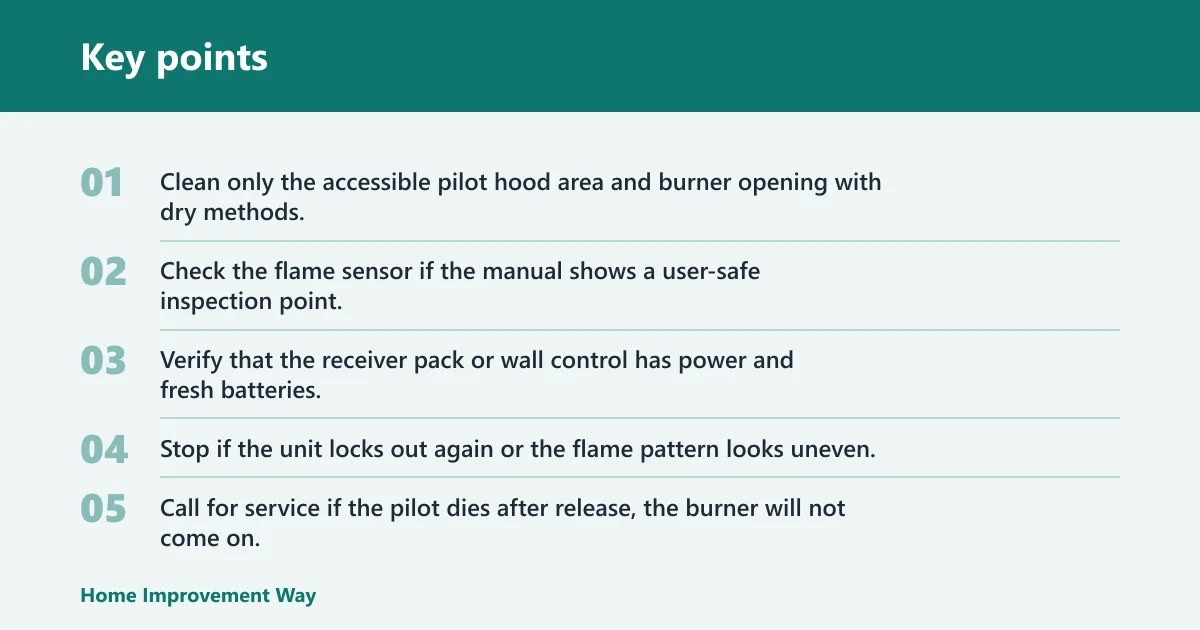
- Clean only the accessible pilot hood area and burner opening with dry methods.
- Check the flame sensor if the manual shows a user-safe inspection point.
- Verify that the receiver pack or wall control has power and fresh batteries.
- Stop if the unit locks out again or the flame pattern looks uneven.
- Call for service if the pilot dies after release, the burner will not come on, or the click persists with no ignition.
For prevention, schedule annual service and keep the access area free of dust so seasonal startup does not begin with a blocked pilot hood or debris at the burner.
Frequently asked questions
Why is my gas fireplace clicking but not lighting?
The most common split is between standing pilot and IPI ignition. Check the shutoff valve, then the remote or wall switch batteries. If it has an OFF / PILOT / ON knob and the pilot will not stay lit, the thermocouple chain is the next likely fault. Stop for gas odor or delayed ignition.
Why is my gas stove clicking but not lighting?
A gas stove usually clicks because the igniter is sparking at the burner, while a fireplace may click because a pilot or module is trying to start. First check the burner cap alignment, then the igniter area for spills or debris. If the flame never appears, stop and inspect the gas supply.
Is a clicking gas fireplace normal when it won’t light?
Brief clicking during startup can be normal, but continuous clicking with no flame is not. On an IPI unit, rapid clicking usually means the module is sparking without ignition. On a standing pilot unit, the click plus no flame points more toward the pilot chain or gas supply than normal operation.
When should I stop troubleshooting and call a pro for a gas fireplace?
Stop immediately if you smell gas, hear a boom or whoosh at startup, see soot, or get a carbon monoxide alarm. Call for service if repeated attempts fail after the shutoff, batteries, and pilot checks are done. Any sign of venting trouble also belongs in the stop-use category.
Can low gas pressure keep a fireplace from lighting?
Yes. Low gas pressure can keep an IPI unit from lighting or can make a standing pilot too weak to keep the safety chain engaged. Homeowners should not attempt live pressure testing. If the shutoff is open and the unit still will not light, that is a good point to bring in a technician.
Sponsored / affiliate links. As an Amazon Associate I earn from qualifying purchases. I may earn additional commission from eligible campaigns.
 ROVSUN 18000 BTU Mini Split AC/Heating System with Inverter, 20 SEER2 Energy Saving 230V Ductless Split-System Air Conditioner with Pre-Charged Condenser, Heat Pump, Remote Control & Installation Kit
 Faryuan Bladeless Heater Fan, 25inch Heating & Cooling & Filter Combo Tower Fan 80° Oscillating with Remote, 9H Timer, 8 Speeds, Portable Quiet for Indoor, Bedroom, Home Office Room, White&Sliver