Can You Use a Space Heater Under a Desk?
Yes, but only if the heater stays on the floor with about 3 feet of clearance from papers, curtains, and the underside of the desk, and plugs directly into a wall outlet. Bad placement can overheat surfaces, trip breakers, or start a fire. This guide explains safe under-desk placement, cord and outlet rules, and when to skip the setup.
Can you use a space heater under a desk?
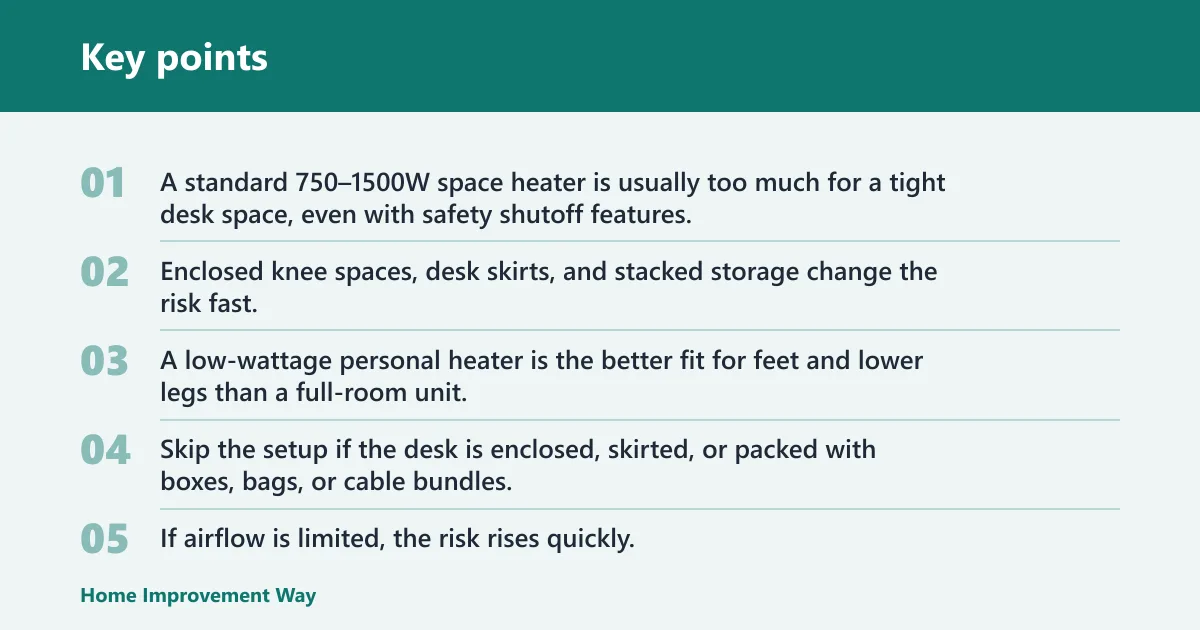


An under-desk heater can be acceptable only in an open, low-clutter setup with enough airflow, a hard nonflammable surface, and direct wall power. A standard 750–1500W space heater is usually too much for a tight desk space, even with safety shutoff features. Enclosed knee spaces, desk skirts, and stacked storage change the risk fast.
When under-desk placement can be acceptable
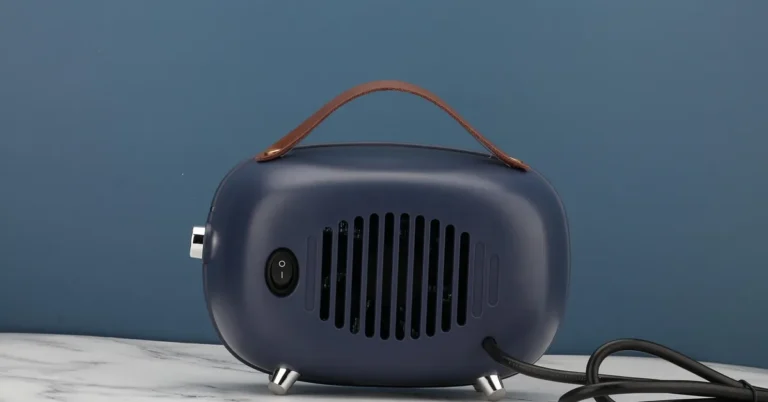
Use the heater only when the floor area under the desk is open on the front and sides, the cord can reach a wall outlet without crossing a rug, and the heater sits upright on a stable surface. A low-wattage personal heater is the better fit for feet and lower legs than a full-room unit.
Suppose a compact 500 W PTC heater is placed on bare flooring under a simple straight desk, with papers kept out of the zone and the cord routed to a wall outlet. That is much closer to acceptable than placing a 1500W tower in a crowded cubby with a skirt and laptop bag.
When under-desk placement is a bad idea
Skip the setup if the desk is enclosed, skirted, or packed with boxes, bags, or cable bundles. A heater under a desk should never be hidden behind a chair, pressed against a panel, or used where knees, chair legs, or paperwork can block the intake or outlet. If airflow is limited, the risk rises quickly.
Why enclosure and airflow change the answer
Heat needs room to move away from the unit. In a closed knee space, hot air recirculates, the case temperature can rise, and nearby items warm up faster than expected. Tip-over protection and overheat protection help, but they are backup features, not permission to crowd the heater.
Desk heater safety checklist
Use this checklist before turning the heater on. Every item should pass. If one fails, the setup is not safe enough for under-desk use.
| Check | Pass | Fail |
|---|---|---|
| Clearance from chair legs | Heater has open space around chair legs and feet. | Chair legs can strike or block the heater. |
| No curtain or skirt contact | No fabric can touch or drape over the heater. | Desk skirt, curtain, or cover hangs into the hot zone. |
| Direct wall outlet | Heater plugs straight into a wall receptacle. | Any adapter, strip, or extension cord is in the path. |
| No power strip | No strip or cube tap is used. | Heater shares a strip with other devices. |
| Stable hard surface | Heater sits on a level, hard, nonflammable floor. | Heater rests on carpet, a rug, or a soft mat. |
| Free intake and outlet airflow | Front, back, and sides stay open. | Vents point into a wall, panel, or stack of items. |
| Cord not under rug | Cord runs openly and is visible. | Cord passes under a rug, mat, or threshold strip. |
| 3-foot combustibles zone | Papers, bags, and fabrics stay outside 3 feet. | Combustible items sit inside the zone. |
| Tip-over shutoff | Heater has automatic shutoff if knocked over. | No tip-over protection is present. |
| Overheat shutoff | Heater shuts down if internal temperature climbs too high. | No overheat protection is present. |
| No unattended use | Someone is present and awake while it runs. | Heater is left on while leaving the room. |
| Office-rule check | Building and employer rules allow it. | Office policy bans personal heaters or corded heating devices. |
What makes an under-desk heater safer?
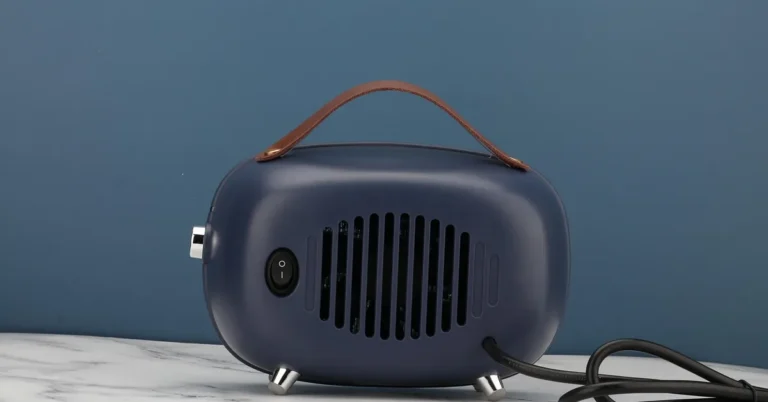
A safer desk heater is usually a low-wattage personal unit, not a full-size room heater. Models listed at 250 W, 375 W, 400 watts, 500 W, 520 W, and 750 W on high show the range people often consider for spot warmth. Lower wattage can help, but only if the placement is still open and controlled.
Low-wattage PTC ceramic heaters
PTC ceramic heaters are common for desk use because they heat quickly and stay compact. Even so, they still need open airflow and a nonflammable surface. Low wattage reduces load; it does not fix bad placement.
Convection and oil-filled options
For a stationary office seat, a quiet convection or oil-filled heater may fit better than a fan-driven model. These options usually warm more gradually and can be less annoying in a quiet room. They still need the same clearance, direct-wall power, and hard-surface placement rules.
Why large 1500W heaters are a poor fit
A 1500W space heater is meant for supplemental heat in a larger area, not a cramped footwell. In a small desk space, that much output can make nearby furniture, cords, and papers heat up too fast. Safety shutoff features do not cancel the need for space and airflow.
How far should a space heater be from furniture?
Keep the heater about 3 feet away from furniture, curtains, bedding, bags, papers, and other combustible materials. That 3-foot clearance also matters around feet, chair legs, and kid or pet zones. If the heater cannot keep that buffer, it is too close.
The 3-foot clearance rule
The 3-foot rule is a practical minimum for combustible materials and for people who might bump, lean, or drop something into the zone. Consumer guidance also says to keep a three-foot kid- and pet-free zone around the heater. In an office, that means no stack of files or tote bag should crowd the space. (Consumerreports)
Desk skirts, curtains, papers, and bags
Fabric is a problem because it can sag into the hot area without warning. Desk skirts, drapes, shipping boxes, paper stacks, and laptop sleeves can all reduce safe space. If any of those items touch the heater or sit within 3 feet, move them first or move the heater.
Clearance around feet and chair legs
Under-desk placement needs clearance not only for heat, but for movement. Chair legs can block vents, and feet can bump the unit when you shift position. Keep the heater where normal chair movement cannot push it against a wall or trap it under the desk frame.
Can you put a space heater on a desk or table
Only if the manufacturer allows that placement and the surface is hard, level, and nonflammable. A desk or table is not the default safe choice. Many heaters are meant for the floor, and a crowded desktop can make heat and cord control worse, not better.
Stable, hard, nonflammable surfaces
Consumer guidance says to place a heater on a hard, level, nonflammable surface. That means a solid tabletop may work only when the model is approved for it and the surface stays clear. A wobbly table, laminate covered in clutter, or shelf beside papers is not a safe substitute.
Why carpet and soft surfaces are unsafe
Carpet and rugs can insulate the base, block airflow, and expose the heater to lint and debris. Under a desk, that becomes more likely because cords, chair legs, and foot traffic crowd the same area. A soft mat is still a poor choice for a heater base.
Manufacturer instructions still control
Even if a surface seems sturdy, follow the label and manual first. Some small heaters are built for floor use only. If the instructions do not permit desk or table placement, do not improvise.
Why outlets matter more than cords
Direct wall power is the safer choice for a desk heater. Consumer guidance says not to use an extension cord with a space heater, and the same rule applies to power strips. The circuit, plug type, and cord routing all matter because heater loads are high and mistakes are common.
Direct wall outlet only
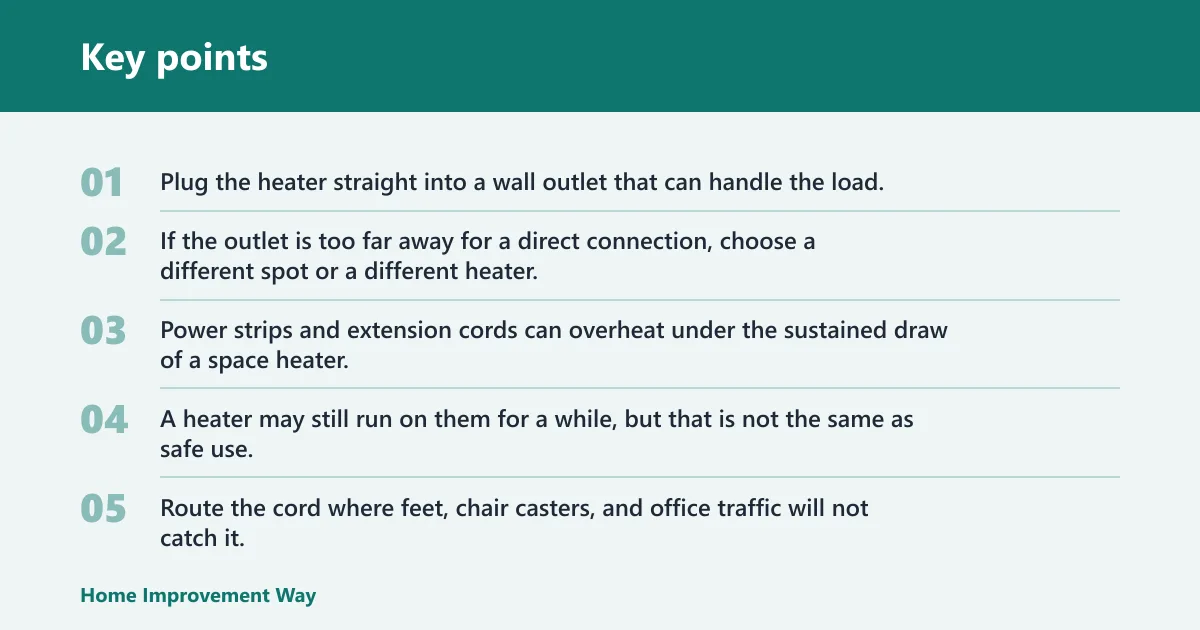
Plug the heater straight into a wall outlet that can handle the load. That reduces resistance, heat buildup, and extra failure points. If the outlet is too far away for a direct connection, choose a different spot or a different heater.
Why power strips and extension cords are a no
Power strips and extension cords can overheat under the sustained draw of a space heater. They also add another trip and melt hazard under a desk. A heater may still run on them for a while, but that is not the same as safe use.
Cord routing that avoids trip hazards
Route the cord where feet, chair casters, and office traffic will not catch it. Do not run it under a rug or across a high-traffic walkway. A common first-timer mistake is hiding the cord behind the chair, where it gets pinched, tugged, or bent sharply.
Office heater choices that fit desk setups
For a home office or shared workspace, the safest choice is usually the one that matches the space, not the hottest one. Office rules, foot traffic, and outlet access matter. A quiet heater that fits the room layout is often better than a stronger unit that creates clutter.
Fan heaters for fast spot warmth
Fan heaters give quick warmth to feet and shins, which is useful if the room is cool and you sit still for long periods. They can also push heat toward nearby papers or fabric if the setup is cramped. They work best when the desk area is open and tidy.
Oil-filled heaters for steady heat
Oil-filled heaters are often a better match for stationary work because they give steady heat with less direct blast. They are bulkier, so floor space matters. In a small office, they may fit better beside the desk than directly under it.
When wall-mounted or radiant options make more sense
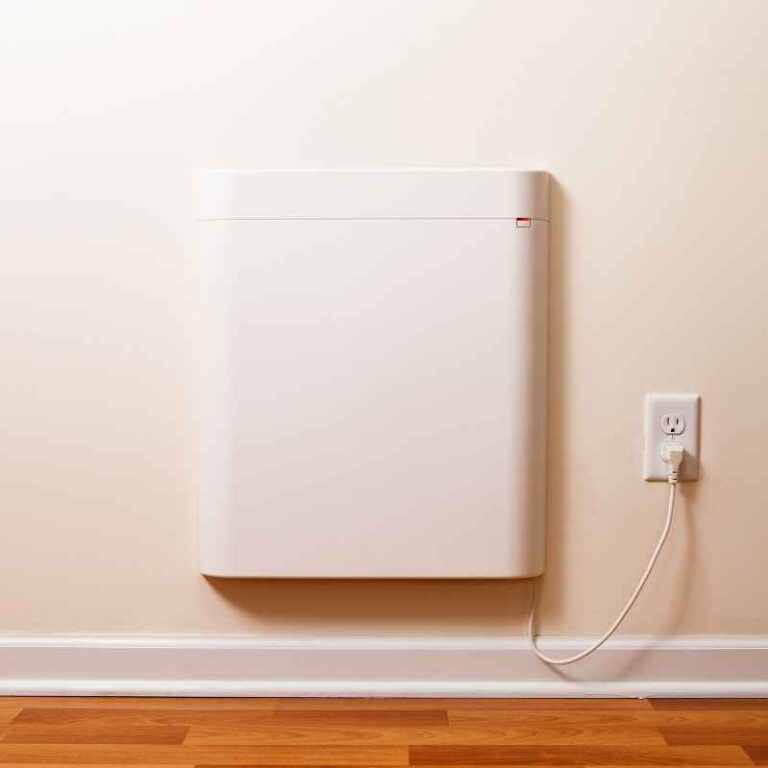
If the desk area is enclosed or the floor is crowded, a wall-mounted or other fixed option may be safer than a portable unit. That keeps the heater out of the footwell and reduces bump risk. In shared offices, fixed solutions also reduce cord clutter and accidental movement.
Under-desk heater safety checklist
Use this list before each heating session. It is a quick pass/fail check, not a shopping guide.
- Confirm open clearance. Make sure the heater has at least 3 feet of open space from papers, curtains, bags, and other combustibles. If the desk skirt or chair position cuts into that zone, move the heater.
- Check the floor surface. Place the heater on a hard, level, nonflammable surface. Do not set it on carpet, a rug, or a soft mat under the desk.
- Verify direct power. Plug the heater directly into a wall outlet. No power strip, cube tap, or extension cord should be involved.
- Inspect airflow paths. Keep intake and outlet vents clear of panels, boxes, chair legs, and feet. If the heater cannot breathe freely, it does not belong there.
- Look for safety shutoffs. Choose a model with tip-over protection and overheat protection. These features are important in tight spaces, but they do not make a bad layout safe.
- Route the cord safely. Keep the cord visible and out of walk paths. Do not run it under a rug, where friction and heat can become a problem.
- Keep it attended. Turn the heater off when leaving the room or when you stop working. Do not leave it running under the desk unattended.
- Check office rules. Make sure your building or employer allows a personal heater. Shared workplaces may restrict devices because of ventilation, foot traffic, and circuit limits.
Picture a 400-watt personal heater tucked under a desk with a tote bag on one side and a power strip on the other. The heater may still warm feet, but the setup fails two safety checks at once. The fix is not a stronger heater; it is a safer layout.
Frequently asked questions
Can you put a space heater under a desk?
Yes, but only in an open setup with 3 feet of clearance, direct wall power, and a hard nonflammable floor. If the desk is skirted, enclosed, crowded, or wired through a strip, the answer is no. Under-desk heat is a placement question first.
Can you put a space heater on a desk?
Only if the manufacturer allows tabletop use and the desk is stable, hard, level, and free of clutter. Many heaters are intended for floor placement instead. If papers, monitors, or cords crowd the surface, choose another location.
Can you put a space heater on a table
Sometimes, but only with a model approved for tabletop use and a nonflammable, steady surface. The table must stay clear of fabrics, paper, and anything that can fall into the heater. If the table wobbles or the cord pulls awkwardly, skip it.
Are space heaters allowed in office buildings?
Not always. Some buildings allow them, some ban them, and some limit them by wattage or location. Shared offices also have foot-traffic and outlet-access issues, so check employer and building rules before you bring one in.
What kind of heater is safest for a home office?
A low-wattage personal heater with tip-over protection and overheat shutoff is usually the better fit for desk warmth. PTC ceramic units around 400–520W are common for this use. For a quiet stationary setup, convection or oil-filled heaters can also work well if the space allows.
Can I use an extension cord or power strip with a desk heater?
No. Consumer guidance says not to use an extension cord with a space heater, and the same caution applies to power strips. Plug the unit directly into a wall outlet so the connection stays cooler and simpler.
Sponsored / affiliate links. As an Amazon Associate I earn from qualifying purchases. I may earn additional commission from eligible campaigns.
 Faryuan Bladeless Heater Fan, 25inch Heating & Cooling & Filter Combo Tower Fan 80° Oscillating with Remote, 9H Timer, 8 Speeds, Portable Quiet for Indoor, Bedroom, Home Office Room, White&Sliver
 MEGAWISE Portable Air Conditioner and Heater, 420W 110V Compact AC Unit with Remote Control, 1400W Cooling Capacity, 800W Heating, Dehumidifier, Fan, Sleep Timer, Champagne