Are Whole-House Humidifiers Worth It?
Whole-house humidifiers make the most sense when winter indoor relative humidity is persistently low, the home uses forced-air heat, and dryness is causing comfort or material problems such as static, chapped skin, or wood movement. The moisture target is usually kept conservative: EPA guidance and extension resources commonly point homeowners away from high indoor humidity because mold risk rises as humidity climbs, with many guidance documents treating roughly 30% to 50% RH as a practical winter band and 50%+ as a risk zone for condensation and microbial growth. For the right home, a whole-house humidifier is a comfort upgrade; for the wrong home, it is a maintenance burden and a moisture hazard.
Verdict
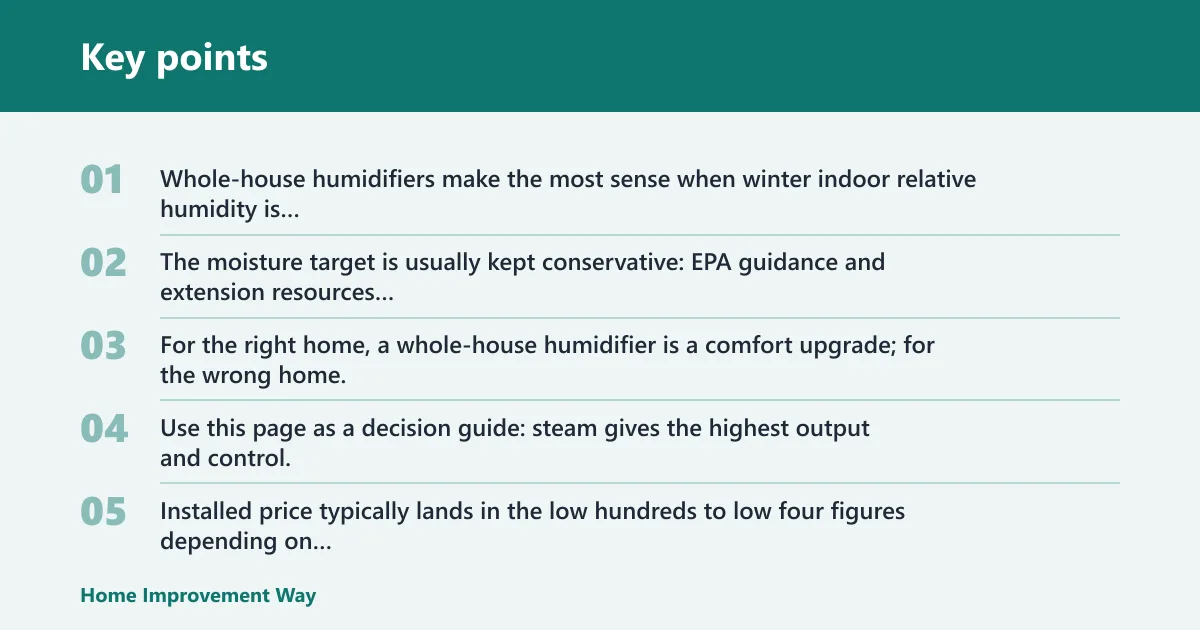

Use this page as a decision guide: steam gives the highest output and control, fan-powered is the middle-ground option, and bypass is the lower-cost, lower-electricity route. Installed price typically lands in the low hundreds to low four figures depending on type and labor, while the right choice depends on house size, furnace runtime, and how much maintenance you are willing to do. For homes with forced-air heat, the biggest mistake is buying by price alone instead of matching output, capacity, and moisture risk.
The best case is a dry winter home with a clear humidity problem and a homeowner willing to maintain the system. The weak case is a tight home with past condensation, a low tolerance for upkeep, or only one room that needs moisture. In those homes, a whole-house unit can be more trouble than it is worth.
Specs at a glance
| Spec | What matters |
|---|---|
| Installed cost | $400 to $1,200 installed |
| Water output | 11.5 to 34.6 gallons per day, depending on model |
| Typical coverage | 500 to 4,000 square feet |
| Steam humidifier output | Up to 34 gallons per day |
| Fan-powered output | Up to 17 to 18 gallons per day |
| Bypass output | Up to 17 to 18 gallons per day; small bypass model up to 12 gallons per day |
| Control | Humidistat monitors humidity and regulates output to a target setting |
| Best-fit types | Steam for large homes and arid climates; bypass for medium or smaller homes; fan-powered for larger homes on a budget |
Who it
The value is strongest in older, leakier homes that lose winter humidity quickly, homes with forced-air heat, and homes with hardwood floors, wood trim, musical instruments, or persistent static. It also fits households that feel dry every heating season and want a whole-home fix rather than room-by-room treatment. Extension and EPA guidance consistently frame indoor RH control as a balance: dry air is uncomfortable, but too much humidity raises mold risk, so the goal is controlled moisture rather than maximum moisture.
Newer, tighter homes need a more careful check. If windows already sweat, if humidity stays stable without help, or if only one bedroom feels dry, a whole-house system may be unnecessary. In that case, the money often goes farther on sealing air leaks or using a portable humidifier where needed.
What the payoff looks like
A properly set whole-house humidifier adds moisture throughout the home and keeps it steadier than a single portable unit in one room. That steadiness matters when dry air is causing chapped lips, itchy eyes, static shocks, or wood movement across several rooms. A humidistat helps by monitoring humidity instead of temperature and regulating output to a target level.
Suppose a 2,000-square-foot home with forced-air heat drops into the low 20% range every winter. A whole-house unit can spread moisture to the main living areas instead of forcing you to move a portable tank from room to room. The system is more useful when the problem is whole-home and recurring.
What makes the value better or worse
The same system can be a smart buy in one house and a weak buy in another. Dry climate, open floor plan, and consistent furnace runtime push the value up. Tight construction, past condensation, and low maintenance tolerance push it down.
That is why output and coverage matter. In Carrier materials, water output ranges from 11.5 to 34.6 gallons per day and typical coverage ranges from 500 to 4,000 square feet for the models discussed here. If the unit is too small for the house, the result is weak comfort gains and the same upkeep burden. Manufacturer specs are the right place to check because “whole-house” does not mean equal capacity across models.
What works
A whole-house humidifier works best when it is sized for the home, the local winter dryness, and the HVAC system. It can add moisture across the whole house, not just one room, and a humidistat can hold the target more consistently than manual guessing. That makes it a practical fix for winter dryness that keeps coming back.
Steam, fan-powered, and bypass designs all do the same basic job, but they fit different homes. Steam models give the most precise control and suit large homes or very dry climates. Fan-powered units are a middle-ground option for larger homes. Bypass units use less electricity than fan-powered models and fit medium or smaller homes well.
Why the humidistat matters
A humidistat is the control device that monitors humidity and regulates output to a set target. That matters because over-humidification is where the trouble starts. Without automatic control, the system can push humidity too high on cold days, then create condensation on windows or wet patches on surfaces.
For most homes, keeping indoor RH in the roughly 30% to 50% range is the practical goal in winter; EPA and extension guidance warn that once humidity pushes above about 50%, mold risk rises and condensation becomes more likely on cold glass and framing. In very cold weather, the correct setpoint may need to be lower than you expect to avoid window sweat.
What does not?
The drawbacks are real. Whole-house humidifiers add installation cost, usually need professional setup, and require maintenance. Evaporator pad or filter replacement is part of the deal, and many manufacturers and installers treat annual service as the baseline, with pads or canisters often replaced every heating season or per the unit’s maintenance schedule. If the unit is neglected, the comfort benefit drops and the moisture risk rises.
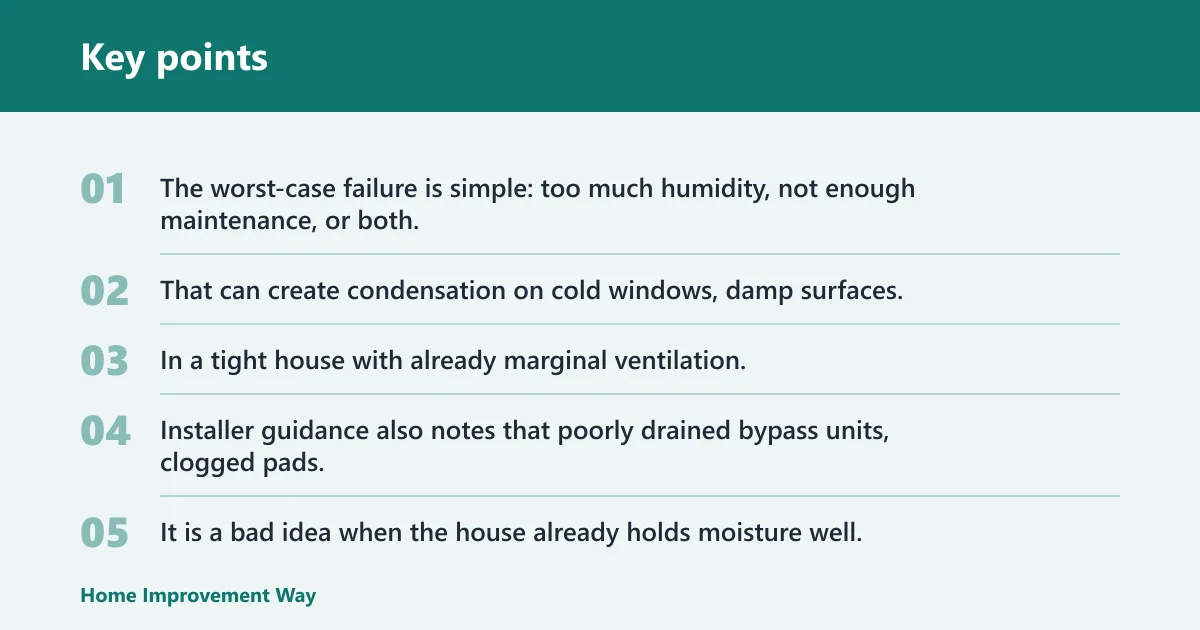
The worst-case failure is simple: too much humidity, not enough maintenance, or both. That can create condensation on cold windows, damp surfaces, and conditions that support mold or mildew. In a tight house with already marginal ventilation, the humidifier can become a net negative instead of a comfort upgrade. Installer guidance also notes that poorly drained bypass units, clogged pads, and mis-set humidistats are common reasons systems underperform.
When it becomes a bad idea
It is a bad idea when the house already holds moisture well, when windows show condensation during cold snaps, or when the homeowner does not want another maintenance task. It can also be a poor buy if the only complaint is dry skin in one bedroom. A portable humidifier is usually easier to justify in that case.
A common first-timer mistake is choosing a higher setting because the air feels dry, then ignoring the windows. If condensation starts on the glass, the target is too high for the conditions. That is the point where the system stops helping and starts creating avoidable moisture problems.
Whole-house humidifier decision matrix
Use this scorecard to judge value before buying. Give 1 point for each low-value condition, 2 points for mixed conditions, and 3 points for strong-fit conditions. Add the points, then use the recommendation band at the bottom.
| Factor | 1 point | 2 points | 3 points |
|---|---|---|---|
| Climate dryness | Mild winter, humidity usually acceptable | Seasonal dryness, some winter discomfort | Dry winter climate, repeated low indoor humidity |
| Home type | Newer tight home with no dryness complaints | Moderately leaky or mixed-performance home | Older leaky home or large home with dry-air complaints |
| HVAC setup | No compatible forced-air system | Compatible, but only one zone needs help | Forced-air heat with whole-home dryness |
| Maintenance tolerance | Low tolerance for upkeep | Willing to do basic checks | Comfortable with regular pad or filter replacement and monitoring |
| Moisture-risk signals | Past window condensation, mold, or wet surfaces | Occasional condensation in cold weather | No condensation history and humidity is consistently low |
Score 5 to 7: skip it or use a portable humidifier. The risk and maintenance burden outweigh the payoff.
Score 8 to 11: consider it only if dry-air complaints affect several rooms and you will keep up with the humidistat and maintenance.
Score 12 to 15: this is the strongest-fit zone for a whole-house humidifier, but the final call should still account for climate, envelope tightness, and condensation risk.
Which type is best?
The best type depends on home size, dryness, and how much control you want. Steam humidifiers are the precision choice. Fan-powered units are a middle-ground option for larger homes. Bypass units are a practical fit for smaller or medium homes, especially when lower electrical use matters.
Steam humidifier
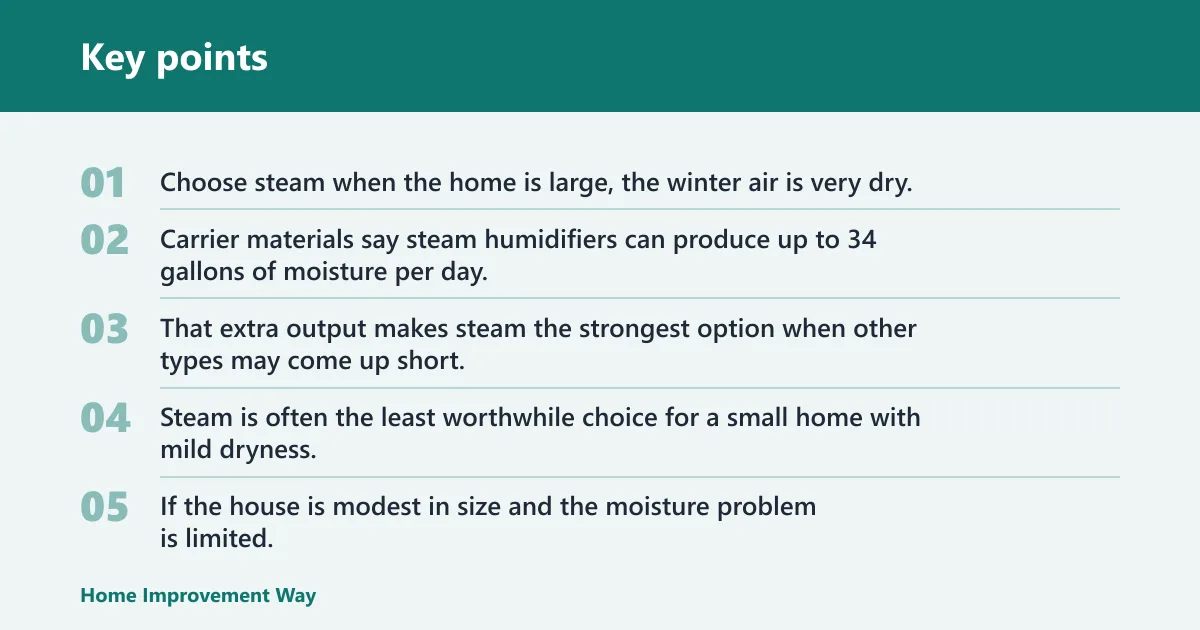
Choose steam when the home is large, the winter air is very dry, or the system needs precise control. Carrier materials say steam humidifiers can produce up to 34 gallons of moisture per day, and they are ideal for large homes and arid climates. That extra output makes steam the strongest option when other types may come up short.
The trade-off is cost and complexity. Steam is often the least worthwhile choice for a small home with mild dryness, because it can be more system than you need. If the house is modest in size and the moisture problem is limited, the added capability may not pay for itself.
Fan-powered humidifier
Fan-powered units are a reasonable choice for larger homes that need more output than a small bypass model can provide. Carrier says fan-powered humidifiers can produce up to 17 to 18 gallons per day. The built-in fan boosts airflow and humidity delivery.
This type makes sense when you want more coverage without moving to steam. The drawback is that it uses more electricity than bypass models. If the home is medium-sized and not especially dry, bypass may be the better value.
Bypass humidifier
Bypass humidifiers fit medium or smaller homes well and use less electricity than fan-powered humidifiers. The same source says bypass models can produce up to 17 to 18 gallons per day, and a small bypass model can produce up to 12 gallons per day. That makes bypass a strong fit when the house does not need the highest output.
This is often the least expensive and least demanding whole-house route. The limitation is capacity. In a large, arid home, bypass can be the wrong match because it may not keep up with the demand.
Least worthwhile setups
The least worthwhile setup is usually a steam unit in a smaller home that already holds humidity well. Another weak fit is a bypass unit in a large, very dry house that needs more output than the system can comfortably deliver. In both cases, the mismatch shrinks the value.
Should you buy one?
Buy a whole-house humidifier if dryness affects more than one room, your home has forced-air heat, and you are willing to keep the humidistat set correctly. It is also a strong candidate for older, leakier homes and for houses with hardwood floors, instruments, or repeated static problems.
Choose a portable humidifier or nothing if the problem is limited to one room, if condensation is already an issue, or if you do not want another maintenance task. Doing nothing can be the better decision when indoor humidity is already acceptable or when the moisture risk is higher than the comfort gain.
How to compare it with doing nothing
Doing nothing costs less up front, but it may leave you with dry air every winter. That can mean more discomfort and more static, plus more movement in wood surfaces. A whole-house humidifier only beats doing nothing when the dryness is real, widespread, and recurring enough to justify the install and upkeep.
Portable humidifiers usually make sense when the problem is isolated. They are cheaper to buy, easier to move, and easier to stop using if condensation appears. The whole-house option pays only when you need whole-home moisture and are prepared to manage it carefully.
Alternatives

Aprilaire 800 is the stronger choice for large homes and very dry climates. Based on the published specs, it brings automatic steam output and coverage for homes up to 10,300 square feet, so it fits situations where lower-output systems may not keep up. The drawback is clear: it is the higher-cost option, and steam capacity is unnecessary for many smaller homes.
Aprilaire 500M is the better value pick for smaller to medium homes that already have forced-air heat and need a practical bypass-style solution. It is rated for homes up to 3,600 square feet and includes a manual humidistat and installation parts. The trade-off is that manual control demands more attention than an automatic steam system, and it is not the best fit for very dry, very large homes.
Who should buy one?
A whole-house humidifier is a good buy if your indoor humidity falls below 30% most winters, you have forced-air heat, and the house feels dry in several rooms at once. It is especially sensible when you already have dryness-related wear on woodwork or recurring static shocks.
Do not buy one just because winter air feels uncomfortable for a week or two. If the problem is local, portable is enough. If the house already shows moisture problems, the safer move may be to skip the humidifier and fix ventilation or air sealing first.
- Check whether humidity is low across the house, not just in one room.
- Look for window condensation, damp corners, or past mold problems.
- Match output to home size and dryness, using gallons per day and coverage area.
- Pick the right type for the HVAC system and your maintenance tolerance.
- Use a humidistat and keep the setting conservative enough to avoid condensation.
Frequently asked questions
Are whole house humidifiers worth it?
Yes, but only for the right home. They are worth it when low winter humidity affects several rooms, the house has forced-air heat, and you are willing to maintain the unit. They are not worth it when moisture is already adequate, the problem is local, or condensation risk is already high.
Are whole house humidifiers worth it for a dry winter climate?
They are most likely to pay off in a dry winter climate. That is where the comfort gain is clearest and the moisture added by the system is most useful. Even then, the unit needs correct sizing and a humidistat, or the benefit can disappear into wasted water and excess humidity.
Is a whole house humidifier a bad idea?
It can be a bad idea in homes that already show condensation, mold risk, or high humidity swings. It is also a poor fit for owners who do not want routine maintenance. In those cases, the unit can add a liability instead of solving a comfort problem.
How much does a whole house humidifier cost to buy and install?
The installed price depends on the unit type, ductwork, electrical work, labor time, and any needed drainage. Manufacturer list prices for consumer models can be lower than the installed total because they do not include labor, controls, or compatibility work.
Which type of whole-house humidifier is best for my home?
Steam is the best fit for large homes and arid climates when precise control matters. Fan-powered works for larger homes on a budget. Bypass is usually best for medium or smaller homes, especially when lower electricity use is a priority and output needs are moderate.
What humidity level should I set a whole-house humidifier to?
A common target is in the conservative middle of the roughly 30% to 50% winter band, and a humidistat helps hold that setting automatically. In colder weather, the right setting may need to be lower to avoid condensation on windows. If surfaces start to sweat, the setting is too high for the conditions. EPA and extension guidance generally support staying below the condensation zone rather than chasing the highest possible RH.
Can a whole-house humidifier cause mold or condensation?
Yes. Humidity above 50% increases mold and bacteria growth risk, and too much moisture can leave condensation on windows and surfaces. The risk rises when the humidifier is poorly maintained, the setting is too aggressive, or the home already has weak ventilation. Mold-control guidance from EPA and extension services consistently warns homeowners to avoid sustained high indoor RH, especially on cold surfaces.
How much water can a whole-house humidifier add per day?
Carrier materials put whole-house humidifier output between 11.5 and 34.6 gallons per day, depending on the model. Steam units can produce up to 34 gallons per day, while fan-powered and bypass models can produce up to 17 to 18 gallons per day. Small bypass models can produce up to 12 gallons per day. These are manufacturer ratings, so actual delivered moisture depends on furnace runtime, duct setup, and the humidity setpoint.
Do whole-house humidifiers save energy or heating costs?
They can, but savings are not guaranteed. Humid air can feel warmer, so some homeowners may lower the thermostat a little and still feel comfortable. The result depends on how dry the home is, how the heat is used, and whether the system is set correctly. Any energy benefit is secondary; the primary job is comfort and humidity control.
Are whole house dehumidifiers worth it?
That is a different question with a different answer. Dehumidifiers are for homes with excess moisture, not dry winter air. If the issue is humidity that stays too low, a dehumidifier would push the home in the wrong direction.
Is whole house humidifier a bad idea?
No, not by default. It becomes a bad idea when the home already shows condensation, the owner will not maintain it, or the need is limited to one room. In a dry, forced-air home with stable upkeep, it can be a good buy.
Sources
Sponsored / affiliate links. As an Amazon Associate I earn from qualifying purchases. I may earn additional commission from eligible campaigns.