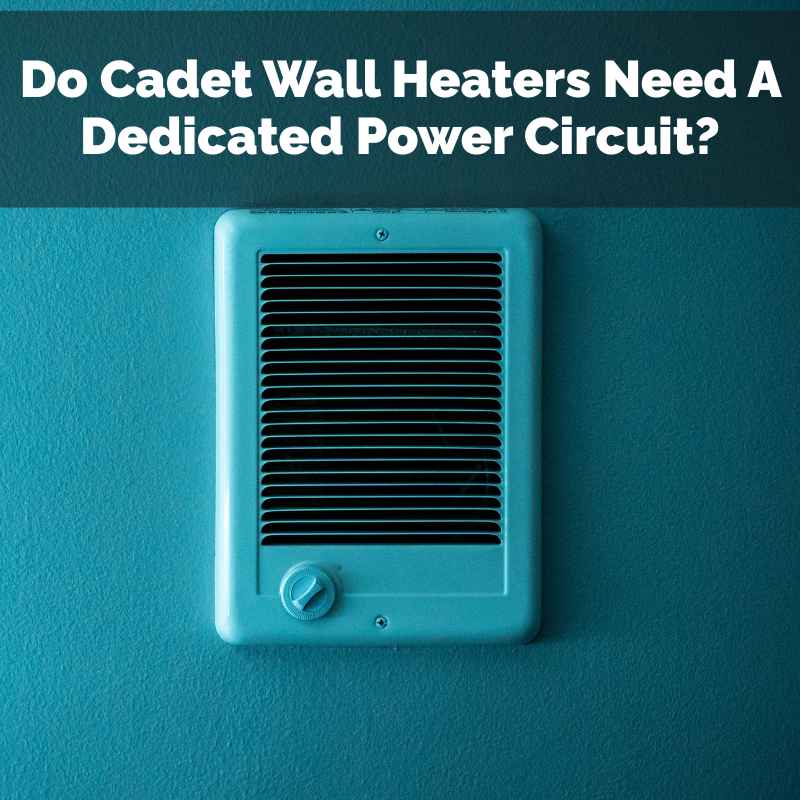
Do Cadet Wall Heaters Need A Dedicated Power Circuit?
It’s a question many of us face when thinking about adding extra warmth to a room. You’ve got a chilly space, and those Cadet wall heaters look like a good, straightforward answer. They’re pretty common, often found in bathrooms, basements, or bedrooms where extra heat is welcome.
But then, the practical side kicks in. How do you hook them up? Is it as simple as plugging them into an existing outlet, or do these heaters have more specific power needs?
This is where things can get a little fuzzy, and it’s totally understandable to want to get it right. Overlooking electrical requirements can lead to more than just a tripped breaker; it can be a safety hazard. Let’s clear up the confusion about whether your Cadet wall heater needs its own special power line.
For most Cadet wall heaters, especially those with higher wattages, a dedicated power circuit is strongly recommended, if not required, to ensure safe and efficient operation. This prevents overloading existing circuits and reduces the risk of electrical issues.
Understanding Cadet Wall Heater Power Needs
Cadet wall heaters are designed to provide efficient heating in specific areas of your home. Like any electrical appliance, they draw power from your home’s electrical system. The amount of power they need depends mainly on their wattage.
Higher wattage heaters use more electricity. Think of it like a light bulb. A small night light uses very little power.
A big floor lamp uses more. A powerful heater is like a really big appliance in terms of power draw.
Your home’s electrical system is divided into circuits. Each circuit is protected by a breaker or fuse. This breaker or fuse has a limit.
It’s designed to shut off the power if too much electricity is trying to flow through it. This prevents wires from getting too hot and causing a fire. When you plug in many devices into one circuit, or a few devices that draw a lot of power, you can exceed that limit.
This is when the breaker trips.
So, the core question is: Do Cadet heaters draw enough power to push an existing circuit to its limit? The answer often depends on the heater’s size and what else is already running on that same circuit. For smaller, lower-wattage models, an existing circuit might be fine.
However, for many common Cadet heater sizes, especially those providing significant heat, they are powerful enough that they really should have their own dedicated circuit.
Why Dedicated Circuits Matter for Safety
Safety is the biggest reason for a dedicated circuit. When an appliance, especially a heating appliance, draws a lot of power, it puts a strain on the electrical wiring. If that wiring isn’t up to the task, or if it’s already being used by other things, it can overheat.
Overheated wires are a serious fire risk. This is why electrical codes often specify requirements for high-draw appliances like electric heaters.
A dedicated circuit means that the Cadet heater is the only appliance on that particular breaker. This ensures that the heater receives all the power it needs without competing with other devices. It also means that the circuit is sized specifically for the heater’s requirements.
This setup prevents overload conditions that could lead to damaged appliances, faulty wiring, or even fires. It’s a proactive step to keep your home and family safe.
It’s not just about preventing fires. Overloading circuits can also damage the heater itself. It can cause premature wear and tear on its components.
This means your heater might not last as long. It might also not perform as well. A dedicated circuit ensures consistent power delivery, helping the heater run optimally.
This leads to better performance and a longer lifespan for the unit. It’s a win-win for safety and efficiency.
My Own Close Call with an Overloaded Circuit
I remember a few years back, I was trying to get my home office set up just right for winter. I had a small space heater, a computer, a monitor, and a printer all running. The room was cold, so I plugged the space heater into the same outlet as the printer.
Everything seemed fine for a while. Then, one afternoon, I heard a strange buzzing sound.
I looked around and realized the buzzing was coming from the wall outlet where the heater and printer were plugged in. The plastic around the outlet felt warm. A little puff of smoke even came out!
My heart jumped into my throat. I immediately unplugged everything. The breaker for that room had tripped.
If I hadn’t noticed the buzzing and the warmth, I dread to think what could have happened.
That experience really hammered home the importance of understanding appliance power needs. That little space heater, combined with the printer, was just too much for the standard circuit it was on. It wasn’t a Cadet heater, but the principle was the same.
Since then, I’ve been much more mindful of what I plug into each circuit. For anything that draws significant power, like a Cadet wall heater, I always check its requirements and consider a dedicated line. It’s a small investment for a lot of peace of mind.
Key Wattage Considerations
Heater Wattage: This is the most critical factor. Most Cadet wall heaters range from 500 watts to over 2000 watts. Higher wattage means higher power draw.
Circuit Breaker Rating: Standard household circuits are often 15 amps or 20 amps. An amp is a measure of electrical current. The total wattage a circuit can handle depends on its amp rating and the voltage (usually 120V in the US).
Continuous Load: Electrical codes often require that a circuit not be loaded beyond 80% of its capacity for continuous use (more than 3 hours). A heater often runs for long periods.
Decoding Your Heater’s Specifications
Every Cadet wall heater comes with a label or plate that lists its electrical specifications. This is your most important source of information. You’ll typically find the wattage (W), voltage (V), and amperage (A).
Sometimes, the manufacturer will explicitly state the recommended circuit breaker size. You might see something like “Requires 120V, 1500W, 12.5A” or “Use 20A circuit.”
Let’s break down the numbers. If a heater is rated at 1500 watts and uses 120 volts, you can figure out its amperage by dividing watts by volts: 1500W / 120V = 12.5 amps. This means the heater draws 12.5 amps when it’s running.
Now, consider your existing circuits. Most standard household circuits are 15 amps. If you plug a 12.5-amp heater into a 15-amp circuit, and that circuit is already powering other things (like lights, a fan, or other outlets), you’re very likely to trip the breaker.
Even if it doesn’t trip immediately, you’re pushing the circuit very close to its limit, which is not safe for continuous operation.
This is why many Cadet heaters, especially those above 1000 watts, are often recommended for or require a 20-amp dedicated circuit. A 20-amp circuit provides more capacity. It can handle the heater’s draw more comfortably, especially when you factor in the 80% rule for continuous loads.
For a 20-amp circuit, 80% is 16 amps, which gives you a good buffer for a 12.5-amp heater.
When Existing Circuits Might Be Enough
There are situations where a Cadet wall heater might be okay on an existing circuit. These are usually for lower-wattage models. For example, a small 500-watt heater might only draw about 4.2 amps (500W / 120V).
If this heater is in a room with very few other electrical devices, it might not cause problems on a 15-amp circuit.
However, you still need to be cautious. What else is on that circuit? Is it a dedicated circuit for outlets, or does it also power lights in the room?
Are you using other devices in that same room simultaneously? These factors all add up. It’s easy to underestimate the total load.
It’s always safer to err on the side of caution.
Another factor is the age and condition of your home’s wiring. Older homes might have wiring that is not as robust as newer systems. This makes them more susceptible to problems when overloaded.
Even if a heater technically fits within the amp rating, older wiring might not handle the sustained load well. It’s a good idea to have an electrician inspect older wiring if you’re planning to add significant electrical loads.
Quick Check for Existing Circuits
- Identify Heater Specs: Find the wattage and amperage on the heater’s label.
- Locate the Breaker: Find the breaker or fuse that controls the outlet you plan to use.
- List Other Devices: Note everything else powered by that same breaker (lights, other outlets, appliances).
- Estimate Total Amperage: Add up the approximate amperage draw of all devices.
- Compare to Breaker Rating: If the total estimated amperage is close to or exceeds 80% of the breaker’s rating (e.g., 12 amps for a 15-amp breaker), it’s likely not suitable.
The “Dedicated Circuit” Explained
A dedicated circuit is a single electrical circuit that is exclusively used by one appliance or a specific group of outlets that will only power one high-demand appliance at a time. For a Cadet wall heater, this means a wire runs directly from your electrical panel (where the breakers are) to the location of the heater, with no other outlets or fixtures branching off from it.
This dedicated line is usually connected to a breaker that is specifically sized for the heater’s needs. For instance, if your Cadet heater requires a 20-amp draw, the electrician will install a 20-amp breaker in your panel for that heater. The wiring itself will also be of the appropriate gauge (thickness) to safely handle that 20-amp load.
Why is this separation so important? It ensures that the heater receives a stable and sufficient supply of electricity. It also prevents a situation where the heater’s power draw could cause other connected devices to malfunction or dim lights.
Imagine trying to run a powerful blender and a toaster at the same time on the same circuit – you might get flickering lights or a tripped breaker. A dedicated circuit for the heater avoids this common problem.
Who Should Install It?
Installing a new electrical circuit is not a DIY job for most homeowners. It involves working with your home’s main electrical panel, which can be dangerous if you don’t have the proper training and safety equipment. Mistakes can lead to electrical shocks, fires, or damage to your entire electrical system.
This is why it is highly recommended, and often legally required, to have a qualified electrician handle the installation of new circuits.
An electrician will know the local electrical codes and ensure the installation meets all safety standards. They can properly size the breaker and wiring. They will also ensure the work is done neatly and safely.
They can also advise you on the best location for the new circuit. Sometimes, they might need to run new wires through walls or ceilings. This requires specific tools and knowledge.
When you hire an electrician, they will typically do the following:
- Assess your electrical panel to see if there is space for a new breaker.
- Determine the correct gauge of wire needed for the heater’s wattage and the circuit length.
- Install a new circuit breaker in the panel.
- Run the new wiring from the panel to the heater location.
- Connect the wiring to the heater and ensure it’s properly grounded.
- Test the circuit to confirm it’s working safely and correctly.
This professional approach guarantees that your Cadet wall heater is powered safely and reliably.
Real-World Scenarios & How They Play Out
Let’s look at a few common situations where this question of dedicated circuits comes up.
Scenario 1: The Cozy Bathroom Upgrade
You’re renovating your bathroom and want to add a Cadet wall heater for those chilly mornings. Bathrooms often have multiple outlets for hairdryers, curling irons, and other devices. They also usually have lighting.
These are typically on a 20-amp circuit, but it’s often a shared circuit.
If you have a 1500W heater (around 12.5 amps) and you plug it into an existing bathroom outlet, and someone else is using a hairdryer (which can draw over 1500W itself, or about 13 amps), the breaker will almost certainly trip. Even without the hairdryer, if the lighting and other outlets are drawing significant power, adding another 12.5 amps could be too much for the 3-hour continuous load rule on a 20-amp circuit (80% of 20 amps is 16 amps).
What happens: The breaker trips frequently. This is annoying and can potentially damage the heater or the breaker over time.
The fix: Run a new, dedicated 20-amp circuit from the panel specifically for the bathroom heater.
This ensures it has all the power it needs and won’t interfere with other bathroom appliances.
Scenario 2: The Basement Man Cave
You’re finishing your basement and want to keep your new “man cave” or entertainment area warm. You’ve got a big TV, a game console, speakers, and maybe a mini-fridge. You install a Cadet wall heater rated at 2000W (about 16.7 amps).
This heater alone draws a lot of power. If you try to plug it into an existing basement circuit that’s already powering your entertainment system, you’re asking for trouble. A 2000W heater often requires its own 20-amp dedicated circuit, and sometimes even a 30-amp circuit depending on the specific model and local codes.
What happens: The breaker trips constantly, possibly even during normal use of the entertainment system. The heater might also not perform at its best.
The fix: A dedicated circuit for the heater is essential.
The electrician will install a new breaker and wiring sized appropriately for the 2000W heater, ensuring it has ample, stable power without impacting the other basement electronics.
Scenario 3: The Small Workshop Nook
You have a small corner in your garage set up as a workshop. You decide to put a smaller Cadet wall heater, perhaps a 1000W model (about 8.3 amps), in that area. The garage might have a few overhead lights and a couple of outlets.
If the garage circuit is already handling the lighting and maybe a power tool or two, adding an 8.3-amp heater could push it over the edge, especially if the breaker is only 15 amps. Even if it doesn’t trip immediately, it might be running close to its 80% limit for continuous use.
What happens: Breaker trips occur, especially if you run a power tool and the heater at the same time. Lights might flicker when the heater kicks on.
The fix: While a dedicated circuit is still the safest bet, for a smaller heater like this, an electrician might assess if the existing circuit is robust enough if it’s a 20-amp circuit and you’re mindful of not running too many other high-draw devices simultaneously.
However, for true peace of mind and optimal performance, a dedicated 15-amp or 20-amp circuit is still the best recommendation.
When is a Dedicated Circuit NOT Strictly Required?
- Very Low Wattage Heaters: Models under 500 watts might be okay on a lightly loaded existing circuit.
- Infrequent Use: If the heater is only used for short bursts and never long periods.
- Lightly Loaded Circuits: If an existing circuit (especially a 20-amp one) powers very few other items.
- Temporary Use: For a very short period, like a few days, with extreme caution.
Note: Even in these cases, it’s crucial to monitor the circuit breaker, outlets, and wiring for any signs of overheating.
What This Means for Your Home
Understanding the power requirements of your Cadet wall heater is essential for a safe and functional home. For most models, especially those above 1000 watts, a dedicated circuit is the best practice. It ensures the heater operates efficiently, prevents overloading of your home’s electrical system, and significantly reduces the risk of electrical fires.
If you’re installing a new Cadet heater, or if you’re experiencing issues like tripped breakers when using your existing one, it’s time to consult an electrician. They can assess your current electrical setup and determine the best course of action. This might involve adding a new dedicated circuit or upgrading existing wiring if necessary.
Ignoring these power requirements can lead to a cascade of problems. You might find yourself constantly resetting breakers. Your appliances could suffer damage.
In the worst-case scenario, it could lead to a dangerous electrical fire. The cost of an electrician to install a dedicated circuit is a small price to pay for the safety and peace of mind it provides. It’s an investment in protecting your home and your family.
Quick Fixes and Preventative Tips
While the main “fix” for a power-hungry heater is a dedicated circuit, here are some tips to help you manage its use and prevent issues.
- Read the Manual: Always check the manufacturer’s specifications for your specific Cadet heater model. It will tell you exactly what power it needs.
- Consult an Electrician: If you are unsure about your home’s wiring or the heater’s requirements, call a professional. They have the expertise to guide you safely.
- Avoid Daisy-Chaining: Never plug a heater into an extension cord, and avoid plugging multiple high-draw devices into a single outlet or power strip.
- Monitor Your Breaker Panel: If a breaker trips, don’t just reset it and forget about it. Try to understand why it tripped. Was it overloaded?
- Check for Warm Outlets/Switches: If any outlets or switches feel warm to the touch, or if you smell a burning odor, turn off the circuit immediately and call an electrician.
- Use Smart Plugs (with caution): For lower-wattage heaters, smart plugs can help monitor energy usage and allow you to schedule them on/off. However, they do not increase a circuit’s capacity.
- Proper Heater Placement: Ensure the heater has adequate clearance around it, as specified by the manufacturer. This is for fire safety and also allows for efficient operation.
Frequently Asked Questions
What is the most common wattage for Cadet wall heaters?
Cadet wall heaters come in a variety of wattages, but common ones you’ll find range from 500 watts up to 2000 watts or even higher for larger models. Lower wattages are suitable for smaller spaces, while higher wattages are needed for larger rooms or to provide significant heating.
Can I use a Cadet wall heater with an extension cord?
No, it is strongly advised against using extension cords with Cadet wall heaters. Extension cords are not designed to handle the high electrical load that heaters draw. Using one can lead to overheating of the cord, melting the insulation, and posing a serious fire risk.
Always plug the heater directly into a wall outlet.
How do I know if my existing circuit is overloaded?
Signs of an overloaded circuit include frequently tripped circuit breakers or blown fuses, flickering lights when appliances turn on, outlets or switch plates that feel warm to the touch, or a burning smell coming from outlets or the breaker panel. If you notice any of these, stop using the appliances on that circuit and call an electrician.
What is the difference between a 15-amp and a 20-amp circuit?
A 15-amp circuit can safely handle about 1800 watts of continuous power (15 amps 120 volts 0.8 for 80% rule). A 20-amp circuit can safely handle about 2400 watts of continuous power (20 amps 120 volts 0.8). Higher amperage circuits can supply more electrical current.
Does a dedicated circuit mean a dedicated breaker?
Yes, generally a dedicated circuit means it has its own specific breaker in your electrical panel. This breaker is sized to protect that particular circuit from overloads. It’s the breaker that allows you to shut off power to that specific circuit without affecting the rest of your home.
Are Cadet heaters energy efficient?
Cadet wall heaters are generally efficient at converting electricity into heat (nearly 100%). However, electric resistance heating is typically more expensive to operate than other heating methods like natural gas or heat pumps because electricity rates can be higher. Their efficiency is in how well they deliver heat, not necessarily in low operating cost.
Conclusion
When it comes to powering your Cadet wall heater, safety and performance go hand-in-hand. While a simple plug-in might seem tempting, the wattage of most heaters means a dedicated power circuit is the safest and most reliable way to go. It protects your home, your appliances, and your family from potential electrical hazards.
Always consult the manufacturer’s guidelines and a qualified electrician to ensure your heater is installed correctly.
Sponsored / affiliate links. As an Amazon Associate I earn from qualifying purchases. I may earn additional commission from eligible campaigns.