How to Lower Humidity in a House in Winter
Aim for roughly 30% to 40% indoor relative humidity in winter. If windows still sweat, lower it a few points and fix the moisture source before adding more ventilation. Ignoring the source can lead to mold, peeling paint, musty air, and higher heating costs. This guide shows how to tell condensation from excess moisture and ventilation problems, then choose the fastest fix.
Winter humidity basics
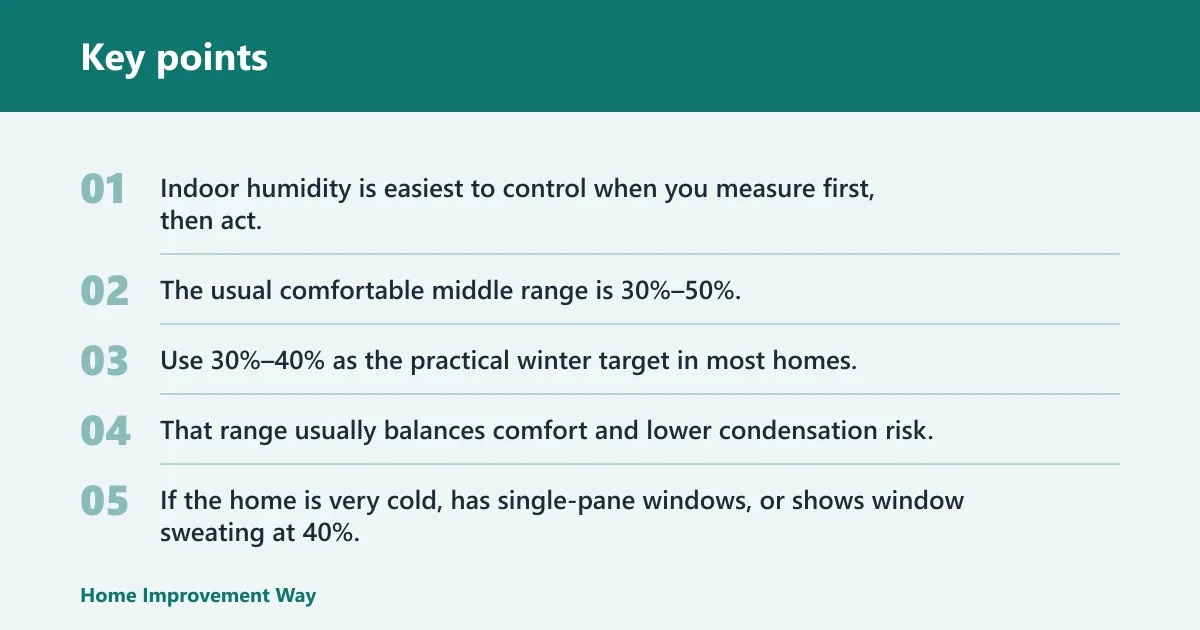


Indoor humidity is easiest to control when you measure first, then act. The usual comfortable middle range is 30%–50%, but winter homes often perform better near the lower end because cold glass, cold wall corners, and other cold surfaces condense sooner.
What relative humidity to aim
Use 30%–40% as the practical winter target in most homes. That range usually balances comfort and lower condensation risk. If the home is very cold, has single-pane windows, or shows window sweating at 40%, move a little lower and keep watching for dryness, static, or nose irritation.
High humidity can feed mold and mildew growth. It can also make wood swell, doors and windows hard to close, wet wood break down and attract destructive insects, and metal surfaces pit and rust.
Why winter condensation shows up first on cold surfaces
Winter condensation usually appears where indoor air meets the coldest surfaces first. That is why you often see moisture on windows, along exterior walls, in bathroom corners, around attic hatches, or near basement framing. The air may be humid everywhere, but the coldest surface shows the problem first.
That difference matters. If only one room has fogged windows, the issue may be local steam or a ventilation fault. If many rooms feel damp, the whole house may be holding moisture or drawing it in from a leak, basement, or attic.
How to measure humidity with a hygrometer
Use a hygrometer before changing anything. Place it in the room with the worst condensation, away from showers, cooking steam, supply vents, and sunny windows. Check it over a full day if you can, because humidity often rises after showers, cooking, and overnight sleep.
A cheap dial gauge can be off enough to mislead you. A digital hygrometer gives a clearer reading, and comparing two rooms can help you see whether the problem is whole-house humidity or one damp zone.
Winter humidity decision table
Use this table to match the symptom to the likely cause and the best first fix. It is faster than guessing at a dehumidifier setting and more useful than treating every damp room the same way.
| Symptom | Likely cause | Best fix |
|---|---|---|
| Bathroom mirror fogs and walls feel wet after a shower | Shower steam and poor exhaust | Run the bathroom exhaust fan during the shower and for 20 minutes after; keep the door mostly closed |
| Kitchen windows sweat while you cook | Steam from boiling, simmering, or dishwashing | Run the kitchen exhaust fan while cooking and for 20 minutes after; use lids when possible |
| Bedroom windows sweat overnight | Sleeping moisture plus weak air circulation | Lower the room humidity, open the door for airflow, and keep curtains from trapping air against the glass |
| Basement smells musty or feels clammy | Groundwater, rainwater intrusion, or poor drainage | Fix leaks, cracks, and water entry first; then dehumidify if the space still stays damp |
| Attic insulation or roof framing shows damp spots | Warm indoor air leaking up, roof leaks, or blocked ventilation | Check for roof leaks and air leaks first; repair them before adding appliances |
If the bathroom mirror fogs every morning while the rest of the house reads around 35% RH, that can point to a local ventilation problem. That points to a local ventilation problem, not a whole-house moisture failure. A bathroom fan that runs long enough often fixes that faster than a dehumidifier placed in another room.
What causes winter humidity in a house?
Winter humidity usually comes from three places: moisture you create indoors, moisture that enters through leaks or cracks, and moisture that gets trapped because the home cannot move air well. Start by identifying which one is active before you choose a tool.
Showering and cooking moisture
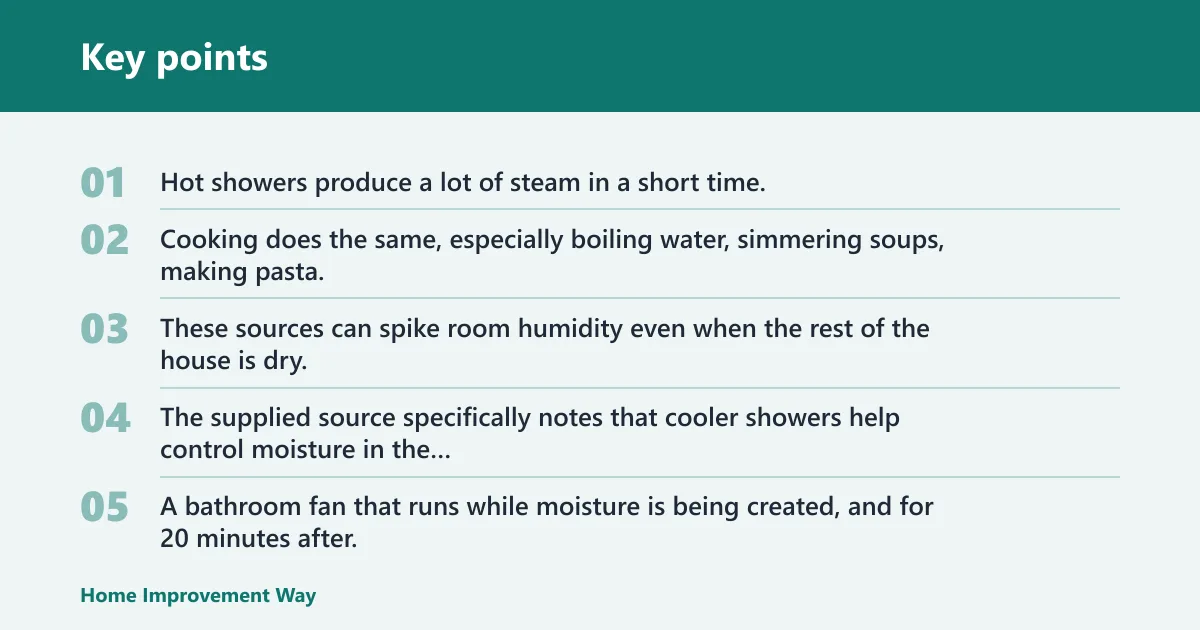
Hot showers produce a lot of steam in a short time. Cooking does the same, especially boiling water, simmering soups, making pasta, and running a dishwasher with a hot dry cycle nearby. These sources can spike room humidity even when the rest of the house is dry.
Use cooler showers when possible. The supplied source specifically notes that cooler showers help control moisture in the house. A bathroom fan that runs while moisture is being created, and for 20 minutes after, clears the room faster than waiting for the mirror to dry on its own.
Laundry and drying clothes indoors
Drying clothes inside adds water vapor to the air. A single load can make a small room feel damp fast, especially in winter when windows stay closed. If you must dry laundry indoors, use a vented laundry area, keep the door open if safe to do so, and run nearby exhaust or circulation fans.
Leaks, cracks, and water intrusion
Fix plumbing leaks, wall cracks, and rainwater or groundwater intrusion first. The source text specifically recommends repairing cracks in walls first. A dehumidifier can reduce the symptom, but it will not solve a pipe leak, a foundation seep, or rainwater entering through damaged grading or flashing.
Basements are a common trouble spot because they sit close to groundwater and foundation joints. Attics are another because roof leaks and air leaks can let moisture reach cold surfaces, where it condenses.
When should you use a dehumidifier?
Use a dehumidifier when the room stays above your target humidity even after you have handled the obvious moisture source. The appliance pulls water out of the air, so it helps most when the problem is trapped indoor moisture rather than a single burst of steam. Choose an ENERGY STAR certified dehumidifier when you can.
Best use cases
A dehumidifier is a good fit for a damp basement, a bedroom that stays humid overnight, or a room that cannot be ventilated well in freezing weather. It also helps after a leak is repaired, once standing water and wet materials are gone.
A common first-timer mistake is buying a dehumidifier for a bathroom that only fogs up after showers. In that case, a fan is usually the better tool because the moisture source is short-lived and local.
When a dehumidifier is the wrong tool
Do not use a dehumidifier as the first fix for a broken exhaust fan, a roof leak, or a wet basement wall. It can lower room humidity, but it does not replace ventilation or stop water intrusion. If the room gets damp only during a shower or a cooking session, target the event, not the whole house.
ENERGY STAR and sizing checks
ENERGY STAR certified dehumidifiers are the safer efficiency choice when you need one. For size, check the manufacturer’s listing for your room size and moisture load, because capacity varies by model. If a unit runs nonstop and the humidity barely changes, either the room is too large for that model or the moisture source is still active.
How to use exhaust fans and airflow

Exhaust fans and airflow are the fastest fixes for short, high-moisture events. They move damp air out before it condenses on mirrors, walls, and windows. In winter, that matters because cold surfaces turn a brief steam burst into visible water quickly.
Bathroom and kitchen fan timing
Run bathroom and kitchen fans while moisture is being created. A common rule of thumb is to keep them on for about 20 minutes after cooking or showering. If your fan has a built-in timer, set it for that runtime. If not, use a phone timer so the fan does not shut off too soon.
Bathroom fans help after hot showers and baths. Kitchen fans help during boiling, frying, simmering, and heavy dishwashing. If the fan is noisy or weak, it may still help, but weak airflow often means the duct, grille, or motor needs service.
Opening windows in cold weather
Opening windows can lower indoor relative humidity when cold outside air is exchanged with damp indoor air and then warmed back inside. Use this only when the weather allows it. In severe cold, the energy loss may be too high, and the room may become uncomfortable before moisture drops enough.
Open windows briefly rather than leaving them cracked all day. A short, strong air exchange is often more useful than a long, weak one. Pair it with fans or open interior doors so the moist air does not just move from one room to another.
Using vents and circulation fans
Use existing vents as designed, and keep furniture from blocking them. Run circulation fans to move moist air toward exhaust points or away from cold glass. This does not remove moisture on its own, but it helps prevent stagnant pockets that condense first.
Suppose a bedroom at the end of a hallway shows 42% RH while the hall sits at 34%. A small circulation fan and a door gap can be enough to equalize that room before you reach for a dehumidifier.
Air filter maintenance matters, but it is not usually the main cause of winter humidity. A clogged AC filter can trap moisture and hurt airflow, which can affect indoor air quality and system performance. Clean or replace the filter on the schedule in your system manual.
Cleaning or replacing the HVAC or AC filter
If the filter looks gray, loaded with dust, or visibly clogged, replace it. Weak airflow can make some rooms feel stuffy and can reduce how well the system moves air. That said, a dirty filter is usually a maintenance issue, not the reason a house is suddenly sweating in winter.
Checking plumbing, wall, and foundation leaks
Look for drip stains, damp drywall, peeling paint, soft trim, and moisture near plumbing lines. Check under sinks, around tubs, near water heaters, and where pipes pass through walls. Small leaks often hide behind cabinets or in utility rooms long before they show up as visible water.
Looking for attic or basement moisture entry
Inspect attic access points, roof penetrations, rim joists, basement cracks, and foundation edges. If you find rainwater or groundwater intrusion, fix the entry first. A dehumidifier can help after that, but it should not be the first answer to a structural water problem.
Plants and room-by-room fixes
Plants are not a whole-room humidity solution. Some plants absorb a little moisture, but the effect is small. Overwatered plants can add moisture, and humid soil can keep a room damper than you expect.
Humidity-loving versus humidity-absorbing plants
Humid-loving plants such as ferns can tolerate moist air, while a few plants are often labeled as moisture-absorbing options. The source includes peace lilies and Boston ferns as moisture-absorbing options. Use that idea carefully, because plant choice is a minor aid, not a primary control method.
Do not overwater indoor plants if you are trying to lower humidity. Wet potting mix, saucers of standing water, and crowded planters can all add moisture back to the room.
Room-by-room quick fixes
Bathrooms need fan runtime, shorter steam events, and door management. Kitchens need the range hood or exhaust fan on during cooking and for 20 minutes after. Bedrooms often need better circulation, fewer moisture sources, and a check for cold-window condensation.
Basements need leak control first, then dehumidification if the air still stays damp. Attics need roof and air-leak checks, because moisture that reaches a cold attic can condense on framing and insulation. If a room is humid only after a specific task, attack the task, not the whole house.
Frequently asked questions
What causes low humidity in a house in winter
Low humidity in winter usually comes from cold outdoor air that has been heated indoors, along with heating systems that dry the air. That can help lower condensation, but it can also make skin, eyes, and sinuses feel dry. If the air is too dry, you may need to add moisture carefully.
How to reduce humidity in house without dehumidifier in winter
Focus on the source. Use bathroom and kitchen exhaust fans, shorten showers, vent cooking steam, open windows briefly when practical, and fix leaks or cracks. Increase air circulation with interior doors, vents, and fans. Plants are minor helpers at best and should not be treated as the main strategy.
Sponsored / affiliate links. As an Amazon Associate I earn from qualifying purchases. I may earn additional commission from eligible campaigns.