Why Is the Humidity High in My House in Winter?
In winter, indoor moisture from showers, cooking, laundry, a humidifier set too high, weak ventilation, or a leak can push relative humidity above about 40% when outdoor temperatures are cold. Ignoring it can feed condensation, mold, and hidden damage inside walls and windows. This guide shows how to tell true whole-house humidity from surface condensation, then track the source in the right order.
Why winter humidity can seem high
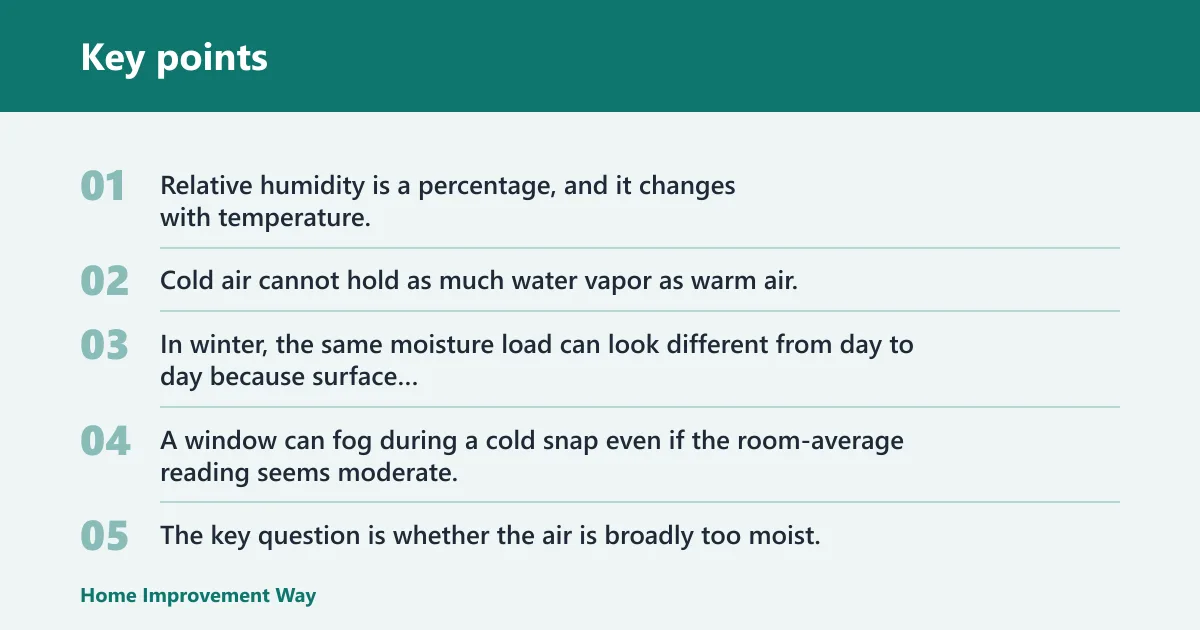


Relative humidity is a percentage, and it changes with temperature. Cold air cannot hold as much water vapor as warm air, so a house can show one reading in the middle of the room and still get wet windows, cold-wall condensation, or damp pipes in specific spots. That mismatch is the first clue.
In winter, the same moisture load can look different from day to day because surface temperature changes faster than room air. A window can fog during a cold snap even if the room-average reading seems moderate. The key question is whether the air is broadly too moist, or whether one cold surface has dropped below the dew point.
Room-average moisture versus cold-surface condensation
A hygrometer measures indoor relative humidity. Put it away from windows, vents, exterior walls, and direct sunlight so it reads the room, not the cold edge of the room. Comparing readings from room to room helps you separate a whole-house moisture problem from a single cold spot.
Say the upstairs bedroom reads 36% RH, but the window frame is sweating and the closet wall feels damp. That points to a cold-surface problem first, not a house that is uniformly wet. The room air may be acceptable while the surface temperature is low enough to trigger condensation.
Why cold outdoor air changes the reading
Outdoor winter air is often dry, but the house still traps moisture from people, cooking, bathing, and equipment. When that indoor moisture is held in a tighter air volume, relative humidity rises. If a humidifier is added on top of that load, the reading can climb quickly.
Cold weather also makes pressure and air movement matter more. Warm indoor air rises and escapes through upper leaks, while replacement air can be pulled in at the basement or lower levels. That stack effect can move moisture through the house and concentrate it in specific rooms.
Winter humidity checklist
Use this checklist to sort the problem in the right order: first confirm the reading, then separate condensation from whole-house humidity, then trace the source. The quick tests are simple, but they point you toward the right next fix.
| Symptom | Likely cause | Quick test | Next fix |
|---|---|---|---|
| Windows sweat at the corners or lower sash | Cold surface, over-set humidifier, or weak window performance | Check room RH with a hygrometer placed in the center of the room, then compare it with a window-frame temperature feel and visible fogging after a cold night | Lower humidifier output, improve airflow at the glass, or improve the window seal and insulation |
| Bathroom mirror clears slowly and walls feel damp after showers | Exhaust fan not running long enough, weak fan, or duct not venting outdoors | Run the fan during the shower and 20 to 30 minutes after; confirm air is moving outdoors, not into an attic or cavity | Repair the duct, clean the fan, or upgrade the fan if needed |
| Basement feels clammy while upstairs feels normal | Basement infiltration, soil moisture, rim joist leakage, or poor dehumidifier performance in cool air | Check for damp walls, efflorescence, or musty odor near the rim joist and slab edges | Seal obvious leaks, address drainage, and use a dehumidifier only where it can work well |
| Closets smell musty or clothes feel damp | Low air circulation, exterior-wall condensation, or hidden leak nearby | Open the door for a day and compare humidity and odor with the rest of the room | Improve air movement, move items away from the exterior wall, and inspect for leaks |
| Humidity rises after showers, cooking, or laundry | Occupant moisture load plus under-ventilation | Note whether the rise lasts more than an hour after the activity ends | Increase exhaust use, vent outdoors, and shorten moisture events where possible |
| Windows fog on mild days too, not only on cold snaps | Humidifier setting too high or hidden moisture source | Turn the humidifier down or off for 24 hours and retest the room RH | Keep the lower setting if condensation stops; otherwise look for leaks or ventilation failure |
How to check for condensation

Condensation forms when a surface drops below the dew point of the nearby air. That is why windows, metal pipes, and exterior corners often get wet first. If the problem repeats, moisture can support mold growth on sills, trim, closets, and wall corners.
Windows and frames
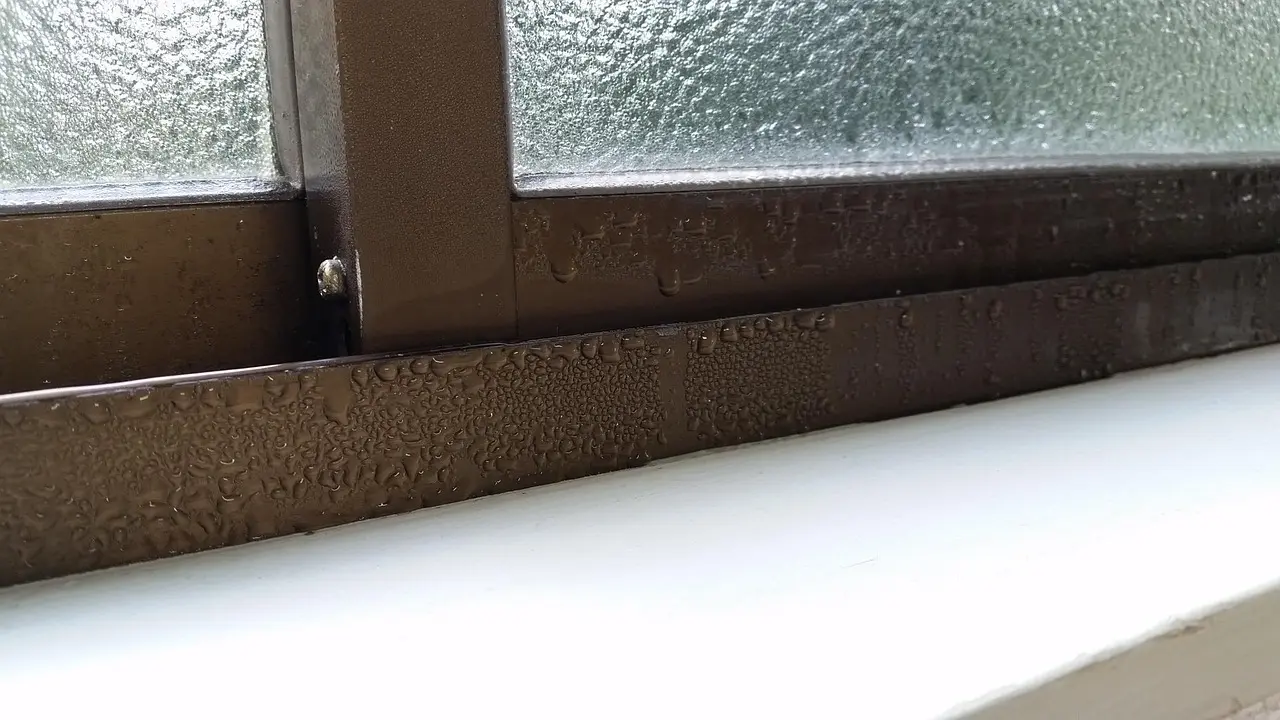
Check the lowest corners, the sash edges, and the space between blinds or curtains and the glass. Persistent water beads, frost, or stained trim mean the surface is too cold for the moisture level in the room. Cold snaps make this worse because the surface temperature falls faster than the room-average RH changes.
If one window sweats and the next room does not, treat it as a local cold-surface issue first. That may mean better air circulation, a tighter window, or lower indoor moisture. It does not automatically mean the whole house is too humid.
Walls, pipes, and corners
Check exterior-facing corners, behind furniture, around supply registers, and along exposed pipes. These spots can stay colder than the center of the room. If moisture keeps returning there, the surface may be reaching dew point even when the hygrometer seems acceptable.
Closets and exterior-facing rooms
Closets trap stagnant air, especially on outside walls. If one closet smells musty while the hallway does not, open the door, move items away from the wall, and inspect the baseboard and upper corners. A repeat damp spot often means a hidden leak or a cold-wall condensation problem.
Is your humidifier the source?
A humidifier can make a house feel too humid in winter if it is set too high, calibrated poorly, or not cleaned. Whole-house units and portable units can both raise relative humidity enough to cause condensation on cold windows, especially in tighter homes or during very cold weather.
Signs the setting is too high
If windows sweat soon after the humidifier starts, or if the house feels muggy while the outdoor air is cold, lower the setting and retest for a full day. Winter comfort is often discussed around 30% to 50% RH, but a colder window can still condense at a lower room-average reading.
Calibration and cleaning checks
Compare the humidifier setting with a separate hygrometer. Built-in displays can drift. Clean the unit according to the manufacturer’s listing for your model, because scale and biofilm can affect output and airflow.
When to lower output or turn it off
If condensation is on the windows, especially during cold snaps, reduce output first. If the fogging stops, the humidifier was part of the problem. If the problem continues with the humidifier off, look next at ventilation, air leaks, or a hidden water source.
Suppose a 1,200-square-foot house has one portable humidifier set for a nursery, and the upstairs bedroom windows fog each morning while the basement stays dry. That pattern points away from a whole-house moisture source and toward one over-set unit or a cold upstairs envelope.
Why ventilation may be failing
Bathroom and kitchen moisture should move outdoors. Exhaust fans, range hoods, HRV and ERV systems, and trickle vents all depend on correct installation and use. If they do not move air outdoors, moisture stays inside and relative humidity rises.
Bathroom fans and shower moisture
Run the bathroom fan during the shower and for about 20 to 30 minutes after. That matters more than many homeowners expect. A fan that is clogged, undersized, noisy but weak, or ducted into an attic will not remove enough moisture.
Check whether the fan actually exhausts outdoors. A vent that dumps into the attic can soak insulation and framing instead of drying the bathroom. That is a repair issue, not a comfort issue.
Kitchen range hoods and cooking moisture
Boiling, simmering, and covered pots can still add moisture. Run the hood during cooking and keep it on briefly after the steam ends. If the hood does not exhaust outdoors, or if it is rarely used, the extra moisture stays in the house.
HRV, ERV, and trickle vent basics
An HRV or ERV can help when it is balanced and maintained, but filters, controls, and ductwork still matter. Trickle vents can also help in some homes if they are actually open and not blocked. In all cases, the system must move moist air outdoors to be effective.
Could a leak be raising humidity?
Hidden water intrusion can raise indoor humidity without obvious flooding. That includes plumbing leaks, attic leaks, basement seepage, and air leakage around the shell of the house. If humidity stays high after occupancy and ventilation checks, a leak rises on the list fast.
Basement and rim joist clues
Look for damp concrete, white mineral staining, rust, musty odor, or wet insulation near the rim joist. Basement leaks and soil moisture can keep a lower level humid even when the rest of the home seems normal. During mild winter spells, outside air infiltration can also carry moisture inward.
Attic and bath fan duct leaks
Bath fan ducts that leak into the attic can dump warm, moist air into a cold space. That can lead to condensation, wet insulation, and mold risk. Check the visible duct path and the exterior termination if accessible.
Suspect a plumbing leak if one area stays damp, paint blisters, flooring cups, or a cabinet under a sink smells musty. A leak that appears only after certain fixtures run points to a plumbing issue, not a general humidity problem. A plumber is the right call when the source is not visible.
When dehumidifiers help in winter
A dehumidifier can help when indoor humidity stays high, especially in basements or problem rooms. It is less effective in colder rooms because performance drops as air temperature falls. That makes room choice and maintenance important.
Best rooms for a portable unit
Basements, laundry rooms, and rooms with persistent dampness are the usual candidates. Place the unit where air can circulate around it, and keep the bucket or drain hose clear. If the room is too cold, the unit may not remove enough moisture to matter.
Why cold rooms reduce performance
Most portable dehumidifiers work best in typical indoor temperatures, not in a chilly basement corner or garage-like space. In colder air, moisture removal slows and the coil can ice up. If the room stays cold, fix the moisture source first and use the dehumidifier only as support.
Bucket and drain hose maintenance
Empty the bucket before it overflows, and check the drain hose for kinks or clogs. A unit that is full, blocked, or dirty cannot keep up. If it runs constantly without lowering the reading, either the room is too cold for good performance or the moisture load is still too high.
How to lower humidity in a house during cold weather
Start with the source, not the symptom. Reduce or shut off an over-set humidifier, run exhaust fans during and after moisture-producing activities, and confirm those fans vent outdoors. Then check room by room for condensation, leaks, and cold surfaces that need attention.
- Check indoor RH with a hygrometer placed away from windows, vents, and exterior walls.
- Inspect windows, bathrooms, basement edges, and closets for repeated moisture.
- Turn down or turn off any humidifier and retest after 24 hours.
- Run bathroom fans 20 to 30 minutes after showers and kitchen fans during and after cooking.
- Verify that exhaust actually leaves the house, not an attic or wall cavity.
- Look for basement seepage, plumbing leaks, attic leaks, or duct leaks if the problem stays.
- Use a dehumidifier only where the temperature is suitable and the unit can drain or be emptied reliably.
Visible mold or musty smells mean the issue should be addressed quickly. Clean what you can see, but do not stop there. The source has to be fixed or the growth returns.
Frequently asked questions
Why is the humidity so high in my house in winter?
High winter humidity usually comes from indoor moisture sources, an over-set humidifier, poor ventilation, or a leak. Relative humidity rises as temperatures fall, and cold windows can condense moisture even when the room reading seems moderate. Check the whole house first, then the cold surfaces.
Why is my house so humid in winter?
A house often feels humid in winter because moisture is being added faster than it is removed. Showers, cooking, laundry, occupants, and humidifiers all add moisture. If exhaust fans are weak or ducted poorly, the extra vapor stays indoors and the reading climbs.
What causes indoor humidity to rise when it is cold outside?
Cold outdoor air changes how indoor moisture behaves. The same amount of water vapor can create a higher relative humidity indoors, and cold surfaces can hit dew point sooner. Air leaks and stack effect can also move moisture to basements, closets, and upper corners.
Can cooking, showering, or laundry make winter humidity too high?
Yes. Those activities add a lot of moisture in a short time, especially if the fan is weak or not used long enough. Run the bathroom fan during showers and for 20 to 30 minutes after, and use the kitchen hood during cooking if it vents outdoors.
Does a humidifier make a house feel too humid in winter?
It can. A humidifier that is set too high, poorly calibrated, or not cleaned can push indoor relative humidity above the level the cold windows and walls can handle. If fogging starts soon after the unit runs, lower the output and retest.
How do I tell if the problem is humidity, condensation, or a leak?
Use a hygrometer for the room, then inspect where the moisture appears. Whole-house humidity shows up in several rooms. Condensation usually repeats on cold windows, exterior walls, or pipes. A leak often creates one damp area, stains, odor, or damage near a fixture or building joint.
Should I run a dehumidifier in winter?
Use one when indoor humidity stays high after ventilation and humidifier checks, especially in basements or damp rooms. Do not expect strong results in cold rooms, where performance drops. Keep the bucket or drain hose maintained so the unit can keep working.
Sponsored / affiliate links. As an Amazon Associate I earn from qualifying purchases. I may earn additional commission from eligible campaigns.
 GAOMON Portable Air Conditioners with Built-in Dehumidifier Function, Fan Mode, Remote Control, for Room, Dorm, Office Quiet AC Unit, 24H Timer, Window Kit, 8000Btu Portable AC White
 Soil Moisture Meter - Soil Monitoring Water Level Indicator | Soil Moisture Meter | Plant Water Level Indicator Humidity Sensor Probe | Indoor Flower Pot Water Level Meter | Water Display (6.49inch)