Cool Mist vs Warm Mist Humidifier in Winter
Choose Cool Mist for kids’ rooms, warmer rooms, and hard-water homes; choose Warm Mist for quiet bedrooms or when you want less mineral dust, but keep it away from children and pets. Picking the wrong type can mean noise, dryness, mineral residue, or a burn hazard. This guide compares room temperature, safety, noise, maintenance, and winter air quality so you can match the humidifier to the room. For the quickest room-by-room shortcut, jump to the winter decision matrix or the indoor humidity targets section.
| Factor | Cool Mist | Warm Mist | Winner |
|---|---|---|---|
| Safety around children and pets | Room-temperature moisture; safer to place in family spaces | Uses heated water and steam; burn or scald risk if touched | Cool Mist |
| Noise | Many models use a fan; ultrasonic versions are the quietest cool mist option | Usually quieter because it does not require a fan | Warm Mist |
| Electricity use | Uses less energy | Uses more energy because a heating element boils water | Cool Mist |
| White dust and mineral residue | More likely to leave mineral dust if you use hard tap water | Less likely to spray mineral dust into the room, though cleaning still matters | Warm Mist |
| Cold-room comfort | Adds moisture without heat | Can help winter air feel warmer and more comfortable | Warm Mist |
| Best use case | Bedrooms, nurseries, and homes that want safer placement | Quiet adult bedrooms and rooms where a little extra warmth is welcome | Tie |
How they differ in winter
Both types add moisture to dry indoor air. That matters when forced-air furnaces, space heaters, and fireplaces pull humidity down. Cool Mist sends room-temperature droplets into the air, while Warm Mist heats water before releasing steam. Winter choice should start with room warmth, safety risk, noise tolerance, and mineral-dust concerns.
What each type does
Cool Mist humidifiers release tiny water droplets into the air. Warm Mist humidifiers heat water to produce steam, so the output feels warmer at the source. That difference matters less than where you plan to put the unit and who can reach it.
The winter trade-off in one
If your room is already cold, a Warm Mist unit can feel more comfortable because it adds moisture without the chill of a fan-driven stream. If safety or lower power use matters more, Cool Mist is the easier default. The better choice depends on the room, not the label.
When should you choose cool mist?
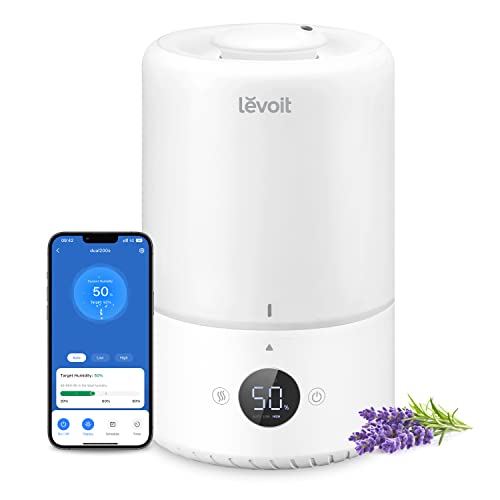
Choose Cool Mist when the room has children, pets, or a placement problem that makes hot steam risky. It is also the better fit when you want lower electricity use, especially in bedrooms or nurseries that run for hours. If noise matters, look at ultrasonic models first; they are the quietest cool mist option.
Safer pick for kids and pets
Cool Mist avoids the burn or scald hazard tied to heated water. That makes it the safer choice for playrooms, nurseries, and low tables that pets can reach. The winter decision matrix below gives the quickest rule of thumb: if someone vulnerable can touch the unit, choose the cooler option.
Best fit for noise-sensitive rooms
Many Cool Mist units use a fan, so they can sound louder than Warm Mist models. Ultrasonic cool mist uses vibrating plate technology and is usually the quietest option in this category. If you are choosing for a light sleeper, start there before you rule out cool mist altogether.
Where ultrasonic, evaporative, and impeller models differ
Ultrasonic cool mist units push water through a vibrating plate, which often makes them simple to rinse clean. Evaporative models use a wet wick and fan, and the wick needs replacement. Impeller models use a rotating disk to fling water into a diffuser, and the exact cleaning routine varies by model.
Say your nursery is 10 by 12 feet, the baby sleeps in a crib across the room, and a cat also uses the space. Cool Mist keeps the hot-water hazard out of reach. An ultrasonic model is the better fit if the fan sound would otherwise wake the room.
When should you choose warm mist?
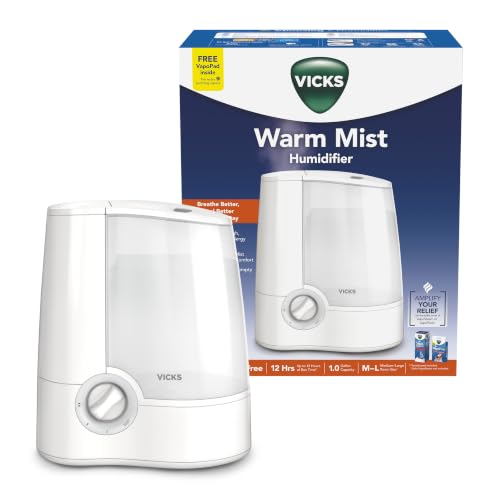
Choose Warm Mist when you want quieter operation and a room that feels less cold at the outlet. It is a better fit for adult bedrooms, especially if safety is controlled and the unit can sit where no one will touch the hot tank or nozzle. The trade-off is higher energy use and a scald risk.
Quieter operation and warmer-feeling air
Warm Mist is usually quieter because it does not require a fan. That can help in a room where the main problem is a hiss or hum from a fan-based model. The benefit is comfort, not extra heating for the whole room.
Why the heating element changes energy use and safety
The heating element boils water, and that raises electricity use. Warm-mist wattage varies by model: some consumer units list a few hundred watts, while many cool-mist units are much lower; always check the nameplate or manual before comparing costs. The key point is that heat also adds risk: the tank and steam can cause scalding, so keep Warm Mist away from children and pets. For child safety guidance, see the U.S. Consumer Product Safety Commission’s advice on portable humidifiers and hot water hazards: Portable Humidifiers.
When warm mist makes sense in a cold room
Warm Mist can make sense in a chilly adult room where a fan would feel annoying and mineral dust is a concern. It does not replace heating, and it should not be treated like a room warmer. It simply adds moisture in a way that can feel less cold at the outlet.
Suppose a bedroom is kept at a lower thermostat setting, and the sleeper wants less fan noise at night. Warm Mist can fit that setup. If the same room also has a toddler or a curious dog, the safer choice shifts back to Cool Mist.
Winter decision matrix
This matrix turns the usual winter use cases into direct picks. It keeps the decision tied to room conditions, safety, and comfort instead of mist temperature alone. Use it as a shortcut when you already know the room’s main problem.
| Scenario | Recommended choice | Best if | Avoid if | Safety risk | Energy use | Noise | Hard-water suitability | Maintenance burden | Short rationale | Red flags |
|---|---|---|---|---|---|---|---|---|---|---|
| Cold bedroom | Warm Mist | Adult room, fan noise is distracting, and the unit can sit out of reach | Children, pets, or low placement where hot parts are reachable | Higher: hot tank and steam can scald | Higher than cool mist because of the heating element | Usually lower than fan-based cool mist | Moderate: less visible dust, but scale still builds up | Moderate: tank cleaning and descaling still needed | Quieter output and a warmer-feeling stream can suit a chilly room used by adults. | Do not use it where a child or pet can touch the tank or nozzle. |
| Nursery | Cool Mist | Safety is the priority and the unit may run overnight | Any setup where cords, tank lids, or mist can be reached from the crib | Lower: no hot water to scald | Usually lower than warm mist | Ultrasonic models are often quietest; fan models are more noticeable | Poor to fair unless distilled water is used | Low to moderate depending on type; wick filters add upkeep | Safer around children, and an ultrasonic model can stay very quiet. | Avoid placing any unit where cords or mist can be reached from the crib. |
| Congestion | Warm Mist | The room is cool and you want the outlet to feel less chilly at night | Hot surfaces are a concern or the room is shared with a child or pet | Higher than cool mist because steam and hot water are involved | Higher than cool mist | Usually quiet | Good for visible dust, but not a substitute for cleaning | Moderate; warm mist still needs regular descaling | Warm steam may feel more comfortable in a cold room and can be easier to tolerate at night. | Keep it out of reach; if safety is the bigger issue, choose Cool Mist instead. |
| Dry skin | Cool Mist | You want the simplest long-run option for a bedroom or family room | The room already runs damp or mold-prone | Lower | Usually lower | Depends on model; ultrasonic is typically quieter than fan-based units | Poor with hard tap water unless distilled water is used | Moderate; mineral cleaning matters more in hard-water homes | Either type can help, but Cool Mist is the safer general pick for long winter run time. | Too much humidity can make the room damp and encourage mold. |
| Hard-water home | Warm Mist | You want to reduce visible white dust in the room | You do not want to descale the heating chamber regularly | Higher than cool mist because of heated water | Higher than cool mist | Usually quiet | Better at limiting airborne mineral dust, though scale still forms | Higher if mineral deposits are heavy | Less mineral dust reaches the room, though regular tank care still matters. | Use distilled water if the model allows it; hard tap water can still scale the tank. |
| Overnight use | Cool Mist | Safety and low operating cost matter most | You need a warmer outlet feel more than you need a safer placement option | Lower overnight burn risk | Lower | Choose ultrasonic if noise is the concern | Poor to fair unless distilled water is used | Moderate: cleaning matters either way | Lower burn risk makes it the safer overnight default in bedrooms and nurseries. | Cleaning matters either way; standing water can support bacterial growth. |
What humidity level should you aim for?
The target is not a single winter number. The EPA recommends keeping indoor relative humidity between 30% and 50% and avoiding levels above 60% because higher humidity can encourage mold and dust mites. In colder weather, the practical ceiling may need to be lower to avoid window condensation and mold risk, especially in tight homes. See the EPA’s indoor humidity guidance and the EPA’s mold prevention advice for the full range.
Signs the air is too dry or too damp
Air that is too dry can leave you with chapped lips, dry skin, and a scratchy throat. Air that is too damp can support mold growth, window condensation, and a musty smell. If the room feels sticky or the windows fog heavily, back off the humidifier output. For a quick winter read on room conditions, use winter bedroom air quality as the mental checklist.
How fireplaces, space heaters, and furnaces change indoor moisture
Forced-air furnaces often dry rooms quickly because they move a lot of warmed air. Space heaters and fireplaces can do the same in the rooms they heat most. If your winter heat source is drying the air, the humidifier should correct that dryness without pushing humidity so high that surfaces stay wet.
How do noise, energy, and white dust compare?
Noise, power use, and mineral residue are the three trade-offs that matter most after safety. Warm Mist is usually quieter, Cool Mist usually uses less electricity, and hard water can make white dust more likely in some cool mist setups. Distilled water helps reduce that problem and can also cut down cleaning headaches.
Fan noise versus steam noise
Many Cool Mist models use a fan, so they can be audible in a quiet bedroom. Warm Mist is quieter because it does not require a fan, though ultrasonic cool mist can be nearly silent. Noise-sensitive buyers should compare the exact mechanism, not just the mist label.
Electricity use and heating element costs
Warm Mist uses more electricity because the heating element boils water. The exact wattage depends on the model, so the safest comparison is the number on the product label or manual; some warm-mist units list several hundred watts, while many cool-mist units are much lower. That difference matters if the unit will run nightly all winter.
Distilled water and mineral dust
Cool Mist units may leave mineral dust when hard tap water is atomized into the air. Distilled water reduces that residue and often reduces scale inside the tank. Warm Mist is less likely to spread mineral dust into the room, but it still needs regular cleaning and descaling. If you need a practical rule, see distilled water use for the shortest answer.
Choose Cool Mist if… / Choose Warm Mist if…
Use Cool Mist when safety, lower power use, or a nursery setup matters most. Use Warm Mist when you want quieter operation, a warmer-feeling output, or less visible mineral dust in the room. In both cases, the cleanest decision is the one that matches your room, your water, and your risk tolerance.
Choose cool mist if…
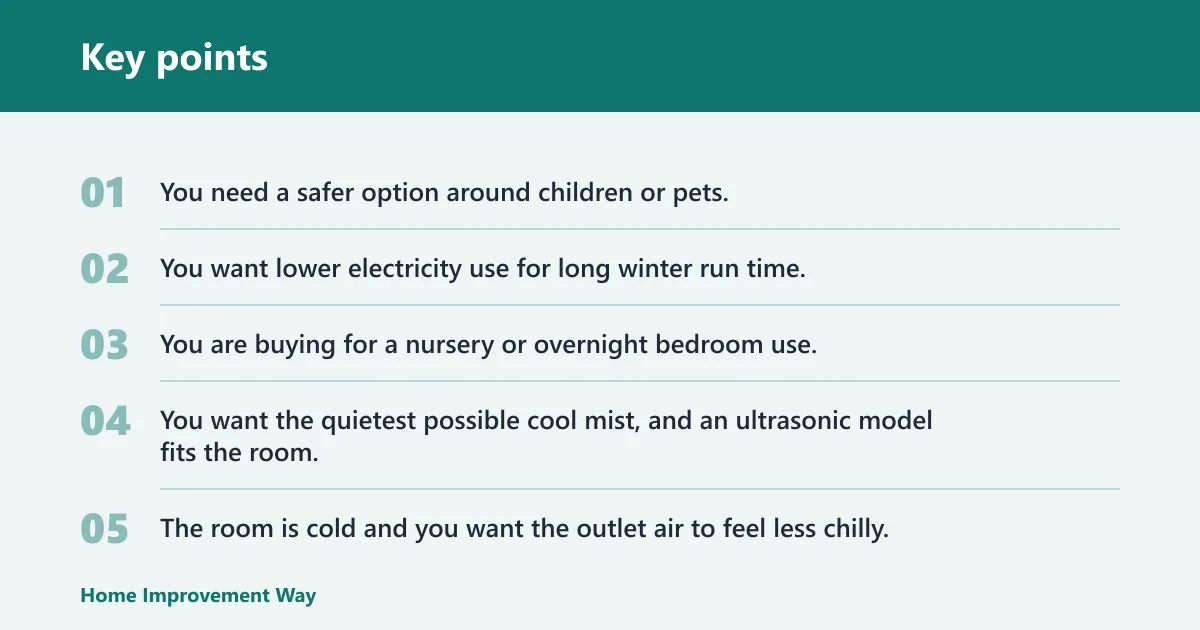
- You need a safer option around children or pets.
- You want lower electricity use for long winter run time.
- You are buying for a nursery or overnight bedroom use.
- You want the quietest possible cool mist, and an ultrasonic model fits the room.
Choose warm mist if…
- The room is cold and you want the outlet air to feel less chilly.
- You need quieter operation and do not want fan noise.
- You are concerned about white dust from hard water.
- The unit will sit where children and pets cannot reach hot surfaces.
Humidity maintenance comes next. Both types need regular cleaning, and standing water can lead to mold or bacterial growth if the tank and filter are neglected. A humidifier that sits unused between nights still needs a dry-out routine before storage and a cleaning routine during winter use. For step-by-step cleaning advice, see the EPA’s humidifier cleaning guidance and the CDC’s humidifier maintenance advice.
Short maintenance checklist
- Empty and dry the tank daily if the model calls for it.
- Wash the tank, base, and removable parts on the schedule in the manual.
- Descale mineral buildup early if you live with hard water.
- Replace wicks or filters on time for evaporative units.
- Use distilled water when the manual allows it and white dust is a problem.
- Store the unit completely dry after the winter season.
Frequently asked questions
When to use cool mist vs warm mist?
Use Cool Mist when you need safer placement, lower electricity use, or a better fit for kids’ rooms and overnight use. Use Warm Mist when the room is cold, you want less fan noise, or you want less mineral dust in the air. The right pick depends on the room, not a universal rule.
Why is cool mist better than warm mist?
Cool Mist is better when safety and operating cost matter most. It avoids the hot-water burn hazard and usually uses less electricity, which helps during long winter run times. It is also the more practical choice in nurseries, shared bedrooms, and homes with pets.
Cool mist vs warm mist humidifier for winter
For winter, the better choice changes with the room. Warm Mist is often better for a quiet, cold adult bedroom, while Cool Mist is usually better for family rooms, nurseries, and homes where safety or lower power use matters. If the house already runs dry from forced-air heat, either can help.
Which humidifier is safer around kids and pets in winter?
Cool Mist is safer around kids and pets because it does not heat water to steam. Warm Mist may cause scalding if it is tipped, touched, or placed within easy reach. If you cannot keep the unit out of reach, Cool Mist is the better choice.
Does warm mist help more when the house feels cold?
It can feel better in a cold room because the outlet steam is warm and there is no fan chill. That said, it does not heat the room the way a space heater does. If comfort is the goal, Warm Mist may feel nicer; if safety is the goal, Cool Mist still wins.
Which humidifier uses less electricity?
Cool Mist uses less electricity because it does not need to boil water. The exact wattage depends on the model, so compare the product label rather than a generic estimate; warm-mist units with heating elements often draw much more power than cool-mist units. For nightly winter operation, that difference can matter.
Is cool mist or warm mist better for congestion?
Warm Mist is often more comfortable for congestion in a cold bedroom because the steam can feel gentler to breathe. Still, comfort should not override safety in a nursery or pet-heavy room. If hot water is a risk, choose Cool Mist and keep the humidity in the healthy range instead of chasing hotter steam.
Evaporative vs ultrasonic for winter bedrooms
If you are narrowing the cool-mist side of the choice, the next decision is usually evaporative versus ultrasonic. Evaporative humidifiers draw air through a wet wick, which can self-limit output as the room gets humid and can help reduce over-humidifying in winter bedrooms. Ultrasonic humidifiers are typically quieter and can be easier to place in light-sleeper rooms, but they may create more mineral dust if you use hard tap water.
When evaporative wins
Evaporative models are a solid winter pick when you want a simpler humidity ceiling, especially in rooms that can get damp quickly. They are also a sensible choice if you prefer a design that tends to be more forgiving when the room already feels humid. The trade-off is wick replacement and a little more maintenance.
When ultrasonic wins
Ultrasonic models are best when noise is the top concern and the room needs a quiet overnight unit. They can be a great fit for winter bedrooms, but distilled water becomes more useful if hard water leaves white dust. If you want the most silent option in a nursery or light sleeper’s room, ultrasonic is usually the first model to compare.
Sources
Authoritative guidance used in this article includes the EPA on indoor humidity and mold prevention, the CDC on humidifier maintenance, and the CPSC on hot-water burn hazards. For energy comparisons, always verify the wattage listed on the exact model’s data plate or manual because humidifier power draw varies widely by design and feature set.
Related winter humidifier reading
If you are comparing placement and room conditions, the most useful follow-ups are indoor humidity targets, winter bedroom air quality, and the distilled water section above. Those three checks usually settle the decision faster than mist temperature alone.
Sponsored / affiliate links. As an Amazon Associate I earn from qualifying purchases. I may earn additional commission from eligible campaigns.