Can You Run a Humidifier All Night?
Yes, you can run a humidifier all night if your room stays between 30% and 50% relative humidity, ideally with a hygrometer or built-in humidistat that cuts output when the target is reached. Too much moisture can leave surfaces damp, feed mold, and aggravate asthma or allergies. This guide explains safe overnight setup, target humidity, and the signs you are overdoing it.
This guide is part of our Space Heaters, Fireplaces and Winter Humidity Guide series.
When to Stop running a humidifier overnight
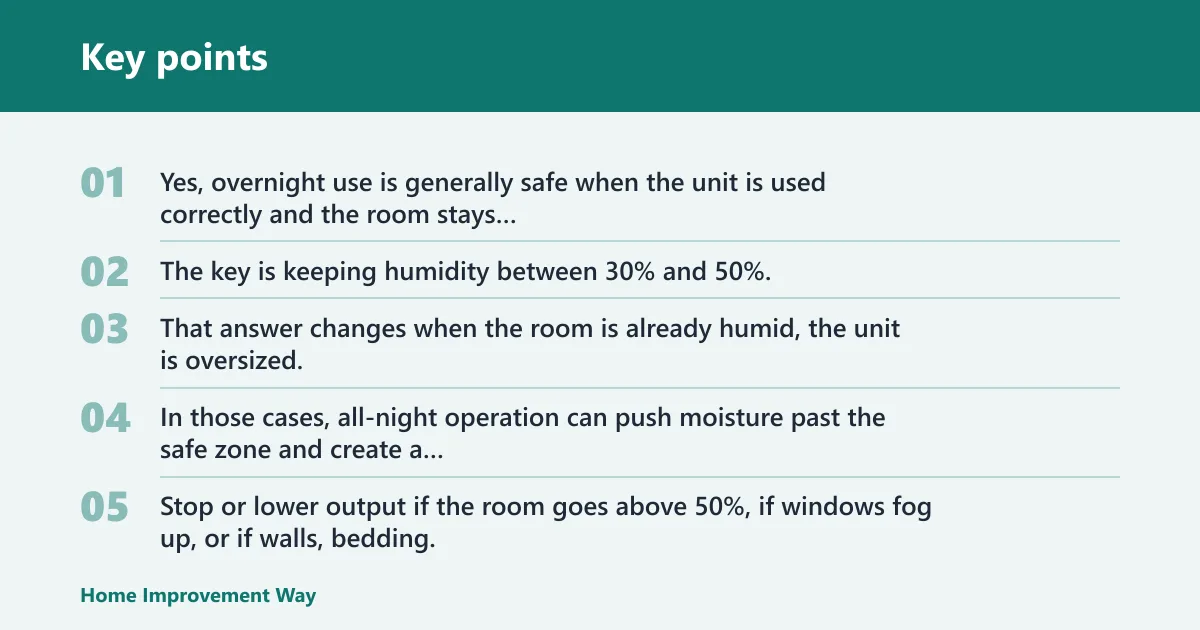


Yes, overnight use is generally safe when the unit is used correctly and the room stays in range. Runtime alone is not the issue. The key is keeping humidity between 30% and 50%, with the unit adjusted or stopped before the room feels damp.
That answer changes when the room is already humid, the unit is oversized, or cold glass starts collecting condensation. In those cases, all-night operation can push moisture past the safe zone and create a problem instead of easing dry air.
When overnight use stops being a good idea
Stop or lower output if the room goes above 50%, if windows fog up, or if walls, bedding, or the floor near the unit feel damp. Those are practical warnings that the room is holding too much moisture. A humidifier should correct dry air, not create wet surfaces.
A humidistat makes this easier because it cycles the unit on and off to hold a target level. If your model does not have one, a hygrometer gives you the same basic feedback without guessing.
Run humidifier all night decision chart
Use this chart to decide whether to run the humidifier all night, lower the output, move the unit, or stop. The right choice depends on room humidity, window condensation, room size, and the humidifier type. Room size matters because a small tank can run out fast in a large, dry bedroom, while a high-output unit can overshoot a small one.
| Room condition | Room size and setup | Humidifier type | Action |
|---|---|---|---|
| Humidity below 30%, no condensation | Small or medium bedroom, closed door, normal winter dryness | Cool mist or evaporative | Run overnight, then check again in the morning |
| Humidity below 30%, no condensation | Large room, drafty windows, very dry outdoor air | Evaporative or higher-capacity cool mist | Run overnight at lower output and monitor with a hygrometer |
| Humidity between 30% and 50% | Any bedroom size | Any type with control | Lower output or let a humidistat cycle the unit |
| Humidity above 50% | Any room, especially a small one | Any type | Stop use until the room dries out |
| Window condensation appears | Cold weather, single-pane glass, or poor insulation | Cool mist, warm mist, or steam vaporizer | Lower output, move the unit, or stop it for the night |
| Humidity stays low but room still feels damp | Unit too close to wall, bedding, or curtains | Cool mist or warm mist | Move the unit farther from soft surfaces and reduce output |
| Humidity stays low despite long runtime | Large room, open door, or high air leakage | Evaporative | Move the unit closer to the sleeping area or choose a higher-output model |
| Dusty white residue appears on nearby surfaces | Ultrasonic unit with tap water | Cool mist ultrasonic | Switch to distilled water and clean the tank and base |
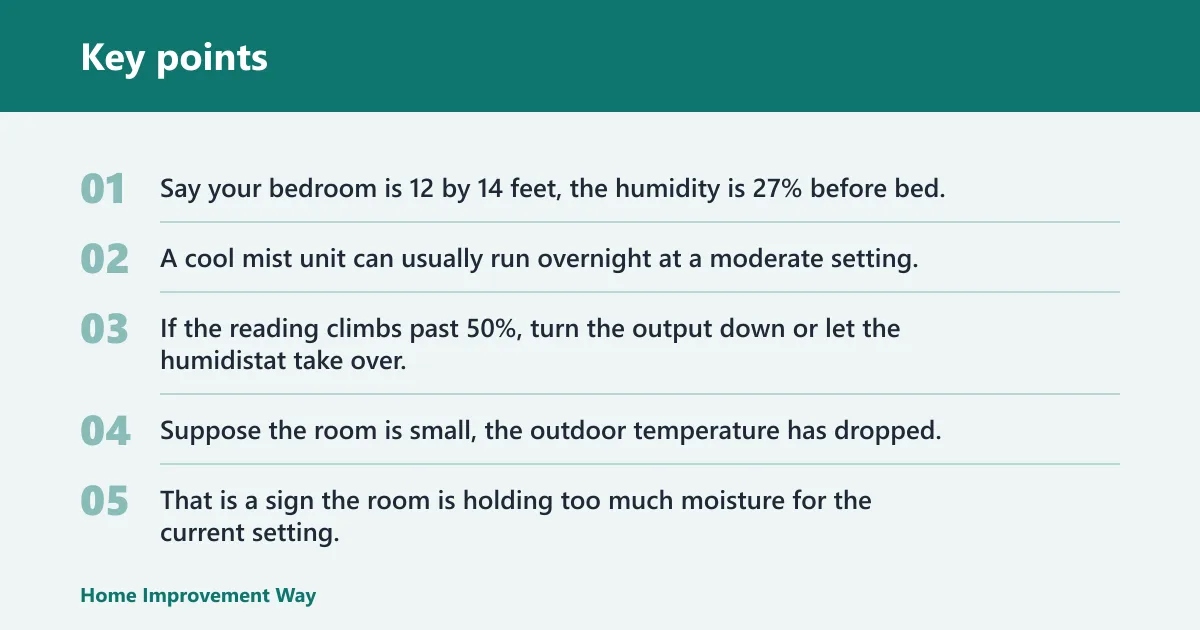
Say your bedroom is 12 by 14 feet, the humidity is 27% before bed, and the windows stay clear. A cool mist unit can usually run overnight at a moderate setting, especially if a hygrometer is on the dresser and the door stays closed. If the reading climbs past 50%, turn the output down or let the humidistat take over.
Suppose the room is small, the outdoor temperature has dropped, and a thin layer of condensation shows on the window by midnight. That is a sign the room is holding too much moisture for the current setting. Lower the output or stop the unit before the glass and wall surfaces stay wet.
What humidity level is best for sleep?
The best humidity for sleep usually falls between 40% and 50%, with 30% to 50% as the common safe target range. Below 30%, many people notice dry throat, dry nose, or irritated skin. Above 50%, the room holds too much moisture and mold risk rises.
Why 30% to 50% is the target range
This range gives you enough moisture to reduce dryness without pushing the room into damp territory. It is broad enough to handle normal weather changes, but it still needs checking. A room that starts at 32% can drift upward through the night, especially in winter when windows stay cold.
What dry air feels like below 30%
Below 30%, air often feels harsh and can leave the nose, lips, and throat dry by morning. That is the point where a humidifier can help most. If the room is already near 35% to 40%, though, overnight use may only need a low setting instead of full output.
What excess moisture looks like above 50%
Above 50%, watch for fogged windows, a damp feel on bedding near the machine, or a musty smell. Those are practical signs that the unit is adding more moisture than the room can hold. Stop or reduce use before the problem spreads to walls or window trim.
Which humidifier type is best overnight?
Cool mist and evaporative humidifiers are usually the easiest choices for bedrooms because they are commonly used overnight and can be adjusted for long runs. Warm mist can help with congestion, but hot steam means placement matters more. Steam vaporizers are often less suitable for unattended bedrooms because of scald risk.
Cool mist humidifiers for bedrooms
Cool mist humidifiers are commonly recommended for bedrooms, and ultrasonic cool mist units are described as quiet for sleep. That makes them a good fit for light sleepers. They still need monitoring, though, because quiet operation does not prevent over-humidifying a small room.
Evaporative humidifiers for longer runs
Evaporative humidifiers use a wick or filter and a fan. They are a solid pick for longer overnight use because output tends to slow as the room approaches balance. They usually need filter maintenance, so a dirty wick can reduce output and leave the room drier than expected.
Warm mist and steam vaporizer safety limits
Warm mist humidifiers heat water to create steam. That can help some people who want warmer moisture, but the burn risk means placement matters. Steam vaporizers boil water to make steam, and that serious scald risk makes them a poor choice for children’s bedrooms and less suitable for unattended use.
How do you keep a room from getting too damp?
Use a hygrometer or humidistat, watch the windows, and place the unit with care. A hygrometer measures room humidity, and it should sit away from direct mist so the reading is accurate. A humidistat does the work for you by cycling the unit on and off to hold the target range. (Wikipedia)
Use a hygrometer or humidistat
A digital hygrometer is commonly recommended because it is easy to read at night. Put it away from the mist stream, not right beside the nozzle. If the humidifier has a humidistat, set the target once and let it control the cycle instead of guessing by feel.
Watch for window condensation and damp surfaces
Window condensation is one of the clearest signs that the room may be too humid. It is more likely in cold weather because the glass surface is colder. If windows fog or bead up, lower runtime, reduce output, or move the unit farther from the sleeping area.
Set placement, output, and water type correctly
Place the unit at least 2-3 feet from the bed, away from bedding and walls, on a waterproof surface. Distilled water helps reduce mineral buildup and can limit visible residue, especially in ultrasonic units. Daily water changes also help inhibit mold growth inside the tank.
- Check the room humidity before bed with a hygrometer.
- Set the humidifier to a low or medium output if the room is already near 40%.
- Keep the unit at least 2-3 feet from the bed.
- Put it on a sturdy, waterproof surface.
- Use distilled water if the unit is ultrasonic or leaves residue.
- Change the water daily and clean the tank as directed by the manufacturer.
- Stop or lower output if the room rises above 50% or windows start to condense.
Bedroom, nursery, and dry-skin targets

Different rooms call for slightly different targets, but the same rule still applies: stay in range and stop adding moisture once the room gets there. Babies, light sleepers, and people with dry skin can all benefit from humidity control, yet none of those situations justify ignoring condensation or running a unit blindly.
| Scenario | Target range | Warning signs | What to do |
|---|---|---|---|
| Bedroom | 30% to 50% | Fogged windows, damp bedding, musty smell | Lower output or stop use |
| Nursery | 30% to 50% | Condensation, damp crib area, noisy placement | Use a hygrometer and keep the unit away from the crib |
| Dry-skin room | 40% to 50% | Skin still feels dry, room drifts above 50% | Raise output only until the room reaches target, then stop or cycle |
Bedroom target range and warning signs
Bedrooms usually do best in the 30% to 50% range. If you wake with a damp pillowcase, window beads, or a stale smell, the room is likely too wet. If you wake with a dry throat and the hygrometer still reads below 30%, the room may need more moisture.
Nursery target range and caution points
For a nursery, keep the same humidity target and add more care with placement and unit type. Cool mist is usually the safer night choice because it avoids hot steam near a child’s sleep space. A steam vaporizer is a poor fit for unattended use because the scald risk is too high.
Dry-skin target range and when to stop adding moisture
If dry skin is the main reason for using the humidifier, aim closer to about 40% to 50% rather than pushing past the upper limit. More moisture is not always better. Once the room is in range, stop increasing output even if the skin still feels dry, because the room may already be holding enough water.
Night setup and maintenance basics
Safe overnight operation depends on setup as much as runtime. Start with a clean tank, fresh water, and a stable location. Modern units with auto shut-off add peace of mind because they stop when the water runs out, which matters if you are leaving the machine on while asleep.
Why auto shut-off matters
Auto shut-off is important for unattended overnight use because it prevents the unit from running dry. That reduces the chance of damage and keeps the humidifier from humming along after the tank is empty. It is a basic feature worth having if you plan to run the machine while sleeping.
Cleaning and distilled water basics
Use distilled water when the manufacturer allows it, especially with ultrasonic models, because it helps reduce mineral deposits and visible white dust. Change the water daily and clean the tank, base, and any filter parts often enough to prevent buildup. A clean unit is easier to control and less likely to spread stale water problems into the room.
A common first-timer mistake is setting the machine high on a cold night because the room feels dry, then waking to fogged glass and a wet sill. The fix is simple: lower the output, move the unit farther from the window, and let the hygrometer tell you when the room is back in range.
Frequently asked questions
Can you use a humidifier at night?
Yes, you can use a humidifier at night if the room stays between 30% and 50% relative humidity. The safer approach is to let a hygrometer or humidistat control the result, not to run the unit at full output by default. Check for condensation before bed and again in the morning.
Is it safe to run a humidifier overnight?
It is usually safe to run a humidifier overnight when the unit is clean, placed correctly, and kept in range. The risk rises when the room goes above 50%, when water sits in the tank too long, or when the humidifier is too close to bedding, walls, or windows.
How long should a humidifier run overnight?
There is no universal number of hours. Let the room humidity decide. In a dry bedroom, a humidifier may need to run for much of the night, but it should stop or cycle once the room reaches the target range. Room size and output rate change the timing a lot.
Should you use a humidifier every night for baby?
Only if the nursery actually needs added moisture and the room stays in range. A baby room should still stay between 30% and 50%, with careful placement and close monitoring. Cool mist is usually the safer choice. Avoid any setup that creates condensation near the crib or walls.
What type of humidifier is best for overnight use?
Cool mist and evaporative humidifiers are usually the best overnight options. Cool mist models are common in bedrooms, and ultrasonic cool mist units are often very quiet. Evaporative units work well for longer runs. Warm mist and steam vaporizers need more caution because of burn and scald risk.
Sponsored / affiliate links. As an Amazon Associate I earn from qualifying purchases. I may earn additional commission from eligible campaigns.