Heater Types Compared: Forced Air, Radiant, and Hydronic
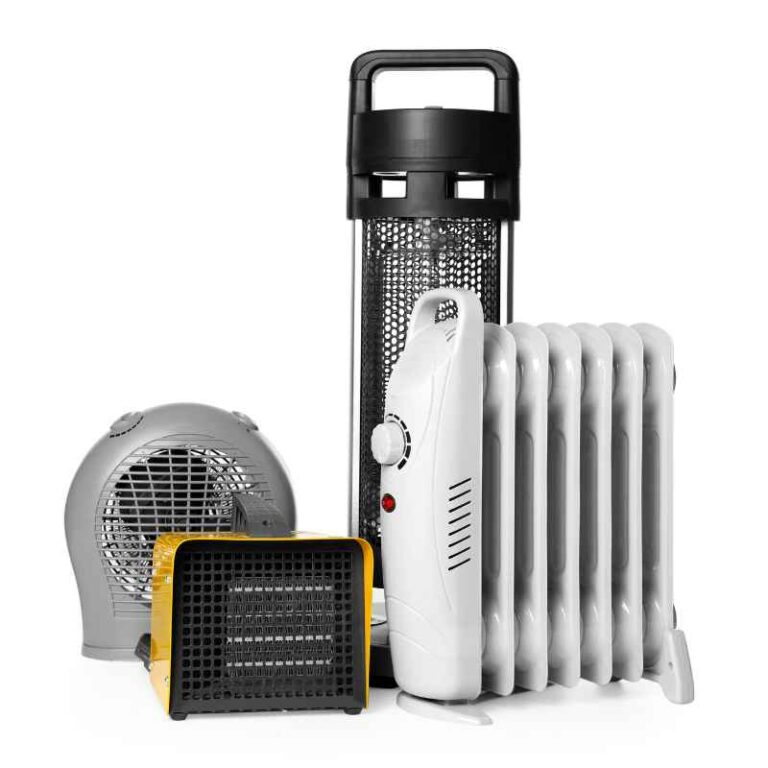
Forced air heats a house quickly and works well when ductwork already exists, especially if you also want central cooling. Hydronic radiant floor heat delivers steadier comfort and quieter operation, but it usually costs more to install and responds more slowly. The best choice depends less on a blanket “efficiency winner” and more on the installed system: duct losses, envelope quality, control strategy, supply temperature, equipment efficiency, and how the home is used. A poor match can leave you with drafts, room-to-room swings, or a heating system that is hard to add later. This guide compares how each type moves heat, affects comfort, and fits real homes.
Forced air, radiant, and hydronic at a glance
Forced air uses a furnace or air handler with a blower to push heated air through ducts and vents. It often pairs with central cooling, so one distribution network can handle both winter heat and summer air conditioning.
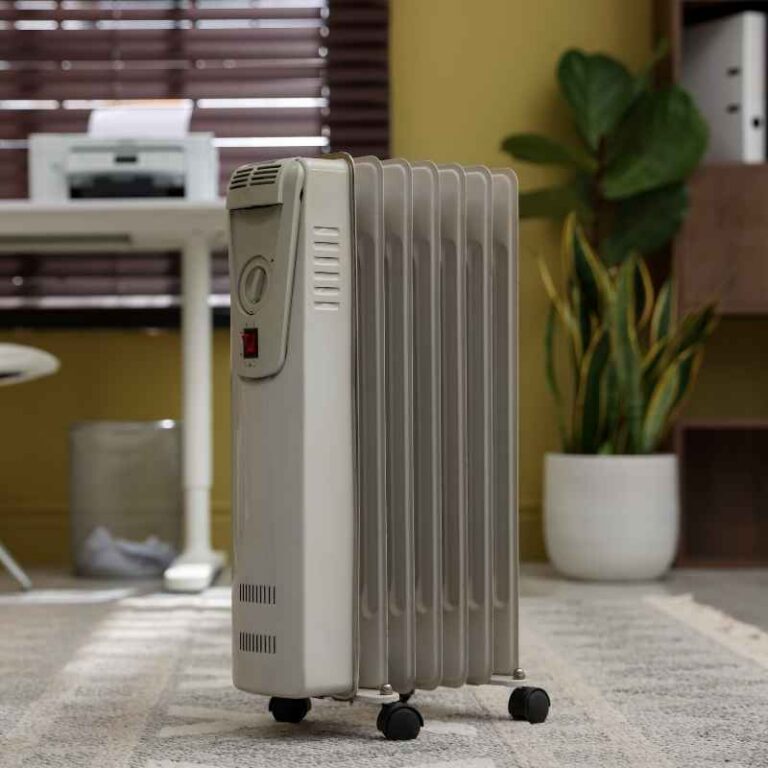
Radiant heat warms people and surfaces directly instead of warming room air first. In homes, radiant heat can be electric or hydronic, and this article focuses on hydronic radiant floor heating, where hot water circulates through tubing beneath the floor.
Hydronic is not a separate comfort category. It is a delivery method for radiant heat. A boiler or other hot-water heat source supplies the tubing, and that boiler can run on natural gas, propane, or other fuels.
The practical trade-off is simple. Forced air responds quickly and can cool the home too, but it depends on ductwork and moves air around the house. Hydronic radiant floors feel steadier and quieter, but they change temperature more slowly and usually cost more to install.
Heater types compared table
This matrix gives a practical starting point for a typical homeowner comparing a ducted retrofit, a radiant floor project, and a hydronic install tied to a boiler. Higher scores are better for the stated priority, except retrofit difficulty, where a higher score means easier to add.
| Priority | Forced air | Radiant | Hydronic radiant floor |
|---|---|---|---|
| Upfront cost | 5 | 2 | 1 |
| Speed of heat | 5 | 2 | 2 |
| Comfort consistency | 3 | 5 | 5 |
| Air quality | 3 | 5 | 5 |
| Retrofit difficulty | 4 if ducts already exist, 1 if they do not | 2 | 1 |
One-line recommendations: existing ducted home with central cooling, choose forced air; home without ducts and a limited remodel budget, choose forced air only if you can add ducts without major demolition; allergy-sensitive household or quiet bedroom wing, choose radiant; major remodel or new build, choose radiant or hydronic radiant floor heat; basement or addition with floor access, hydronic can fit well if the floor system can be opened up.
Cost: install price and operating drivers
Forced air usually has the lowest installed cost when ducts are already in place. Industry and consumer guidance commonly puts a replacement in the low thousands for a simple swap, while adding new ductwork can push total project cost much higher. Hydronic radiant floors typically sit at the high end because the job includes tubing, manifolds, controls, floor assembly work, and often a boiler. Existing-home retrofits can span a very wide range; a small zone can be modest, while a whole-house radiant project can reach the tens of thousands.
Operating cost is not determined by system type alone. DOE guidance on duct systems and ENERGY STAR recommendations both emphasize that leakage, poor sealing, and ducts in unconditioned spaces can waste a large share of delivered heat. ENERGY STAR notes that duct sealing and insulation can materially improve performance, and the Department of Energy has long warned that leaky duct systems can lose a significant amount of conditioned air before it reaches the rooms. That means a well-sealed forced air system can outperform a poorly designed radiant or hydronic setup on real-world bills.
Fuel type, insulation, setbacks, and supply temperature matter too. Hydronic systems often use lower water temperatures and can be very effective with a high-efficiency boiler, but they still need good design and controls. Forced air can be competitive when the furnace is efficient, ducts are tight, and the thermostat strategy avoids oversized temperature swings.
Comfort: response speed, zoning, and room feel
Forced air heats fastest because it moves warmed air immediately through ducts and vents. That quick response helps with short setbacks, occupied schedules, and rooms that cool down after doors open or windows leak. (Thisoldhouse)
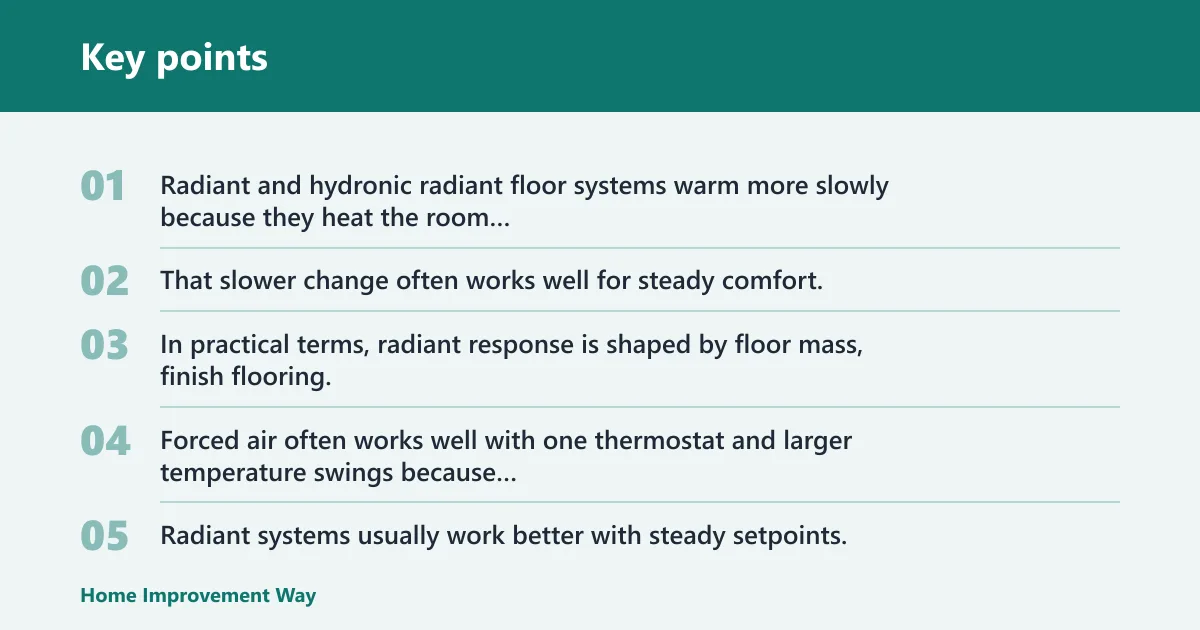
Radiant and hydronic radiant floor systems warm more slowly because they heat the room through surfaces and objects, then the air follows. That slower change often works well for steady comfort, but it is a drawback when you want fast recovery after a setback. In practical terms, radiant response is shaped by floor mass, finish flooring, tubing depth, and water temperature.
Thermostat strategy matters here. Forced air often works well with one thermostat and larger temperature swings because recovery is quick. Radiant systems usually work better with steady setpoints, since long setbacks can take time to recover and can leave floors cooler than expected for a while.
Say your 1,800-square-foot ranch has ducts and you drop the thermostat at night. Forced air can bring the house back sooner in the morning. If that same house used radiant floors, the better approach would be a smaller setback or a constant setpoint, so the floor never falls far behind.
Room type matters
Bedrooms often benefit from radiant or hydronic heat because the comfort is quiet and even. Basements can also be a strong fit if the slab or subfloor can be accessed for tubing or panels.
High-ceiling spaces are often better candidates for radiant than for forced air, since warm air from ducts can stratify and pool overhead. Additions are a mixed case: if the addition lacks ducts, radiant may avoid a costly new duct branch, but a small forced air extension can still make sense when the main system already has spare capacity.
Air quality and noise
Radiant heat does not circulate dust or allergens the way forced air can. That makes it a strong option for allergy-sensitive households or anyone who wants less air movement in sleeping areas.
Forced air systems can circulate dust and allergens if filtration is weak or maintenance is skipped. The air filter matters here. When replaced regularly, it improves indoor air quality; when it clogs, it can reduce efficiency and airflow. ASHRAE and ENERGY STAR both stress that filtration and duct cleanliness influence comfort, airflow, and indoor air quality in real homes.
Noise also separates the systems. Hydronic radiant heat operates silently. Forced air usually makes more sound because a blower motor starts, moves air through ducts, and can produce register noise or pressure changes as it cycles.
Is radiant heat better than forced air for allergies? Usually yes, especially when the main concern is dust, pollen, or pet dander moving through the house. That said, a well-maintained forced air system with a good filter can still perform reasonably well, so the real question is how much air movement the household can tolerate.
Retrofit and new-build fit
Retrofit complexity is where many homeowners make the wrong call. If ducts already exist, forced air is usually easier to add or replace. If ducts are missing, adding them can raise cost because you need chases, registers, returns, and space for duct runs.
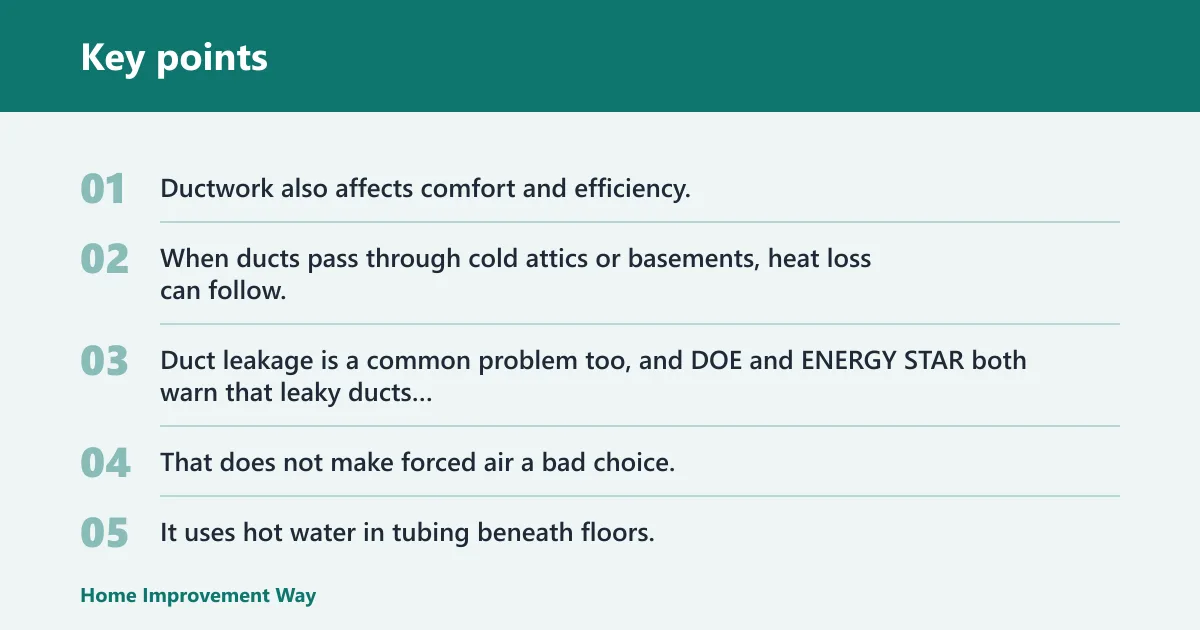
Ductwork also affects comfort and efficiency. When ducts pass through cold attics or basements, heat loss can follow. Duct leakage is a common problem too, and DOE and ENERGY STAR both warn that leaky ducts can waste a meaningful share of conditioned air. That does not make forced air a bad choice, but it does make duct condition a central part of the decision.
Hydronic radiant floor heating is different. It uses hot water in tubing beneath floors, so it needs a boiler or similar hot-water heat source and a distribution layout that fits the floor structure. Installation is typically higher cost upfront because the work is complex.
Picture a two-level home where the main floor already has ducts, but the finished basement does not. The main floor may be a clean fit for forced air. The basement, though, can make radiant or hydronic radiant heat attractive if floor access exists and the owner wants quieter comfort without another duct branch.
Boiler and tubing considerations
Hydronic systems need a boiler and professional installation. The boiler heats the water that circulates through tubing or radiators, and service access matters because the system depends on pumps, controls, and water-side components.
Hydronic radiant floors can pair with natural gas, propane, or other fuel sources. That flexibility helps in some homes, but it does not remove the main retrofit issue: the floor assembly must accommodate the tubing, heat transfer layer, and controls.
Thermostat strategy
Thermostat strategy should match the system’s response time. Forced air can handle setbacks and quick rebounds because the air handler delivers heat fast. Radiant floors usually do better with smaller setbacks, a steadier schedule, and control logic that anticipates the slab or floor mass.
For hydronic radiant heat, zoning can be useful, but aggressive night setbacks often backfire because the floor itself stores heat and releases it slowly. In contrast, a forced air system can often recover from a lower overnight setpoint without noticeable comfort loss if the ducts, filter, and equipment are in good condition.
Smart thermostats help most when they are set for the right system. A radiant floor often benefits from steady comfort and fewer large swings. A forced air system can use more flexible scheduling, especially in homes with variable occupancy or rooms that are used only part of the day.
Frequently asked questions
What is the difference between forced air, radiant, and hydronic heat?
Forced air moves heated air through ducts and vents with a furnace or blower. Radiant heat warms people and surfaces directly. Hydronic is one radiant delivery method that uses hot water in tubing beneath floors or in radiators, fed by a boiler or similar hot-water heat source.
Which heating system is most efficient for a house?
There is no universal winner. Installed performance depends on insulation, duct losses, controls, fuel source, and supply temperature. A tight, well-designed forced air system can outperform a poorly designed radiant setup, while a well-commissioned hydronic system can be very efficient.
Is radiant heat better than forced air for allergies?
Usually yes. Radiant heat does not circulate dust or allergens the same way forced air can, so it is often better for allergy or asthma concerns. Forced air can still work well if the filter is upgraded and replaced on schedule, but maintenance becomes part of comfort.
Does forced air heat cost less to install than hydronic heat?
Usually yes. Forced air is generally less expensive to install, especially when ducts already exist. Hydronic radiant floor heating usually costs more because the project includes tubing, a boiler or heat source, manifold hardware, and more labor in the floor assembly.
Which heating system gives the most even comfort?
Radiant, especially hydronic radiant floor heat, usually gives the most even comfort. It warms surfaces directly, tends to avoid the hot-and-cold swings of ducted air, and can feel comfortable at a lower thermostat setting. Forced air can be very usable, but it is more prone to room-to-room variation.
Can radiant heat work in an existing home?
Yes, but retrofit difficulty depends on the house. Radiant can work in an existing home during a major remodel, basement finish, or floor replacement. If floor access is limited and walls are already closed, installation becomes more disruptive and costly than in new construction.
Is hydronic heat the same as radiant heat?
No. Hydronic is one way to deliver radiant heat. The comfort comes from radiant transfer to the room, while hydronic describes the hot-water tubing and boiler system that supplies it. That distinction matters because the heat source, piping, and installation complexity all affect the project.
Which system heats up faster: forced air or radiant?
Forced air heats faster. The blower moves warm air quickly through the house, so the room temperature changes sooner. Radiant and hydronic systems change more slowly because they must warm floors, surfaces, and objects before the room feels fully warm.
Do forced air systems work with central air conditioning?
Yes. Forced air systems commonly pair with central air conditioning because they already use ducts and vents. That is one of the strongest reasons homeowners choose them for existing homes: the same distribution network can handle both heating and cooling.
What are the downsides of hydronic radiant heating?
The main downsides are higher upfront cost, more complex installation, and slower response time. Hydronic systems also depend on a boiler and careful design, so repairs and changes can be more involved after the floor is finished. That makes planning and layout more important than with simple duct replacement.
Sponsored / affiliate links. As an Amazon Associate I earn from qualifying purchases. I may earn additional commission from eligible campaigns.