Which Way Does the Furnace Filter Arrow Point?
The furnace filter arrow should point toward the furnace blower and ductwork, in the direction air moves. Install it backward and you can restrict airflow, add strain to the system, and let dust slip past a poor seal. HVAC manufacturers generally specify that the arrow should follow the airflow path through the filter media, with the reinforced side facing downstream. This guide shows how to read the arrow, confirm airflow when the slot is confusing, and check that the filter fits the right way in the right opening.
Understanding the arrow and airflow direction
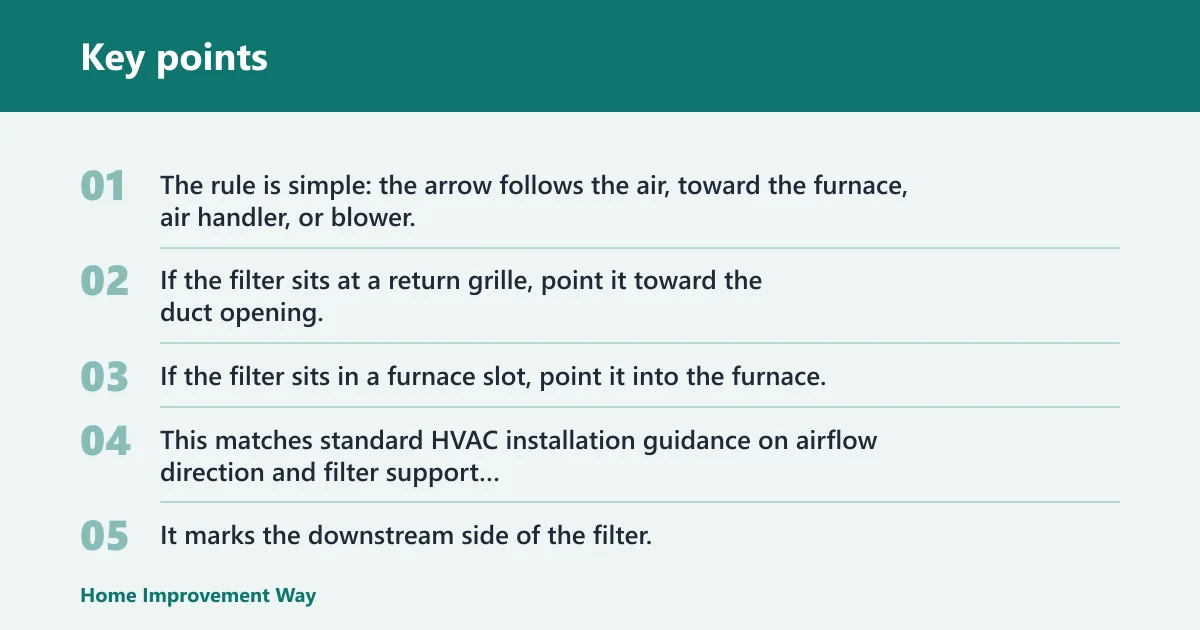


The rule is simple: the arrow follows the air, toward the furnace, air handler, or blower. If the filter sits at a return grille, point it toward the duct opening, not back into the room. If the filter sits in a furnace slot, point it into the furnace. This matches standard HVAC installation guidance on airflow direction and filter support orientation.
Arrow direction versus airflow path
The arrow is not decoration. It marks the downstream side of the filter, the side the air reaches after it passes through the media. In most systems, the filter sits on the return side before the blower, so the arrow points where the air goes next. Manufacturer guidance for pleated filters typically places the supporting wire or reinforced side on the blower side so the media is supported under load.
On a pleated filter, the reinforced side or wire backing usually faces the furnace or other downstream side. That backing supports the media as air pulls through it, which is consistent with common HVAC filter installation instructions from manufacturers and industry training references. If the filter has a visible frame edge and a marked arrow, follow the airflow, not the easiest way the frame slides in.
Where the filter sits changes the answer
The opening matters because the same filter can look “backward” if you focus on the room side instead of the duct path. A wall return, ceiling return, floor return, furnace slot, and deep media cabinet all place the filter in a different position relative to airflow.
That is why the arrow on the old filter helps, but it does not always settle the question. If the old filter is missing, faded, or installed wrong, use the air path and the equipment layout instead of copying the last setup blindly. Trane, Carrier, and other HVAC installation guides emphasize tracing the return air path to the blower side when the slot orientation is unclear.
Furnace filter airflow matrix
This matrix gives you a quick way to read the arrow when the installation is obvious, or when the slot is not. Use it as a decision tree: identify the filter location first, then match the arrow to the air path, then confirm that the filter sits snugly in the opening.
| Filter location | What the arrow should do | How to verify airflow without tools | What mistake is most common |
|---|---|---|---|
| Wall return grille | Point into the wall, toward the duct opening | Hold a tissue near the grille; it should draw toward the opening when the blower runs | Pointing the arrow back into the room |
| Ceiling return grille | Point toward the return opening, away from the room and into the duct path | With the blower on, a tissue should lift toward the grille | Installing the filter with the arrow aimed the wrong way for the airflow path |
| Floor return grille | Point down into the floor opening, toward the return duct | Place a tissue near the grille; it should be pulled toward the floor opening when the blower runs | Assuming floor returns work opposite to wall or ceiling returns |
| Upflow furnace slot | Point up | Look for air entering low and leaving at the top of the furnace | Following the cabinet face instead of the airflow path |
| Downflow furnace | Point down | Check that the air enters at the top and moves downward through the unit | Reversing the arrow because the cabinet door opens from above |
| Horizontal furnace | Point toward the blower end | Trace the duct path through the attic or crawl space and follow the pull toward the blower | Copying the direction from the nearest panel seam instead of the air path |
| Deep media cabinet | Point toward the air handler or blower side | Follow the pull from the return side into the cabinet and toward the unit | Installing it by frame shape only, without checking the flow direction |
Wall and ceiling returns
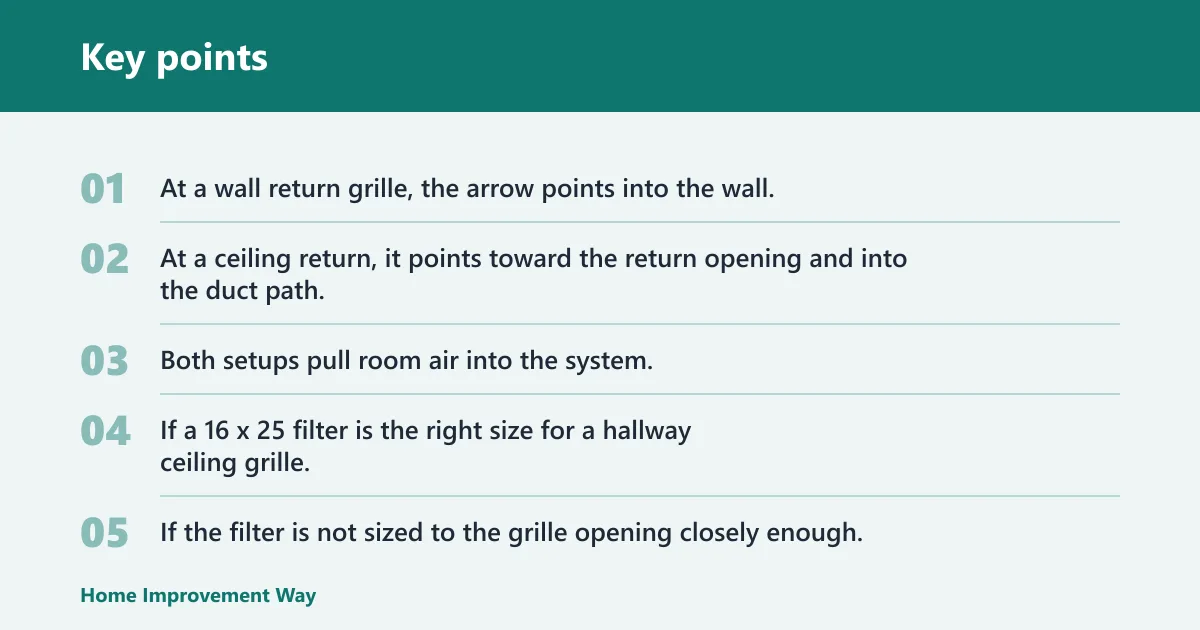
At a wall return grille, the arrow points into the wall. At a ceiling return, it points toward the return opening and into the duct path. Both setups pull room air into the system, so the arrow always faces away from the room and toward the return opening.
If a 16 x 25 filter is the right size for a hallway ceiling grille, the arrow should still follow the air path into the return, not back into the room. If the filter is not sized to the grille opening closely enough, the direction alone will not prevent bypass around the frame.
Upflow and downflow furnaces
An upflow furnace brings air in low and sends it out at the top, so the arrow usually points up. A downflow furnace does the opposite, so the arrow should point down. The cabinet shape can mislead you, but the air path does not change.
Picture a closet furnace with the return entering at the top and supply leaving through the floor. The arrow should point down into the unit. If the label on the frame conflicts with the obvious air path, trust the air path and check the return and supply layout again.
Horizontal furnaces and deep cabinets
In a horizontal furnace, the filter arrow points toward the blower end. These systems are common in attics or crawl spaces, where the cabinet may be mounted sideways and the filter slot can look upside down at first glance.
A deep media cabinet can also confuse the eye because the filter is larger and the frame may sit several inches from the equipment face. In that case, the arrow still points toward the downstream side, which is the furnace or air handler side after the return air passes through the media.
Wrong slot vs wrong direction
These are not the same problem. A filter can face the correct way and still be installed in the wrong opening, which can leave gaps, reduce filtration, or prevent the door from sealing. A wrong slot problem is about location; a wrong direction problem is about airflow orientation. Fix both before you assume the filter itself is bad.
What if the arrow is worn off?
If the arrow is gone or unreadable, use the dirty side, the air path, and a quick airflow check. The darker or dustier side often faces the return side, while the cleaner or reinforced side faces the furnace or blower. That is a clue, not a guarantee.
Use the dirty side
On many old filters, the side facing the return grille collects more visible dust. The downstream side often stays cleaner because the media is supported there and the air has already passed through the filter. If both sides look similar, do not guess from appearance alone.
Use a tissue test
A tissue test is simple. Hold a small piece of tissue near the return grille or open slot while the blower runs. If the air pulls the tissue toward the opening, that is the intake side, and the arrow should point that way.
Use the fan-on test
Run the system fan if your thermostat allows continuous fan operation. Then check which side pulls air and which side pushes it away. This is especially useful in cramped horizontal installs where the opening is hard to see and the old filter is missing.
What happens if the filter goes in backward?
A backwards filter can reduce airflow. It may also load with dust faster on the wrong side, which can make the system work harder than it should. HVAC manufacturers warn that restricted airflow can reduce comfort, increase noise, and stress components over time. The result is not always immediate failure, but the system can become noisier, weaker, and less efficient.
Airflow restriction
When the filter faces the wrong direction, air has to pass through the filter in the direction it was not meant to support. That can add resistance. In a tight system, that resistance can be enough to reduce the amount of air moving across the coil or heat exchanger, which is why industry guidance consistently warns against installed-backwards filters and clogged media.
Possible short cycling
Restricted airflow can contribute to short cycling because the equipment may trip a safety control if heat buildup or cooling imbalance gets too high. The exact symptom depends on the system, but the key point is the same: poor airflow can cause the furnace to stop sooner than it should. If the blower seems to struggle, the filter orientation is one of the first things to check.
Dust bypass and coil loading
A backwards filter does not only affect airflow. If the fit is loose, dust can move around the edges and settle downstream. That can load the coil, dirty the blower compartment, and make the filter seem like it is failing even when the real issue is direction plus poor fit.
Does fit matter as much as direction?
Yes. Exact size and fit matter as much as the arrow because a loose filter can allow bypass. A filter that is the right direction but the wrong size can still let air move around the edges instead of through the media. Direction and seal both matter, and most HVAC manufacturers allow only small dimensional tolerance between the printed filter size and the actual cabinet opening.
Exact size checks
Check the printed dimensions on the frame and match them to the slot or grille opening. An undersized filter can shift, rattle, or leave a gap. A filter that is too thick for the cabinet may bow, bind, or prevent the door from closing fully. A close fit is important because even a correctly oriented filter can underperform if the frame does not seat properly.
Gaps that let air bypass
Any open edge can become a bypass path. Air takes the easiest route, so a loose fit can move dust around the filter rather than through it. That can make a properly pointed arrow less useful than a tight filter in the correct slot.
When to replace a loose filter
Replace a filter if it will not sit flat, the frame bends when installed, or the cabinet door has to force it into place. Do not tape around the frame unless the equipment instructions allow it. A better-sized filter is the cleaner fix.
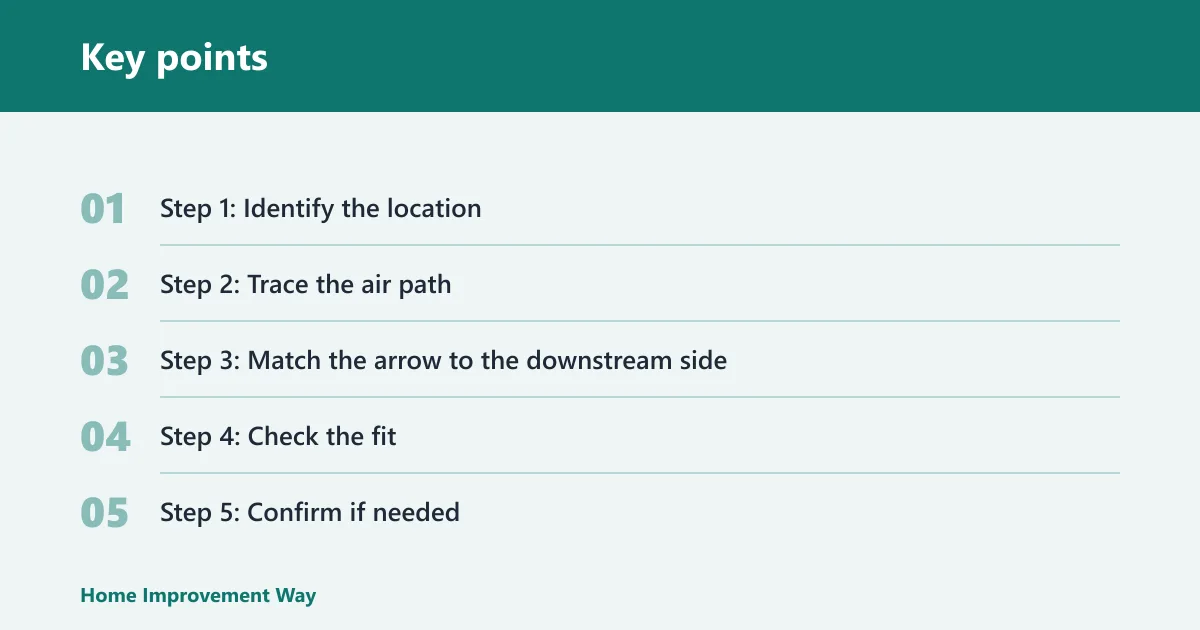
- Step 1: Identify the location. Find the filter location: return grille, furnace slot, or media cabinet.
- Step 2: Trace the air path. Trace the air path from the room to the blower.
- Step 3: Match the arrow to the downstream side. Point the arrow toward that downstream side.
- Step 4: Check the fit. Check that the filter fits flat, with no open gaps around the frame.
- Step 5: Confirm if needed. If the arrow is unclear, use the tissue or fan-on test.
Frequently asked questions
Which way does the furnace filter arrow point?
The furnace filter arrow points in the direction of airflow, toward the furnace blower and ductwork. At a furnace slot, that usually means into the furnace. At a return grille, the arrow points into the wall, ceiling, or floor opening rather than back into the room. If the arrow is missing, follow the return-to-blower path and reinstall the filter toward the downstream side.
Which way should the furnace filter arrow point on a furnace filter?
It should point toward the downstream side of the system, which is the side air reaches after passing through the filter. In most homes that means toward the furnace, air handler, or blower. If the filter is at a return grille, point it toward the grille opening. If the arrow is absent, use the air path and the equipment layout instead of guessing from the frame.
How do I tell which way my furnace filter goes if the arrow is worn off?
Use the air path first. The return side pulls air from the room, and the blower side is downstream. A tissue test or fan-on test can confirm which side is drawing air. If the filter has a reinforced side, that side usually faces the furnace or blower. If the arrow is missing, reinstall the filter so the reinforced side ends up on the blower side.
What happens if a furnace filter is installed backwards?
A backwards filter can reduce airflow, and that can raise strain on the system. It can also let dust bypass a loose fit and load the coil or blower area faster. Some systems may short cycle if the airflow restriction becomes severe enough. If this happens, check both direction and fit before assuming the filter media itself is the problem.
Which way should the arrow point on the air filter at a ceiling return?
At a ceiling return, the arrow should point toward the return opening and into the duct path. The filter belongs on the return side, where room air moves into the opening. If the arrow points the wrong way for that location, the filter is facing opposite the airflow. If the arrow is missing, confirm with a tissue test before reinstalling it.
Which way should the arrow point on a furnace filter in a horizontal unit?
In a horizontal furnace, the arrow points toward the blower end and follows the duct path through the attic or crawl space. The cabinet may sit sideways, so do not use the panel orientation alone. Use the direction the air is actually moving. If the arrow is worn off, trace the return side to the blower side and reinstall accordingly.
Sponsored / affiliate links. As an Amazon Associate I earn from qualifying purchases. I may earn additional commission from eligible campaigns.