Why Is My House Not Reaching the Thermostat Setpoint?
If your furnace or heat pump runs but the house will not reach setpoint, start with the thermostat mode, fan setting, batteries, and displayed temperature. Then check airflow and filters, then ask whether the system is undersized or underperforming. Leaving it alone can mean higher bills, weak comfort, and longer run times. This guide shows a fast way to separate thermostat, airflow, and equipment-capacity problems, then points to furnace- or heat-pump-specific faults.
Why the house stays below setpoint


When the house stays cooler than the thermostat setting, the problem may be at the thermostat, in airflow, or in the heating equipment itself. A running system can still fall short of setpoint, especially if heat delivery is restricted or the equipment loses output in cold weather.
The fastest way to avoid wasted service calls is to check the thermostat first, then look for airflow limits, then decide whether the furnace or heat pump is failing to deliver enough heat.
Setpoint versus room temperature
The setpoint is the temperature you choose on the thermostat. The room temperature is the actual temperature the thermostat senses. If the setpoint is around 70°F and the room is around 66°F, the system should keep heating until it closes that gap. If it cannot, something is limiting heat delivery or capacity.
A thermostat can also be a few degrees off if it is not calibrated properly. Battery problems or loose wiring can add confusion, especially if the display is dim, resets, or reacts slowly.
Say your thermostat is set to 69°F, the display reads 69°F, and the house hangs at 65°F with the heat running almost nonstop. That points away from a simple setpoint mistake and toward airflow, outdoor-unit issues, or a furnace that cannot keep up.
Check the thermostat first
Before you assume the heater has failed, verify the thermostat mode, fan setting, batteries, and displayed temperature. A heat pump in the wrong mode can blow cool air, and a furnace or heat pump controlled by a weak or misread thermostat may never reach the target temperature.
Heat mode and fan setting
Make sure the thermostat is set to heat mode, not cool or off. If the system is a heat pump, the wrong mode can make it look like the system is working while the house still feels cold. Also check the fan setting. Continuous fan mode can move air even when the compressor or burners are not heating, which can make lukewarm air feel colder.
If registers blow cold air, start with the thermostat mode. That quick check rules out one of the most common setup mistakes.
Battery, wiring, and calibration checks
Replace weak batteries if the thermostat uses them. Look for a blank screen, erratic schedule changes, or a display that seems to lag behind room conditions. If the thermostat is hardwired, loose or damaged wiring can interrupt proper calls for heat.
If the thermostat seems off by a few degrees, calibration may be the issue. An HVAC technician can verify that reading during service and confirm whether the thermostat is sending the right signal.
Quick thermostat check list
- Set the system to heat mode.
- Confirm the fan is not forcing continuous circulation unless you want that setting.
- Compare the displayed room temperature with a separate thermometer if you have one.
- Replace batteries if the thermostat uses them.
- Check for error messages, blank display, or loose mounting.
Airflow problems that limit heat delivery
Restricted airflow can make both furnaces and heat pumps look weak. Heat may be produced, but it never reaches the rooms in full volume. A dirty air filter, closed registers, weak blower fan, or leaky ducts can all reduce delivered heat.
Dirty air filter
A dirty or clogged filter is one of the first things to check. It cuts airflow across the heat exchanger in a furnace and across the indoor coil in a heat pump. That lowers heat delivery and can make the system run longer without reaching setpoint.
Replacement interval matters. If the filter looks gray, loaded with dust, or collapsed, replace it now rather than waiting for the usual schedule.
Closed registers and duct leakage
Closed or blocked supply registers reduce airflow in the rooms that need heat. Furniture, rugs, or drapes can do the same thing. Duct leakage can also send heated air into walls, attics, or crawl spaces before it reaches the living area.
If several rooms are cold while the equipment keeps running, duct loss or blocked registers may be part of the problem.
Weak blower fan
The blower fan moves heated air through the indoor unit and into the ducts. If it is weak, dirty, or failing, you may notice low airflow from the vents even though the heater is on. That can make warm air feel brief and uneven.
Blower problems need service when airflow is consistently low, the fan is noisy, or the system trips on safety limits.
A common first-time mistake is replacing the thermostat before checking the filter. A heavily loaded filter can make a healthy furnace or heat pump look defective, and the temperature gap may shrink as soon as airflow is restored.
Heat pump problems to check next
A heat pump can keep running and still fail to warm the house enough, especially in freezing weather. The outdoor unit, indoor unit, refrigerant charge, and reversing valve all affect heating output. In cold weather, a heat pump can lose capacity even when it is technically working.
Outdoor coil ice or frost
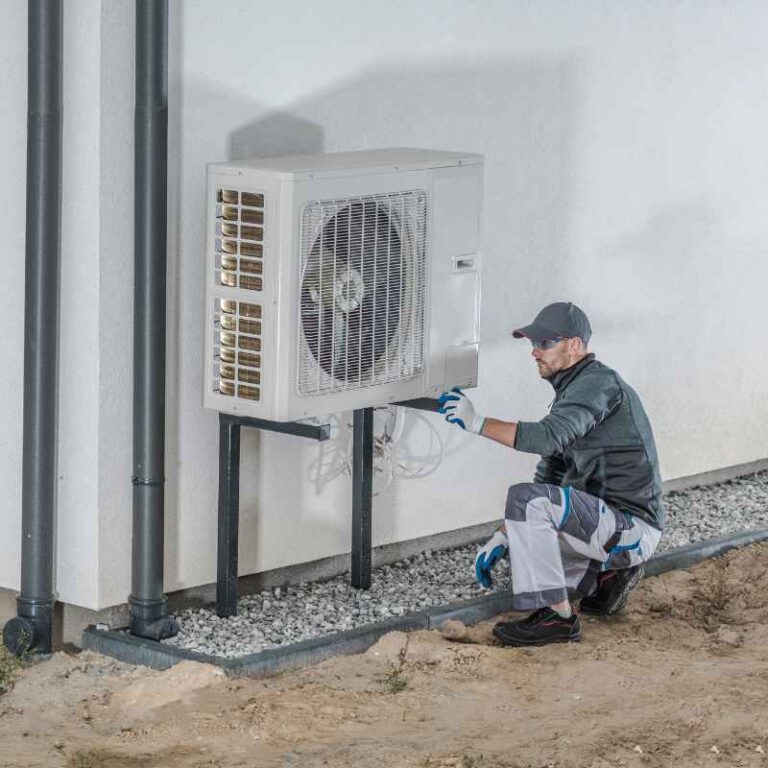
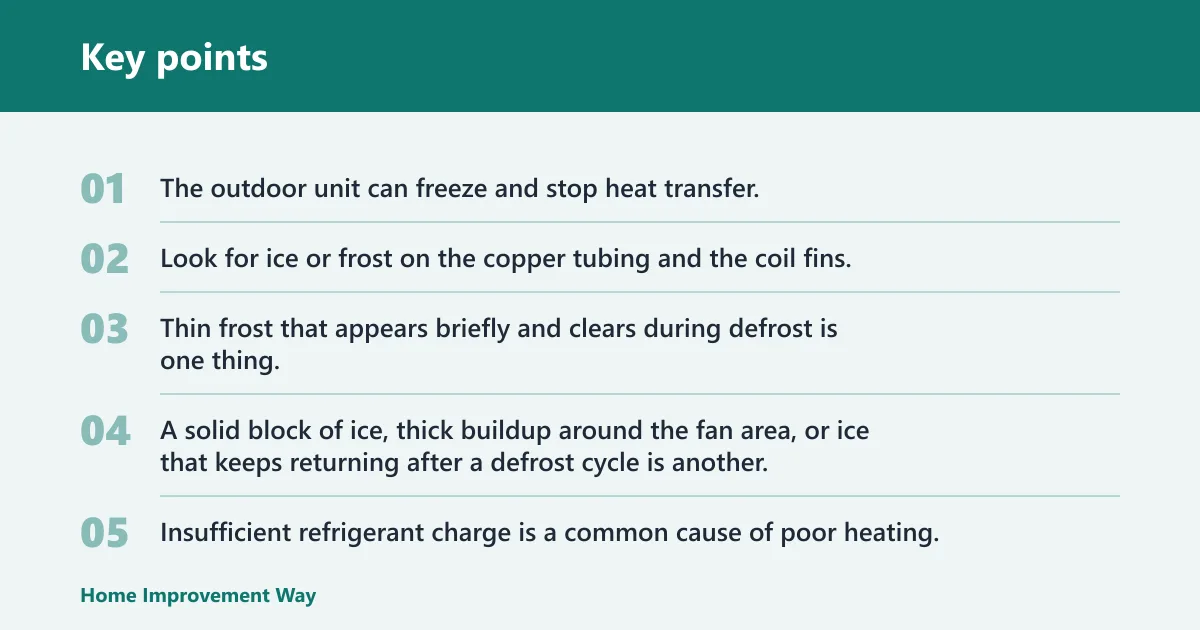
The outdoor unit can freeze and stop heat transfer. Look for ice or frost on the copper tubing and the coil fins. Light frost during cold, damp weather can happen during normal operation, but heavy ice that spreads across the unit is a warning sign.
Heavy ice on the outdoor unit is urgent because it blocks heat transfer and can damage the system if it keeps running that way.
How much frost is too much?
Thin frost that appears briefly and clears during defrost is one thing. A solid block of ice, thick buildup around the fan area, or ice that keeps returning after a defrost cycle is another. That pattern points to a problem with airflow, refrigerant charge, controls, or the outdoor unit itself.
Low refrigerant charge
Insufficient refrigerant charge is a common cause of poor heating. When refrigerant is low, the system cannot move enough heat indoors, and the coil can frost or freeze. That loss of heating capacity can look like a thermostat problem when it is really a system issue.
Low refrigerant usually needs a technician because leak repair and charging involve sealed-system work and refrigerant handling.
Reversing valve faults
The reversing valve controls whether a heat pump heats or cools. If it sticks or malfunctions, the system may cool when it should heat, or it may move into the wrong mode and leave the house cold. That is a common answer when a heat pump is running but no warm air comes from the vents.
Cold-weather capacity limits
Heat pumps are commonly reported to lose heating output as outdoor temperature drops. That does not mean the system is broken. It means the available heat in the outdoor air is lower, so the unit may run longer and still struggle to reach setpoint on very cold days.
If the house stays a few degrees below setpoint only during cold snaps, the system may be working but under capacity for the weather or the home’s heat loss.
Furnace issues that can cause the same symptom
A furnace can run and still underheat the home if airflow is poor, the burners are not producing enough heat, or the equipment is too small for the house. Furnace complaints often sound different from heat pump complaints, but the symptom is the same: the room never reaches the thermostat setting.
Poor airflow across the heat exchanger
If air cannot move properly across the heat exchanger, the furnace may overheat, shut down early, or deliver less warm air to the rooms. Dirty filters, blocked registers, and weak blowers can all cause that result.
When a furnace starts and stops repeatedly without warming the house, airflow restriction is high on the list.
Burner or ignition problems
If the burners do not light fully or stay lit, the furnace may run without producing normal heat. You may notice short heating cycles, no warm air, or repeated starts. These faults need a technician because they can involve gas, ignition, or safety controls.
Undersized equipment
If the furnace is too small for the home’s heat loss, it may run constantly and still fall short of setpoint. That is more likely in additions, poorly insulated homes, or systems that were sized for a different layout. In that case, the equipment may be operating correctly but cannot keep up.
Repair can help a lot when the issue is dirty filters, a weak blower, or a control fault. Replacement becomes more likely when the unit is undersized, older, or facing repeated major repairs.
Heating troubleshooting matrix
| Symptom | Likely cause | Quick homeowner check | Likely severity | Recommended next step |
|---|---|---|---|---|
| House stays below setpoint | Thermostat set wrong or misreading | Confirm heat mode, setpoint, batteries, and displayed room temperature | Low to moderate | Correct the settings; if the reading still seems off, schedule calibration verification |
| Warm air stops before setpoint | Dirty air filter | Remove and inspect the filter for dust loading or collapse | Moderate | Replace the filter and recheck temperature rise over the next cycle |
| Weak airflow from vents | Closed registers or blocked returns | Open supply registers and clear furniture or rugs from returns | Low to moderate | Restore airflow, then watch whether the temperature gap shrinks |
| Uneven room temperatures | Duct leakage | Look for obvious gaps, disconnected ducts, or cold attic/crawlspace sections | Moderate | Book duct inspection and sealing |
| Fan runs but heat feels weak | Weak blower fan | Notice whether airflow is lower than usual or the fan sounds strained | Moderate to high | Call for blower diagnosis and motor testing |
| Outdoor unit has frost | Normal defrost or cold, damp weather | Check whether frost clears during defrost and whether airflow is normal | Low if light and temporary | Monitor briefly; if frost thickens or stays, schedule service |
| Outdoor unit is heavily iced | Outdoor coil ice, airflow issue, or control fault | Look for solid ice or ice on the copper tubing | High | Shut down heating if advised by the manufacturer and call an HVAC technician |
| Heat pump runs but air stays cool | Reversing valve fault | Verify the thermostat is in heat mode and the system is not accidentally cooling | High | Schedule professional diagnosis of the reversing valve and controls |
| Long run time, poor heating output | Low refrigerant charge | Look for icing, weak heat, or repeated inability to reach setpoint | High | Call for leak detection, repair, and proper charging |
| Heater runs constantly in very cold weather | Heat pump capacity limit or undersized equipment | Compare the temperature gap on mild days versus freezing days | Moderate to high | Have a technician evaluate capacity, auxiliary heat, or system sizing |
| Furnace lights but home still feels cold | Burner or ignition issue | Listen for short cycling, repeated ignition attempts, or no warm airflow | High | Schedule furnace service for combustion and safety checks |
When to call an HVAC technician
Call an HVAC technician when the thermostat checks out, the filter is clean, airflow is normal, and the home still will not reach setpoint. Refrigerant handling, electrical troubleshooting, thermostat calibration verification, burner diagnosis, and reversing-valve testing should be done by a pro.
Urgency goes up when you see heavy ice on the outdoor unit, repeated short cycling, no warm air from the vents, or a persistent temperature gap that does not improve after basic checks.
Repair versus replace
- Confirm the simplest causes. Check mode, fan setting, batteries, filter condition, and register positions first. Those items are cheap to fix and often explain the symptom.
- Look for repeated failures. If the system has recurring blower, ignition, icing, or refrigerant problems, service costs can stack up fast. Repeated sealed-system or control failures push the decision toward replacement.
- Compare capacity to the home. If the equipment runs correctly but still cannot keep up during normal weather, undersized equipment may be the real issue. In that case, repair may not solve the comfort problem.
- Ask for a full diagnosis. A technician can test refrigerant charge, electrical components, thermostat calibration, and airflow. That gives you a clearer repair-versus-replace decision than guessing from symptoms alone.
Frequently asked questions
Why is my house not reaching the temperature I set on the thermostat?
Start with the thermostat, then airflow, then equipment capacity. Check heat mode, fan setting, batteries, and the displayed temperature. If those are correct, look at the filter, registers, blower, and duct leaks. If the system still cannot close the gap, the furnace or heat pump may be underperforming.
Why is my furnace running but the house still feels cold?
A furnace can run and still underheat the home if airflow is restricted, the blower is weak, burners are not delivering normal heat, or the unit is undersized. A dirty filter or closed registers can make the problem worse by reducing the amount of warm air that reaches the rooms.
Why does warm air stop coming out of my vents before the set temperature is reached?
That pattern often points to a thermostat issue, airflow restriction, or a heating cycle that ends too soon. Check the mode, filter, and registers first. If those are fine, a weak blower, burner problem, or heat pump fault may be cutting heat delivery before the house warms up.
Can a dirty filter keep my house from reaching the thermostat setting?
Yes. A dirty or clogged filter restricts airflow, which reduces heat delivery and can make the system run longer without reaching setpoint. It can also stress the blower and other components. If the filter looks loaded with dust, replace it before looking for a larger failure.
Could the thermostat be set wrong even if the heat is on?
Yes. The system can be in heat mode and still be set incorrectly if the fan is on continuously, the setpoint is too low, or the thermostat is reading room temperature inaccurately. Weak batteries or calibration error can also make the display misleading.
Why would an outdoor heat pump unit be frozen in winter?
Some frost can happen during normal operation, especially in cold, damp weather. Heavy ice is different. It usually points to restricted airflow, low refrigerant, a control issue, or a defrost problem. Ice on the copper tubing and a unit that stays iced over deserve prompt service.
How do I know if low refrigerant is causing poor heating?
Look for weak heat, long run times, icing on the outdoor unit, and a house that never reaches setpoint even though the system runs. Low refrigerant often reduces heating capacity and can freeze the coil. A technician needs to confirm the leak and restore the proper charge.
Is a bad reversing valve why my heat pump is not heating?
It can be. The reversing valve controls whether the heat pump heats or cools. If it sticks or fails, the system may cool when it should heat or leave the home with little to no warm air. That is a technician-level repair, not a thermostat fix.
When is frozen ice on a heat pump an emergency?
Heavy ice is urgent when it covers much of the outdoor unit, keeps returning after defrost, or blocks the fan and coil. Light frost can be normal for a short time. Solid ice means heat transfer is blocked and the system may be at risk if it keeps running.
Should I call an HVAC technician or check the thermostat first?
Check the thermostat first. Verify heat mode, setpoint, fan setting, batteries, and the room-temperature reading. If those are correct and the house still will not reach setpoint, call an HVAC technician for airflow, refrigerant, electrical, calibration, or burner diagnosis.
Sponsored / affiliate links. As an Amazon Associate I earn from qualifying purchases. I may earn additional commission from eligible campaigns.