Why Is My Furnace Squealing or Screeching?
A furnace that squeals or screeches usually points to the blower motor, draft inducer, belt, or wheel. If the noise starts suddenly or the unit strains, shut it off and call for service. Ignoring it can lead to a seized motor, burned belt, or airflow loss that raises repair costs. This guide shows how to match the sound to the likely part and what you can safely check first.
What the sound pattern usually means
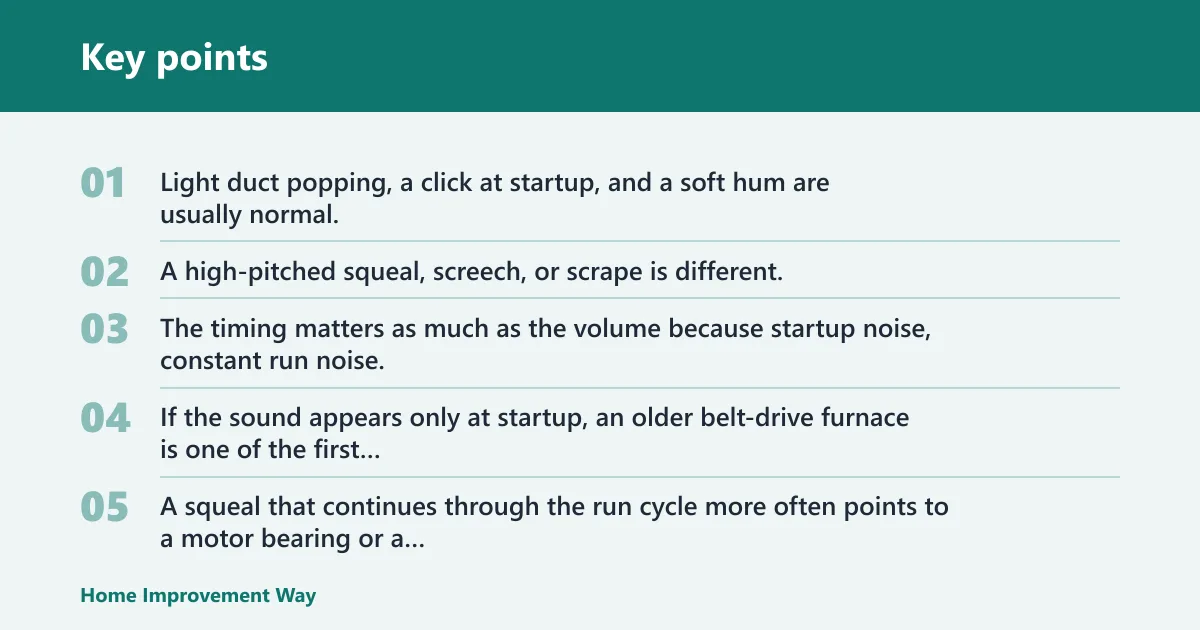


Every furnace makes some sound. Light duct popping, a click at startup, and a soft hum are usually normal. A high-pitched squeal, screech, or scrape is different. The timing matters as much as the volume because startup noise, constant run noise, and shutdown noise often point to different parts.
Startup only versus constant noise
If the sound appears only at startup, an older belt-drive furnace is one of the first suspects. A squeal that continues through the run cycle more often points to a motor bearing or a blower wheel that may be rubbing or loose. A brief sound that fades fast is less urgent than a noise that stays constant.
Squeal, screech, whine, or scrape
A squeal or whine usually comes from friction in a rotating part. A screech is often sharper and can mean the problem is more advanced. Scraping is different again. It usually means metal is touching metal, which moves the issue closer to a service call.
When the sound points to a motor, belt, or wheel
Direct-drive furnaces can squeal from worn blower motor bearings. Older belt-drive furnaces can squeal from a glazed, loose, or stretched belt. The blower wheel can scrape, rub, or squeal if it is loose on the shaft or touching the housing. The draft inducer motor can also squeal or whine.
Furnace squeal decision table
Use the sound pattern first, then compare what you hear with the likely part. This table keeps the checks to safe homeowner steps only.
| Sound timing | Sound type | Likely component | Safe homeowner check | Urgency level |
|---|---|---|---|---|
| Startup | Squeal | Belt-drive blower belt | Check whether the furnace is an older belt-drive unit and look at the air filter for blockage | Call soon |
| Startup | Whine | Draft inducer motor or blower motor bearings | Listen for whether the sound fades after ignition or continues into the run cycle | Call soon |
| During run | Squeal | Blower motor bearings | Check the filter and note whether airflow seems weak at supply vents | Call soon |
| During run | Scrape | Blower wheel | Look for obvious loose panels or visible vibration without opening the cabinet | Shut it off and call |
| Shutdown | Squeal or whine | Motor bearings | Notice whether the sound appears as the motor slows down | Call soon |
| Any time | Grinding or loud scraping | Wheel contact or failing motor | Turn the furnace off and do not keep cycling it | Shut it off and call |
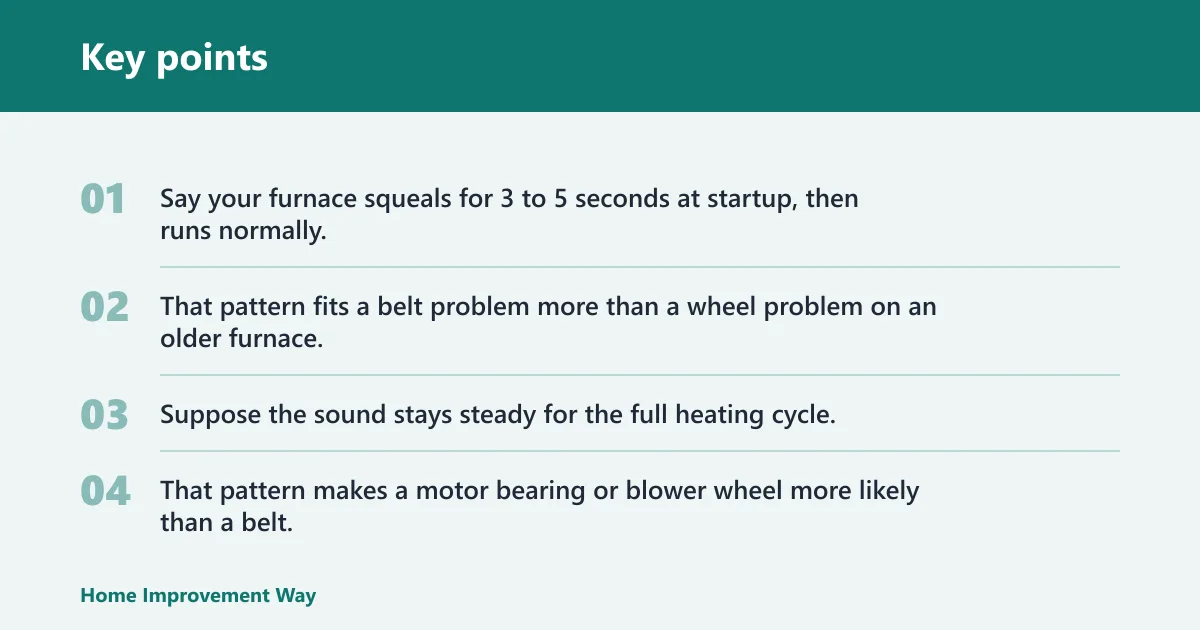
Say your furnace squeals for 3 to 5 seconds at startup, then runs normally. That pattern fits a belt problem more than a wheel problem on an older furnace. Suppose the sound stays steady for the full heating cycle. That pattern makes a motor bearing or blower wheel more likely than a belt.
Could a blower motor be the cause?
Yes. A blower motor can cause a squealing noise, especially in a direct-drive furnace with worn bearings. Motor bearings wear out over time, dry out, or lose lubrication. That can create a high-pitched squeal or whine, and in worse cases the motor can seize.
Direct-drive blower motor symptoms
On a direct-drive furnace, the blower motor is tied closely to the fan assembly, so bearing wear often shows up as a steady noise while the blower runs. The sound may get louder as the system heats up. It may also change pitch with blower speed, which is a clue that the motor is involved.
Motor bearing wear and high-pitched noise
Motor bearings do not usually fail all at once. They often start with a light squeal, then move to a louder whine. If the motor has to work harder because of a clogged filter or another airflow restriction, the noise can seem more obvious. That does not mean the filter is the root cause.
When the blower motor needs service
If the sound is constant during the run cycle, gets worse over time, or turns into scraping, the blower motor needs service. A failing motor is typically not a simple homeowner repair. Turning the furnace off is the safer move if the noise becomes harsh, the blower slows, or the unit struggles to move air.
Could the draft inducer motor be squealing?
Yes. The draft inducer motor vents combustion gases before the burners run. It can squeal or whine when its bearings wear. This noise often starts before the main blower comes on, so the sound can seem to come from a furnace that is still in the ignition stage.
What the inducer does
The inducer runs early in the heating cycle. Its job is to move combustion gases so the furnace can operate safely. Because it starts before heat is delivered to the home, a noise that appears at the beginning of the cycle can point to the inducer instead of the blower motor.
Bearing wear in the inducer
Like the blower motor, the inducer uses bearings that wear over time. A dry or worn bearing can squeal or whine. If the sound is there only for the first part of the cycle and then changes, the inducer is worth suspecting before the blower assembly.
Why inducer noise can start before heat
Noise that starts before burners light often means the problem is in the preheat stage. That timing matters. It separates inducer noise from blower noise and helps narrow the part without opening the furnace cabinet.
Belt-drive furnaces and startup squeal
Older belt-drive furnaces can squeal at startup because the belt slips or vibrates before it settles. Squealing can signal a worn blower belt in older furnaces. A glazed belt, a loose belt, or a stretched belt is a common reason. This is one of the clearest timing clues in furnace noise diagnosis.
Glazed belts
A glazed belt loses grip. That can make it squeal as soon as the motor starts. The sound may be brief, then fade as the belt catches. If it returns every cycle, the belt is likely worn rather than simply dusty.
Loose or stretched belts
A belt that has stretched can slip on the pulley. That creates a sharp startup squeal and sometimes a pulsing noise while the furnace runs. On older systems, this is more likely than a blower motor fault. It is still a service issue, not a noise to ignore.
Why older furnaces squeal more at startup
Older belt-drive furnaces have more parts that can slip at the beginning of the cycle. The belt has to grab and move the blower wheel quickly. If the belt is worn, that first second of movement is where the squeal shows up most often.
Blower wheel rubbing or scraping
A blower wheel can scrape, rub, or squeal if it is loose on the shaft or contacting the housing. That sound is usually more urgent than a simple squeal because it can mean the wheel is misaligned or the assembly is damaged. Scraping is one of the clearest signs to stop using the furnace.
Loose wheel on the shaft
If the wheel loosens on the shaft, it can wobble and rub as it spins. That may produce a squeal at first, then a rougher noise as the contact increases. A loose wheel also affects airflow, which can make the furnace sound strained.
Wheel contact with the housing
When the wheel touches the housing, the sound often becomes metallic. You may hear scraping more than squealing. That is not a filter issue by itself. It points to a mechanical problem in the blower assembly that needs service.
Why scraping needs faster service
Scraping can damage the wheel, the housing, or the motor if the parts keep rubbing. It can also reduce airflow. If the furnace starts making a loud scrape or grind, shut it off and schedule service soon.
What you can safely check first
Keep the first pass simple. Check the air filter, listen for when the noise starts, and look for obvious looseness without opening the cabinet. Do not remove panels, touch wiring, or reach into moving parts. Those checks are enough to separate a filter issue from a likely mechanical fault.
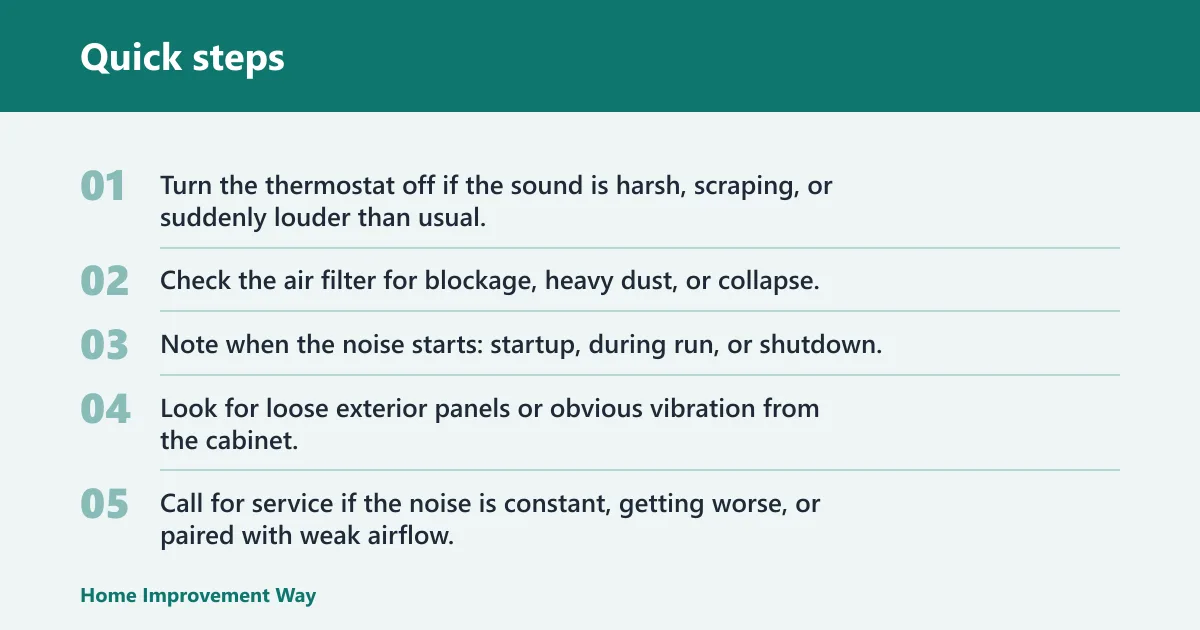
- Turn the thermostat off if the sound is harsh, scraping, or suddenly louder than usual.
- Check the air filter for blockage, heavy dust, or collapse.
- Note when the noise starts: startup, during run, or shutdown.
- Look for loose exterior panels or obvious vibration from the cabinet.
- Call for service if the noise is constant, getting worse, or paired with weak airflow.
Check the air filter
A dirty or blocked air filter can raise system strain and make noise more noticeable. It can also reduce airflow enough to make a motor work harder. That said, a filter is more often a noise amplifier than the root cause of a true squeal. If the filter is packed, replace it first.
Listen for when the noise starts
Startup squeal points more toward a belt or an inducer bearing. A sound that continues while the furnace runs points more toward the blower motor or blower wheel. A shutdown squeal can also point to a bearing issue as the part slows down.
Look for obvious looseness without opening the cabinet
Check for loose external panels, rattling screws, or clear vibration. Stop there. Anything deeper belongs to a technician. If the furnace is making a loud boom rather than a squeal, that is a different problem: delayed ignition. Burners ignite after gas accumulates, which creates a bang or boom and can damage the heat exchanger, the safety-critical part that separates combustion gases from indoor air.
Why is my furnace squealing?
Why is my furnace squealing? The most common causes are a worn blower motor bearing, a draft inducer motor with worn bearings, a belt problem in an older furnace, or a blower wheel that is rubbing. The sound pattern matters. Startup squeals often point to a belt, while steady run noise points more often to a motor or wheel.
Why is my furnace screeching when it starts?
Why is my furnace screeching when it starts? That pattern often points to an older belt-drive furnace with a glazed, loose, or stretched belt. It can also come from the draft inducer motor if the noise begins before heat is delivered. A startup screech is usually a call-soon issue, unless it turns into grinding.
Why is my furnace so loud all of a sudden?
Why is my furnace so loud all of a sudden? A sudden change usually means a part has shifted, worn down, or started rubbing. The blower wheel may be contacting the housing, a bearing may be failing, or a belt may be slipping more than before. If the loudness is paired with scraping, shut the furnace off.
Why is my heater squeaking?
Why is my heater squeaking? In most forced-air systems, squeaking points to a rotating part that is under friction. That can be the blower motor, the draft inducer, the belt in an older unit, or the blower wheel. A dirty air filter can add strain, but it does not explain every squeak.
Is furnace squealing dangerous or just annoying?
Is furnace squealing dangerous or just annoying? It can be either. A light squeal from a worn belt or bearing is often a service issue, not an emergency. But scraping, grinding, a burning smell, weak airflow, or a loud boom changes the picture and calls for immediate shutoff and service.
Should I turn off my furnace if it makes a screeching sound?
Should I turn off my furnace if it makes a screeching sound? Yes, if the screech is loud, sudden, or paired with scraping, grinding, burning smells, or weak airflow. A steady squeal alone can often wait for a prompt service visit, but a harsh mechanical sound means continued operation could cause more damage.
Frequently asked questions
Can a blower motor cause a squealing noise?
Can a blower motor cause a squealing noise? Yes. Direct-drive blower motors can squeal or whine when their bearings wear out. The sound often continues during the run cycle and may get louder over time. If the motor starts to sound rough, service is the right next step.
Can the draft inducer motor make a squealing sound?
Can the draft inducer motor make a squealing sound? Yes. The draft inducer motor can squeal or whine when its bearings wear. Because it runs early in the cycle, the sound may appear before the burners light. That timing helps separate inducer noise from blower noise.
Could a dirty air filter make my furnace squeal?
Could a dirty air filter make my furnace squeal? It can make the system work harder and make other noises more noticeable. It is worth checking first. But a clogged filter is not the usual source of a true squeal. A worn belt, bearing, or rubbing wheel is more likely.
Why is my furnace making noise?
Why is my furnace making noise? Some sounds are normal, including a click at startup, soft hum, and light duct popping. A squeal, screech, or scrape points to a part that is wearing or rubbing. If the sound is new, louder, or rougher than before, plan on service soon.
Sponsored / affiliate links. As an Amazon Associate I earn from qualifying purchases. I may earn additional commission from eligible campaigns.
 Faryuan Bladeless Heater Fan, 25inch Heating & Cooling & Filter Combo Tower Fan 80° Oscillating with Remote, 9H Timer, 8 Speeds, Portable Quiet for Indoor, Bedroom, Home Office Room, White&Sliver
 ROVSUN 18000 BTU Mini Split AC/Heating System with Inverter, 20 SEER2 Energy Saving 230V Ductless Split-System Air Conditioner with Pre-Charged Condenser, Heat Pump, Remote Control & Installation Kit