How Long Does a Heat Pump Defrost Cycle Last?
A normal heat pump defrost cycle usually lasts about 5 to 10 minutes, according to manufacturer service literature and general guidance from the U.S. Department of Energy’s Energy Saver heat pump overview. A cycle that runs much longer, repeats often, or never finishes often points to a problem. Ignoring it can leave you with weak heat, higher bills, and possible compressor damage.
What does a heat pump defrost cycle do?
A heat pump can frost over on cold, damp days because its outdoor coil is pulling heat from outdoor air. When that frost gets heavy enough, the unit switches into defrost mode to melt ice off the outdoor coil and keep heat moving indoors. Short, periodic defrosts can be normal.
During defrost, the system reverses refrigerant flow so the outdoor coil warms up instead of gathering heat. That change helps clear ice that would otherwise block airflow through the coil and reduce heating output.
Why does frost form on the outdoor coil?
The outdoor coil sits outside in cold air, and it is the part that absorbs heat from that air. When outdoor temperature is near freezing and humidity is high, moisture can condense on the coil and freeze. Wind, snow, and blocked airflow can make frost build faster.
What switches during defrost?
The reversing valve changes refrigerant flow direction so the outdoor coil becomes warmer. The defrost control board watches sensor input and decides when to start and stop the cycle. Many systems also bring on auxiliary heat indoors so the home does not feel a sudden drop in supply temperature.
Why can indoor heat feel different briefly?
It is common for the air coming from indoor registers to feel cooler for a short time during defrost. The outdoor unit sends heat to the outside coil to melt ice, so the indoor section may depend on auxiliary heat for a short period. That change should end on its own and should not last long on a healthy system.
How long should a heat pump defrost cycle last?
Most manufacturers describe defrost as a short cycle, commonly about 5 to 10 minutes, though exact timing varies by model, outdoor temperature, and how much ice has formed. A short cycle that ends on its own is usually normal. Long or repeated cycles deserve a closer look.
Cold weather alone does not make defrost a fault. It does make defrost happen more often. Near-freezing temperatures with humidity, mist, snow, or heavy wind can push the system into defrost more frequently because frost forms faster on the outdoor coil. For additional context on icing conditions, see heat pump icing causes.
What counts as frequent versus normal?
A few defrost cycles on a wet, cold day can be normal. What is less normal is a pattern that repeats every hour or two, or a cycle that seems to start again soon after the previous one ends. If the pattern is steady and the home still heats well, the system may simply be responding to weather.
Frequent defrosting becomes more suspicious when it happens in mild outdoor conditions, when the outdoor coil is only lightly frosted, or when indoor heat output drops noticeably between cycles.
How does a heat pump defrost cycle work?
The system starts defrost when the control board sees conditions that suggest the outdoor coil is icing up. It then shifts the reversing valve, energizes the defrost circuit, and warms the outdoor coil until the frost melts or the board sees a safe stopping point. That process should end on its own.
How does the reversing valve operate?
The reversing valve changes the direction of refrigerant flow. In heating mode, the outdoor coil absorbs heat and the indoor coil releases it. In defrost, the valve flips so heat is moved to the outdoor coil, which thaws the ice that has formed there. If you are comparing backup modes, see auxiliary vs emergency heat.
What do the defrost control board inputs do?
The defrost control board uses sensor input and timing logic to decide when to begin and end the cycle. Some boards rely on temperature and time together. Others use additional inputs from the outdoor coil sensor or thermistor. If the board cannot read those signals correctly, the cycle may start at the wrong time or fail to end.
What is the outdoor coil sensor or thermistor role?
The outdoor coil sensor or thermistor reads coil temperature and usually sits on or near the outdoor coil assembly. If that sensor drifts out of range, comes loose, or fails, the board may think the coil is still frozen when it is not. That can lead to extra defrosts, a long cycle, or no defrost at all.
When do repeated defrost cycles point to trouble?
Repeated defrosts can mean the system is struggling with airflow, sensing, refrigerant charge, or control logic. If ice returns within hours, the cycle never ends, or auxiliary heat seems to run far more than expected, the issue is more likely than normal winter operation. That is the point to troubleshoot further.
Picture a heat pump on a 25°F night with drizzle and light snow. A brief defrost of about 7 minutes every so often can be normal. If that same unit goes back into defrost again soon and the outdoor coil is still packed with ice, the problem is likely no longer just weather.
Say a system keeps switching into defrost after every short heating run, and the indoor air feels lukewarm for long stretches. That pattern fits more than normal frost. It can point to restricted airflow, a bad sensor, or a board that is not reading termination correctly.
What if ice returns within hours?
If the outdoor coil freezes again within a few hours, check for dirty filters, blocked vents, snow around the cabinet, or debris on the coil. If those items are clear, the unit may be low on refrigerant or the outdoor fan may not be moving enough air across the coil.
What if the cycle never ends?
A defrost cycle that seems to run forever is not normal. That can point to a failed sensor, a bad control board, a stuck reversing valve, or a wiring issue. If the unit stays in defrost long enough that indoor heat output becomes weak and recovery is slow, shut the system down and call for service.
What if auxiliary heat runs too often?
Auxiliary heat during defrost is normal. Auxiliary heat running much of the time is not. If electric strips or emergency heat are carrying the load for long periods, the system may be compensating for poor airflow, icing, low refrigerant, or a control fault. That also raises energy use fast.
What should you check first around the unit?
Start with the simple items that can block airflow. A dirty indoor filter, a clogged outdoor coil, snow piled against the cabinet, or leaves and grass around the base can all contribute to icing and repeated defrosts. These are easy checks and often worth doing before scheduling service.
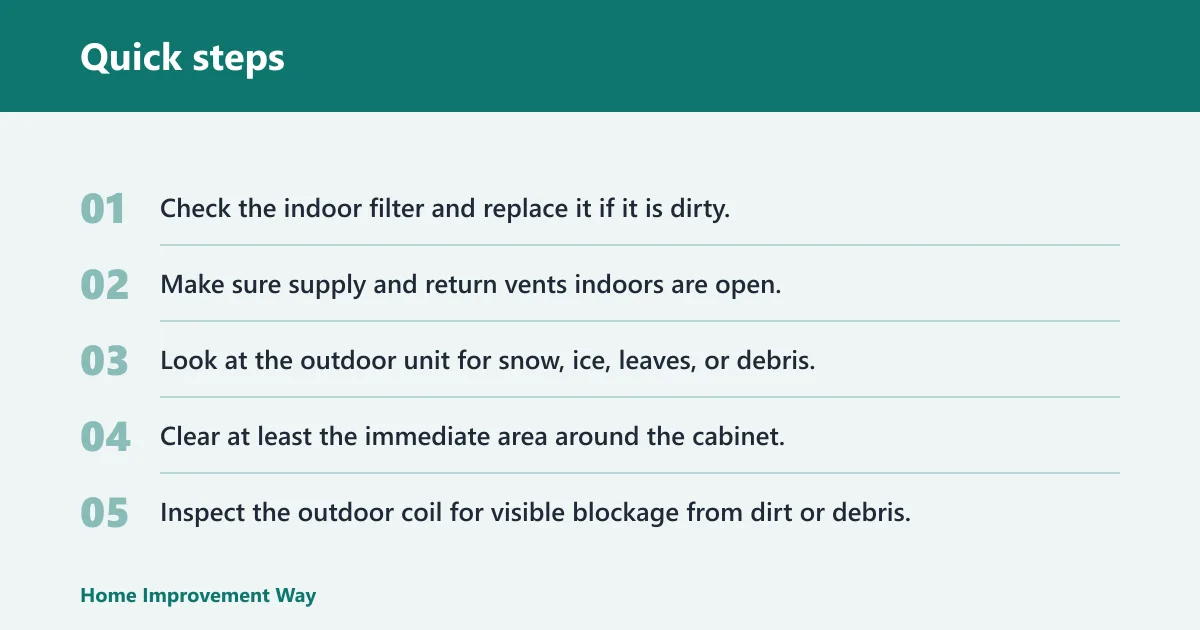
- Check the indoor filter and replace it if it is dirty.
- Make sure supply and return vents indoors are open.
- Look at the outdoor unit for snow, ice, leaves, or debris.
- Clear at least the immediate area around the cabinet.
- Inspect the outdoor coil for visible blockage from dirt or debris.
- Watch the system through one defrost cycle and note how long it lasts.
How can a dirty filter affect airflow?
A clogged filter can reduce airflow across the indoor coil and affect the system’s overall performance. Low airflow can make the heat pump work harder and may contribute to icing patterns that trigger more defrosts. Replace a dirty filter before assuming the outdoor unit has failed. For more on airflow-related performance issues, see dirty filter airflow problems.
What outdoor blockage should you clear?
The outdoor coil needs open airflow to absorb heat. If snow drifts against the cabinet or ice blocks the coil face, the unit can frost faster and spend more time in defrost. Clear snow gently and keep the unit free of piled yard debris.
How much debris or clearance matters?
Leaves, grass clippings, mulch, and shrubs too close to the unit all reduce airflow. Poor clearance around the outdoor unit can also trap moisture and make frost more likely. The fix may be as simple as opening the space around the cabinet and cleaning the coil area.
What does the triage table tell you?
The table below helps separate normal defrost behavior from patterns that need service. Use it to match the symptom, likely cause, and the safest next step. If the unit keeps icing, runs in defrost too long, or stops heating well, the table points to when you should stop running it.
| Symptom | Likely cause | Normal vs abnormal timing | Next step | What you can safely check now |
|---|---|---|---|---|
| Short cycle ends in 5 to 10 minutes | Normal frost melt during cold, humid weather | Normal if it happens only as needed and heat returns soon | Monitor the pattern and check for light frost only | Look for weather conditions, light frost, and normal heat recovery |
| Frequent defrosts every hour or two | Airflow restriction, outdoor coil blockage, or low refrigerant | Abnormal if the pattern repeats in mild weather or keeps increasing | Check filter, coil, snow, and clearance; then schedule service | Check the filter, open vents, clear snow/debris, and verify outdoor clearance |
| Ice returns within hours after defrost | Dirty coil, weak outdoor fan, sensor error, or refrigerant issue | Abnormal if frost comes back quickly after a full cycle | Inspect for blockage first; call for diagnostics if clear | Look for blocked airflow, fan issues, or visible debris on the coil |
| Cycle never ends or runs far past 10 minutes | Defrost control board, thermistor, reversing valve, or wiring fault | Abnormal if the unit stays in defrost and indoor heat drops | Shut down if needed and arrange professional repair | Stop running the unit if heat is weak and the coil remains iced over |
| Auxiliary heat runs excessively during defrost | Normal short backup during defrost, or abnormal if it stays on | Normal only for brief defrost periods | Track how long it runs; investigate if it stays active | Confirm whether the backup heat turns off after defrost ends |
Why does auxiliary heat come on during defrost?
Auxiliary heat often comes on during defrost because the outdoor unit is no longer delivering heat to the house for a few minutes. That backup helps keep indoor temperature steadier, but it also uses more energy than heat pump operation. Brief use is normal; long use is not.
If the indoor air feels slightly cooler during defrost and then recovers once the cycle ends, that is usually expected. If the home keeps depending on auxiliary heat after the cycle finishes, the system may have an unrelated heating problem, such as airflow restriction, low refrigerant, or a control fault.
Climate matters here. In a damp coastal area, a properly working unit may defrost more often than a unit in a dry cold area. Inverter systems can also behave differently from older single-stage units because they modulate capacity instead of running in only one mode.
How do you tell normal from not normal?
Normal defrost is short, occasional, and followed by a quick return to steady heat. It usually happens only when outdoor conditions favor frost formation. What makes the pattern abnormal is repetition without improvement, long run time, or icing that quickly comes back after the cycle ends.
What is a normal short cycle?
A short cycle that ends within about 5 to 10 minutes and restores heat output is usually fine. This is especially true on cold, damp days when frost is expected. You should not see long delays in recovery or repeated icing immediately after a completed cycle.
What are warning signs?
Warning signs include a coil that stays iced over after the cycle, defrost runs that exceed about 10 to 15 minutes repeatedly, a unit that keeps cycling back into defrost, or indoor heat that stays weak. Those patterns point to trouble rather than routine winter operation.
Frequently asked questions
How long does a heat pump defrost cycle last?
A normal heat pump defrost cycle usually lasts 5 to 10 minutes. The exact time varies by unit, outdoor temperature, and how much frost has built up. If a cycle runs much longer, repeats often, or never finishes, that points away from normal winter operation and toward a fault.
What is the purpose of the defrost cycle on a heat pump?
The purpose is to remove frost from the outdoor coil so the unit can keep absorbing heat from outside air. If the coil stays iced over, airflow drops and heating output falls. Defrost keeps the system from getting bogged down by frozen buildup in cold, humid weather.
How long does a defrost cycle last on a heat pump in cold weather?
In cold weather, a defrost cycle still usually lasts about 5 to 10 minutes, but it may happen more often. Heavy humidity, snow, and wind can make frost form faster on the outdoor coil. More frequent cycles can be normal if they are short and the unit heats well between them.
Why is my heat pump stuck in defrost mode too long?
A cycle that seems stuck too long can point to a bad outdoor coil sensor, a faulty defrost control board, a reversing valve issue, or wiring trouble. If the unit stays in defrost and the indoor air stays weak, that is not normal. Turn to service rather than waiting for it to clear on its own.
What should I check if my heat pump keeps icing up?
Check the indoor filter, outdoor coil, and the area around the unit first. Remove snow, leaves, and debris, and make sure airflow is not blocked. If the coil still freezes quickly after those checks, the problem may be low refrigerant, poor fan performance, or a sensor or board fault.
Does frequent defrosting mean my heat pump is broken?
Not always. Frequent defrosting can be normal in cold, damp weather, especially if each cycle is short and the system heats normally afterward. It becomes a concern when the cycles are long, the ice returns within hours, auxiliary heat runs too much, or the unit struggles to heat the home.
Sources
- U.S. Department of Energy — Heat Pump Systems
- Trane — Defrost Cycle
- Lennox — Defrost Cycle
- American Standard Heating & Air Conditioning — What Is a Defrost Cycle?
- Mitsubishi Electric Trane HVAC US — What Is a Heat Pump Defrost Cycle?
Sponsored / affiliate links. As an Amazon Associate I earn from qualifying purchases. I may earn additional commission from eligible campaigns.