Is a Furnace Tune-Up Worth the Money?
Yes, a furnace tune-up is usually worth the money when your system is due for yearly service and is heating normally; if it’s short-cycling, noisy, or leaving cold rooms, pay for diagnostics instead. Skipping maintenance can mean higher gas bills, avoidable shutdowns, and repair bills that can run far above the price of a service visit. This guide explains when a tune-up pays off, when it is mostly insurance, and when your money belongs in diagnostics first.
This guide is part of our Furnace Troubleshooting: Fix Common Winter Heating Problems series.
When to get a furnace tune-up and when to call for repairs
A furnace tune-up is worth it when the unit is operating normally, is due for annual service, and has no active symptoms that point to a fault. It is usually less useful when the furnace is already acting up, because maintenance does not replace a repair diagnosis. For a healthy system, the value comes from safety checks, cleaner operation, and fewer surprise failures.
When the answer is yes
If your furnace runs quietly, heats evenly, and has been serviced within the last year, a tune-up is a sensible preventive buy. Typical service includes inspection, cleaning, testing, and minor adjustments, with prices commonly landing in the $70 to $200 range, according to industry pricing guides and local HVAC service listings. For many homeowners, that is cheaper than a midwinter service call plus a repair that could have been prevented.
When it is mostly insurance
On an older but still stable system, a tune-up often acts like insurance. The benefit may be less about dramatic savings and more about catching wear before the heating season. DOE and Energy Star materials generally frame maintenance as a way to keep equipment operating efficiently, but actual savings vary widely with the furnace’s starting condition, usage, and climate.
When you should skip to diagnostics
Go straight to a repair diagnostic if you have repeated shutdowns, loud banging, a gas smell, water around the unit, cold rooms that persist after thermostat changes, or a furnace that will not stay lit. Those are symptom-driven problems. Maintenance may still be needed later, but a tune-up is not the right first step when the system is already failing.
Is a HVAC tune-up worth it?
Yes, if by HVAC tune-up you mean a scheduled preventive service for heating and cooling equipment, it can be worth it for the same reasons a furnace tune-up is: safety, reliability, and lower waste. The wording is broader than furnace maintenance, though, so the exact scope may include additional checks on the air conditioner, heat pump, or controls.
For heating-only homes, the HVAC label often changes nothing about the furnace work itself. Ask what is included before you buy. Some companies bundle furnace service with other seasonal checks, while others use HVAC tune-up as a marketing term for a basic furnace visit plus add-on items.
How much does a furnace tune-up cost?
Expect a one-time furnace tune-up to cost about $70 to $200, with basic service often priced at $80 to $150 and a standard annual tune-up commonly listed at $90 to $200. Maintenance plans usually cost $100 to $300 per year, and some oil furnaces cost more to service, at $150 to $400. Pricing guides from national consumer and service marketplaces show wide regional variation.
Typical one-time price range
A single visit is the easiest option if your furnace is newer, recently serviced, and not showing symptoms. First-time customer specials often drop the price to $59 to $89, which can be a good trial rate if the scope is clear. A qualified technician usually spends 45 to 90 minutes on the work, depending on access, furnace type, and condition.
What maintenance plans usually cost
These may include one or two visits, priority service, and repair discounts. That can make sense for older equipment or homes that want predictable scheduling.
What affects the bill
Price shifts with furnace type, system age, oil versus gas, local labor rates, and whether the service includes combustion testing, venting checks, or a humidifier or filter cabinet cleaning. High-efficiency furnaces can take more time because the condensate drain and PVC venting need attention. A low quote is not valuable if it skips the safety checks.
What does a furnace tune-up include?
A real furnace tune-up should include inspection, cleaning, testing, and minor adjustments, with safety checks first and comfort adjustments second. The essentials are the heat exchanger, burners, flame sensor, gas pressure, blower motor, thermostat calibration, and venting. Optional extras can be useful, but they should not replace core combustion and safety work.
Inspection and safety checks
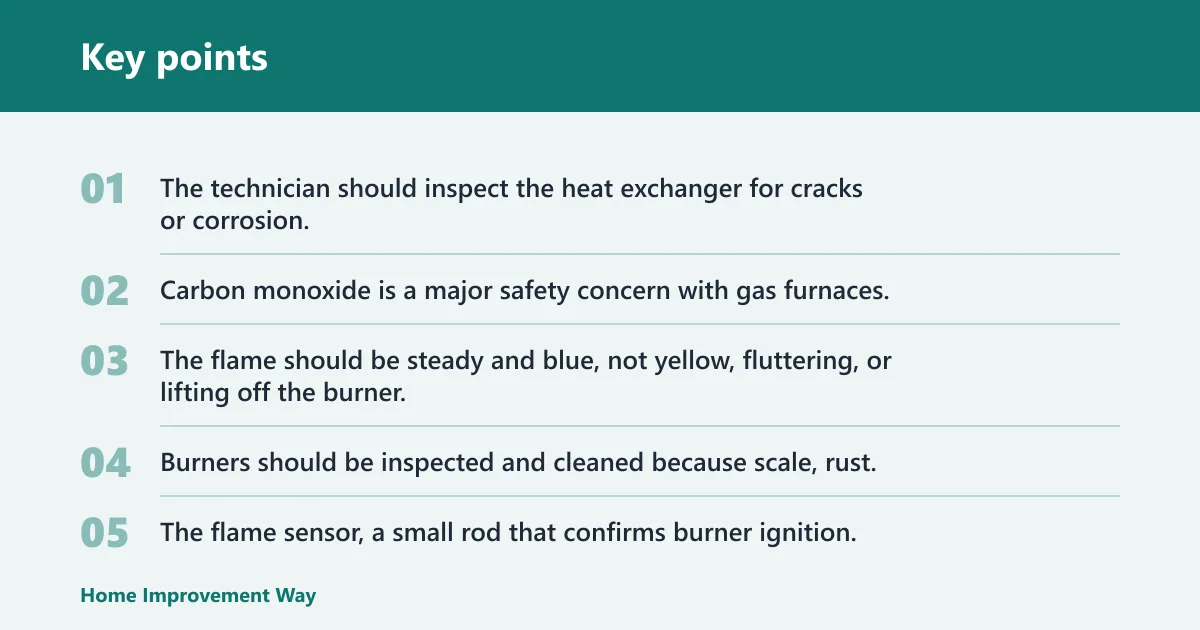
The technician should inspect the heat exchanger for cracks or corrosion, because cracks can allow carbon monoxide into the home. Carbon monoxide is a major safety concern with gas furnaces, and tune-ups often include checks that reduce that risk. The flame should be steady and blue, not yellow, fluttering, or lifting off the burner.
Burners should be inspected and cleaned because scale, rust, and carbon deposits can build up. The flame sensor, a small rod that confirms burner ignition, is commonly cleaned during service. A dirty flame sensor is one of the most common reasons a furnace short-cycles. Gas pressure should also be checked or adjusted as part of proper calibration, following the furnace manual.
Cleaning and adjustment work
Cleaning often includes the burners, flame sensor, and accessible cabinet dust. The blower motor should be inspected for amperage draw because it moves conditioned air through the ducts, and a weak motor can contribute to uneven heating. Thermostat calibration should be verified so the system responds to the temperature you set, not a drifting reading.
High-efficiency condensing furnaces need extra attention. The condensate drain should be checked for clogs, since a blocked drain can cause water issues and shutdowns. PVC venting should be inspected for damage, poor slope, loose joints, or obstructions. Those checks matter because venting and condensate problems can affect both safety and operation.
What is essential versus optional?
Essential items are the ones tied to safety, combustion, and reliable ignition: heat exchanger inspection, burner cleaning, flame sensor cleaning, gas pressure checks, and venting review. Useful but less critical items include cabinet cleaning, filter replacement if needed, and minor comfort adjustments. A tune-up that skips the essential checks is not a real tune-up.
How do you decide between tune-up, maintenance plan, and diagnostics?
Use a plain score. Add 0, 1, or 2 points for each factor: furnace age, utility-bill trend, breakdown history, warranty status, and symptom severity. Scores of 0 to 3 point to a one-time tune-up, 4 to 6 point to a maintenance plan, and 7 to 10 point to a diagnostic visit. Active symptoms should push the decision toward diagnostics even if the total is lower.
| Factor | Low concern | Moderate concern | High concern | Best next step |
|---|---|---|---|---|
| Age | Under 5 years | 5 to 12 years | Over 12 years | Service if normal; plan if older; diagnose if symptoms appear |
| Utility-bill trend | Stable or seasonal only | Slow rise with normal heating load | Sharp rise with same weather and settings | Tune-up for moderate drift; diagnostic if the jump is sudden |
| Breakdown history | No recent repairs | One minor repair in the last 2 years | Repeated service calls or winter failures | Maintenance plan if recurring age-related wear; diagnostic if failures repeat now |
| Warranty status | Out of warranty | Warranty active but paperwork incomplete | Warranty active and maintenance required by terms | Buy service and keep records if coverage matters |
| Symptom severity | No symptoms | Minor comfort drift only | Short-cycling, loud noise, water, gas smell, or cold rooms | Tune-up for none or mild issues; diagnostic for active symptoms |
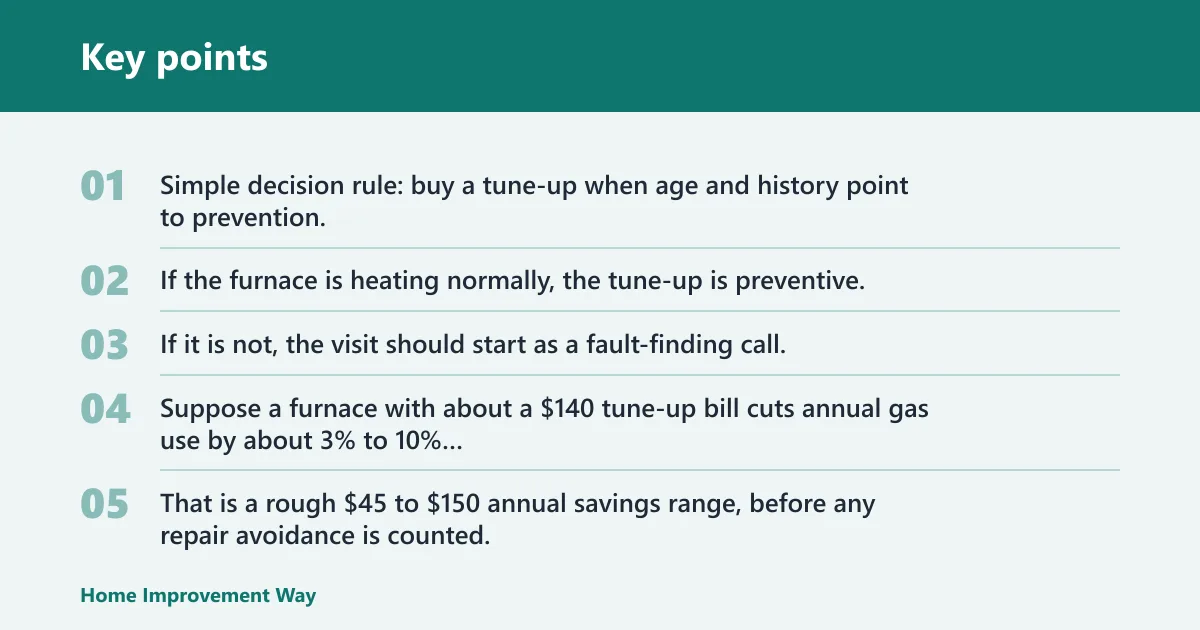
Simple decision rule: buy a tune-up when age and history point to prevention; buy a maintenance plan when the furnace is older, service records matter, or you want priority service; buy diagnostics when the system is already misbehaving. If the furnace is heating normally, the tune-up is preventive. If it is not, the visit should start as a fault-finding call.
What a practical break-even scenario looks like
Suppose a furnace with about a $140 tune-up bill cuts annual gas use by about 3% to 10% on a $1,500 heating bill. That is a rough $45 to $150 annual savings range, before any repair avoidance is counted. Because the savings depend on condition and usage, it is safer to treat this as a possible outcome rather than a promise.
Say your 11-year-old furnace has a small rise in gas use, no active faults, and one ignition trouble symptom that may point to a flame-sensor or igniter issue. A one-time tune-up is the better first buy. If the same furnace starts short-cycling every day, the smarter move is a repair diagnostic, because cleaning a sensor does not explain repeated shutdowns by itself.
What should a technician check?
A proper tune-up should focus first on safety and combustion quality, then on airflow and controls. The heat exchanger, burners, flame sensor, gas pressure, blower motor, thermostat calibration, and condensate drain are the core checks. Optional extras are fine, but they should never crowd out the items that affect carbon monoxide risk and heating performance.
Heat exchanger and carbon monoxide risk
The heat exchanger is the key safety component in a gas furnace. Cracks can let combustion gases mix with indoor air, which is why visual inspection and related safety checks matter so much. If a technician finds a suspect exchanger, stop thinking maintenance and start thinking replacement or deeper diagnostics.
Burners, flame sensor, and gas pressure
Burners should burn with a steady blue flame. Dirty burners can cause poor ignition and uneven combustion. The flame sensor should be cleaned because soot or oxidation can cause short-cycling. Gas pressure should be measured and adjusted only if needed, since combustion performance depends on the furnace receiving the correct fuel flow.
Blower motor and thermostat calibration
The blower motor should be checked for amperage draw and general operation. Weak airflow can lead to poor comfort, long run times, and uneven room temperatures. Thermostat calibration matters too. If the thermostat reads incorrectly, the furnace may run too long, stop too early, or cycle in a way that wastes energy.
Condensate drain and venting on high-efficiency models
High-efficiency furnaces need drain and venting checks that standard models do not. The condensate drain can clog, and that can trigger leaks or shutdowns. PVC venting should be inspected for blockage, sagging, or loose joints. Those issues can affect both efficiency and safe exhaust flow.
Does a furnace tune-up prevent breakdowns?
It can reduce the odds of a breakdown, but it cannot prevent every failure. A tune-up may catch worn igniters, dirty sensors, loose connections, weak airflow, or drainage problems before they turn into winter outages. It cannot repair a cracked heat exchanger, a failing motor, or a control board that is already failing.
What maintenance can catch early
Preventive service often finds buildup, miscalibration, and small wear patterns before they become urgent. That is why annual service can be worthwhile even when the furnace still heats normally. Catching a dirty flame sensor, a clogged drain, or a weak burner pattern early is cheaper than waiting for a no-heat call.
What it cannot fix
Maintenance is not a cure for active symptoms that point to a failed part. Repeated shutdowns, odd noises, gas odors, and leaks need diagnosis. A tune-up may reveal the cause, but it should not be sold as a substitute for fault-finding when the furnace is already malfunctioning.
How do maintenance records affect warranty claims?
Keep service records if the furnace is under warranty or if you may sell the home later. Warranty coverage is not automatic, and many manufacturers want proof that the system was maintained as required. Save the receipt, the checklist, and any notes on parts inspected or adjusted. That paperwork can matter.
What to save after service
- The itemized receipt with the date of service.
- The technician’s checklist or service report.
- Any notes about safety findings, repairs, or parts replaced.
- Proof of filter changes if the company notes them.
- Copies of prior service records in the same folder or file.
Documentation helps if you need to support a warranty claim after a part fails. It also shows a pattern of care if a future technician needs context. If a company offers a maintenance plan, ask how records are stored and whether you can access them later. That is often more useful than a loose promise of coverage.
Frequently asked questions
How often should a furnace be serviced?
Most furnaces should be serviced once a year, ideally before heating season. Annual service keeps the schedule simple and helps catch wear before cold weather arrives. If the system is older, has a history of repairs, or includes a high-efficiency condensate system, yearly attention matters even more.
Does a tune-up improve energy efficiency?
Yes, it can. DOE and Energy Star guidance support the idea that proper maintenance helps heating equipment run more efficiently, but the exact gain depends on the starting condition of the furnace. Claims of 5% to 15% improvement or 3% to 10% annual savings should be treated as rough ranges, not guaranteed results.
Can a tune-up help prevent furnace breakdowns?
Yes, it can lower the chance of an avoidable failure by catching dirty sensors, burner buildup, weak airflow, and small mechanical issues early. It will not stop every repair, though. If the furnace is already short-cycling, noisy, or leaking, you need diagnostics first.
Will skipping maintenance void my warranty?
Sometimes it can affect a claim, but not always in the same way. Many manufacturers expect proof of regular care and may list maintenance requirements in the owner’s manual or warranty terms. Keep receipts, dates, and service notes. That paperwork helps show the furnace was maintained according to the warranty terms.
What should be included in a real furnace tune-up?
A real tune-up should include inspection, cleaning, testing, and minor adjustments. The essential checks are the heat exchanger, burners, flame sensor, gas pressure, blower motor, thermostat calibration, and venting or condensate drain where applicable. If those items are missing, the visit is incomplete.
When is the best time to schedule furnace maintenance?
Fall is the best time, before the first long cold spell. That timing gives you time to fix small problems without emergency pressure. Early winter still works if you missed the fall window, but the schedule can be tighter and parts may be less convenient to replace.
Sponsored / affiliate links. As an Amazon Associate I earn from qualifying purchases. I may earn additional commission from eligible campaigns.