How to Tell If a Furnace Capacitor Is Bad
A furnace capacitor is probably bad when the blower motor hums but will not start, starts late, or runs weakly, and the part shows bulging, oil leakage, or a burned case. Leaving it alone can mean no heat, repeated breaker trips, or a motor that overheats and fails. This guide shows you how to spot capacitor symptoms, separate them from wiring or safety-switch faults, and decide when to stop and call for service.
What you’ll need


- Multimeter with capacitance mode
- Insulated screwdriver or discharge tool
- Flashlight
- Gloves and eye protection
- Replacement label details: microfarad rating and voltage rating
How do you know if your furnace capacitor is bad?
Start with the symptom pattern. A weak furnace capacitor often shows up as a humming blower, delayed startup, slow airflow, or a blower that never starts. The clue is often a failure that comes and goes under load, not a unit that dies every time.
Separate capacitor symptoms from other faults before opening anything deeper. A locked blower motor, loose wiring, control board trouble, or a safety-switch shutdown can look similar. Many modern furnaces use ECM blower motors and may not have a blower capacitor at all. If the furnace hums but the blower stays still, that is a strong capacitor clue, but it is not proof by itself.
Look for the symptom pattern
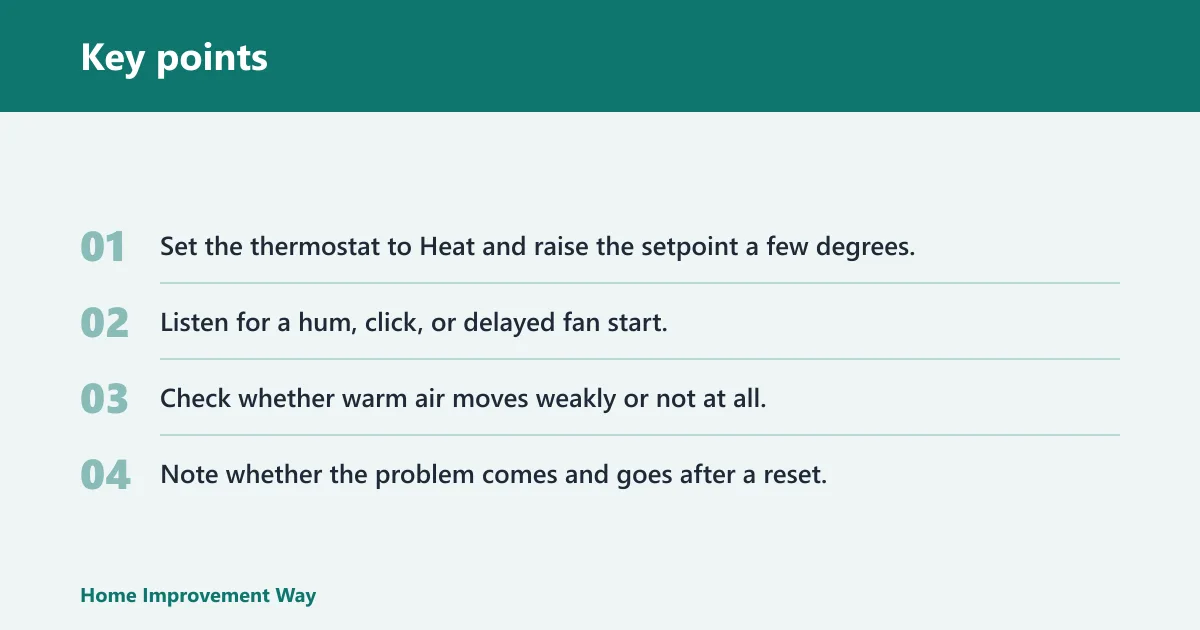
- Set the thermostat to Heat and raise the setpoint a few degrees.
- Listen for a hum, click, or delayed fan start.
- Check whether warm air moves weakly or not at all.
- Note whether the problem comes and goes after a reset.
Say your furnace hums for several seconds, then the blower starts only after a delay. That pattern fits a weak capacitor better than a simple thermostat problem, especially if the same unit sometimes starts normally and sometimes does not.
Safety first before you open the cabinet
Turn off power at the breaker before touching the cabinet. A furnace capacitor stores electrical charge, and that charge can remain after the power is off. Treat every terminal as energized until it is discharged safely.
Stop if you see damaged wiring, scorch marks, or a hot cabinet. Those signs push the problem beyond a simple capacitor check and into territory where a technician should inspect the blower motor, control board, and safety devices.
Safe homeowner checks
- Turn the thermostat to Off.
- Switch off the furnace breaker.
- Wait several minutes before opening the access panel.
- Use a flashlight, not a phone flash near bare terminals.
Capacitor symptom matrix
| Symptom | Likely capacitor behavior | Likely non-capacitor causes | Safe homeowner checks | When to stop and call a pro |
|---|---|---|---|---|
| Furnace hums but the blower does not start | Capacitor may be too weak to jump-start the blower motor | Locked blower motor, bad wiring, control board fault | Listen for hum, check whether the fan ever starts on its own | Stop if the motor is hot or the cabinet needs deeper disassembly |
| Blower starts late or runs slowly | Weak capacitance can leave the blower motor underpowered | Dirty blower wheel, failing motor, low voltage, loose connections | Note delay length and whether airflow improves after a reset | Call a pro if airflow stays weak after a reset |
| Furnace shuts down after a short run | Capacitor stress can cause the motor to overheat and trip protection | Thermal overload switch, airflow restriction, failing motor | Watch for a start, brief run, then shutdown sequence | Stop if the cabinet is hot or shutdown repeats |
| Breaker trips or overload switch opens | A weak capacitor can contribute to overload, but it is not the only cause | Shorted motor, damaged wiring, control fault, overheating | Check whether the trip happens on startup or after a few minutes | Stop after one reset if the breaker trips again |
How to test the capacitor with a multimeter
Use a multimeter with capacitance mode to compare the measured microfarad value with the rated label. A capacitor can look fine and still read weak. Match the replacement to the original voltage rating too; a lower voltage rating can be a problem, while the same or a higher rating is generally acceptable.
Test it safely
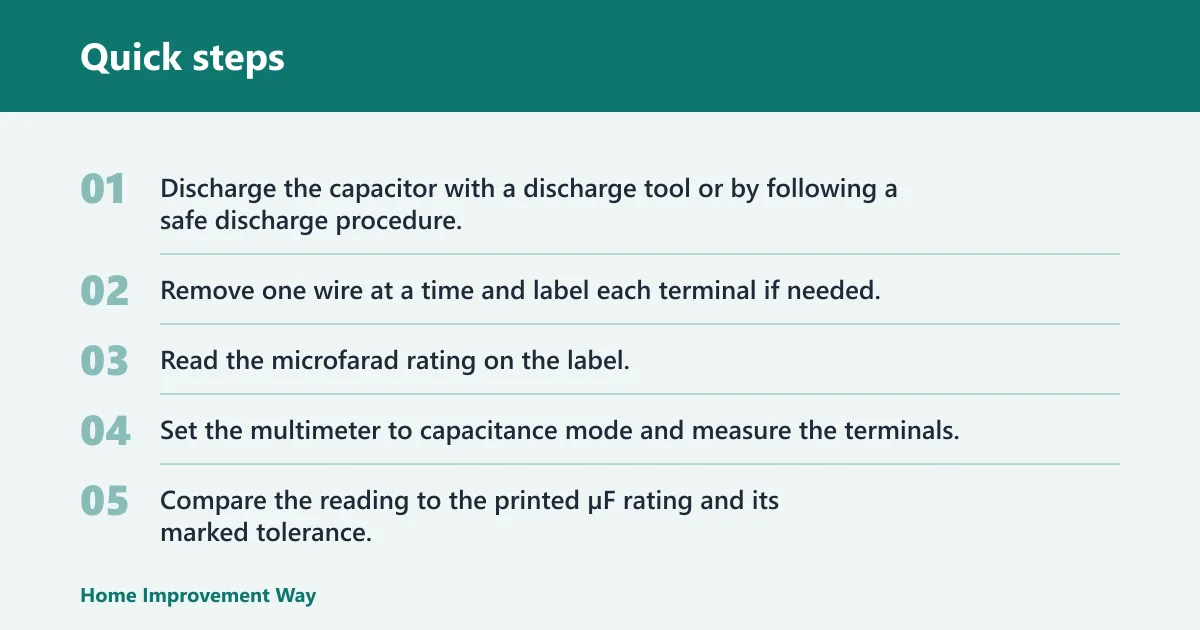
- Discharge the capacitor with a discharge tool or by following a safe discharge procedure.
- Remove one wire at a time and label each terminal if needed.
- Read the microfarad rating on the label.
- Set the multimeter to capacitance mode and measure the terminals.
- Compare the reading to the printed µF rating and its marked tolerance.
- Replace the part if the reading is outside the labeled tolerance or the case is damaged.
Picture a capacitor labeled 5 µF with visible swelling at the top. If a meter also shows a low reading, replace it rather than trying to repair it. A furnace capacitor can only be replaced, not repaired.
What happens when a furnace capacitor goes bad?
A bad furnace capacitor can stop the system from moving heated air by weakening the blower motor. The motor may hum, stall, run slowly, or fail to start at all. In that state, the furnace can make heat but not deliver it through the ducts.
That extra strain can trip the thermal overload switch if the motor runs too hot. Continued operation can also stress the blower motor and other parts. Heat, age, wrong rating, and installation problems all shorten capacitor life, and furnace capacitors can last about 10 to 20 years.
Why the shutdown happens
- The capacitor weakens.
- The blower motor struggles to start or run at speed.
- The motor draws extra stress and heat.
- The thermal overload switch may open to protect the system.
How to replace it without guessing
Replace by label match, not by shape. The replacement furnace capacitor should generally match the microfarad rating printed on the old part and the voltage rating on the label. A lower voltage rating is the real concern; the same or a higher voltage rating is generally acceptable.
If the cabinet still hums, trips, or overheats after replacement, stop there. That points away from the capacitor and toward the blower motor, wiring, control board, or another safety device.
Replacement checks
- Compare the old label to the new part before installation.
- Match the microfarad rating exactly.
- Match the voltage rating to the original part or higher.
- Reconnect wires exactly as they were.
- Restore power and watch one heat cycle.
A common first-timer mistake is replacing a capacitor by physical size alone. A capacitor with the right case shape but the wrong µF or voltage can fail early or leave the blower motor underpowered.
Common mistakes
- Skipping discharge before touching terminals.
- Replacing by size instead of matching µF and voltage.
- Assuming every hum is a capacitor fault when the blower motor may be locked.
- Ignoring loose wiring that mimics capacitor failure.
- Closing the cabinet after replacement even though the furnace still hums or trips.
If that didn’t work, try this next
- Turn power off again and recheck every wire on the capacitor terminals.
- Inspect the blower wheel for a mechanical bind if the motor still hums.
- Check for burnt connectors, damaged insulation, or a tripped thermal overload switch.
- Call a technician if the motor is hot, the breaker trips again, or the cabinet needs deeper disassembly.
Suppose the furnace starts after a new capacitor is installed, but only for one cycle and then trips again. That pattern often means the capacitor was part of the problem, while the blower motor or wiring still needs attention.
Frequently asked questions
Can a bad capacitor make a furnace hum but not start?
Yes. A humming furnace with no blower start is one of the clearest capacitor failure patterns. A locked motor or wiring fault can sound similar, so the hum alone is not final proof. The next check is a capacitance reading against the label.
What should a replacement furnace capacitor match?
The replacement must match the original microfarad rating and voltage rating. The µF value controls how the blower motor starts, and the voltage rating should be the same or higher than the old part. A lower voltage can cause problems.
Can I replace a furnace capacitor myself?
Only if you can shut off power, discharge the part safely, and match the label exactly. If the cabinet is hot, the wiring is damaged, or the breaker trips again after replacement, stop and call a technician. Deeper diagnosis may be needed for the blower motor or control board.
Sponsored / affiliate links. As an Amazon Associate I earn from qualifying purchases. I may earn additional commission from eligible campaigns.