Kerosene Heater vs Electric Heater: Which Is Cheaper Overall?
Bottom line: for normal room heating, an electric heater is often less expensive overall; at around $0.16/kWh, a 1,500-watt heater can cost about $0.24 per hour, while a kerosene heater can cost roughly $0.40 to $0.80 per hour in fuel alone, depending on output and local fuel price (EIA electricity price data; state fuel-price trackers and kerosene market listings). Pick the wrong one, and you can end up with higher winter bills, more upkeep, and avoidable indoor-air risk. This guide compares fuel, electricity, maintenance, and outage value so you can see when kerosene wins and when electric does.
Assumptions used in this comparison: electricity rate ranges use common residential pricing references from the U.S. Energy Information Administration (EIA), kerosene price ranges reflect state and regional fuel-price tracker-style listings, and heater output ranges reflect typical manufacturer specifications and DOE/Energy Star-style electrical load math. Costs below are estimates, not quotes, and local rates can change the result materially.
Method note: to make the comparison fair, this article normalizes operating cost by cost per million BTU and separates output, efficiency, and delivered heat. That matters because a 1,500-watt electric heater is only about 5,118 BTU/h on paper (1.5 kW × 3,412 BTU/kWh), so comparing it directly with a 17,000 BTU/h kerosene heater is not like-for-like unless you adjust for the heat actually delivered to the room (DOE/Energy Star; EIA unit conversion guidance).
Last updated: October 2026. Prices and guidance should be checked against current local utility and fuel listings before buying.
| Decision factor | Kerosene heater | electric heater | Winner |
|---|---|---|---|
| Operating cost | Usually higher fuel cost per hour, especially where kerosene prices run near the top of the listed range (state fuel-price trackers; local kerosene listings). | Usually lower cost per hour at common utility rates, especially for a 1,500-watt unit (EIA retail electricity prices). | electric heater |
| Upfront price | Typically $100 to $350, with vented whole-house models reaching $850 or more (manufacturer specs and retailer listings). | Basic models start around $20 and premium models can reach $200 (manufacturer specs and retailer listings). | electric heater |
| Maintenance | Wick replacement, cleaning, fuel handling, and periodic servicing add real cost. | Minimal maintenance in normal use. | electric heater |
| Outage use | Can still heat without grid power if you have fuel and ventilation. | Needs power from the grid, generator, or battery setup. | Kerosene heater |
| Indoor simplicity | Needs ventilation and carbon monoxide precautions (CPSC; NFPA; CDC). | No direct emissions and simpler indoor use. | electric heater |
Kerosene heater vs electric heater: the real cost
Short answer: the cheaper heater depends on purchase price, fuel or electricity, maintenance, heat output, and the value of heat during an outage. A unit that looks cheap on the shelf can cost more over a winter if fuel runs high, the wick needs replacement, or you need backup power. Local rates change the answer fast, so the same heater can be a bargain in one home and a poor buy in another.
What counts as cost
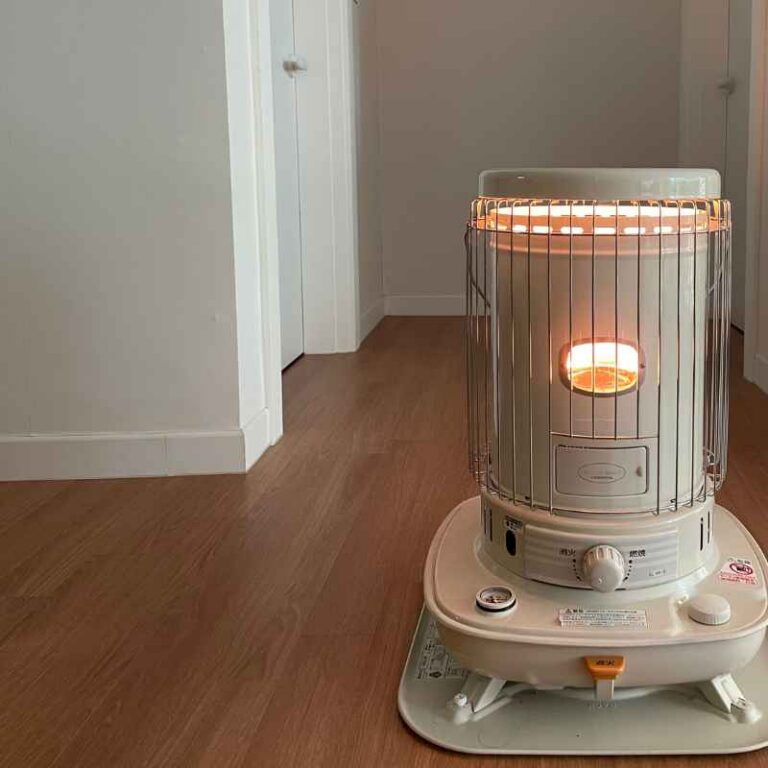
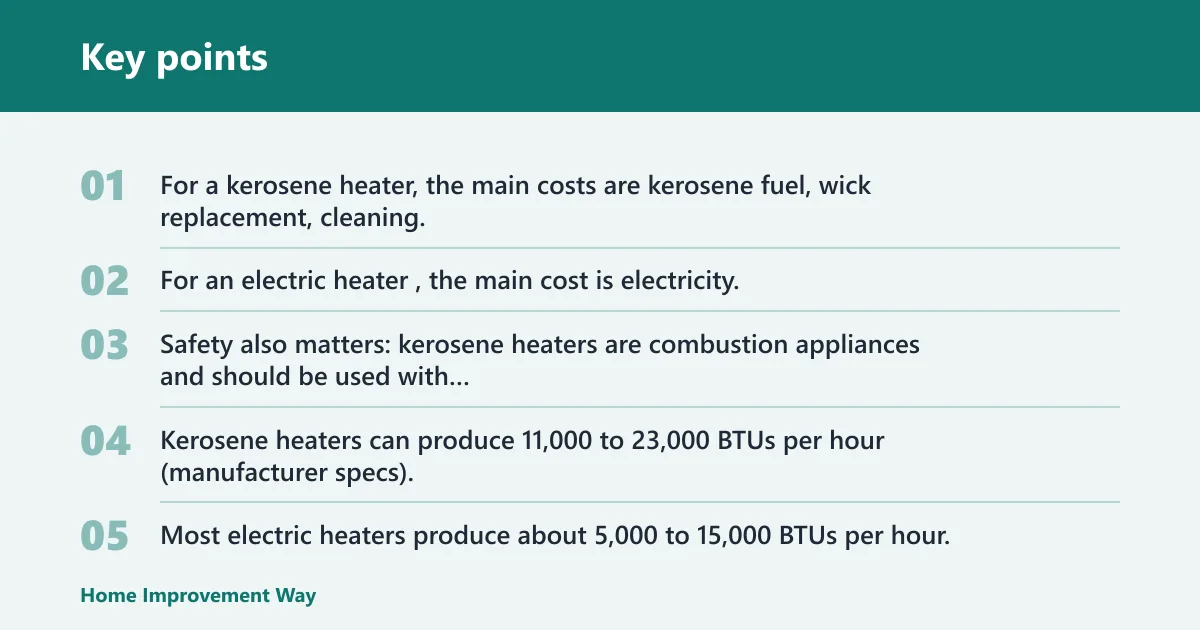
For a kerosene heater, the main costs are kerosene fuel, wick replacement, cleaning, fuel handling, and the purchase price. For an electric heater, the main cost is electricity, plus the purchase price and any backup power if you need heat during an outage. Safety also matters: kerosene heaters are combustion appliances and should be used with ventilation and carbon monoxide precautions, while electric heaters still require safe placement and circuit awareness (CPSC; NFPA; CDC).
Kerosene heaters can produce 11,000 to 23,000 BTUs per hour (manufacturer specs), and kerosene contains about 131,000 BTUs per gallon (DOE/Energy content references). Most electric heaters produce about 5,000 to 15,000 BTUs per hour, and a typical 1,500-watt electric heater is roughly 5,118 BTU/h from electrical input alone (1.5 kW × 3,412 BTU/kWh; DOE/Energy Star; manufacturer specs). At common residential rates, a 1,500-watt heater often costs about $0.15 to $0.45 per hour to run (EIA electricity price data).
Why local prices change the answer
Kerosene fuel costs are often listed around $3.50 to $5.00 per gallon in many tracked markets, while electricity costs are commonly found around $0.10 to $0.30 per kWh depending on state and utility territory (state energy offices, fuel-price trackers, and EIA). That means the same heater can shift from “reasonable” to “expensive” as soon as your zip code changes.
Cost per BTU gives the cleanest comparison. It shows what you pay for a unit of heat, which is more useful than a sticker price or tank size.
Kerosene heater cost table
This table uses a midrange kerosene heater load of about 17,000 BTUs per hour, which equals about 0.13 gallons per hour based on the 131,000 BTUs per gallon figure (DOE/EIA energy content references). Kerosene maintenance is shown as an annualized wick allowance of about $15 per year, using the listed $10 to $20 wick cost as a simple midpoint.
| Scenario | Hourly kerosene cost | Hourly 1500W electric cost | Annualized kerosene maintenance | Break-even note |
|---|---|---|---|---|
| Low electric rate | About $0.55/hour | About $0.15/hour | About $15/year | Electric is clearly cheaper for routine room heat. |
| Average U.S. rate | About $0.55/hour | About $0.24/hour | About $15/year | Electric still wins unless outage use has real value. |
| Expensive electric rate | About $0.55/hour | About $0.45/hour | About $15/year | Kerosene gets closer, but electric can still be cheaper on pure fuel cost. |
Reusable break-even formula: compare electric cost per hour to kerosene cost per hour + annual maintenance spread across expected annual hours. In plain language: (heater kWh per hour × local electricity rate) vs. [(BTU/h ÷ 131,000) × kerosene price per gallon] + maintenance per hour. If you run the heater only a few dozen hours per winter, maintenance matters less; if you use it often, maintenance and fuel handling matter more.
How much does each heater cost to run?
Kerosene heater hourly cost formula
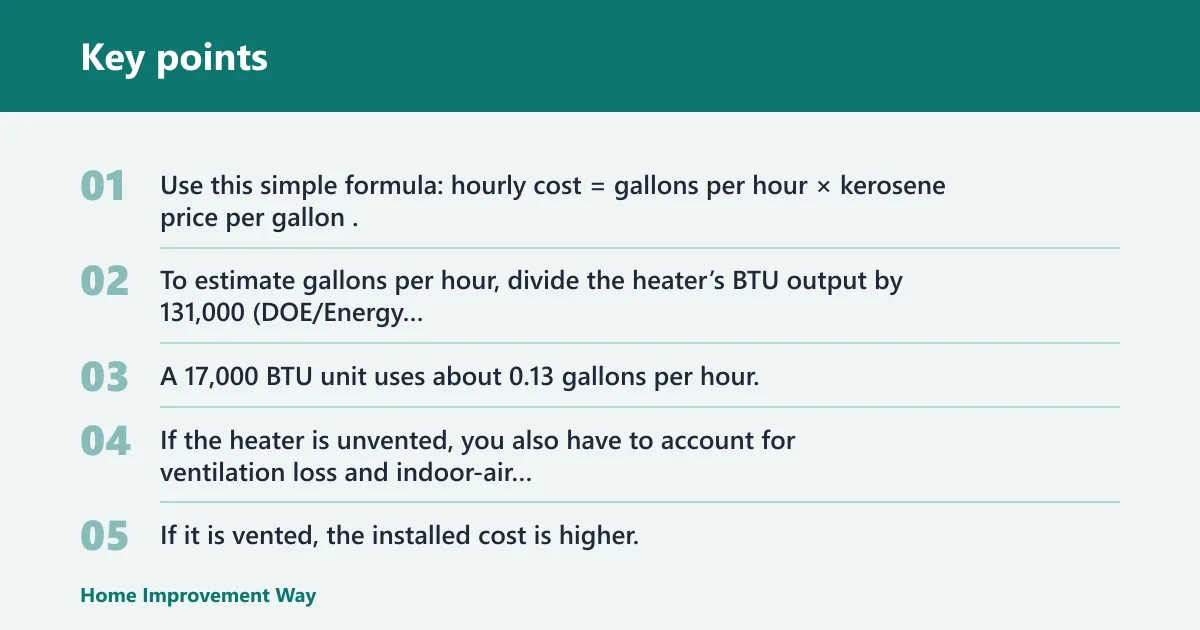
Use this simple formula: hourly cost = gallons per hour × kerosene price per gallon. To estimate gallons per hour, divide the heater’s BTU output by 131,000 (DOE/Energy content references). A 17,000 BTU unit uses about 0.13 gallons per hour, which is about $0.46 at $3.50 per gallon and about $0.65 at $5.00 per gallon.
That is fuel-only cost. If the heater is unvented, you also have to account for ventilation loss and indoor-air management. If it is vented, the installed cost is higher, but the room air side of the equation changes. CPSC, NFPA, and CDC guidance consistently emphasize proper ventilation and carbon monoxide safety for combustion heaters used indoors.
1500-watt electric heater hourly cost formula
Use this formula: kilowatts × electricity rate. A 1,500-watt heater draws 1.5 kWh each hour, so at $0.10/kWh it costs about $0.15 per hour, at $0.16/kWh it costs about $0.24 per hour, and at $0.30/kWh it costs about $0.45 per hour (EIA retail electricity rates).
That plain math is why electric often wins for daily room heat. You do not buy fuel, and upkeep stays light.
Cost per BTU comparison
One kilowatt-hour equals 3,412 BTUs (DOE/EIA conversion guidance). That makes it easier to compare heat output against operating cost. Using the supplied cost ranges, kerosene heaters may cost roughly $26 to $37 per million BTUs, while electric heaters may cost roughly $29 to $88 per million BTUs depending on the local electric rate and the heater’s electrical load.
The overlap matters. At low electric rates, electric heat can beat kerosene on cost per BTU. At higher rates, kerosene can move closer, and outage value may tip the choice even if the raw heat cost is not lower.
Text table: local price combinations and break-even pressure
Use this table as a quick check. It crosses low/average/high kerosene prices with low/average/high electric rates. The numbers are approximate and assume the same midrange kerosene heater output used above, plus a 1,500-watt electric heater as the benchmark.
| Fuel / electric price mix | Low electric rate | Average electric rate | High electric rate |
|---|---|---|---|
| Low kerosene price | Electric usually wins on cost per hour. | Electric usually wins; kerosene may only win on outage value. | Closer match, but kerosene still needs outage or heat-output advantage to justify itself. |
| Average kerosene price | Electric usually wins for daily room heat. | Electric usually wins unless you value outage readiness highly. | Near break-even territory on fuel-only cost, especially if kerosene output better matches the room. |
| High kerosene price | Electric usually wins by a wide margin. | Electric usually wins by a wide margin. | Kerosene rarely wins on pure operating cost unless outage use is critical. |
Which heater is cheaper to buy and maintain?
Electric heaters usually win on purchase price and upkeep. Kerosene heaters generally cost $100 to $350 upfront, while electric heaters are typically less expensive upfront, with basic models starting around $20 and premium models up to $200 (manufacturer specs and retailer listings).
Typical purchase price differences
That lower entry price makes electric the easy buy for a spare bedroom, office, or bathroom. Kerosene units cost more at the start, and vented whole-house kerosene models can reach $850 or more. The price gap is only part of the story, though; the right choice also depends on whether you need heat when the grid is down.
Kerosene maintenance items that add to ownership cost
The hidden cost is not huge, but it is real. Wick replacement costs $10 to $20, and that is only one part of ownership. Cleaning the burn area, handling fuel safely, and keeping the unit serviced can add time and money, especially if the heater sees heavy use.
Suppose you heat a drafty 200-square-foot room for several weeks during winter. If the heater needs a wick midseason and regular cleaning to keep performance steady, the ownership cost is no longer just the gallon price at the pump.
Why electric maintenance stays low
Electric heaters have fewer wear items. Ceramic, oil-filled, and infrared models all still need basic care, but the cost is usually limited to cleaning dust and using the heater correctly. There is no wick, no fuel tank to store, and no combustion residue.
How much heat do they actually produce?
Short answer: kerosene heaters usually deliver more heat than a basic plug-in unit, which is why they are common for larger rooms and outage use. Electric heaters are more limited in output, but they are easier to place, easier to power, and better suited to short-term supplemental heat.
Kerosene heater BTU output range
Kerosene heaters can produce 11,000 to 23,000 BTUs per hour (manufacturer specs). That range covers many portable space-heating jobs and explains why kerosene can feel more useful in bigger rooms or colder spaces.
Picture a basement family room that loses heat fast. A higher-output kerosene heater can cover more space than a small plug-in unit, but it also brings ventilation requirements and combustion risk with it (CPSC; NFPA; CDC).
Electric heater output limits
Most electric heaters produce 5,000 to 15,000 BTUs per hour, depending on the model and control settings (manufacturer specs). A 1,500-watt heater is common because it runs on a standard household circuit in many homes and keeps operating cost predictable (DOE/Energy Star-style load calculations; EIA electricity pricing).
Room size and heat delivery
Smaller rooms are easier to heat than larger ones. That is where electric heat often makes the most sense. Bigger rooms, colder spaces, and outage conditions are the places where kerosene has a stronger case, especially if the heater’s BTU output matches the room.
Choose Kerosene heater if… / Choose electric heater if…

Short answer: choose Kerosene heater if you need heat during a power outage, your electricity rate is high, or you need more portable heat in a larger room and you can provide proper ventilation. Choose electric heater if you want the lowest day-to-day hassle, low maintenance, and the simpler option for normal room heating.
- Choose Kerosene heater if outage readiness matters and you can store fuel safely.
- Choose Kerosene heater if your local electric rate is high enough that the hourly gap matters.
- Choose Kerosene heater if you need higher BTU output than a small plug-in unit can provide.
- Choose electric heater if you want a simple setup with minimal maintenance.
- Choose electric heater if your room is small and your utility rate is low to moderate.
- Choose electric heater if indoor air quality and no direct emissions matter more than outage use.
Safety should decide the issue when the room is tight or the ventilation is poor. Kerosene heaters need proper ventilation because combustion can create carbon monoxide risk and fire hazards; CPSC, NFPA, and CDC all stress ventilation, working alarms, and safe placement for combustion appliances. Electric heaters also need care, but their risks are mostly electrical and placement-related rather than combustion-related.
A common first-timer mistake is picking the heater by purchase price alone. That can hide the cost of fuel, the cost of a wick, and the cost of running backup power when the grid is down.


Frequently asked questions
Is a kerosene heater cheaper to run than an electric heater?
Short answer: usually no for normal room heating. A typical 1,500-watt electric heater can cost about $0.15 to $0.45 per hour (EIA electricity pricing), while a kerosene heater often lands around $0.40 to $0.80 per hour in fuel alone depending on local kerosene price and output (state fuel-price trackers and manufacturer BTU specs). Kerosene can still make sense when outage use or high electric rates change the math.
How much does it cost to run a kerosene heater per hour?
Using the supplied fuel range, a kerosene heater often costs about $0.40 to $0.80 per hour in fuel alone, depending on output and local kerosene price. A midrange setup near 17,000 BTUs per hour sits around the middle of that range before maintenance is added.
How much does it cost to run a 1500-watt electric heater per hour?
At $0.10 per kWh, it costs about $0.15 per hour. At $0.16 per kWh, it costs about $0.24 per hour. At $0.30 per kWh, it costs about $0.45 per hour (EIA retail electricity pricing). That steady cost is one of the main reasons electric often wins on routine use.
Which heater is cheaper overall after fuel, maintenance, and purchase price?
Electric heater usually wins for most households because it has the lower upfront price, lower maintenance, and lower hourly cost at common rates. Kerosene can close the gap when electricity is expensive or when outage heat has real value. The total answer changes with local prices and how often you use the heater.
Do kerosene heaters cost less in a power outage?
Yes, if the alternative is a powered heater that cannot run during an outage. Kerosene can provide heat without grid power, so its value rises when you would otherwise need a generator, a large battery setup, or no heat at all. That outage value is part of the total cost.
Which heater is safer for indoor use, kerosene or electric?
Short answer: electric heater is generally safer for indoor use because it has no direct emissions and no combustion process. Kerosene heaters require ventilation, careful fuel handling, and carbon monoxide awareness (CPSC; NFPA; CDC). Either type needs clear space around it, but the risk profile is very different.
Sources: U.S. Energy Information Administration (EIA) residential electricity price data and unit conversion references; U.S. Department of Energy and Energy Star-style heater output and electrical-load guidance; U.S. Consumer Product Safety Commission (CPSC), National Fire Protection Association (NFPA), and Centers for Disease Control and Prevention (CDC) guidance on indoor combustion heater safety and carbon monoxide prevention; manufacturer specifications for heater BTU output and retail market listings for purchase-price examples; state energy office and fuel-price tracker listings for kerosene price ranges.
Sponsored / affiliate links. As an Amazon Associate I earn from qualifying purchases. I may earn additional commission from eligible campaigns.
 Sunvasagoo 12,000 BTU Portable Air Conditioner With 4 Modes, Cools Up to 750 Sq.Ft, 3-In-1 Room Air Conditioner with Remote/24Hrs Timer, Easy Install Kit for Home
 Sunvasagoo 12,000 BTU Portable Air Conditioner, Cools Up to 550 Sq. Ft, 3-In-1 Room Air Conditioner With Drainage-Free, 48db Quiet Operation, Remote Control, 24Hrs Timer, Easy Install Kit for Home