Electric Heater vs Propane Heater: Which Costs Less to Run?
Propane usually costs less to run only when the gallon price is low; at $0.16/kWh electricity and about 90% propane efficiency, electric costs around $47 per million BTU delivered, and propane breaks even at roughly $3.90/gal. Guessing wrong can make a garage heater cost twice what you expect, or leave you short on heat when the temperature drops. This guide compares per-hour and per-BTU costs using current fuel-price math, then shows which heater wins for rooms, garages, and backup use.
| Factor | Electric heater | propane heater | Winner |
|---|---|---|---|
| Fuel unit and comparison basis | Prices by kWh; 1 kWh equals about 3,412 BTU at the heater input. | Prices by gallon; a gallon of propane contains approximately 91,500 Btu. | tie |
| Point-of-use efficiency | Electric resistance heat is 100% efficient at the point of use. | Most portable propane heaters are commonly reported to deliver about 80% to 95% of the fuel’s heat. | Electric heater |
| Typical delivered heat cost | At $0.16/kWh, electric resistance heat costs about $47 per million Btu delivered. | At $2.75/gal and 90% efficiency, propane heat costs about $33 per million Btu delivered. | propane heater |
| Small portable-heater runtime | At 5,000 BTU/h and $0.18/kWh, electric costs around $0.26 per hour. | At 5,000 BTU/h and $2.55/gal with about 80% efficiency, propane costs around $0.17 per hour. | propane heater |
| Installation and daily use | Simple plug-in use and quieter operation. | Needs fuel handling, ventilation, and CO safety precautions. | Electric heater |
Heater cost table
This table uses delivered heat, not nameplate output, so the comparison stays fair. Your local electricity rate and delivered propane price change the result, which is why the same heater can look cheap in one house and expensive in another.
| Output | Electric heater hourly cost | propane heater hourly cost at 80% efficiency | ||||
|---|---|---|---|---|---|---|
| $0.12/kWh | $0.1844/kWh | $0.25/kWh | $2.55/gal | $3.00/gal | $3.96/gal | |
| 5,000 BTU/h | $0.18 | $0.27 | $0.37 | $0.17 | $0.20 | $0.27 |
| 9,000 BTU/h | $0.32 | $0.49 | $0.66 | $0.31 | $0.37 | $0.49 |
| 18,000 BTU/h | $0.63 | $0.97 | $1.32 | $0.63 | $0.74 | $0.97 |
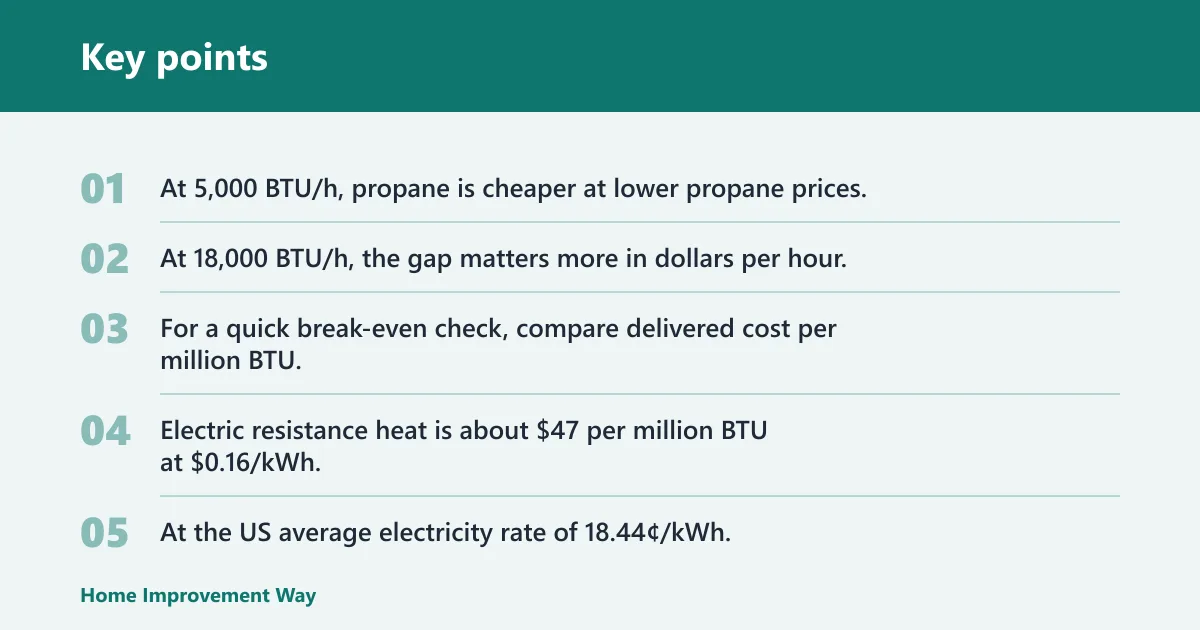
At 5,000 BTU/h, propane is cheaper at lower propane prices, but the edge shrinks fast as the gallon price rises. At 18,000 BTU/h, the gap matters more in dollars per hour, so garage and backup-heat comparisons deserve real math instead of guesswork.
For a quick break-even check, compare delivered cost per million BTU. Electric resistance heat is about $47 per million BTU at $0.16/kWh, while propane is about $33 per million BTU delivered at $2.75/gal and 90% efficiency. At the US average electricity rate of 18.44¢/kWh, the break-even propane price is about $3.96 per gallon.
Hourly cost at 5,000 BTU
At this low output, both options can look cheap on paper, but the local rate still decides the winner. Electric resistance heat can be the simpler choice when you already have a nearby outlet and a small insulated room. Propane pulls ahead when electricity is expensive and the heater runs for long stretches.
Hourly cost at 9,000 BTU
This is a common size for a small room or workshop zone. Propane usually keeps the lower hourly cost when the delivered gallon price stays near the low end, while electric resistance heat gets more expensive as the kWh rate rises toward the national average and beyond.
Hourly cost at 18,000 BTU
At higher output, the hourly spread is easier to see, and the wrong fuel choice gets expensive quickly. For a drafty garage or a backup setup, propane often wins on fuel cost alone, but only if you account for ventilation, fuel handling, and the heater’s efficiency.
Break-even notes for electricity rate and propane price
A useful shortcut is to compare the local marginal electricity rate against the delivered propane price. If your propane price is below the break-even level for your kWh rate, propane can beat electric resistance heat on running cost; if it is above that level, electric resistance heat can be the cheaper of the two.
How do you compare cost per BTU?
You compare cost per delivered BTU by converting both fuels to the same heat unit, then adjusting for efficiency. Electric resistance heat is the simple case because it converts electricity at the point of use at 100% efficiency. Propane needs one more step because the heater does not turn every fuel BTU into room heat.
Convert kWh to BTU
Use 1 kWh equals about 3,412 BTU. To estimate delivered heat cost for electric resistance heat, divide your kWh price by 3,412 BTU per kWh, then scale up to a million BTU if you want a cleaner comparison number.
Convert propane gallons to BTU
Use 1 gallon of propane = 91,500 BTU. Then divide by the heater’s efficiency, because a portable propane heater often delivers about 80% to 95% of that heat to the space. If you are comparing a furnace-style system, use the AFUE or efficiency rating you actually have.
Adjust for heater efficiency or COP
For propane, multiply the fuel heat by the efficiency fraction before you price it. For a heat pump, use the coefficient of performance, or COP, instead of 100% efficiency. A COP of 2.8 means the unit moves about 2.8 units of heat for each unit of electric input, which is why a heat pump is a different comparison from electric resistance heat.
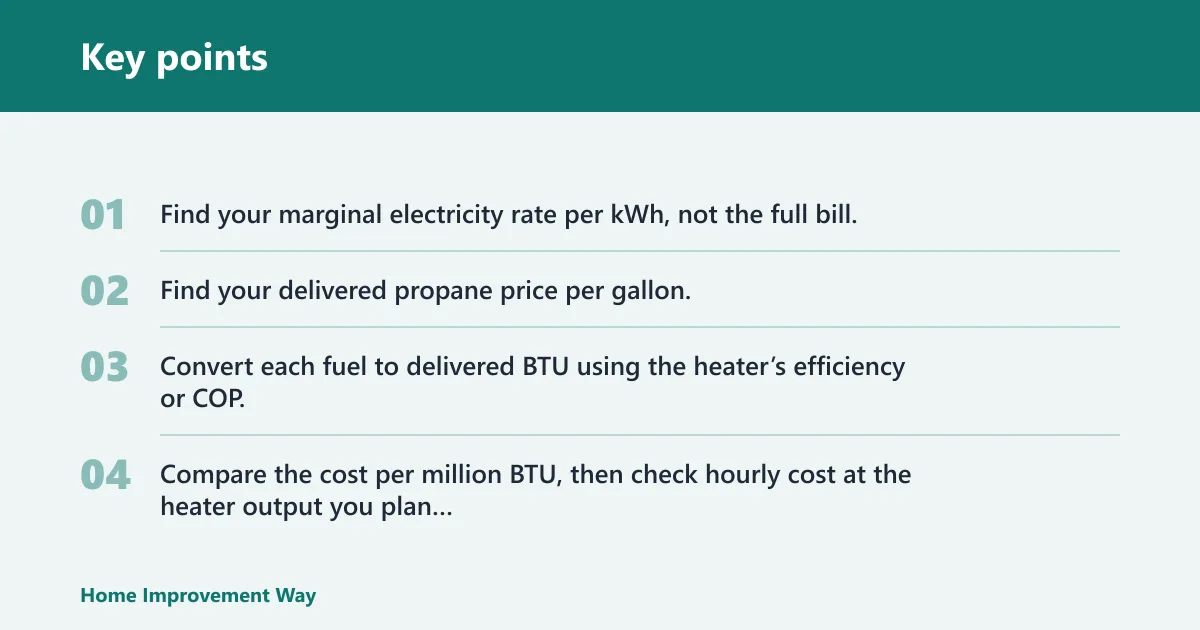
- Find your marginal electricity rate per kWh, not the full bill.
- Find your delivered propane price per gallon, including delivery if that is part of the fuel cost.
- Convert each fuel to delivered BTU using the heater’s efficiency or COP.
- Compare the cost per million BTU, then check hourly cost at the heater output you plan to use.
Is electric heater cheaper than propane?
Electric heater is cheaper only when your local electricity rate is low enough, or your propane price is high enough, that the delivered BTU cost crosses over. At $0.16/kWh and 90% propane efficiency, propane is cheaper on fuel. At higher propane prices, electric resistance heat can take the lead.
When electric resistance heat wins
Electric resistance heat wins when the propane gallon price climbs above the break-even point for your electricity rate. It also wins on simplicity if you want a plug-in heater for a small room, a short-use space, or a place where venting a combustion heater is awkward.
When propane wins
Propane often wins in a garage, shop, or outage setup when the heater runs for many hours and delivered propane stays reasonably priced. A common first-timer mistake is comparing sticker prices instead of fuel cost per BTU, which makes a cheap-looking electric heater expensive over a long cold spell.
Where the local rate breaks the tie
At the US average electricity rate of 18.44¢/kWh, the break-even propane price is about $3.96 per gallon. Below that delivered propane price, propane is often the cheaper running choice; above it, electric resistance heat can be the lower-cost option if the heater output and runtime are similar.
Say your 18,000 BTU garage heater runs 8 hours a day. If the propane price is low and the space is drafty, the fuel bill can stay below the electric resistance bill by a noticeable margin. If the propane price jumps and the room is sealed better than expected, the advantage can shrink fast.
What price inputs should you use?
Use your marginal electricity rate and your delivered propane price. Do not mix in fixed customer charges, tank rental, or unrelated utility fees unless you label them as add-ons. The goal is to compare the fuel that powers the heater, not the full monthly utility bill.
Electricity rate to use
Use the variable or marginal cents per kWh on your bill. If your utility has time-of-use pricing, use the rate that applies when the heater will actually run. Skip the monthly customer charge when you are comparing fuel cost per hour.
Delivered propane price to use
Use the delivered price per gallon, not only the posted propane rate if delivery fees are always part of the order. If you rent a tank or pay service fees, keep those separate unless you want a full ownership cost, because they are not part of the fuel itself.
Which fees to include and exclude?
Include delivery fees only if they are unavoidable and tied to the fuel order. Exclude tank rental, service contracts, and fixed electric charges from a simple run-cost comparison. That keeps the math clean and makes the per-hour result usable for a room, garage, or backup heater decision.
Choose Electric heater if… / Choose propane heater if…

Choose electric heater if you want the simplest setup, the quietest operation, and the cleanest plug-in option for a small room. Choose propane heater if you need higher-output heat, expect long runtimes in a garage or outage, and your delivered propane price sits below the break-even point for your electricity rate.
Choose Electric heater if…
- You are heating a small insulated room and already have a suitable outlet nearby.
- You want no combustion, no venting, and less day-to-day setup.
- You care more about convenience and quiet operation than the lowest fuel bill.
Choose propane heater if…
- You are heating a drafty garage, shop, or temporary work area.
- You need backup heat during outages or in a site-specific setup without easy electric service.
- Your delivered propane price is below the break-even level for your local electricity rate.
Picture a 12-by-16 room with decent insulation and a heater that only runs in the evening. Electric resistance heat is often the cleaner choice there because the output demand is modest and the installation is simple. Now picture a detached garage with a cracked slab and cold air leaking under the door; propane can make more sense if you need a fast temperature rise and can handle the safety steps.

Do heat pumps change the answer?
Yes, but only if you are talking about a heat pump, not electric resistance heat. A heat pump moves heat instead of making it at 100% input-to-output efficiency, so its running cost can undercut both propane and electric resistance heat in mild weather. Seasonal COP drops as outdoor temperature falls.
Why heat pumps are not electric resistance heat
Electric resistance heat turns electricity directly into heat at the unit. A heat pump uses electricity to move heat from outside to inside, so its cost depends on COP, not simple resistance conversion. That is why the same electricity rate can lead to very different running costs.
Seasonal COP and mild-weather savings
The article’s break-even reference points show that a heat pump can beat propane at about $0.16 per kWh when COP is above roughly 1.4, and at $0.25 per kWh it needs a COP above about 2.2. In mild weather, that is plausible; in colder weather, the COP falls and the savings shrink.
When a heat pump can beat both options
A heat pump can be the lowest-cost choice in a climate where outdoor temperatures stay moderate for much of the heating season. It is not the same comparison as a portable electric resistance heater, though, so do not use heat-pump savings to assume an electric plug-in heater will cost the same.
Frequently asked questions
Is an electric heater cheaper to run than a propane heater?
Not usually. Electric resistance heat is often the most expensive heating option on a per-BTU basis, but propane can cost more when your delivered gallon price is high. The winner depends on the electricity rate, propane price, and heater efficiency you plug into the math.
How much does propane cost per hour compared with electric heat?
At 5,000 BTU/h, propane can be around $0.17 to $0.27 per hour across the prices in this guide, while electric resistance heat ranges from about $0.18 to $0.37 per hour. At higher outputs, the hourly gap widens, so local fuel price matters more.
At what propane price does electric heat become cheaper?
At the US average electricity rate of 18.44¢/kWh, the break-even propane price is about $3.96 per gallon. If your delivered propane price is above that, electric resistance heat can be cheaper to run. If it is below that, propane often has the edge.
Are propane heaters cheaper than electric resistance heaters?
Often yes, on delivered BTU cost. A propane heater at $2.75 per gallon and 90% efficiency comes out around $33 per million BTU delivered, while electric resistance heat at $0.16/kWh is about $47 per million BTU delivered. Local prices can flip the result.
Which is cheaper to run in a small room: electric or propane?
For a small insulated room, electric is often easier and can be cost-competitive if your kWh rate is low. Propane can still win on fuel cost, but the room size is small enough that convenience, venting, and safety often matter as much as the raw hourly price.
How do I compare propane and electric heater costs per BTU?
Convert electricity with 1 kWh equals about 3,412 BTU, then price the kWh at your marginal rate. Convert propane with 1 gallon of propane = 91,500 BTU, then adjust for heater efficiency. Compare both on a delivered cost per million BTU basis.
Does a heat pump change the propane vs electric comparison?
Yes. A heat pump is not electric resistance heat, and its COP can make it cheaper than both in mild weather. At $0.16/kWh, the break-even COP is roughly 1.4; at $0.25/kWh, it is about 2.2. As outdoor temperature drops, COP falls.
Sponsored / affiliate links. As an Amazon Associate I earn from qualifying purchases. I may earn additional commission from eligible campaigns.