5 Best Energy-Efficient Space Heaters for Large Rooms Compared (2026)
For most large rooms, the best energy-efficient portable space heater is not the one claiming a magical efficiency percentage. Nearly every 120-volt resistance heater converts the electricity it draws into room heat. The useful differences are thermostat accuracy, low-power modes, heat distribution, noise, safety controls, and whether the heater lets you warm the occupied room while turning down whole-home heat.
Affiliate disclosure: Home Improvement Way may earn a commission from qualifying Amazon purchases. Product selection here is based on current manufacturer specifications and cross-referenced documentation, not a claim that we physically tested every heater.
Our picks at a glance
| Pick | Best for | Maximum draw | Control advantage |
|---|---|---|---|
| Vornado Velocity 5R | Whole-room circulation | Verify current label; standard portable-heater class | Automatic climate control |
| Dr Infrared DR-968 | Drafty occupied rooms | 1,500W | 1,000W low + auto thermostat |
| De’Longhi Dragon4 TRD40615E | Quiet background warmth | 1,500W | 700/800/1,500W + ECO |
| PELONIS PSHO07JM1AGB | Budget wattage control | 1,500W | 600/900/1,500W |
| Dreo Solaris Max (2nd Gen.) | Wide seating areas | Verify exact current model | Thermostat + oscillation |
How we compared energy efficiency without inventing a lab test
This is a Tier C comparison. We did not measure these five units in one controlled room, so we do not claim “tested,” rank them by fabricated heating hours, or repeat retailer star ratings as technical evidence. We compared current manufacturer pages, manuals, electrical input, available heat levels, thermostat and timer behavior, distribution method, safety controls, warranty information, and the kind of room each design can realistically serve.
Our original dataset separates conversion efficiency from operating efficiency. Resistance heaters are effectively similar at converting purchased electricity into indoor heat. A heater can still cost less to use if a more accurate thermostat cycles it off sooner, a lower setting matches the remaining heat loss, or better distribution makes occupants comfortable at a lower setpoint. Those are control and use advantages, not free heat.
The five best energy-efficient space heaters for large rooms compared
1. Vornado Velocity 5R – Best overall for whole-room air circulation
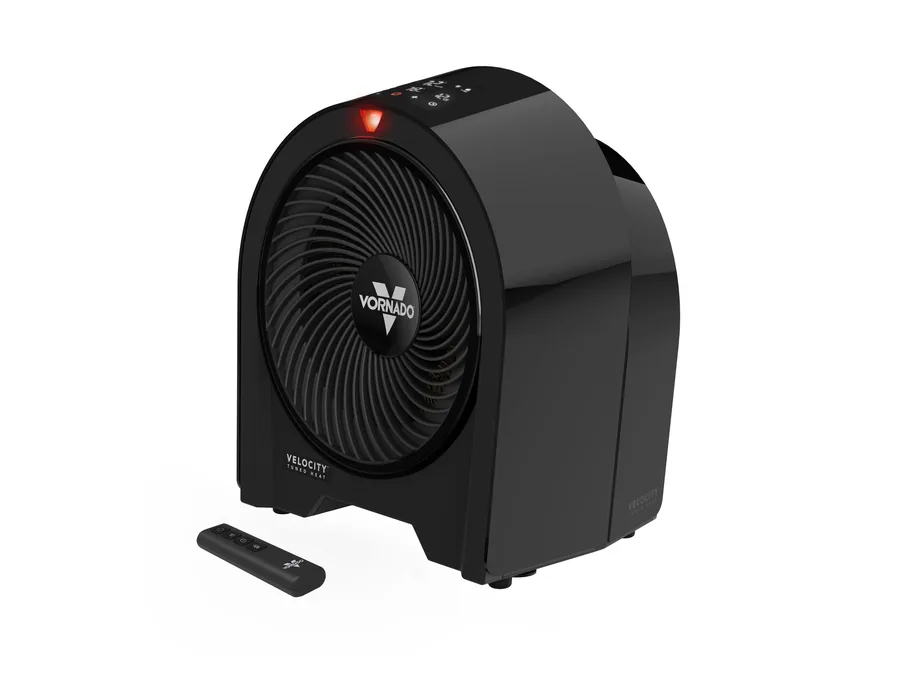
Verified specification set: Two heat settings; automatic climate control; 1-12 hour timer; fan-only mode; tip-over protection; five-year guarantee.
Best for: This is the strongest fit when a large room feels uneven rather than merely cold near one chair. Vornado’s design emphasis is room circulation, and its automatic climate control can cycle output around a set temperature instead of requiring constant manual changes.
Skip if: The manufacturer describes whole-room comfort but does not publish a universal square-foot rating on the product page. Room insulation, ceiling height, outdoor temperature, and open doorways still decide whether one 120-volt heater is enough.
Check the current Amazon listing for Vornado Velocity 5R. Confirm the model number, voltage, safety certification, seller, and return terms before ordering.
2. Dr Infrared Heater DR-968 – Best for drafty living rooms
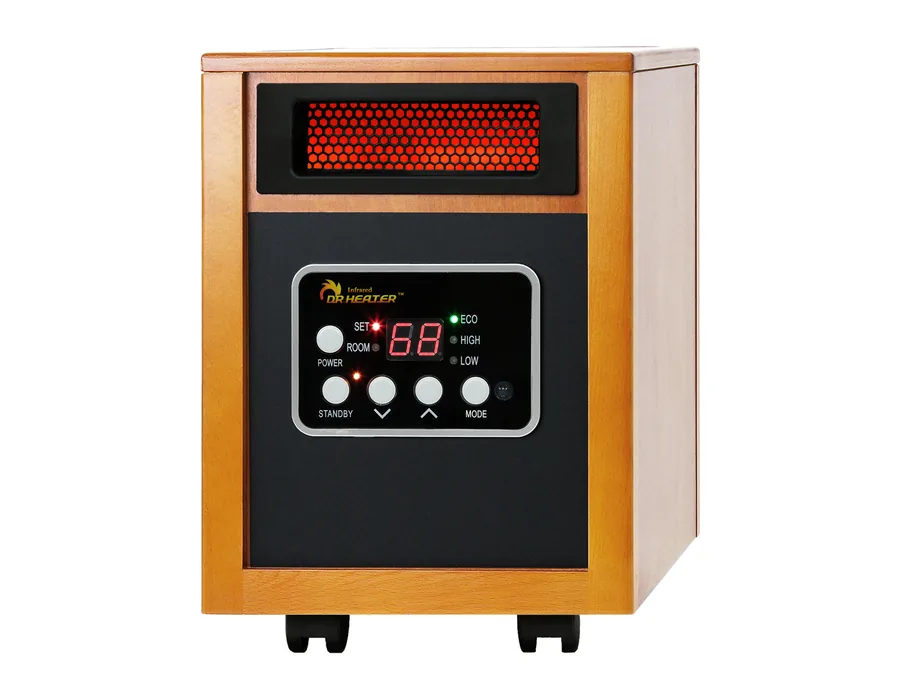
Verified specification set: 1,500W maximum; 1,000W low; 50-85 F thermostat; 12-hour timer; 39 dB claimed noise; casters; UL certification.
Best for: The combined quartz-infrared and PTC system is useful when occupants want both direct warmth and circulated room air. The thermostat and two meaningful power levels provide better control than a single-output heater with only a timer.
Skip if: The maker’s statements about greater heat delivery describe transfer and airflow, not creation of extra energy. At the wall outlet, maximum input is still 1,500 watts, so savings depend on cycling and zone-heating strategy.
Check the current Amazon listing for Dr Infrared Heater DR-968. Confirm the model number, voltage, safety certification, seller, and return terms before ordering.
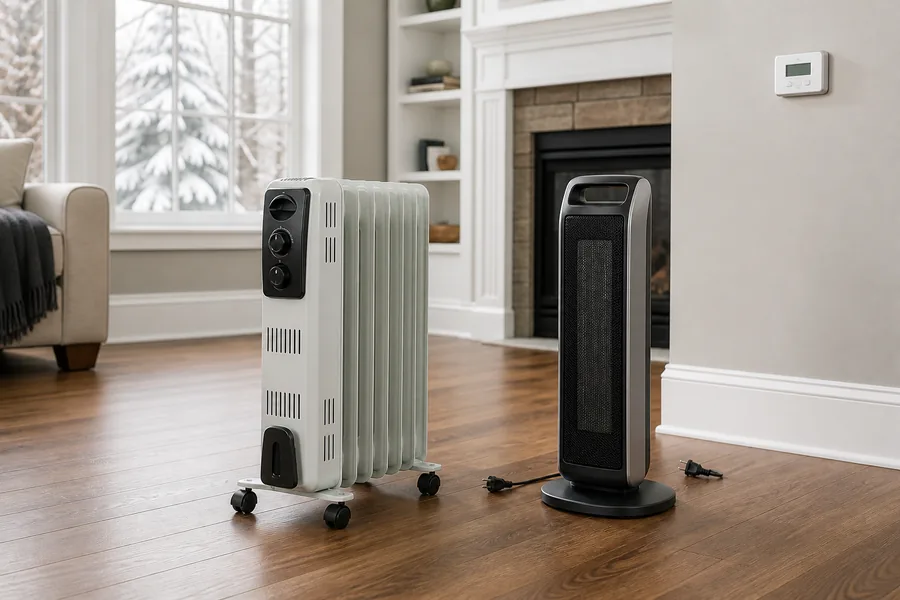
3. De’Longhi Dragon4 TRD40615E – Best quiet pick for steady background heat
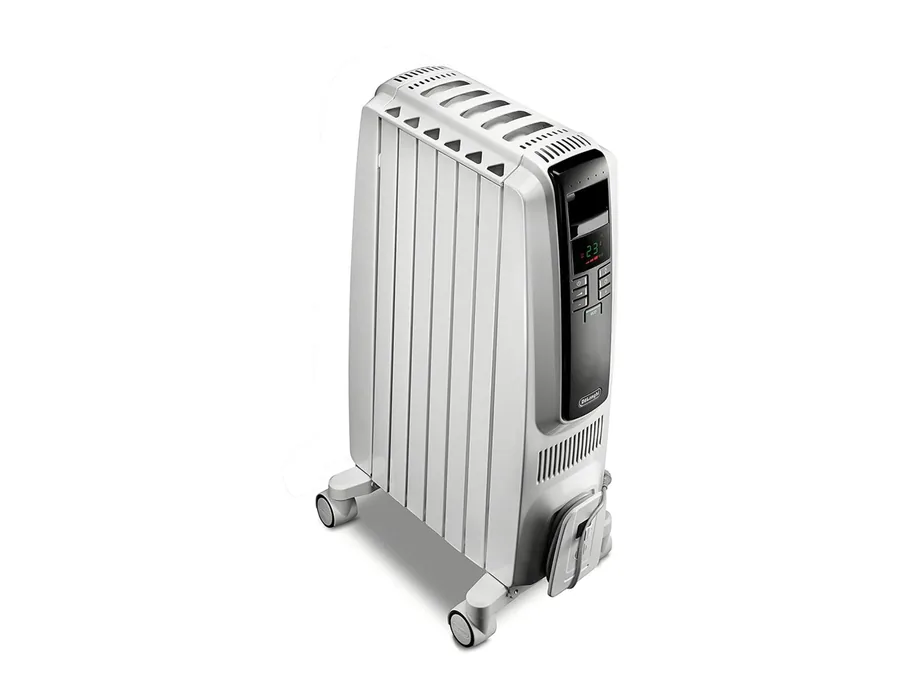
Verified specification set: 1,500/800/700W settings; oil-filled radiant design; ECO function; 24-hour timer; digital thermostat; child lock; thermal shutoff.
Best for: An oil-filled radiator is slow to change room temperature but silent in normal operation and stable once warm. It suits a large enclosed bedroom, office, or living area where low noise and fewer temperature swings matter more than an immediate blast of hot air.
Skip if: It is heavier and slower than a ceramic fan heater, and its heat distribution is less effective across open connected rooms. The published 45-cubic-meter capacity is not equivalent to a guaranteed U.S. square-foot rating.
Check the current Amazon listing for De'Longhi Dragon4 TRD40615E. Confirm the model number, voltage, safety certification, seller, and return terms before ordering.
4. PELONIS PSHO07JM1AGB Oil-Filled Radiator – Best budget control over wattage
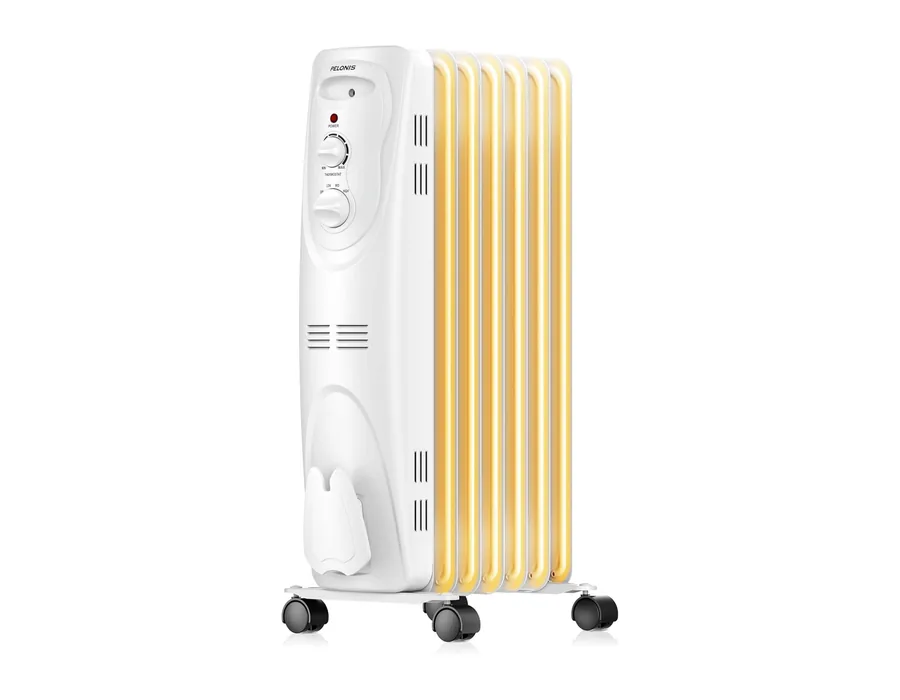
Verified specification set: 600/900/1,500W modes; mechanical thermostat; fanless radiant heat; tip-over and overheat protection; ETL certified; up to 250 sq ft claimed.
Best for: The three distinct power settings make electrical demand transparent. Low and medium settings can be useful after a well-insulated room reaches temperature, while high provides the same 1,500-watt ceiling as most portable U.S. heaters.
Skip if: The 250-square-foot claim should be treated as a favorable-condition estimate, not a promise for a high-ceiling or leaky room. Mechanical thermostats are usually less precise than digital controls.
Check the current Amazon listing for PELONIS PSHO07JM1AGB Oil-Filled Radiator. Confirm the model number, voltage, safety certification, seller, and return terms before ordering.
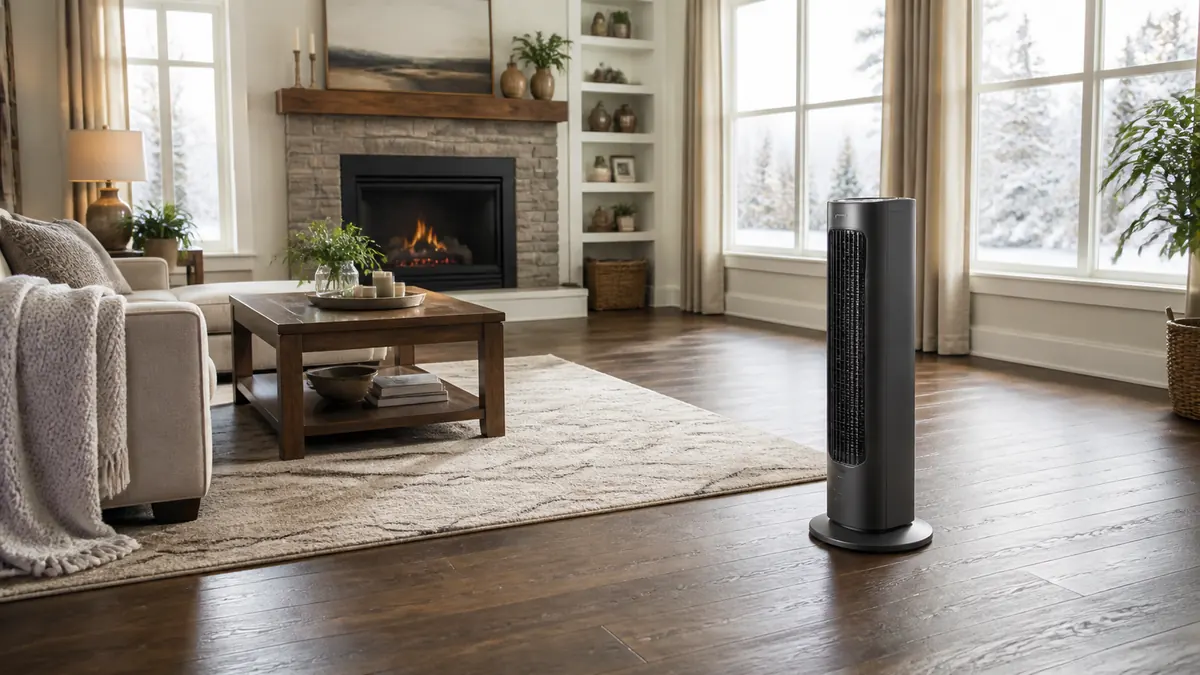
5. Dreo Solaris Max (2nd Gen.) – Best tower format for wide seating areas
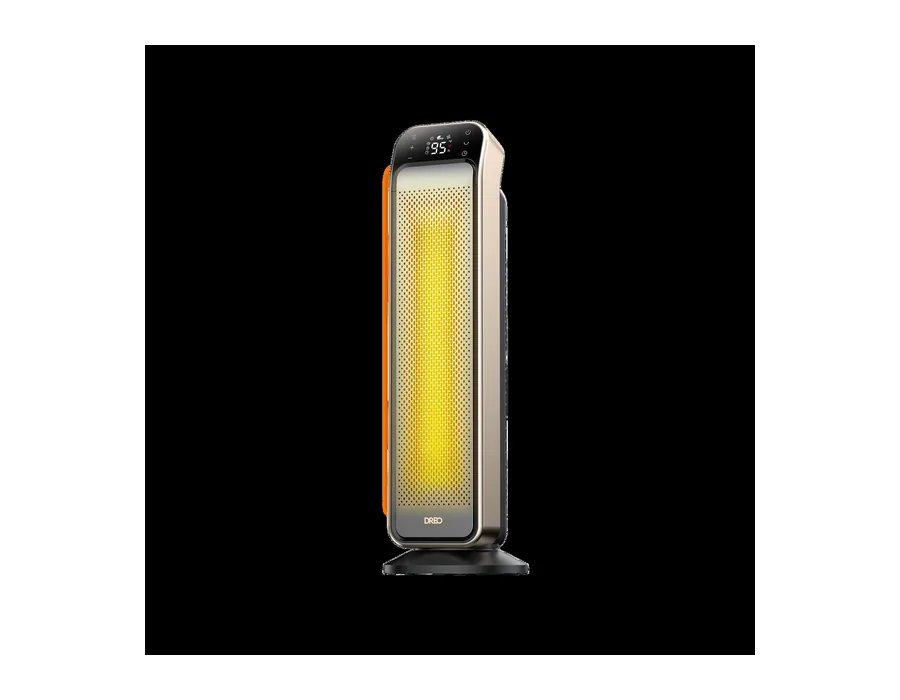
Verified specification set: Tower ceramic format; thermostat and ECO-oriented controls; oscillating distribution; remote operation; current model listed by Dreo.
Best for: A tall oscillating outlet can spread perceived warmth across a sofa or shared work area faster than a stationary radiator. It is the practical pick when the occupied zone is wide and quick comfort matters.
Skip if: Model naming and marketplace listings change often, so buyers should match the exact model on Dreo’s current product page before ordering. Oscillation improves distribution, not electrical conversion efficiency.
Check the current Amazon listing for Dreo Solaris Max (2nd Gen.). Confirm the model number, voltage, safety certification, seller, and return terms before ordering.
Original cost dataset: what thermostat cycling changes
The table below uses a disclosed calculation rather than a product marketing claim. Formula: hourly cost = input kilowatts x duty cycle x electricity rate. At an example U.S. rate of $0.17 per kWh, a 1,500W heater costs about $0.255 for one uninterrupted hour. Your actual utility rate and thermostat duty cycle determine the result.
| Average duty cycle | Average demand | Cost per hour at $0.17/kWh | Eight-hour cost |
|---|---|---|---|
| 25% | 0.375 kW | $0.064 | $0.51 |
| 50% | 0.750 kW | $0.128 | $1.02 |
| 75% | 1.125 kW | $0.191 | $1.53 |
| 100% | 1.500 kW | $0.255 | $2.04 |
This dataset explains why “ECO” does not make a 1,500W element consume 500W while it is energized. ECO mode can reduce total energy by lowering output, changing the target temperature, or cycling the element off for more of the hour. A thermostat that averages a 50% duty cycle uses roughly half the energy of continuous full-power operation over the same period.
Can one 1,500W heater really heat a large room?
A common sizing shortcut assigns about 10 watts per square foot under moderate conditions, which would place a 1,500W heater near 150 square feet. Treat that only as a screening estimate. A newer insulated 250-square-foot room with an eight-foot ceiling may respond better than a 150-square-foot room with old windows, exterior doors, a vaulted ceiling, or open stairs. Manufacturer square-foot claims rarely normalize all those variables.
For a defensible check, estimate the room volume and observe actual heat loss. If the heater runs continuously yet room temperature still falls, the load exceeds the unit’s delivered heat under those conditions. Air sealing, closing unused doors, insulating window coverings kept safely away from the heater, or improving the main heating system can matter more than changing between two 1,500W portable heaters.
How to choose the right heater type
Ceramic fan heater: fastest perceived change
A ceramic element and fan move warm air quickly, making this type useful for a living room that is occupied for a few hours. Oscillation can widen the comfort zone. The tradeoffs are fan noise, faster cooling after shutoff, and the need to keep intake and outlet paths clear.
Oil-filled radiator: quietest steady heat
A sealed oil-filled radiator warms slowly and releases heat without a fan. It is attractive for long occupied periods, bedrooms, and offices where noise matters. Thermal mass smooths temperature changes but does not create extra energy; the practical savings come from thermostat cycling and lower selectable wattage after warm-up.
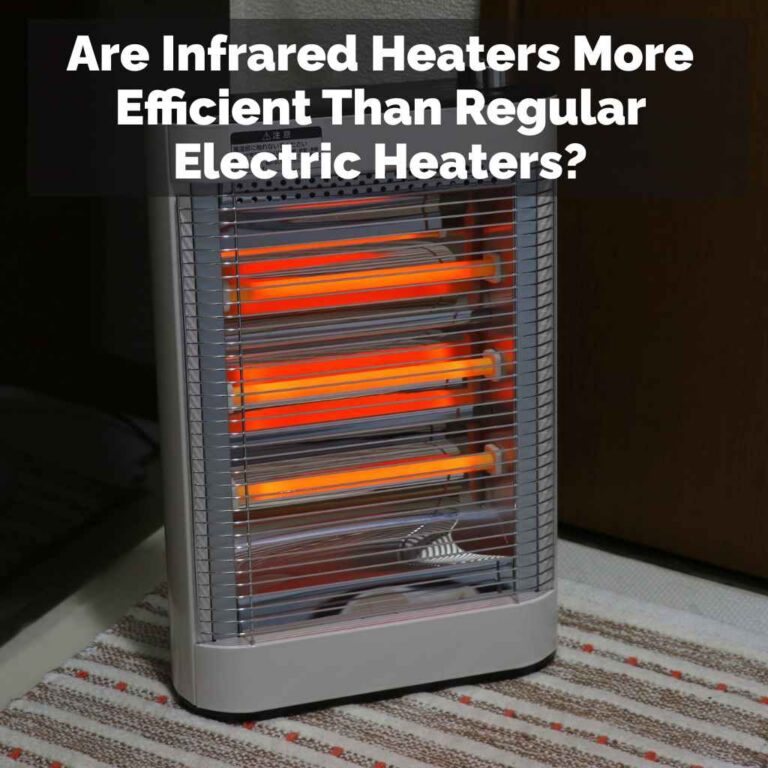
Infrared or hybrid: useful for people and surfaces
Radiant heat can improve comfort before all room air reaches the same temperature. Hybrid units add airflow to distribute that heat. This can be useful in a drafty occupied zone, but furniture and room geometry affect the result. Infrared is not automatically cheaper at identical wattage and run time.
Features that reduce waste in real use
- A real thermostat with a clearly stated temperature range
- Low and medium wattage settings, not cosmetic mode names
- A timer that limits forgotten run time
- Distribution suited to the occupied zone
- Controls that are readable enough to use consistently
- Tip-over and overheat shutoffs plus recognized safety certification
- A current manual and a warranty from an identifiable manufacturer
Space-heater electrical and fire safety
The U.S. Consumer Product Safety Commission and fire-safety guidance consistently treat portable heaters as high-current appliances requiring clear space and direct wall-outlet connection. Follow the exact manual, keep combustible material at least the stated distance away, and place the unit on a stable surface where it cannot block an exit.
- Plug the heater directly into a suitable wall outlet; do not use an extension cord or power strip unless the manufacturer explicitly permits it.
- Do not share an overloaded circuit with another high-draw appliance.
- Stop using a heater if the plug, cord, outlet, or wall plate becomes unusually hot, discolored, loose, or damaged.
- Keep children, pets, bedding, curtains, furniture, and water away from the unit.
- Turn the heater off when leaving the room or sleeping unless its manual explicitly permits the intended use and all placement rules are met.
Common buying mistakes
The first mistake is buying by square-foot headline alone. The second is assuming infrared, ceramic, or oil-filled technology changes the basic cost of continuous 1,500W operation. The third is paying for an app while ignoring thermostat behavior, low-power settings, outlet condition, room layout, and noise. Finally, do not select a heater for an open floor plan as though walls and doors contain the heat; portable units perform most predictably in one enclosed occupied room.
A two-minute decision rule before you buy
First, decide whether the goal is to warm people quickly or hold an enclosed room at a steady temperature. Choose a ceramic or circulating heater for quick occupied-zone comfort, and an oil-filled radiator for quiet, extended background heat. Second, inspect the intended outlet and circuit rather than assuming any convenient receptacle is suitable for a continuous high-current load. Third, compare the room against the 1,500W ceiling: if existing portable heaters already run continuously without maintaining temperature, another heater of the same input is unlikely to solve the underlying heat-loss problem. In that case, air sealing, insulation, HVAC service, or a properly sized heat-pump solution deserves attention before another portable-heater purchase.
Frequently asked questions
Which space heater uses the least electricity for a large room?
At the same wattage and run time, portable resistance heaters use essentially the same electricity. The lower-cost choice is the heater that maintains comfort with a lower average duty cycle through suitable distribution, thermostat control, room zoning, and selectable power levels.
Are infrared heaters more energy efficient than ceramic heaters?
Not automatically. Infrared heat can make a nearby person feel warm before all room air warms, while a ceramic fan distributes heated air quickly. Either can save energy when matched to the occupied zone, but neither defeats the electricity represented by its wattage and run time.
Is an oil-filled radiator cheaper to run?
It is cheaper only when its thermostat or lower settings reduce average power use, or when its quiet steady heat lets you use the room differently. Stored heat released after the element cycles off was already purchased while the element was on.
What size room can a 1,500W space heater heat?
About 150 square feet is a common moderate-condition estimate, but insulation, ceiling height, windows, air leakage, climate, and open doorways can move the result substantially. Use room response and heater duty cycle as the final check.
Do portable space heaters have ENERGY STAR certification?
Portable electric resistance space heaters generally are not an ENERGY STAR-qualified product category. Treat an unsupported ENERGY STAR claim cautiously and verify certification through official program listings rather than a marketplace badge.
Final verdict
For broad circulation in an enclosed large room, the Vornado Velocity 5R is the most balanced compared pick. The DR-968 suits mixed radiant and convective comfort, while the De’Longhi and PELONIS oil-filled models favor quiet sustained use. Choose the Dreo tower when quick warmth across a wide seating zone matters. Whichever design you choose, room heat loss and thermostat duty cycle will affect the bill more than the heating-element label.
Primary references: Vornado Velocity 5R specifications, Dr Infrared DR-968 specifications, De’Longhi Dragon4 specifications, and PELONIS specifications.
Sponsored / affiliate links. As an Amazon Associate I earn from qualifying purchases. I may earn additional commission from eligible campaigns.