Which Heater Works Best in a Basement Laundry Room?
For many basement laundry rooms, an oil-filled radiator is a good fit if quiet, steady background heat is the goal and there is floor space to spare; a 1500-watt unit is often a good choice for small to medium rooms, and room size should be matched to square footage and insulation rather than simply choosing a larger heater.
Laundry room heater matrix


The right heater depends on the room’s weak point, not the marketing label. A damp, crowded laundry room needs different traits than a drafty open basement corner, and washer-dryer humidity swings change the target from “heat the room fast” to “stay comfortable without adding noise or clutter.”
| Heater type | Moisture tolerance | Noise | Floor-space use | Warm-up speed | Best for | Avoid if |
|---|---|---|---|---|---|---|
| Oil-filled radiator | Moderate; keep away from water sources, puddles, and wet floors | Very quiet | Uses floor space | Slow | Steady background warmth in 150 to 250 sq ft rooms | You need fast heat or have almost no open floor area |
| Ceramic PTC | Moderate; fan parts still need dry placement | Noticeable fan noise | Portable, compact | Fast | Quick warm-up in a small or medium laundry room | Lint movement, fan sound, or sleeping-room quiet matter most |
| Infrared | Moderate; best kept well away from splash zones | Quiet or no-fan variants | Portable or wall-mounted, depending on model | Fast on the people and objects it faces | Drafty zones and targeted heat near a folding or sorting area | You want even whole-room mixing or broad background warmth |
| Wall-mounted heater | Moderate; installation location matters | Usually quiet to low-noise | Saves floor space | Varies by design | Rooms where floor area is blocked by appliances or shelving | You rent, need portability, or have low-clearance shelving nearby |
📊 Consumer Reports tested more than 150 space heaters. Source: Best Space Heaters for a Home Office.
Oil-filled radiator
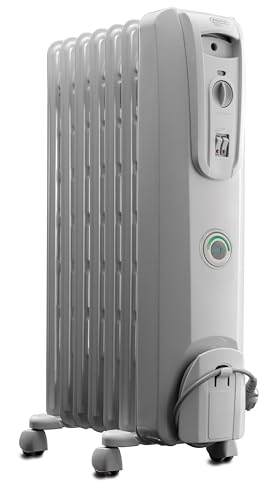
An oil-filled radiator is the strongest default choice when you want steady, quiet heat. A 1500-watt model fits the common household ceiling for portable heaters, and the heat retention after shutdown helps smooth out temperature swings after the washer or dryer cycles off.
Why it fits a laundry room
Oil-filled radiators heat slowly, then hold warmth longer than a fan heater. That matters in a basement laundry room because the space often cools down again between loads, and a heater that keeps releasing heat after shutdown can reduce start-stop cycling.
Quiet operation is the other advantage. If the laundry area doubles as a workbench, hobby space, or nearby TV room, fan noise from a ceramic heater can become the thing you notice most.
When to choose it
Choose this type when the room is roughly 150-250 sq ft, the floor plan allows a portable heater to sit clear of traffic, and your goal is comfort rather than a blast of hot air. It is the better answer when you want background warmth while folding clothes or waiting on a drying cycle.
Picture a 180 sq ft basement laundry room with a concrete floor and a short hallway draft. A 1500-watt oil-filled radiator can make that space feel less cold without adding fan noise or blowing lint around.
When to avoid it
Avoid it if you need fast heat after stepping into a cold room, or if the floor is already crowded with a washer, dryer, hamper, detergent shelf, and cleaning supplies. It also loses appeal when the only open area sits too close to splashing water or wet floors.
Is a ceramic heater better for fast warm-up?
Yes, if speed matters more than silence. A 1500-watt ceramic PTC heater can heat quickly, and fan-assisted airflow helps move warm air across the room faster than an oil-filled radiator. That makes it useful when you only want the laundry room comfortable for short visits.
What to expect from ceramic PTC heat
Many ceramic units add oscillation, which spreads heat across a wider angle instead of aiming it at one spot. That helps in awkward laundry room layouts where one side is blocked by a dryer and another by a sink or utility shelf. An oscillation angle of about 70° is one common example of a wider heat throw.
The tradeoff is fan noise. Even a low-noise unit is still moving air, and that can matter in a basement where sound bounces off concrete walls and appliances. A fan also has more potential to stir lint than a silent radiant heater.
When it is the better choice
Use ceramic PTC when you need quick warm-up in a small or medium room, or when the heater will run only while you are actively in the space. It is also a good fit if you want a compact portable heater that you can move out of the way after laundry day.
A common mistake is picking a portable radiant heater for a basement laundry room and then realizing it warms only the spot in front of it while the rest of the room stays chilly. That is a placement problem, not a power problem.
Are infrared heaters good for damp basements?
They can be, but only for the right job. Infrared heaters give direct radiant heat to people and nearby objects, so they work well in drafty zones or for spot heating near a folding counter. They are less useful if you want the whole room mixed evenly.
Where infrared works best
Infrared shines in a basement laundry room that feels cold because of drafts rather than lack of heat output. If you stand in one area to sort clothes, the direct warmth can feel immediate, especially with quiet or no-fan variants.
That does not mean infrared belongs near moisture. Keep it away from water hookups, puddles, wet floors, and detergent storage. A damp basement is not the same as a splash zone.
Where infrared falls short
Choose something else if your goal is to warm the entire room more evenly. Infrared does not mix air the way a fan heater does, so corners can stay cool even while the area in front of the heater feels comfortable.
It is a better fit for a drafty workstation than for a room that needs to stay uniformly warm while the washer and dryer run.
Should you use a wall-mounted heater?
Use a wall-mounted heater when floor space is the main problem and a fixed, controlled heat source is preferred. A wall-mounted unit can include Wi-Fi control, a remote, a thermostat, and a timer, which can make it practical for a laundry room that needs scheduled heat rather than portable warmth.
What makes wall-mounted units different
Wall-mounted heaters save floor space, which matters in basements where the washer, dryer, utility sink, and low shelving already compete for room. The Heat Storm Phoenix is a wall-mounted infrared and fan hybrid, and a Dreo smart wall heater is described as Wi-Fi enabled and wall-mounted.
That said, wall units are not automatic wins. They need manufacturer-required clearance space, careful mounting height, and a proper power plan. Some larger or colder spaces may also call for a dedicated circuit.
When to skip one
Skip a wall-mounted heater if you rent, need to move the heater from room to room, or have low-clearance shelving that crowds the wall above the appliances. Wall heaters can also be a poor fit if service access around the washer or dryer would be blocked.
Suppose your laundry room has a narrow wall section above a hamper and detergent shelf. A wall unit may fit physically, but maintenance access and clearance rules still decide whether it is a smart choice.
How to choose the right heater
Start with room size, then add insulation, draftiness, and placement limits. For many basement laundry rooms, 150 to 250 sq ft is a reasonable baseline for a 1500-watt heater, but a colder, leakier room may still feel underheated if the layout blocks airflow or the room is poorly insulated.
Use square footage first
A 1500-watt heater is the common ceiling for portable household units on standard circuits. The De’Longhi Dragon is listed at 1500 watts and covers 150-250 sq ft, while one review says a heater can warm spaces up to 750 square feet as supplemental heat, which is a different use case from a small laundry room.
For a compact room, a 1500-watt heater is usually the starting point. For a larger basement laundry area, the decision is less about “more watts” and more about whether you need broader coverage, better placement, or a fixed wall unit.
Follow moisture and placement rules
Keep heaters away from water hookups, puddles, wet floors, and detergent storage. Laundry rooms have more splash risk than a typical basement den, so cord placement matters. Do not run the cord where it can cross a damp floor or be trapped behind a washer.
Consumer Reports recommends keeping space heaters on the floor and not plugging heaters into extension cords. Those two rules matter more in a laundry room than in a dry living area because the space already combines water, cords, and frequent movement. (Consumerreports)
Match the noise level to the room use
Oil-filled radiators are the quietest fit for steady warmth. Infrared units can also be quiet, especially no-fan versions. Ceramic heaters are faster, but fan noise can clash with sleep, TV, or work nearby, and that sound becomes more noticeable in a concrete basement.
Use the thermostat and timer
A digital thermostat keeps the room at the temperature you set instead of letting the heater run hot, then shut off late. That cuts wasted runtime and helps stop the room from swinging between warm and cold after each dryer cycle. A timer adds another layer of control when you only need heat during laundry tasks.
Check safety shutoff features
For portable heaters, look for tip-over protection, overheat protection, cool-touch housing, ETL or UL certification, and flame-retardant materials. Tip-over and overheat shutoffs matter because a laundry room combines moving laundry baskets, loose cords, and fabric close to a hot appliance.
- Measure the room in square feet and note any blocked wall space.
- Mark water hookups, puddle-prone areas, and appliance clearances.
- Decide whether quiet background heat or fast spot heat matters more.
- Choose oil-filled, ceramic, infrared, or wall-mounted based on that constraint.
- Confirm thermostat, timer, and shutoff features before buying.
If the room is small and used only for short laundry sessions, a ceramic PTC heater may be enough. If the room is drafty but you only stand in one place, infrared can be the better fit. If the room stays cold for hours and you want low noise, the oil-filled radiator stays ahead.
Frequently asked questions
What type of heater is best for a basement laundry room?
For most basement laundry rooms, an oil-filled radiator is the best overall fit because it is quiet, steady, and better for background warmth. If you need fast warm-up, a ceramic PTC heater is the better short-term choice. If floor space is the main limit, consider a wall-mounted heater instead.
Is an oil-filled radiator better than a ceramic heater for a laundry room?
Usually yes, if your priority is quiet comfort and steady heat. A ceramic heater is better when you need rapid warm-up, but its fan noise and airflow can be a drawback in a laundry room. Oil-filled radiators suit longer sessions and quieter spaces more comfortably.
Are infrared heaters good for basements with moisture?
They can work in a basement with normal humidity, but they should stay well away from puddles, wet floors, and water hookups. Infrared is best for targeted warmth in drafty zones, not for splash-prone areas or for heating the whole room evenly.
How many watts do I need to heat a basement laundry room?
For many small to medium basement laundry rooms, 1500 watts is the practical ceiling for a portable heater on a standard household circuit. That output often fits roughly 150 to 250 sq ft, but insulation, drafts, and room shape can push the choice toward better placement or a wall-mounted unit.
Should I use a wall-mounted heater in a laundry room basement?
Use one if floor space is tight and you want fixed heat with thermostat and timer control. A wall-mounted heater needs careful clearance planning, correct mounting height, and possibly a dedicated circuit. It is less suitable if you rent or need to move the heater around.
Which heater is quiet enough for a laundry room basement?
An oil-filled radiator is usually the quietest choice, followed by some infrared heaters with no fan. Ceramic heaters are the noisiest of the common options because the fan helps move heat quickly. If the laundry room sits near a sleeping area or TV space, quiet operation matters a lot.
Do I need a thermostat and timer for a basement heater?
They are strongly useful, especially in a laundry room where heat needs change by task. A thermostat holds the setpoint instead of overheating the room, and a timer trims wasted runtime. Together, they make it easier to keep the room comfortable without leaving a heater on longer than needed.
Sponsored / affiliate links. As an Amazon Associate I earn from qualifying purchases. I may earn additional commission from eligible campaigns.