Helicoil vs. Thread Repair Insert: Which Should You Use?
Use a wire Helicoil for light-duty, thin-wall, or precision thread repairs; choose a solid thread insert when you need higher torque retention, better hole stability, or better vibration resistance in damaged metal threads. The wrong insert choice can pull threads, loosen fasteners, force repeat repairs, and damage the parent material. This guide compares failure modes, materials, load, and service conditions so you can pick the right repair.
This guide is part of our Screw repair and tools guide series.
Choosing Wire Insets vs. Solid Sleeves Based on Failure Mode
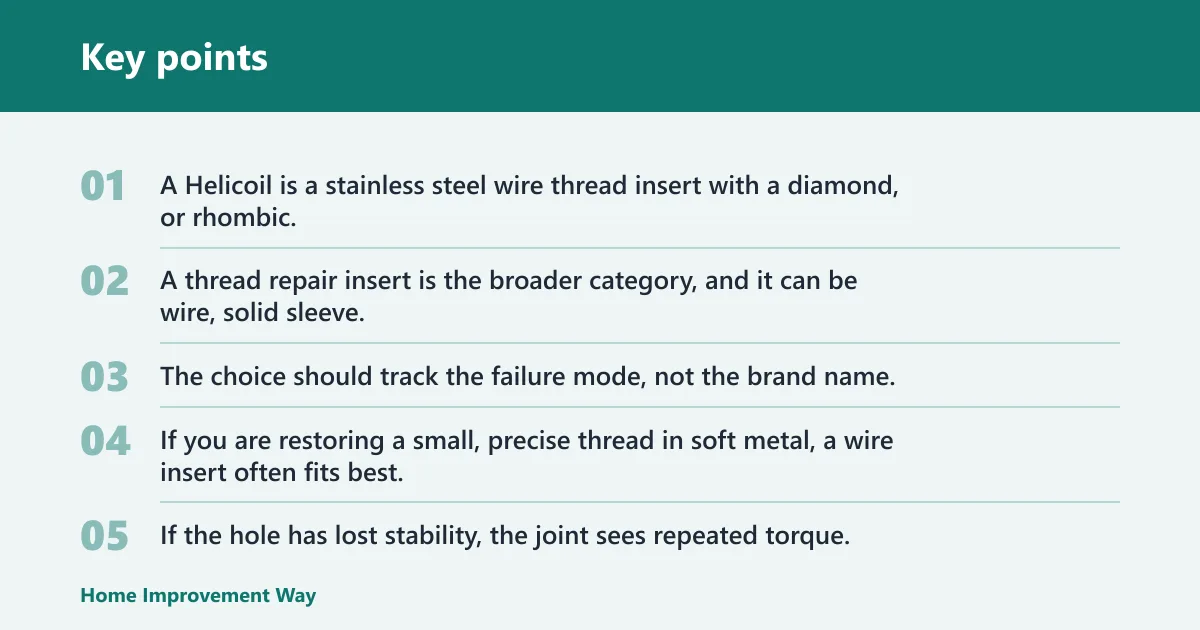


A Helicoil is a stainless steel wire thread insert with a diamond, or rhombic, cross-section. A thread repair insert is the broader category, and it can be wire, solid sleeve, press-fit, screw-in, heat-set, or molded-in depending on the job.
The choice should track the failure mode, not the brand name. If you are restoring a small, precise thread in soft metal, a wire insert often fits best. If the hole has lost stability, the joint sees repeated torque, or vibration is the main problem, a solid insert usually deserves priority.
| Decision factor | Helicoil | Thread repair insert | Winner |
|---|---|---|---|
| Torque retention in damaged holes | Good for light to moderate service | Better when hole stability matters more | Thread repair insert |
| Vibration resistance | Good with Screwlock versions | Often better in solid, locked designs | Thread repair insert |
| Installation difficulty | Moderate; drill, STI tap, and install | Varies by type; some need more setup | Helicoil |
| Future removability | Strong for routine service, especially Free Running | Can be good, but depends on style | Helicoil |
| Suitability for aluminum | Excellent in low shear strength aluminum | Also useful, especially when load is higher | Helicoil |
| Suitability for steel | Useful in repaired steel threads | Often better for heavily loaded steel joints | Thread repair insert |
| Suitability for plastic | Limited; usually a non-metallic insert path is better | Broad category includes molded-in and heat-set options | Thread repair insert |
| Best fit for precision routine maintenance | Strong fit | Depends on insert style | Helicoil |
Torque capacity
Solid inserts usually win when torque retention is the priority because they give you more material around the internal thread form. A Helicoil restores the thread cleanly and can outlast the parent metal in normal service, but it is still a wire form, not a thicker sleeve.
For stripped fasteners that see repeated tightening, a solid thread repair insert is often the safer pick. For a smaller machine screw in aluminum, a Helicoil is usually enough and easier to service later.
Vibration resistance and locking behavior
Helicoil offers Free Running and Screwlock versions. Free Running is non-locking and suits routine maintenance where normal screw removal is expected. Screwlock adds clamping area and frictional locking for captive screw retention.
For high vibration, a locking insert matters more than the brand label. HELICOIL Screwlock is presented as providing captive screw locking without extra locking hardware, and ISO 2320 is often used as a reference point for locking torque behavior.
Future removability and repeat service
Free Running inserts are easier to live with when the fastener comes out often. That matters on covers, inspection panels, and access plates where you want the screw to feel normal on the next service cycle.
Solid inserts can also be serviceable, but they may be less forgiving if the hole is damaged again or if the repair must be revisited after a bad install. For routine maintenance, Helicoil usually keeps the path simpler.
Suitability for aluminum, steel, and plastic
Helicoil is a strong match for aluminum and aluminum-magnesium alloys, which have low shear strength and often need stronger internal threads. Böllhoff describes HELICOIL as ideal for low shear strength materials such as aluminium, and that is why it shows up so often in lightweight construction.
For steel, the repair goal often shifts from simple thread restoration to preserving load and hole geometry. For plastic and other non metallic materials, thread repair inserts span a wider set of options, including molded-in and heat-set styles, so a wire insert is not always the best fit.
📊 Böllhoff says HELICOIL thread inserts have been reliable in practice for over 65 years. Source: Boellhoff.
What is a Helicoil, and what is a thread repair insert?
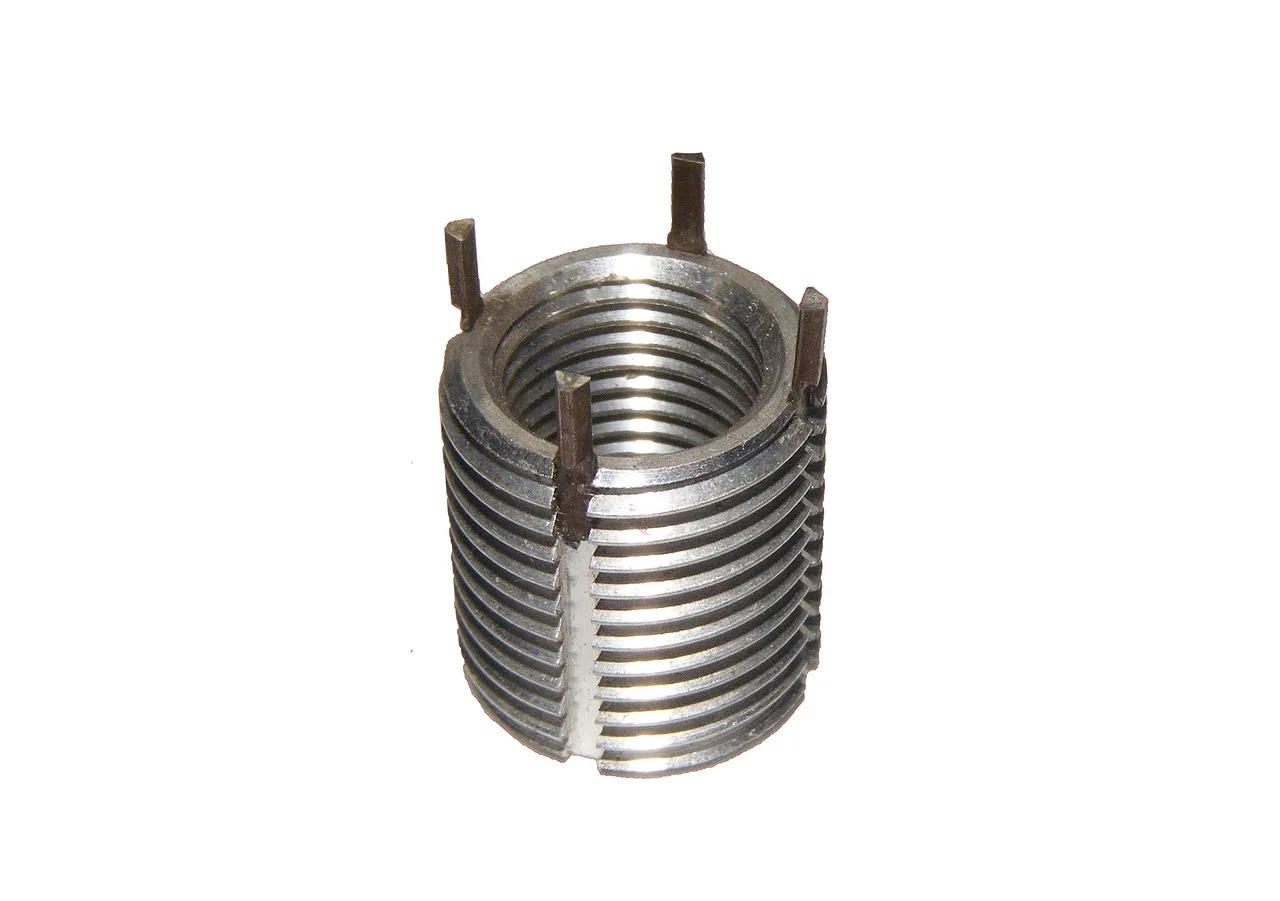
A Helicoil is a brand-specific wire thread insert made from stainless steel wire with a diamond cross section. It is used in softer metallic or non metallic materials, and genuine HELICOIL inserts are available in Free Running and Screwlock versions for different service needs.
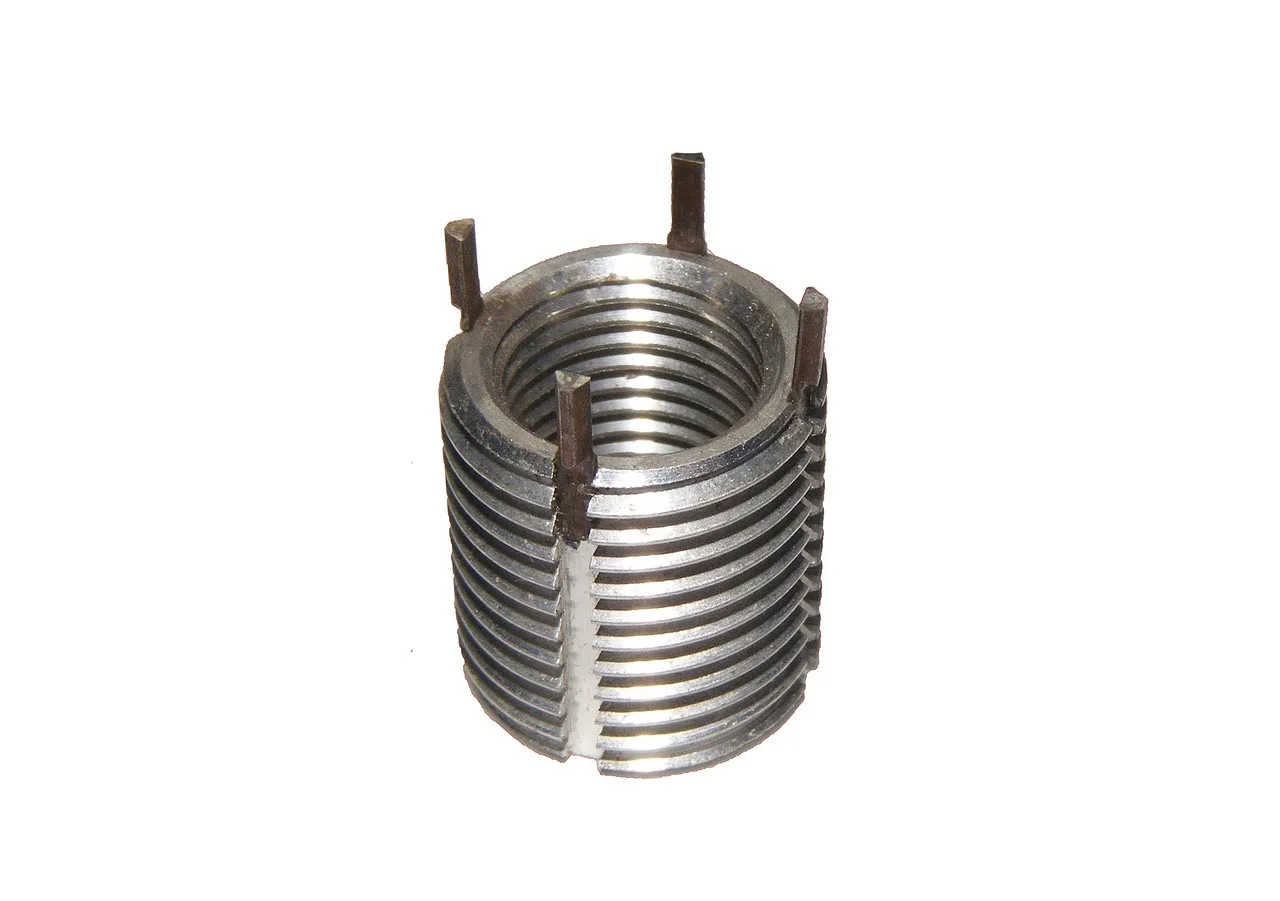
A thread repair insert is the broader category of embedded components used to improve or repair damaged threaded holes. That category includes wire and solid sleeves, and it may be installed by press fitting, screwing in, hot melting, or in-mold embedding.
Helicoil wire thread insert basics
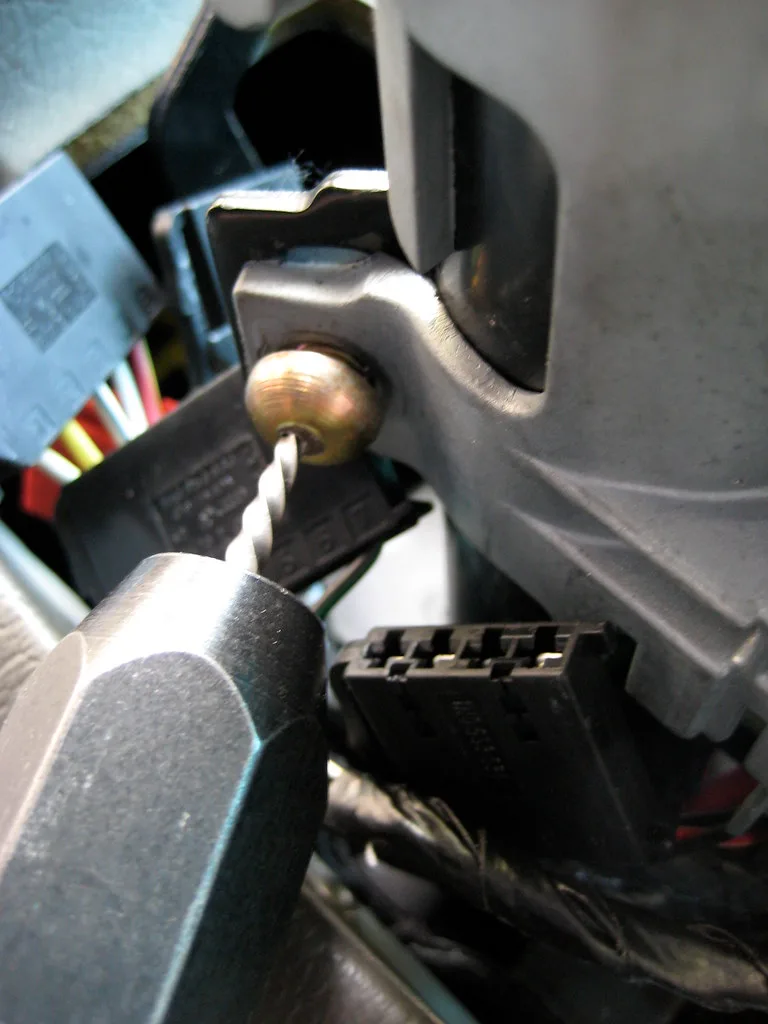
HELICOIL repairs usually require a drill, an STI tap, and an installation tool. The insert forms a new internal thread after the parent hole is drilled oversize and tapped with the special insert tap.
HELICOIL has been identified as an industry leader since 1938, and Böllhoff says HELICOIL thread inserts have been reliable in practice for over 65 years. Those facts explain the brand’s staying power, but they do not change the basic repair rule: use the insert that matches the failure mode.
What counts as a thread repair insert
Thread repair insert is the wider technical term. It covers wire coils, solid threaded sleeves, and other embedded fixes for damaged internal threads in metal, plastic, and composite parts.
That broader category matters because the repair path can change with the parent material and with the way the part failed. A stripped aluminum cover, an oversize steel hole, and a molded plastic boss do not call for the same repair geometry.
Free Running and Screwlock as insert types, not separate repair jobs
Free Running and Screwlock are HELICOIL insert styles, not separate repair categories. Free Running is non-locking and suits normal removal. Screwlock adds frictional locking for joints that need to resist loosening.
HELICOIL Plus meets DIN 13 6H dimensional stability, with 4H for special requirements, while HELICOIL Smart reduces installation time by approximately 20 percent. Those details matter when you are choosing within the HELICOIL line, but they do not replace the bigger decision between wire and solid repair formats.
How do the two compare on performance and service life?
The main performance difference is simple: a wire insert restores thread form with less bulk, while a solid thread repair insert usually brings more wall support and better load retention. That difference shows up most clearly under torque, vibration, and repeated service.
Torque capacity
Wire inserts work well for many stripped threads, especially in softer metals, but they are not the first choice when the joint repeatedly sees high clamp load or aggressive service torque. Solid inserts are often preferred when the repaired hole needs more stability under load.
A common first-timer mistake is to choose the same insert for a valve cover screw and a high-load bracket bolt. Those jobs fail differently, so the repair should not be identical.
Vibration resistance and locking behavior
Vibration is where insert style and locking design matter most. A Free Running insert is meant for normal maintenance. A Screwlock insert adds friction so the fastener stays put better under cyclic loading.
When the joint is exposed to machine vibration, engine shake, or repeated thermal cycling, a solid insert with locking behavior can be the better call. That is especially true when loosening would create a safety or downtime problem.
Future removability and repeat service
Helicoil’s strength in service is its repeatability. If you need to remove and reinstall the same fastener often, the repaired thread should still feel familiar and remain easy to work with.
Solid inserts can also be durable, but some styles are less forgiving if the repair hole is damaged again. If the part will see periodic teardown, the easiest successful repair is often the one that stays stable without making future service harder.
Suitability for aluminum, steel, and plastic
Aluminum and aluminum-magnesium alloys are the classic Helicoil use case because the parent material can strip long before the fastener itself fails. The insert restores the internal thread with a stronger wear surface.
Steel and plastic shift the decision toward application details. Steel may need a stronger, more rigid repair geometry. Plastic often needs a different insert family altogether, especially where the repair is molded in or heat-set instead of cut with an STI tap.
Which repair method should I use for my material?
Use the parent material as the first filter. Aluminum and other low shear strength metals often suit Helicoil well. Steel can take either path, but the load case matters more. Plastic usually points to a broader thread repair insert system rather than a wire coil.
Aluminum and aluminum-magnesium alloys
For aluminum, Helicoil is often the default answer because it protects soft parent material while restoring usable internal threads. This matters in lightweight construction, covers, housings, and other parts that need a tougher thread than the base metal can provide.
Choose a solid insert instead when the aluminum hole has been enlarged, wall thickness is marginal, or the joint carries a higher clamp load than a wire insert should absorb. The weaker the parent material, the more important hole stability becomes.
Steel and other higher-strength metals
Steel parts can still strip, especially after over-torque, corrosion, or repeated service. A wire insert can work well there, but a solid thread repair insert is often better when the repaired joint must hold load with less chance of movement in the hole.
If the fastener is structural or the part sees repeat assembly, favor the insert style that supports the hole most firmly. The repair goal is not only to get threads back; it is to keep them there.
Plastic and other non metallic materials
Plastic usually needs a different repair strategy than metal. Since thread repair inserts may be press-fit, screw-in, heat-set, or molded-in, that category covers options that fit plastic far better than a standard wire coil does.
For a non metallic part, check whether the joint depends on molded retention, heat, or a special boss design. In my experience, a wire insert is not usually the first choice for plastic.
Which insert is better for vibration, heat, or repeated service?
Use Free Running inserts for normal maintenance, Screwlock inserts for captive fasteners, and solid thread repair inserts when the load, vibration, or hole condition makes friction alone too weak. Heat matters too, especially in engine and exhaust-adjacent repairs.
Free Running insert for routine maintenance
Free Running is the right call when the fastener will come out regularly and you want ordinary screw feel on every service visit. That is why it suits covers, access panels, and equipment that gets checked often.
HELICOIL offers Free Running versions in product families such as HELICOIL Plus, Smart, Tangfree, and Classic.
Screwlock insert for captive screw locking
Screwlock belongs in joints that shake, vibrate, or loosen over time. The locking area adds friction so the screw resists backing out without extra locking hardware.
ISO 2320 becomes relevant when you care about locking torque behavior in a repeatable way. If the spec calls for controlled retention, Screwlock is the HELICOIL variant to look at first.
High-temperature cases such as spark plug holes
Spark plug thread repair kits are a special case because the joint lives in a hot engine environment and the hole must survive repeated service. HELICOIL includes spark plug thread repair kits for saving engine blocks in those specific holes.
That is not a generic thread repair job. The temperature, access, and sealing demands are different enough that a dedicated kit is the safer choice.
When ISO 2320 and locking torque behavior matter
If the maintenance spec mentions locking torque, or if loosening would create a repeat-failure cycle, treat the locking behavior as a design requirement. ISO 2320 is the standard reference point for that behavior.
In those jobs, a Free Running insert is only suitable if another locking method already exists. Otherwise, a Screwlock insert or a solid locking repair is the more defensible choice.
Decision matrix: 8 real-world repair scenarios
Use this matrix as a practical filter. It compares the two options by what matters most in real repair work: torque capacity, vibration resistance, installation difficulty, future removability, and material fit.
| Scenario | Helicoil | Thread repair insert | Winner |
|---|---|---|---|
| Stripped aluminum engine cover | Excellent fit for soft aluminum, easy to service later | Works, but usually more than needed | Helicoil |
| Loose threaded hole in a vibration-heavy bracket | Better with Screwlock, but wire form still limited | Better hole support and vibration control | Thread repair insert |
| Spark plug thread repair | Dedicated spark plug kits exist for this job | Possible, but kit selection is less direct | Helicoil |
| Frequently removed fastener in a machine housing | Free Running fits routine service well | Depends on style and service access | Helicoil |
| Oversize hole after a failed repair | May not restore enough hole stability | Solid insert often handles damaged geometry better | Thread repair insert |
| Low-access maintenance joint | Smaller tool path and familiar kit flow | Can be harder to align or seat | Helicoil |
| Lightweight precision assembly | Clean fit for small, precise threads | May be unnecessarily heavy-duty | Helicoil |
| Joint that must be reopened often | Free Running insert keeps service simple | Can work, but may not feel as natural on repeat service | Helicoil |
Say your M8 aluminum cover has stripped threads after an over-torque. A Free Running Helicoil usually returns the joint to service with the least change to the part, and the next service visit stays straightforward.
Suppose a bracket on a vibrating machine has an elongated hole and the bolt keeps loosening. A solid thread repair insert is often the better repair because the hole itself needs more support, not only a restored thread form.
Choose Helicoil if… / Choose a solid thread repair insert if…
Choose Helicoil if the job is a lightweight precision repair, the parent material is soft aluminum or another low shear strength metal, the fastener needs routine removal, or the kit must stay simple with a drill, STI tap, and install tool.
Choose a solid thread repair insert if hole stability is poor, the joint sees high vibration, torque retention matters more than easy installation, the hole has already failed more than once, or the repair needs extra support in steel or a heavily loaded assembly.
- Identify the failure mode: stripped threads, loosening, oversize hole, or vibration.
- Check the parent material: aluminum, steel, or plastic.
- Estimate service load: routine removal, repeated torque, or structural retention.
- Decide whether locking behavior is needed.
- Match the kit size to the original bolt or screw size, not the damaged hole size.
- Verify that the kit includes the correct drill, STI tap, inserts, and installation tool.
How do I choose the right insert kit size for a bolt hole?
Start with the original fastener size, then match the repair kit to that thread designation. Thread repair kits are commonly sold in metric and inch sizes, and the listed contents usually include drills, taps, inserts, and installation tools.
For example, the official HELICOIL metric kit listing covers M5, M6, M8, M10, and M12, and a listed 1/4-20 kit is described as restoring stripped threads permanently. Pick the size from the fastener spec, not from the damaged opening.
Practical size-selection checklist
Use this sequence:
- Read the fastener head, service manual, or parts drawing for the nominal thread size.
- Confirm pitch for metric threads, since M8 can have more than one pitch in service contexts.
- Check the kit range: metric or inch, and confirm the exact size is included.
- Measure remaining wall thickness before choosing a larger repair path.
- Make sure the insert length fits the engagement depth you need.
- Confirm access for the drill, STI tap, and insertion tool before starting.
Are Helicoil inserts permanent?
Helicoil repairs are intended to be durable, and a listed 1/4-20 kit is described as restoring stripped threads permanently. In practice, “permanent” means the repair is meant to stay in service like a normal threaded hole, not that it can never be removed or replaced.
The real question is whether the repair will outlast the service conditions. In soft metals and routine maintenance jobs, a properly installed Helicoil can last a long time. If the joint is overloaded or the hole is already unstable, a solid insert may be the better long-term option.
Do I need a special tap for a Helicoil repair?
Yes. Helicoil repairs usually require an STI tap, which is a special tap made for thread inserts. It cuts the holding thread after you drill the hole oversize, and that internal thread is sized for the insert rather than for the original fastener.
A standard tap does not create the correct thread form for most insert systems. If the kit calls for an STI tap, use that tap and not a normal machine-thread tap.
When is a screwlock insert better than a free-running insert?
A Screwlock insert is better when the joint needs locking friction to resist loosening under vibration, thermal cycling, or repeated movement. Free Running is better when normal screw removal matters more than retention and the fastener is not trying to back out on its own.
If the screw is a maintenance fastener, choose Free Running. If the screw is a captive fastener in a vibrating assembly, choose Screwlock and confirm the locking torque requirements from the application spec.
Can thread repair inserts handle vibration and heat?
Yes, but the answer depends on insert type and job type. Some inserts are made for locking behavior and vibration control, while spark plug thread repair kits are designed for high-temperature engine service. The insert has to match both the load and the environment.
For vibration, Screwlock designs and solid inserts are often stronger choices than a plain Free Running wire coil. For heat, use the kit built for the application rather than assuming any insert will fit.
Are helicoils used for spark plug threads?
Yes. HELICOIL includes spark plug thread repair kits for high-temperature engine applications, including saving engine blocks with damaged spark plug holes. Those repairs are application-specific, because spark plug service brings heat, sealing, and access constraints that ordinary thread repairs do not.
Use the spark-plug-specific kit rather than a general-purpose insert kit. The threads may be similar, but the service conditions are not.
Which is stronger: a wire insert or a solid threaded insert?
Neither wins in every situation. A solid threaded insert is usually the stronger choice when torque retention, hole stability, or vibration resistance matter most, while a wire insert can be the better choice for precision, lighter-duty repairs, and easier repeat service.
If the question is raw load support in a difficult hole, solid often has the edge. If the question is restoring a soft aluminum thread for regular maintenance, wire often wins on fit, simplicity, and serviceability.
Frequently asked questions
What is the difference between a Helicoil and a thread repair insert?
A Helicoil is one specific brand of stainless steel wire insert with a diamond cross-section. A thread repair insert is the broader category that includes wire and solid styles, plus different installation methods such as press-fit, screw-in, heat-set, or molded-in.
Which thread repair insert should I use for aluminum?
For aluminum and aluminum-magnesium alloys, a Helicoil is often the first choice because it suits low shear strength material and restores threads cleanly. Choose a solid insert instead if the hole is badly damaged, the joint carries higher load, or vibration control matters more than ease of installation.
Sponsored / affiliate links. As an Amazon Associate I earn from qualifying purchases. I may earn additional commission from eligible campaigns.