How To Pick A Camper Door Lock Safely
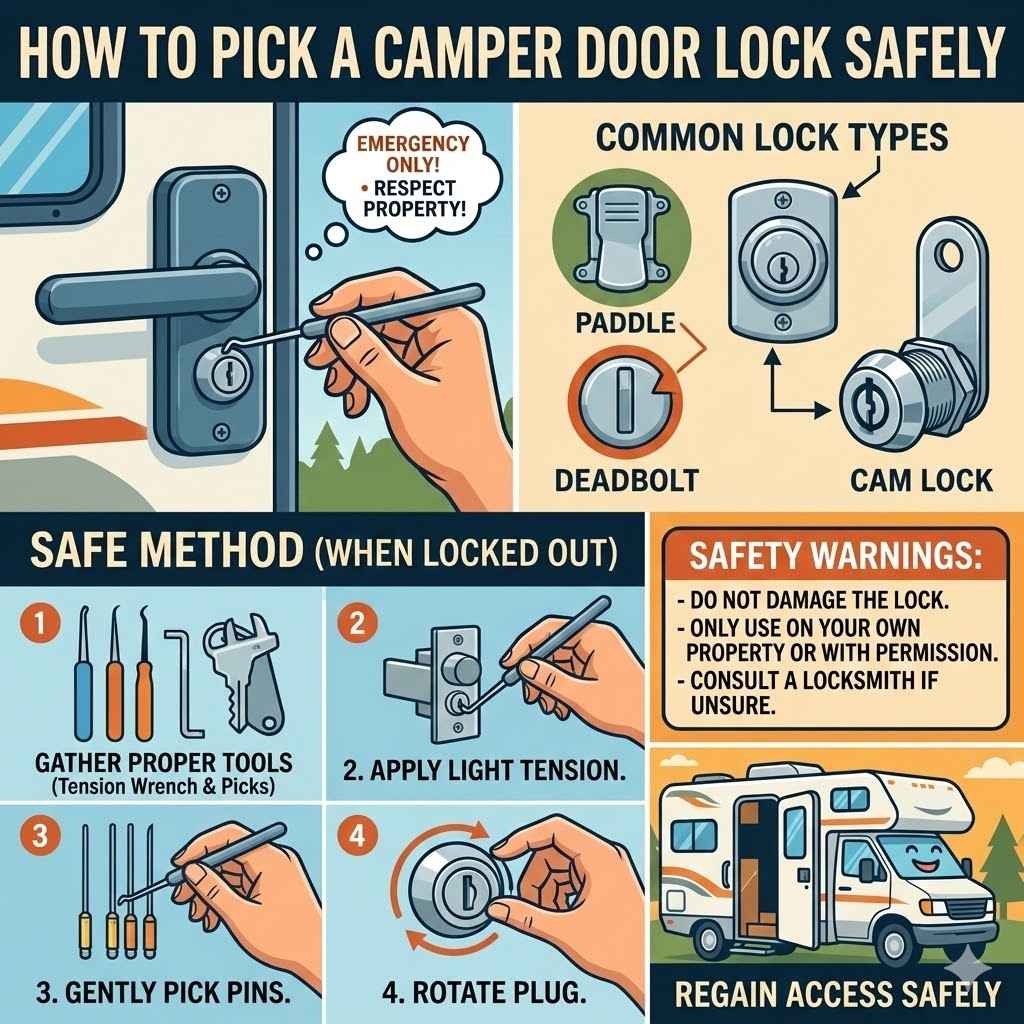
Many people wonder about how to pick a camper door lock safely, especially if they’ve misplaced their keys. It can seem tricky at first, and you might worry about damaging your camper. But don’t worry!
This guide will show you a simple way to approach it. We’ll go through each step clearly so you can feel confident. Let’s get started and learn how to pick a camper door lock safely.
Picking A Camper Door Lock Safely Basics
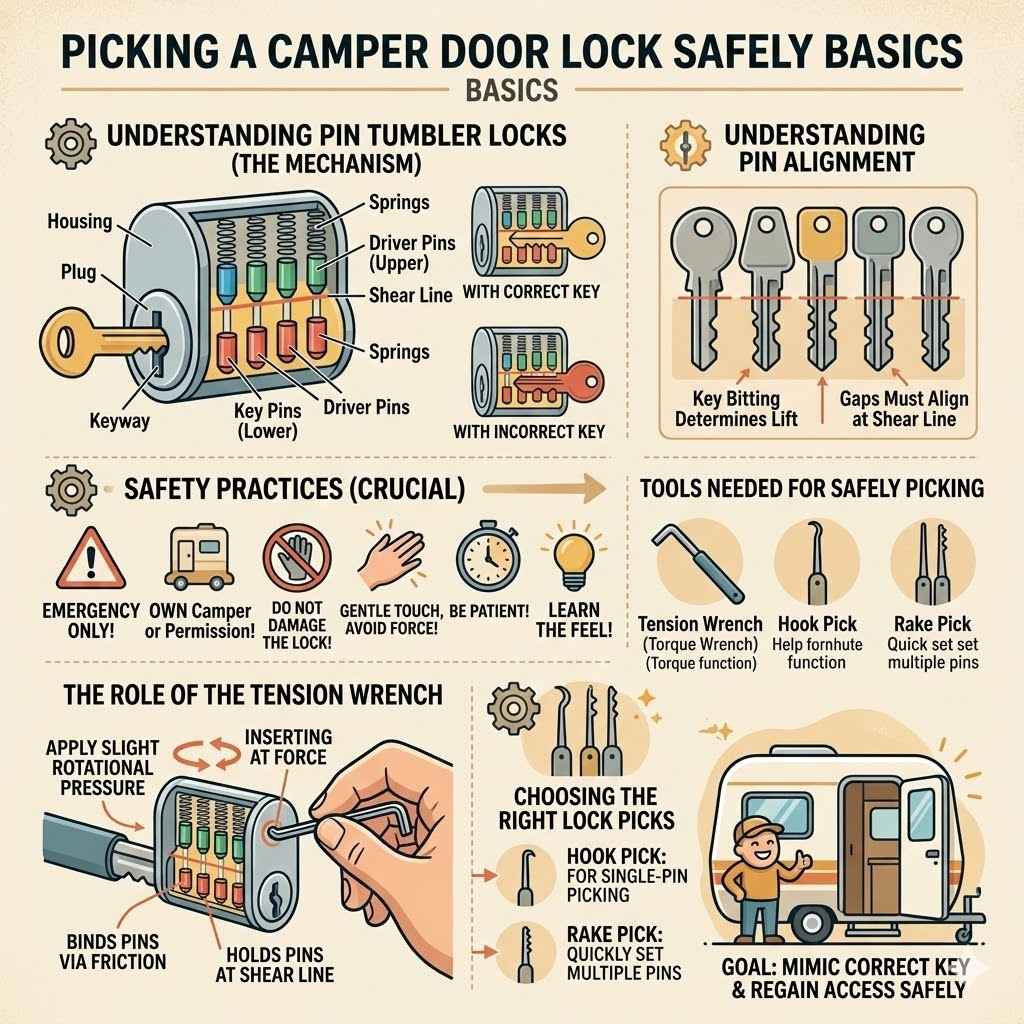
Understanding the basics of how camper door locks work is important before you try picking one. Most camper door locks use a pin tumbler system, much like many house doors. A pin tumbler lock has a cylinder that needs to be turned to open.
Inside this cylinder are pins, which are split into two parts. When you insert the correct key, its shape aligns these pins perfectly, allowing the cylinder to rotate. Without the right key, the pins block the cylinder’s movement.
Learning how to pick it means learning how to manually align these pins.
It’s a skill that requires patience and a gentle touch. Trying to force things can easily break the lock or damage the door. The goal is to mimic the action of the correct key using specialized tools.
This guide focuses on safe methods that minimize any risk to your camper’s door. We will explore the tools you might need and the precise steps to follow. Safety is the top priority throughout this process.
Understanding Pin Tumbler Locks
A pin tumbler lock is a very common type of lock. It works using a series of pins that must be aligned to a specific height. These pins are usually made of metal.
Each lock has a set of pins divided into two parts: the key pin and the driver pin. They are separated by a shear line. This shear line is the edge of the cylinder where the plug meets the housing.
Think of it as a very thin dividing line inside the lock.
When no key is inserted, the driver pins are pushed down by springs. They push the key pins down too. This causes the pins to extend across the shear line.
This blocks the cylinder from turning. The springs are usually located at the top of the lock cylinder, pushing the driver pins down into the plug. The key pins rest on top of the driver pins.
When the correct key is inserted, its unique cuts push each pin pair up. Each pin pair is lifted to a specific height. The goal is for the gap between the key pin and the driver pin to rest exactly on the shear line.
When all the pin pairs are correctly aligned at the shear line, the cylinder can rotate freely. This unlocks the door. Picking a lock is essentially recreating this perfect alignment manually.
For example, imagine a simple 5-pin lock. Each pin position has a key pin and a driver pin. The key’s bitting, or the pattern of its cuts, determines how high each pin pair is lifted.
If the key is made correctly, all the breaks between the key pins and driver pins will line up perfectly at the shear line. This allows the plug to turn. If even one pin is not at the shear line, the cylinder will not turn.
How Key Cuts Affect Pin Alignment
The specific shape and depth of each cut on a key are crucial. These cuts correspond to the different lengths of the key pins. When you the key goes.
The warding on the keyway guides the key and prevents certain types of keys from being inserted. As the key slides in, each cut pushes up the corresponding key pin.
The driver pin rests on top of the key pin. When the key is in place, the shear line should be between the key pin and the driver pin. The key’s cuts are designed so that when fully inserted, the gap between the key pin and driver pin aligns exactly with the edge of the cylinder housing.
This is the shear line. The springs above the driver pins push them down, keeping the key pins in their place.
Different keys will have different cut depths. A deeper cut on the key will push the key pin higher. A shallower cut will push it less high.
This variation is what allows a unique key to open a specific lock. When picking a lock, you’re trying to feel for these small gaps and lift each pin to the precise point where it’s at the shear line, held there by tension.
Think of it like stacking blocks. If you have a row of stacked blocks, and you need to make them all sit perfectly on a thin edge, you have to adjust each stack. In a lock, the driver pins are pushed down by springs.
The key pins sit below them. The key’s cuts lift the key pins. This separation happens at the shear line.
Tools Needed for Picking Camper Locks
To pick a camper door lock safely, you’ll need a few basic tools. The most important are a tension wrench and a set of lock picks. These are designed to manipulate the pins inside the lock without causing damage.
Using the wrong tools or applying too much force can easily damage the lock mechanism.
A tension wrench, also called a torque wrench, is used to apply slight rotational pressure to the lock cylinder. This pressure is what holds the pins in place once they are picked. Without tension, the pins would simply fall back down.
It’s essential to use just enough tension; too much can bind the pins and make picking impossible, while too little means they won’t stay set.
Lock picks come in various shapes and sizes. For camper door locks, which are often simpler, you might primarily use a hook pick and a rake pick. A hook pick is good for single-pin picking, where you lift each pin individually.
A rake pick has a wavy or toothed edge and is used to quickly set multiple pins at once by rapidly raking it across the lock. You might also use a diamond pick, which is similar to a hook but has a diamond-shaped tip.
Other helpful items could include a small flashlight to see inside the keyway if needed, and maybe a pair of small needle-nose pliers, though these are not strictly for picking but for handling small parts if something goes wrong. It is critical to acquire tools designed for lock picking, rather than trying to improvise with household items, as these can be too large or brittle and cause damage.
The Role of the Tension Wrench
The tension wrench is perhaps the most critical tool after the pick itself. Its main job is to apply rotational force, or torque, to the plug of the lock cylinder. This force is what keeps the pins set once you’ve lifted them to the shear line.
Imagine trying to hold up a bunch of small objects that are trying to fall; you need something to keep them in place.
When you insert the tension wrench into the bottom of the keyway and apply a slight turn, you are essentially trying to turn the lock. This slight turning force creates friction and binds the pins. When you lift a pin to the shear line, the slight binding caused by the tension wrench will hold the top half of the pin (the driver pin) in place, just above the shear line.
The bottom half (the key pin) will be held below it.
The amount of tension needed varies greatly depending on the lock and the tools you are using. It’s a feel you develop with practice. Too much tension will cause the pins to bind so tightly that you cannot move them with your pick.
It will feel like everything is jammed. Too little tension means the pins won’t be held in place once you’ve set them. They will just fall back down when you lift your pick.
It’s a delicate balance. You want enough tension to bind the pins, but not so much that you can’t manipulate them. Many lock pickers use constant, light tension.
Some people prefer to vary their tension slightly, easing up as they pick and increasing it again. Finding the right amount of tension is one of the most challenging parts of learning to pick locks. It’s something you’ll learn through trial and error.
Choosing the Right Lock Picks
When you’re starting out, it’s best to get a basic lock picking set. These usually contain a variety of picks that cover most common scenarios. For camper locks, you’ll likely be dealing with simpler mechanisms.
A set that includes a few hook picks of different lengths and curvatures is very useful. These allow you to feel and lift individual pins precisely.
A rake pick, such as a half-diamond or a city rake, can also be very effective. Raking involves quickly moving the pick in and out of the lock while applying tension. The idea is that the pick will bounce the pins, and by chance, some might land at the shear line.
You then use the tension to hold those in place and repeat the process until all pins are set.
Consider getting a set that includes a plug spinner. A plug spinner is a tool that can give the cylinder a quick twist after all pins are set. This can sometimes be faster than using the tension wrench alone to turn the cylinder.
However, for beginners, mastering the tension wrench is more fundamental.
Some sets also come with extractors, which are useful if a pin gets stuck or a piece breaks off inside the lock. Most starter kits will have enough variety for you to experiment and learn. Look for sets that have picks made from good quality steel, as they will be more durable and less likely to bend or break.
Many online retailers offer beginner-friendly sets at reasonable prices.
Step-by-Step Guide to Picking A Camper Door Lock Safely
Picking a camper door lock safely involves a methodical approach. The key is to work slowly and deliberately, paying attention to the feedback you get from the lock. Rushing the process is the quickest way to cause damage or frustration.
Remember, the goal is to bypass the lock, not to break it.
Before you begin, ensure you have a clear workspace. Make sure you have good lighting and that you can comfortably position yourself to work on the lock. If you’re outdoors, try to shield the lock from wind and dust, which can interfere with the delicate process.
Having a small container to hold your tools is also a good idea so they don’t get lost.
We will cover the essential steps: inserting the tension wrench, applying tension, using a pick to set pins, and finally opening the lock. Each step requires a different kind of attention. Let’s break down how to pick a camper door lock safely.
Applying Tension Correctly
The first critical step is applying tension with the tension wrench. the key normally goes.
You want to insert it so that it can turn the cylinder. The wrench should fit snugly but not too tightly.
Once the wrench is in place, apply light rotational pressure. You are trying to turn the cylinder in the direction it would normally turn to unlock. This is usually counter-clockwise for most deadbolts and door handles.
The amount of pressure is key; it should be just enough to create a slight binding effect on the pins.
Think of it as gently trying to turn a stiff doorknob. If you push too hard, you’ll just jam it. If you don’t push hard enough, it won’t budge.
You’ll feel a slight resistance. This resistance is what will help you. It makes one side of the pin, the driver pin, catch on the shear line when you lift its corresponding key pin.
It’s important to maintain this light, constant tension throughout the picking process. Your tension wrench should be a stable part of your setup. You don’t want it to move around.
If the tension slips, the pins you’ve set can fall back down, and you’ll have to start over. Feeling the right amount of tension takes practice. Don’t get discouraged if it takes time to get the feel for it.
Feeling for the Binding Pin
With light tension applied, you’ll start using your lock pick. Insert your chosen pick, often a hook pick, into the top of the keyway, above the tension wrench. Gently move the pick towards the back of the lock.
Your goal is to feel each pin as you encounter it.
As you gently push each pin upwards with your pick, you’re trying to find the “binding pin.” The binding pin is the one that feels the most resistant to being lifted. Because of the slight tension you are applying, one pin will be slightly more jammed than the others. This is the pin you want to lift.
When you find a pin that feels stiff, lift it slowly and steadily. As you lift it, pay close attention to the feedback you get through your pick and the tension wrench. If you lift the pin to the correct height, you will feel a slight “click” or a subtle give.
At the same time, the tension wrench might move very slightly.
This subtle movement or click indicates that the driver pin has cleared the shear line and the plug has rotated just a tiny bit. The tension wrench is holding it in place. Once a pin is set, it should feel loose compared to the other pins.
You can then move on to the next binding pin. It’s a process of elimination and gentle manipulation.
Setting the Pins
Once you identify a binding pin, lift it slowly with your pick until you feel that slight click or give. This is the pin “setting.” At this point, the driver pin should be above the shear line, and the key pin below it, with the gap perfectly aligned. The plug will have rotated very slightly, enough to hold that pin in place.
After setting a pin, it’s crucial to maintain your light tension. You’ll then continue to feel for the next binding pin. It might be the next one in line, or it could be any other pin.
You are essentially working through the lock, finding and setting each pin one by one.
As you set more pins, you’ll notice that the tension wrench starts to turn more freely. This is a good sign! It means you are getting closer to opening the lock.
Some pins might be easier to set than others. Some might require a little more lift or a slight jiggle. Always use a gentle touch.
If you accidentally lift a pin too high, the driver pin can get caught on the edge of the cylinder housing. This is called oversetting. If this happens, you’ll feel increased resistance.
You might need to ease off the tension slightly and let the pins reset before trying again. Patience is vital here.
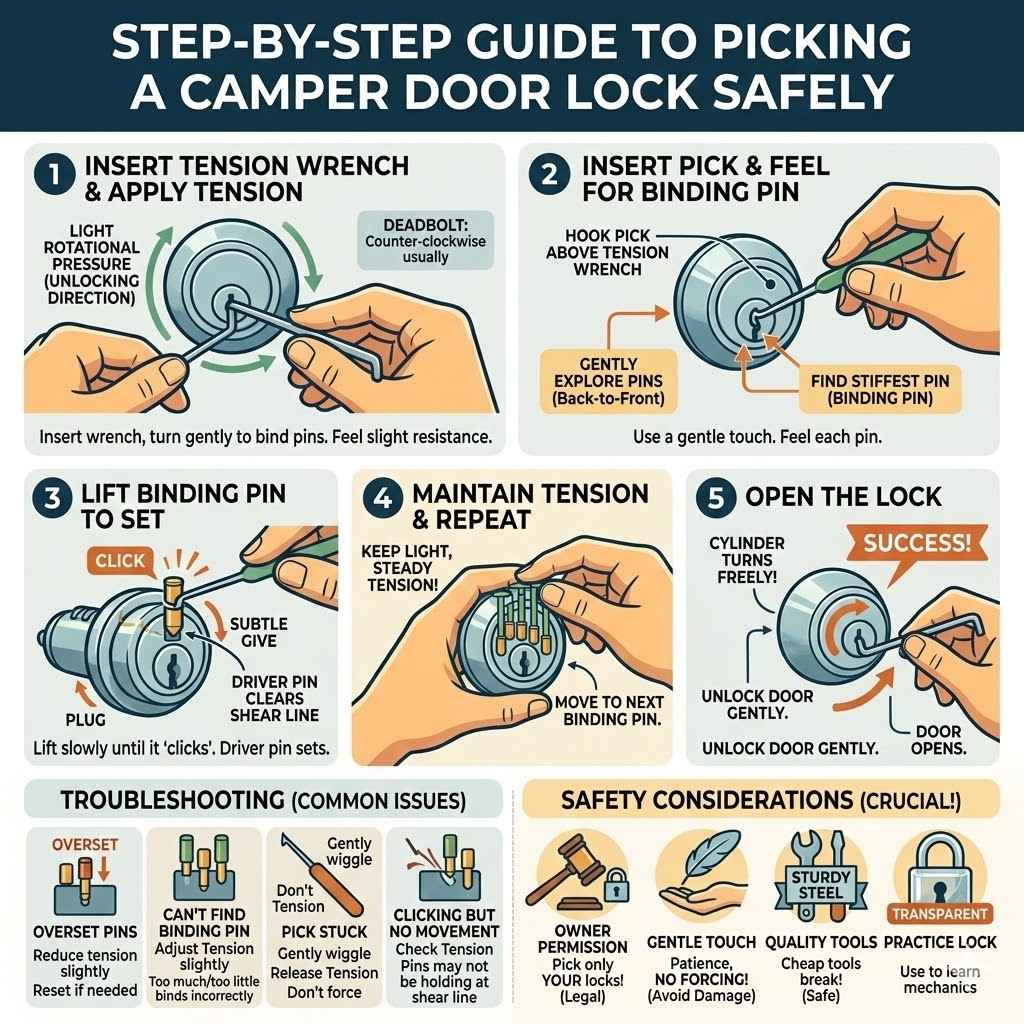
- Insert the tension wrench into the bottom of the keyway and apply light, steady turning pressure.
- Gently insert your hook pick into the top of the keyway.
- Feel for the pin that offers the most resistance (the binding pin).
- Lift the binding pin slowly and steadily until you feel a click or a give, indicating it has set.
- Maintain tension and move to the next binding pin. Repeat steps 3-5 until all pins are set.
Dealing with Overset Pins
Oversetting a pin happens when you lift it too high. The driver pin gets jammed on the edge of the cylinder, preventing it from falling back down. This can feel like a solid block.
If you encounter this, the most common solution is to ease off the tension slightly. Let the pins relax a little.
Sometimes, just reducing the tension for a moment allows the overset pin to fall back into place. Then, you can reapply your light tension and try to lift that pin again, being more careful this time. It’s important not to force it.
Forcing an overset pin will likely damage the lock or break your pick.
If easing tension doesn’t work, you might need to completely release the tension and let all the pins drop. Then, you can start the picking process from the beginning. This can be frustrating, but it’s a normal part of learning.
It’s better to restart than to force something and cause damage.
Another technique is to gently wiggle the tension wrench while trying to lift the overset pin. This slight movement can sometimes help the pin to seat correctly. The goal is to be gentle and responsive to the feedback from the lock.
Each lock is different, and sometimes a particular pin might be more sensitive to tension or movement.
Opening The Lock
Once you have successfully set all the pins, the cylinder should be able to turn freely. You will notice that the tension wrench can now be turned further, with much less resistance than before. This is the moment of success!
Continue to turn the tension wrench gently in the unlocking direction. The door should now open. If it doesn’t open immediately, double-check that you have set all the pins.
Sometimes, one pin might have slipped back down, especially if your tension was inconsistent.
If you are using a plug spinner, this is where you would use it. After all pins are set, you would attach the plug spinner to the plug and give it a quick twist. This is a faster way to open the lock, but mastering the tension wrench is a more fundamental skill.
Congratulations! You have successfully picked the camper door lock. Remember to be proud of your accomplishment and to use this skill responsibly.
It’s a useful ability to have in situations like a lockout.
Troubleshooting Common Issues
There are a few common problems you might run into. One is not being able to find a binding pin. This usually means your tension is either too high or too low.
Try adjusting the tension slightly. If you still can’t find it, release tension completely and start again.
Another issue is feeling like all pins are set, but the lock won’t open. This could mean one pin is slightly overset or not quite at the shear line. Try to gently jiggle the tension wrench while very lightly probing the pins again.
You might find one that needs a tiny adjustment.
If a pick gets stuck, don’t force it. Try wiggling it gently. If it feels truly stuck, it’s best to release tension and try to free it.
Sometimes, debris in the lock can cause problems. If you suspect debris, you could try a quick blast of compressed air, but only if you’re sure it won’t make the problem worse.
If you hear a clicking sound but no movement, it might be that the pins are setting, but the plug isn’t rotating enough to hold them. This again points to tension. Too little tension, and the pins won’t stay set.
Too much, and the pins bind too tightly. Finding that sweet spot is key.
Alternative Methods for Camper Locks
While picking is a common method, other non-destructive ways exist for certain types of camper locks. For example, some older or simpler campers might have wafer locks, which have flat wafers instead of pins. These can sometimes be opened with a specialized wafer pick or even a tension wrench and a thin piece of metal.
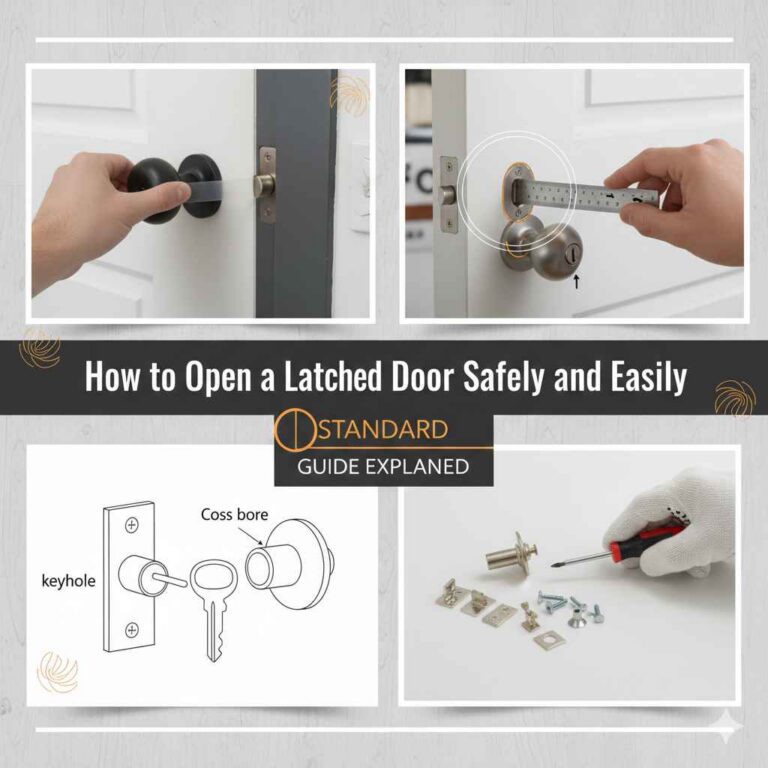
Another very simple lock type found on some older RVs is a basic spring latch. These can sometimes be bypassed by sliding a thin, stiff piece of plastic or metal, like a credit card or a strong shim, between the door and the frame. You then try to push the latch bolt back into the door.
This is not a picking method but a bypass technique.
Some campers may also have keyless entry systems or electronic locks. These operate on entirely different principles. If your camper has an electronic lock, picking is not applicable.
You would need to consult the manufacturer’s manual for lockout procedures, which might involve a reset code or a physical override key.
It is important to identify the type of lock on your camper door before attempting any method. For pin tumbler locks, picking is the standard. However, always consider if a simpler bypass method is possible, especially if you are in an emergency situation and have limited tools.
Using a Shim
A shim is a thin, flexible piece of material that can be used to bypass certain types of latches. This method is generally more effective on simpler spring latches, common on interior doors or some older camper doors, rather than true deadbolts. The idea is to slip the shim between the door and the door frame, directly where the latch bolt is located.
You’ll want a shim that is stiff enough to push the latch bolt but flexible enough to slide into the gap. Old credit cards, laminated cards, or purpose-made metal shims work well. You slide the shim into the gap, angling it towards the latch bolt.
Once the shim is in place, you push it inwards and downwards (or in the direction the latch bolt would retract). As you apply pressure, you can also try to push or jiggle the door. The shim pushes against the angled face of the latch bolt, forcing it to retract into the door.
This effectively opens the door without picking the lock.
This method requires a gap between the door and the frame, and the latch must have an angled surface that the shim can push against. It’s a very quick and effective bypass for specific lock types. However, it won’t work on deadbolts or locks that don’t have a spring latch mechanism.
Always ensure you are using a method appropriate for your lock.
Safety Considerations When Picking
When you are learning how to pick a camper door lock safely, safety is the absolute number one priority. You want to avoid any damage to your camper. This means being patient and using a gentle touch.
Never force anything. If a tool feels like it’s jamming, stop and reassess.
Also, consider the legal aspects. You should only ever pick locks that you own or have explicit permission to pick. Picking someone else’s lock, even if you are trying to be helpful, can lead to serious legal trouble.
Make sure you are on your property or have the owner’s consent.
When practicing, use a clear practice lock first. These are often made of transparent plastic, allowing you to see the pins and how they are setting. This is invaluable for learning the mechanics and developing the feel for tension and pin setting without risking damage to a real lock.
It’s also important to use quality tools. Cheap, brittle tools are more likely to break inside the lock, creating a much bigger problem than a lockout. Invest in a decent beginner’s set.
This will make the learning process much smoother and safer for both you and your lock.
Practicing on a Lockout
If you find yourself locked out of your camper, taking a deep breath is the first step. Panic can lead to rushed decisions and potential damage. Assess the situation calmly.
If you have your tools with you and are confident in your skills, proceed slowly and deliberately.
Remember the steps: tension, finding the binding pin, setting the pin, and repeating. If you’re struggling, try adjusting your tension slightly. Sometimes, a tiny change can make a big difference.
If you’re not making progress after a significant amount of time, it might be wiser to call a locksmith.
Calling a professional locksmith is always a safe option, especially if you are unsure or worried about damaging your camper. They have the experience and specialized tools to open locks quickly and often non-destructively. It’s a trade-off between time, cost, and potential damage.
Learning to pick is a skill that can save you money and hassle in the long run, but knowing when to call for help is also crucial.
For instance, if you are on a camping trip and locked out, a locksmith might be your quickest route back into your camper so you don’t miss out on your activities. However, if you are at home and want to practice, using a practice lock or a spare lock from an old appliance is a great way to build confidence before attempting it on your camper.
Frequently Asked Questions
Question: Can I really learn how to pick a camper door lock safely?
Answer: Yes, with practice and the right tools, you can learn how to pick a camper door lock safely. It requires patience and a gentle touch, focusing on the mechanics of the lock rather than force.
Question: What is the most important tool for picking a camper lock?
Answer: The two most important tools are the tension wrench and a set of lock picks, like a hook pick. The tension wrench applies the necessary torque to hold the pins in place.
Question: Will picking my camper lock damage it?
Answer: If done correctly and gently, picking a lock should not cause damage. However, using excessive force or the wrong tools can definitely damage the lock mechanism.
Question: How long does it take to pick a camper door lock?
Answer: For a beginner, it can take anywhere from a few minutes to over an hour, or even longer. With practice, you can become much faster, often opening simple locks in under a minute.
Question: Should I pick my camper lock if I’m not sure how to do it?
Answer: If you are unsure or concerned about causing damage, it is always best to call a professional locksmith. They have the expertise and tools to open it safely and efficiently.
Conclusion
Learning how to pick a camper door lock safely is an achievable skill. You’ve learned about pin tumbler locks, the essential tools like tension wrenches and picks, and a step-by-step process. Remember to be patient, use light tension, and feel for each pin setting.
Always prioritize safety and only practice on locks you own. This knowledge empowers you to handle lockouts responsibly.