Manual Damper vs. Top-Sealing Damper: Which Is Safer?
For most homes, a top-sealing damper is the better barrier against smoke spillage and heat loss, but a manual throat damper is less likely to fail stuck closed; the safer choice depends on chimney condition and inspection access. A bad damper can push smoke into the room or leave you paying to heat outdoors. This guide compares failure modes, inspection triggers, and retrofit limits for both types.
Comparing safety factors between damper types
| Decision factor | Manual damper | top-sealing damper | Winner |
|---|---|---|---|
| Smoke containment when closed | Often leaks more because the plate may not seal airtight. | Uses a rubber seal for a tighter airtight and watertight fit. | top-sealing damper |
| Risk of stuck-closed failure | Can rust, warp, or stick, but the mechanism is simple and visible near the firebox. | Can have cable, latch, or seal problems at the chimney top. | Manual damper |
| Heat loss and draft control | Usually leaves more leakage and can allow more draft. | Generally reduces drafts and heat loss better. | top-sealing damper |
| Moisture exposure and corrosion | Throat dampers are usually cast iron and exposed to moisture and condensation. | More resistant to moisture-related corrosion, though the roof-top unit still needs seal care. | top-sealing damper |
| Retrofit fit in masonry chimneys | Usually straightforward if the existing throat setup works and moves freely. | Needs a compatible flue size, top access, and a chimney that can accept the assembly. | Manual damper |
Smoke containment when closed
A top-sealing damper usually wins here because it closes at the chimney top and the rubber seal gives a tighter fit. A throat damper sits just above the firebox, and that lower plate often leaves more leakage at the damper edges, especially if the plate is warped or the frame is worn.
That difference matters when the fireplace is idle. A looser seal lets room air move through the flue, which can cool the house and carry odors or outdoor air with it.
Risk of stuck-closed failure
Manual dampers have fewer parts. The plate, handle, and pivot are easier to inspect because they sit above the firebox in the lower part of the flue. Top-sealing units add cable and latch parts, so the safety question is not only whether they seal well, but also whether they will open reliably when venting is needed.
If a cable on a top-sealing unit binds after a storm, the damper may look fine from inside the home, yet the flue can remain partly closed at the top until a technician checks it.
Heat loss and draft control
Top-sealing dampers generally reduce drafts and heat loss better because they seal at the chimney termination rather than above the firebox. That helps when the fireplace is not in use, especially in windy weather or in homes that pull cold air down the flue.
Manual dampers still work, but the seal is usually less complete. If the plate does not meet the throat evenly, conditioned air can leave the room through the flue even when the fireplace is cold.
Moisture exposure and corrosion
Throat dampers are usually cast iron and exposed to moisture and condensation near the firebox opening, so rust is a common wear issue. Top-sealing dampers are more resistant to moisture-related corrosion because they close at the top and keep rain out when the rubber seal is intact.
That said, a top-mounted unit is not immune to weather. The difference is where the wear shows up: a throat damper often rusts at the plate and pivot, while a top-sealing damper often fails at the seal, cable, or latch.
Retrofit fit in masonry chimneys
A masonry chimney does not automatically accept a top-sealing retrofit. The flue must be accessible at the top, the chimney crown and cap area must allow mounting, and the system must still open fully for safe venting before a fire is lit.
If the chimney already has a serviceable throat damper and the firebox setup is sound, the lower-cost option may remain the practical choice. If drafts, odor, or rain intrusion are the problem, the top-sealing route often makes more sense.
Damper comparison matrix
Here is the failure-mode view homeowners need. Safety depends on what fails, not only where the damper sits.
| Damper type | Common failure mode | Homeowner safety implication |
|---|---|---|
| Manual damper | Rust, warping, or a plate that does not move fully | Poor venting can send smoke into the room and can leave the flue partly blocked. |
| Manual damper | Does not close tightly | More draft, more heat loss, and more chance of outdoor air entering the house. |
| top-sealing damper | Worn or cracked rubber seal | Less airtight closure, more heat loss, and possible moisture entry. |
| top-sealing damper | Stuck cable or latch problem | The flue may not open fully before lighting, which can cause smoke spillage or poor draft. |
| top-sealing damper | Top-mounted corrosion or debris around the mechanism | The damper may not close or open as intended, which turns a good seal into a venting problem. |
Can a closed damper make the fireplace unsafe?
Yes. If the flue is not open before lighting, smoke and combustion gases can back up into the room instead of moving outdoors. A closed damper can also leave the fire short of draft, which makes starting harder and raises the chance of smoke spill.
What happens if the flue is not open
The flue is the passage that carries smoke and combustion gases outdoors. If the damper plate blocks that path, the fireplace cannot vent properly. In a worst case, the room fills with smoke quickly and the fire burns poorly because the exhaust path is restricted.
A common first-timer mistake is to crack the damper partially open and assume that is enough. If the plate does not move fully to the open position, the vent path is still restricted and the fire can spill smoke as soon as it gets going.
Signs the damper is blocking venting
Watch for smoke rolling out of the firebox, a strong odor after lighting, a plate that feels jammed, or visible soot staining near the opening. Those signs point to a venting problem that should be checked before another fire is started.
If you see smoke spill with the damper supposedly open, stop using the fireplace. The issue may be a stuck plate, a blocked flue, or a top-sealing cable that is not lifting the damper fully.
Which damper type seals better?
Top-sealing dampers usually seal better. They close at the top of the chimney rather than at the bottom, and the rubber seal is built for a watertight and airtight fit. That makes them better at stopping drafts, rain entry, and air leakage when the fireplace is idle.
Rubber seal wear on top-sealing dampers
The seal is also the weak point. A cracked, flattened, or missing rubber seal can erase much of the airtight advantage and create a false sense of security because the damper still looks closed from inside the home.
That is why a top-sealing damper should not be judged only by its location. A damaged seal can leak almost as badly as a loose throat plate.
Why throat dampers usually leave more leakage
Manual throat dampers are a traditional lower-cost option, but the plate has to align well with the frame to close tightly. Wear at the pivot, soot buildup, and warping can leave small gaps that matter when the home is cold or windy.
That leakage does not always make the fireplace unsafe to use, but it can make it less comfortable and less efficient to leave closed.
Which damper type is less likely to stick or fail closed?
Neither type is immune. Manual dampers can rust, warp, or stick; top-sealing units can fail through cable, latch, or seal problems. If the question is purely about a stuck-closed condition, the simpler manual throat damper usually has fewer moving parts that can fail at the chimney top.
Rust, warping, and stuck plates
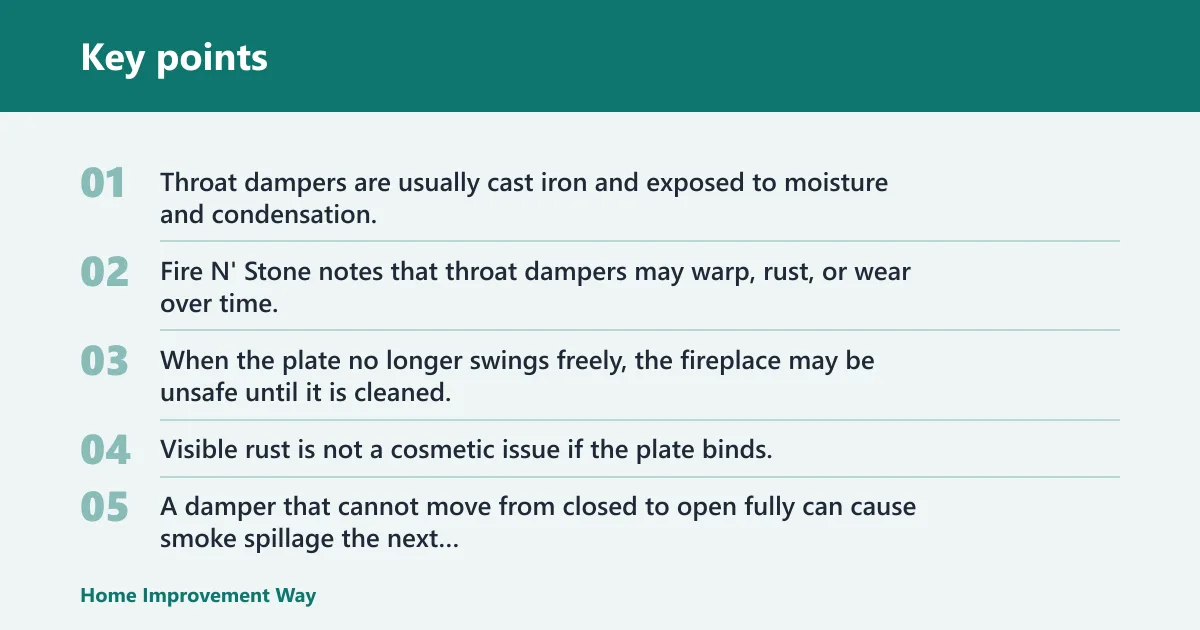
Throat dampers are usually cast iron and exposed to moisture and condensation, so rust is a practical concern. Fire N’ Stone notes that throat dampers may warp, rust, or wear over time. When the plate no longer swings freely, the fireplace may be unsafe until it is cleaned, repaired, or replaced.
Visible rust is not a cosmetic issue if the plate binds. A damper that cannot move from closed to open fully can cause smoke spillage the next time you light a fire.
Cable, seal, and latch problems at the chimney top
Top-sealing dampers remove the throat pivot problem, but they add cable and latch parts that need to work together. The rubber seal can also crack or wear and require replacement, especially if the unit has been in service through several wet seasons.
Picture a top-sealing damper that closes neatly but the cable has frayed inside the chase. The fireplace may look ready from the living room, yet the flue may not open fully at the top.
Why damp conditions change the risk profile
Damp or humid climates affect both types, but not in the same way. A throat damper sees more direct moisture and condensation near the firebox, while a top-sealing unit faces weather at the chimney top. The practical difference is where you are more likely to see the first failure sign.
With a manual unit, look for rusted hinges and a warped plate. With a top-sealing unit, look for a worn seal, stiff cable movement, or a latch that does not release smoothly.
Choose Manual damper if… / Choose top-sealing damper if…
Choose the manual damper if your chimney already has a working throat plate, you want the simplest mechanism, or you need to avoid a retrofit that cannot be fit cleanly at the chimney top. Choose the top-sealing damper if drafts, odor, rain intrusion, or heat loss are the main complaints and the chimney is compatible with a top-mounted retrofit.
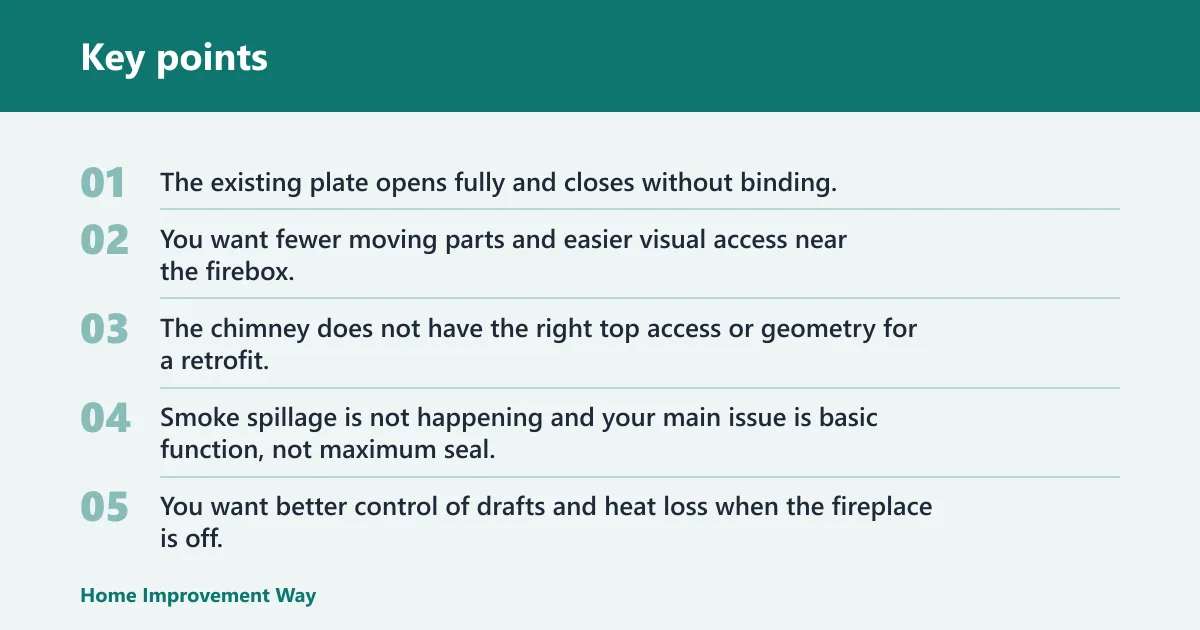
Choose Manual damper if…
- The existing plate opens fully and closes without binding.
- You want fewer moving parts and easier visual access near the firebox.
- The chimney does not have the right top access or geometry for a retrofit.
- Smoke spillage is not happening and your main issue is basic function, not maximum seal.
Choose top-sealing damper if…
- You want better control of drafts and heat loss when the fireplace is off.
- Moisture intrusion, odors, or pests are part of the problem.
- The chimney can accept a top-mounted assembly and the seal can be serviced later.
- You want a tighter airtight and watertight closure than a typical throat plate provides.
Masonry chimney compatibility checks before replacement
Before switching to a top-sealing damper in a masonry chimney, check three things: the flue must be reachable from the top, the existing chimney crown and cap area must accept the hardware, and the new damper must still open fully for safe venting. If any of those fail, the retrofit may need a different design or a different repair plan.
Say your masonry chimney has a sound firebox but a warped throat plate and a loose draft around the fireplace opening. If the top of the flue is accessible and the replacement can be mounted cleanly, a top-sealing retrofit can make sense. If the chimney top is damaged or inaccessible, stay with the safer repair path the technician recommends.
When should a damper be inspected or replaced?
A chimney inspection should be part of the whole fireplace system check, not just the damper. Yearly chimney inspections are commonly recommended, and a qualified chimney technician, such as one certified by CSIA, is a good choice to evaluate damper wear, damage, and operation under applicable NFPA guidance. Video inspection can help when the flue is hard to view from the firebox.
Manual damper vs top-sealing damper checklist
- Smoke spills into the room when the fireplace is lit.
- The damper plate is stuck open or stuck closed.
- The rubber seal is cracked, missing, or visibly damaged.
- You see visible rust that keeps the plate from moving freely.
Inspect or replace when you notice these triggers
- The damper does not open fully or does not close fully.
- The handle, lever, cable, or latch feels rough, loose, or jammed.
- There is soot leakage, smoke odor, or evidence of backdraft.
- The seal or plate shows warping, holes, heavy corrosion, or damage after an inspection.
A damaged damper does not always mean the fireplace is unusable forever. It does mean you need a professional assessment before another fire, because the safety issue is venting reliability, not only appearance.
Frequently asked questions
Is a top-sealing damper safer than a manual throat damper?
For smoke containment and heat loss, usually yes. A top-sealing damper seals at the top of the chimney and uses a rubber seal for a tighter fit, while a manual throat damper is simpler and less likely to fail stuck closed. The safer choice depends on condition, fit, and whether the unit opens fully.
Can a damper be unsafe if it does not open fully?
Yes. If the damper does not open fully, the flue cannot vent smoke and combustion gases the way it should. That raises the chance of smoke spillage, poor draft, and difficulty starting a fire. A partially open damper should be treated as a venting problem, not a minor annoyance.
What happens if I light a fire with the damper closed?
Smoke and gases can spill into the room instead of leaving through the flue. That can fill the firebox area with smoke, create odor, and make the fire burn poorly. If the damper is closed, do not light the fire until you confirm it is fully open and moving freely.
Does a top-sealing damper reduce drafts and heat loss better?
Yes, usually. Because it seals at the top of the chimney and uses a rubber seal, it generally blocks drafts and heat loss better than a throat damper. That advantage only holds if the seal is intact and the damper still opens and closes properly when needed.
Which damper type lasts longer in damp or humid climates?
It depends on where the moisture attack is strongest. Throat dampers are usually cast iron and exposed to moisture and condensation near the firebox, while top-sealing dampers are more resistant to moisture-related corrosion but still face weather at the chimney top. Inspection matters more than the climate label alone.
How do I tell whether my fireplace has a throat damper or top-sealing damper?
Look above the firebox first. If you see a metal plate and handle or lever inside the fireplace opening, you likely have a throat damper. If the control is a cable-operated mechanism and the seal is at the chimney top, you likely have a top-sealing damper.
Can a stuck or rusted damper make a fireplace unsafe to use?
Yes. A stuck or rusted damper can block venting, trap smoke, or leave the flue partly closed when you need it open. If the plate does not move freely or the seal is visibly damaged, stop using the fireplace until a qualified technician checks the system and restores reliable operation.
Sponsored / affiliate links. As an Amazon Associate I earn from qualifying purchases. I may earn additional commission from eligible campaigns.