How to Childproof a Fireplace for Toddlers and Preschoolers
Childproof a fireplace for toddlers and preschoolers by choosing a barrier that fits the child’s climbing ability: anchored fireplace gates for moving toddlers, higher mounted screens for preschoolers, plus locked tools, cooled surfaces, and controlled airflow. If you skip this, burns, falls, and access to hot coals or sharp fireplace tools become real risks. The CPSC warns that glass fireplace doors can stay hot enough to cause burns, and the NFPA emphasizes keeping combustible items and children away from home fire sources. This guide covers barrier selection, hearth padding, tool storage, heat protection, and air-quality steps.
What you’ll need


- Wall-mounted baby safety fence sized to span the fireplace zone
- Fireplace door lock for hot glass doors or an accessible firebox
- Hearth edge protectors that fit the hearth shape tightly
- Carbon monoxide detector placement for the room or nearby hall
- Storage plan for fireplace tools, matches, lighters, and decor
- Basic tape measure and pencil for marking climb points and clearances
- Mounting hardware approved for your wall type and barrier system
Gate vs screen: which fireplace barrier is best?
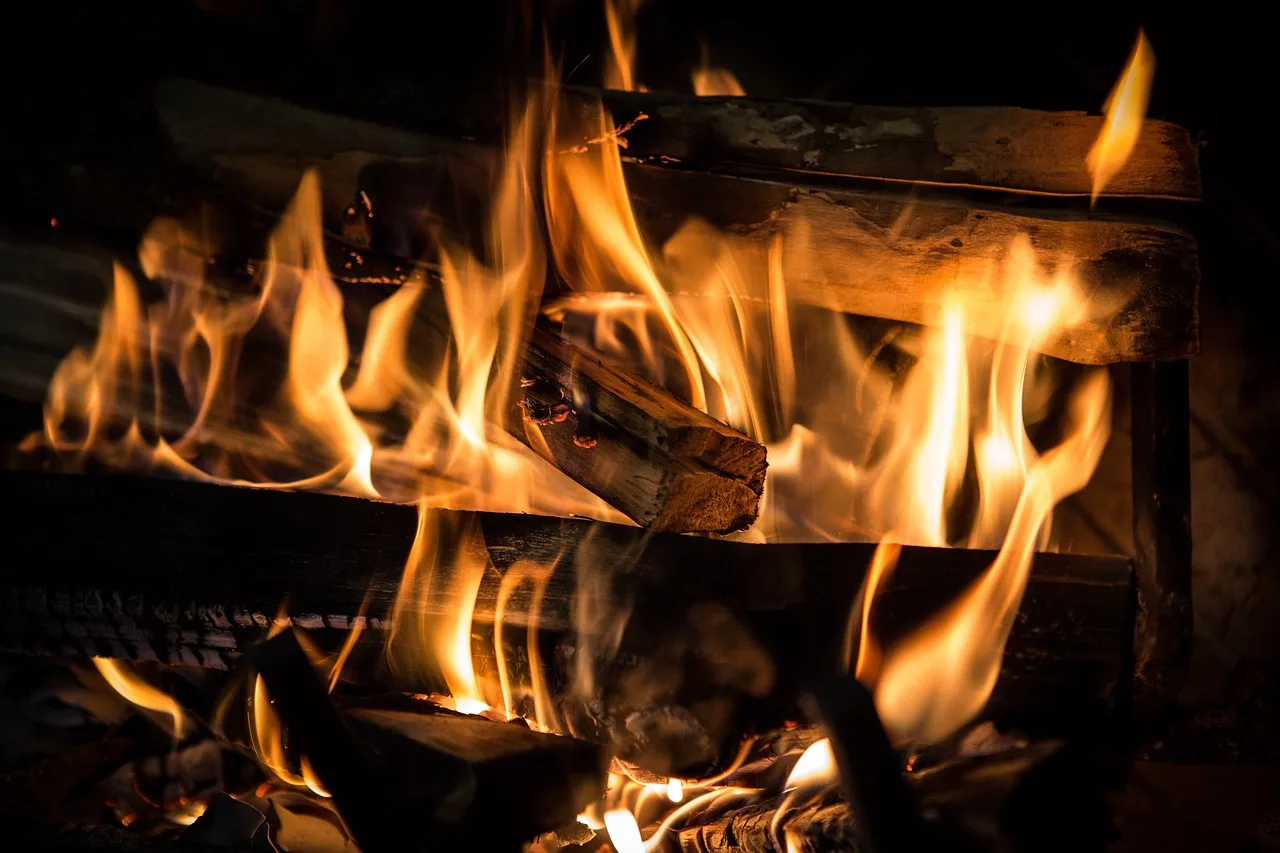
The best barrier depends on how your child moves near the fireplace. An anchored fireplace gate or wall-mounted safety fence is usually the strongest choice for toddlers who pull up, push objects, or climb. A higher mounted screen can help for preschoolers, but it should supplement—not replace—distance and lockouts. CPSC guidance on hot glass and NFPA fire-safety advice both support creating a physical buffer, not just a visual one.
When to use a wall-mounted baby safety fence
Use a wall-mounted baby safety fence when the child is active around furniture, pulls to stand, or runs into objects. It keeps distance between the child and the fireplace, and it should be sturdy enough not to be pulled over. It also needs to let adults reach the hearth when needed.
When a freestanding screen is not enough
A freestanding fireplace screen can help with spark control, but it is often too weak to stop active toddlers. A child could pull it over, and a running toddler could knock it over. Use a freestanding fireplace screen only as a secondary layer unless it is mounted or anchored.
How to keep adult access without creating gaps
Choose a barrier that opens or detaches at the adult entry point, not one that leaves a wide gap on one side. Check for openings at the floor, wall corners, and hinge line. If an adult can step through easily, a toddler may be able to squeeze, lean, or climb through later.
How do I childproof a fireplace for a toddler?
Childproof a fireplace for a toddler by building layers: a sturdy wall-mounted fence, locked doors or controls, hearth edge protection, and out-of-reach storage for tools and accessories. Do the setup before a child starts crawling, because once pulling up begins, the risk shifts from touching to climbing and tipping.
Safest setup by age and climbing ability
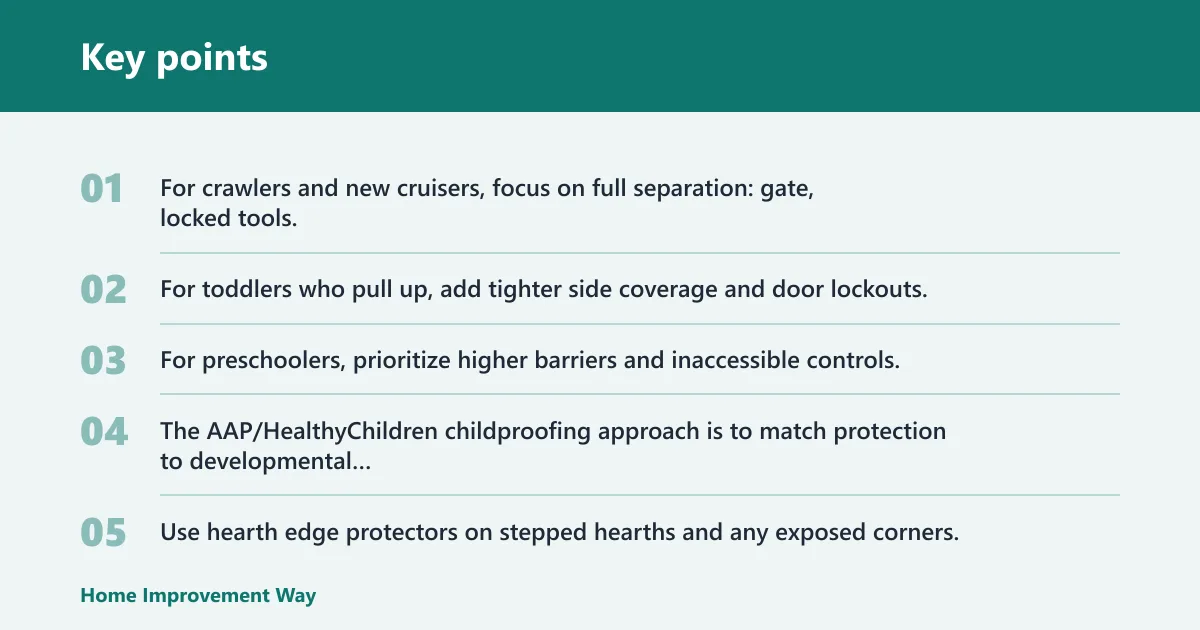
For crawlers and new cruisers, focus on full separation: gate, locked tools, and no climbable furniture nearby. For toddlers who pull up, add tighter side coverage and door lockouts. For preschoolers, prioritize higher barriers and inaccessible controls, because climbing skill matters more than age alone. The AAP/HealthyChildren childproofing approach is to match protection to developmental ability, not just the birthday.
Cover sharp hearth corners
Use hearth edge protectors on stepped hearths and any exposed corners. They cut down on impact and cut injuries when a child slips, bumps the edge, or falls toward the hearth. Hearth edge protectors should fit the hearth shape closely. The protector should follow the hearth shape tightly so a child cannot peel it off easily.
Move fireplace tools and accessories out of reach
Store pokers, tongs, shovels, matches, and lighters out of reach. Tools can be sharp, hot, or easy to pull down if left standing near the hearth. If the set is decorative, treat it the same way: put it where a child cannot grab, swing, or tip it.
Clear ashes and debris
Remove ashes and loose debris regularly, even when the fireplace is not in use. Fine ash can be inhaled or swallowed, and a child can reach into a firebox that looks cool. A vacuum designed for ash cleanup or a metal container with a tight lid keeps the area safer during maintenance.
Fireplace safety audit table
| Fireplace component | Toddler/preschool risk | Recommended control | Common failure mode |
|---|---|---|---|
| Hot glass doors | Burns from touching a surface that looks cool | Fireplace door lock plus a barrier in front of the unit | Relying on the latch alone with no distance barrier |
| Open hearth | Falls into the firebox or onto coals | Wall-mounted baby safety fence and kept-clear floor space | Using a loose screen that can be pushed aside |
| Sharp hearth corners | Head, face, or arm impact injury | Hearth edge protectors that match the hearth shape | Padding that peels off or leaves hard edges exposed |
| Fireplace tools | Pinch, cut, or burn injuries; falling objects | Store out of reach in a closed cabinet or high hook | Leaving tools in a stand beside the hearth |
| Ashes | Inhalation or swallowing of fine residue | Regular cleanup and sealed disposal | Leaving the ash bucket open or near the floor |
| Control panels | Unwanted ignition, heat changes, or surprise activation | Control panel covers, lockout features, or inaccessible mounting | Buttons and switches left at child height |
| Carbon monoxide exposure | Odorless, colorless gas exposure in a working fireplace home | Carbon monoxide detector in the home and regular testing | Assuming occasional use lowers the need for detection |
Before every fire: pass/fail checklist for parents
Run this quick checklist before lighting any fire. If even one item fails, delay use until it is fixed. The goal is to catch drift from everyday life—vacuuming, visitors, toy rotation, or furniture moving—before a child finds a new gap or climb point.
- Barrier anchors secure: Pass only if the fence or gate is firmly anchored and cannot tip, slide, or pull loose.
- Side gaps closed: Pass only if there are no wide openings at the wall, corners, hinge line, or floor.
- Tools stored away: Pass only if pokers, tongs, matches, lighters, and decorative tools are out of reach.
- Ashes removed: Pass only if loose ash and debris are cleared and disposal is sealed.
- Lock status verified: Pass only if fireplace doors, gas controls, electric touch panels, and remotes are secured or out of reach.
- Detector tested: Pass only if the carbon monoxide detector has been tested according to manufacturer instructions.
- Furniture moved back: Pass only if sofas, chairs, benches, and toy storage are not close enough to create a climb zone.
Step-by-step childproofing plan
- Measure the fireplace zone and mark every climb point, including side walls, furniture edges, and hearth steps.
- Install the main barrier so it cannot tip or pull over; a wall-mounted baby safety fence is the better choice for active toddlers.
- Add a fireplace door lock if there are glass doors or a reachable firebox, then test that the lock resists quick tugging.
- Cover sharp hearth corners with snug edge protectors, especially on stepped hearths that create a knee or head strike point.
- Move tools, matches, lighters, and decor out of reach, and do not leave them in a stand beside the fireplace.
- Remove ashes and debris, then place a carbon monoxide detector according to the device instructions and test it before the fireplace is used.
Say your living room has a 12-inch stepped hearth and a preschooler who climbs onto the sofa to reach it. A low freestanding screen may still let that child lean over the top or grab the frame. A wall-mounted fence with tight corners and a door lock gives better separation.
Suppose your fireplace is dormant most months, but the door still has hot glass after use and the tool set sits beside it. The setup still needs a barrier, a door lock, hearth protection, and tool storage, since a fireplace that is not burning can still expose a child to edges, glass, or ash.
Gas and electric fireplace safety for children
Gas and electric fireplaces need childproofing too, even when there are no visible flames. Gas units can keep glass hot after shutdown, and electric units can heat the trim, glass, or surround. Hidden ignition, remote activation, and touch-panel controls make accidental starts possible, so the safest plan is a barrier plus lockouts and inaccessible controls.
Hot glass after shutdown
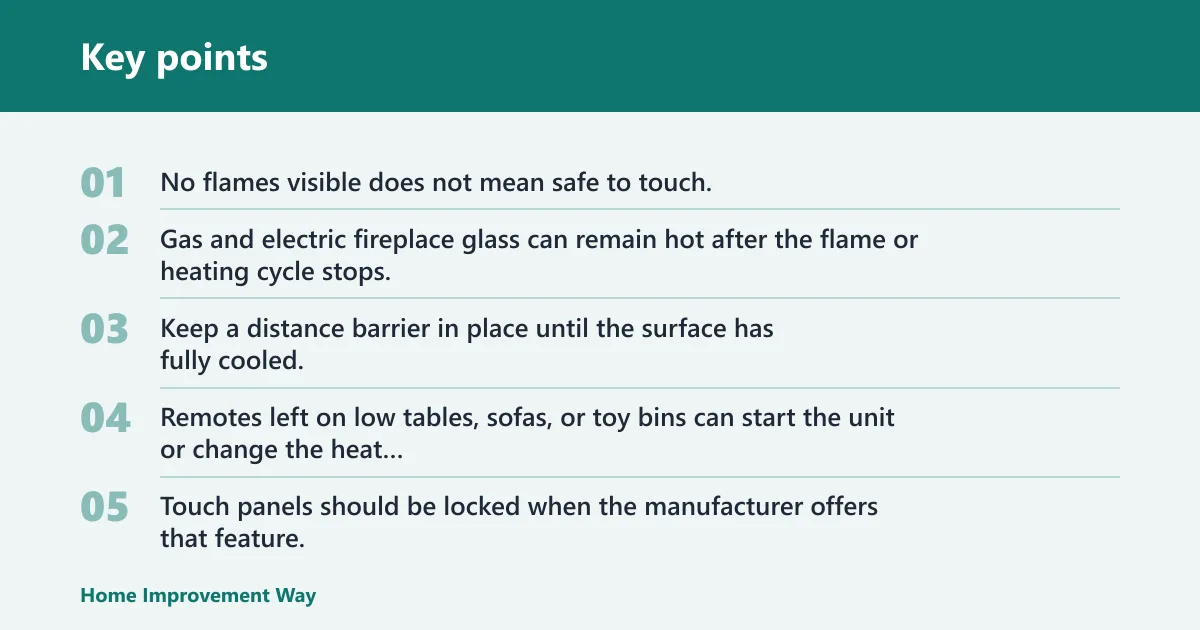
No flames visible does not mean safe to touch. Gas and electric fireplace glass can remain hot after the flame or heating cycle stops, and children often assume a dark unit is cool. Keep a distance barrier in place until the surface has fully cooled, and treat the glass as a burn hazard every time.
Remote controls, touch panels, and child access
Remotes left on low tables, sofas, or toy bins can start the unit or change the heat setting. Touch panels should be locked when the manufacturer offers that feature, and the control area should be mounted or covered so a child cannot tap it. Many manufacturers recommend lockouts or control covers specifically to prevent accidental activation.
Pilot, ignition, and power controls
Gas fireplaces may have pilot controls, ignition switches, or wall-mounted remotes that should not be reachable by children. Electric fireplaces can also have power switches behind a trim panel or on the wall. Use the manufacturer’s lockout instructions for each model, because controls vary and a “safe” setting on one unit may not prevent child activation on another.
What are the most common mistakes?
The biggest mistake is using a screen as the only barrier. Freestanding fireplace screens are fine for spark control, but they are not a complete child barrier for active toddlers and can topple if not mounted or anchored. A second common mistake is leaving the hearth zone easy to climb from nearby furniture.
Using a screen as the only barrier
A freestanding screen can move if a child pulls up on it or runs into it. For a toddler, that is a problem. If you choose a screen, anchor it and keep it far enough from the fireplace to matter. Do not count on the screen alone to stop access.
Leaving hot glass, tools, or controls reachable
Hot glass doors, tool sets, buttons, and switches should all be treated as access points. Lock the door, block the controls, and move tools away from the floor. A child can reach these faster than most adults expect, especially during busy evening routines.
Skipping checks before every fire
Before each use, do a quick pass: barrier secure, doors locked, tools stored, ashes removed, and detector active. If anything changed since the last fire, fix it before lighting. A childproof setup can drift out of position after vacuuming, furniture moves, or holiday decorating.
Frequently asked questions
How do I childproof a fireplace without blocking access for adults?
Use a wall-mounted baby safety fence with an adult access point that opens or removes quickly. The barrier should stay anchored and not leave wide side gaps. That setup keeps children back while still letting an adult tend the fire, clean the hearth, or check the door lock.
What is the safest way to block a fireplace from a preschooler?
A wall-mounted baby safety fence is the safer main barrier for a preschooler who climbs or pushes. Pair it with a fireplace door lock and keep the hearth clear. A freestanding screen is usually too easy to move, especially if the child runs into it or leans on it.
Should I use a fireplace gate or a screen for kids?
Use a wall-mounted gate or fence as the main barrier. A freestanding screen can help with sparks, but it is not strong enough on its own for many children. If you already have a screen, anchor it and treat it as one layer, not the whole plan.
How do I keep a toddler away from a hot fireplace hearth?
Keep the toddler outside the hearth zone with a sturdy barrier, then add hearth edge protectors for stepped or sharp edges. Move furniture back if it gives the child a launch point. The goal is distance first, padding second, and no reachable objects that invite climbing.
What should I do with fireplace tools when kids are around?
Put tools, matches, and lighters out of reach in a closed cabinet, high shelf, or locked storage. Do not leave them in a stand beside the hearth. Tools can be sharp, hot, or easy to pull down, so placement matters as much as the tool itself.
Do I need a carbon monoxide detector with a fireplace?
Yes. A carbon monoxide detector should be part of the setup in homes with working fireplaces, even if the fireplace is used only occasionally. Carbon monoxide has no odor or color, so a detector is the practical warning device. Test it on the schedule listed by the manufacturer.
What safety steps matter for gas or electric fireplaces with children?
Block or lock the controls, keep children away from hot glass panels, and treat gas or electric units as childproofing projects too. Buttons, switches, remote controls, and touch panels should not be reachable. A barrier in front plus locked controls is the safest combination for most homes.
Sources
- CPSC: Fireplaces and Wood-Burning Stoves
- NFPA: Heating Safety
- HealthyChildren: Childproofing Your Home
- CDC: Carbon Monoxide Poisoning
- NFPA: Carbon Monoxide
Related safety guides
- carbon monoxide detector placement
- baby-proofing sharp corners
- safe heater/fire safety
- childproofing living rooms
Sponsored / affiliate links. As an Amazon Associate I earn from qualifying purchases. I may earn additional commission from eligible campaigns.