
What Is a Rick of Firewood? Size, Volume, and Value
A rick of firewood is a stacked pile usually 4 feet high and 8 feet long, but its volume depends on log length; many sellers mean one face cord, not a full cord. If you misread that label, you can pay full-cord money for far less wood. This guide explains the rick, face cord, and cord, then shows how to check whether the stack matches the price and promised size.
What is a rick of firewood?
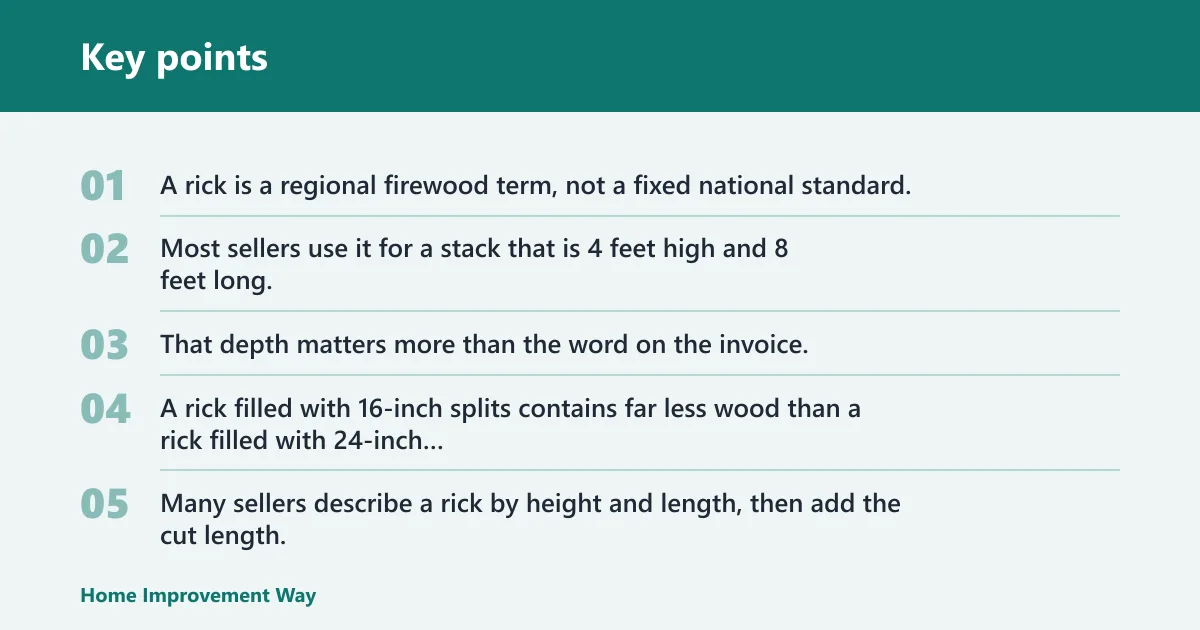

A rick is a regional firewood term, not a fixed national standard. Most sellers use it for a stack that is 4 feet high and 8 feet long, but the depth changes with the length of the split logs, so the label alone does not tell you how much wood you are getting.
That depth matters more than the word on the invoice. A rick filled with 16-inch splits contains far less wood than a rick filled with 24-inch splits, even though the stack face looks the same from the front.
How sellers usually describe a rick
Many sellers describe a rick by height and length, then add the cut length. A common version is “4 by 8 by 16,” which means 4 feet high, 8 feet long, and 16-inch pieces. Without that third number, the term stays vague.
A pickup truck bed often enters the conversation here. Sellers may compare a load to “a rick” or “a face cord” because buyers can picture a bed full of stacked splits more easily than a cubic-foot count.
Rick, face cord, and cord
A rick and a face cord are often used the same way, and several sellers treat them as interchangeable. The standard cord is different: 4 feet high, 4 feet wide, and 8 feet long, for 128 cubic feet. That fixed cord size is the clean benchmark for price comparison.
The face of the stack stays the same in a rick or face cord, but the depth changes with cut length. That is why a buyer can hear the same word and still get different amounts of wood from one seller to the next.
Why 128 cubic feet is the only fixed benchmark
A cord is the one measurement that does not change with seller wording. It is 4 by 4 by 8 feet, or 128 cubic feet. That makes it the best unit for comparing firewood offers, especially when one seller quotes a rick and another quotes a cord.
Keep in mind that stacked cubic feet include air space between splits. That is normal. You are still comparing stack volume, not solid wood volume, so the same stack shape can hold less usable wood if the splits are large and loosely stacked.
How much wood does a rick hold?
The answer depends on depth. A 4-by-8 face with 12-inch wood holds about 32 cubic feet; with 16-inch wood, about 42.67 cubic feet; with 24-inch wood, about 64 cubic feet. That is why the label alone is not enough.
Log length drives the volume because it sets the stack depth. If a seller says “one rick” without giving cut length, you still do not know whether you are buying about one-quarter cord, one-third cord, or one-half cord.
Why air space changes the count
Firewood is sold as a stack, not a block of solid wood. The gaps between splits are part of the stacked measurement, so cubic feet tell you the size of the pile, not the exact amount of solid wood inside it. That is why tight stacking matters.
Two stacks can both measure 4 by 8 feet and still not have the same value if one is loose and the other is packed tightly. Measure the outside dimensions, and ask how the wood was stacked and whether the seller measured after delivery.
Why log length drives the answer
Firewood is commonly cut in the 14- to 18-inch range, and 16-inch pieces are common for stoves. Longer cuts make a deeper rick and increase the volume in that same 4-by-8 face. Shorter cuts do the opposite.
That matters when you are comparing prices. A rick of 12-inch splits and a rick of 18-inch splits are not the same load, even if the seller uses the same word for both.
Firewood rick calculator

Use this table to compare common rick depths in cubic feet and cord equivalents. The math assumes a 4-foot by 8-foot face. The depth comes from the cut length, and the cord equivalent uses 128 cubic feet as the full cord standard.
| Rick depth | Stack size | Cubic feet | Cord equivalent | Buyer rule |
|---|---|---|---|---|
| 12 inches | 4 ft × 8 ft × 1 ft | 32 | 0.25 cord | Pay quarter-cord money unless the seller gives extra volume or premium wood. |
| 14 inches | 4 ft × 8 ft × 14 in | 37.33 | 0.291 cord | Ask for the exact cut length and price it against a quarter cord, not a full cord. |
| 16 inches | 4 ft × 8 ft × 16 in | 42.67 | 0.333 cord | This is the common comparison point; one-third cord pricing is the usual target. |
| 18 inches | 4 ft × 8 ft × 18 in | 48 | 0.375 cord | Pay more than a 16-inch rick only if the longer splits fit your stove and the price tracks the added volume. |
| 24 inches | 4 ft × 8 ft × 2 ft | 64 | 0.5 cord | This is half a cord by volume, so do not accept face-cord language without the math. |
Say your seller advertises a “rick” and gives you 16-inch splits. That stack is about 42.67 cubic feet, or one-third of a cord. If the same seller charges a full-cord price, you are paying cord money for only a third of a cord.
Suppose the seller says “one rick” but delivers 24-inch splits. That is 64 cubic feet, which is half a cord. The label changed nothing; the depth changed the value. The only fair comparison is the measured volume.
Why does log length change the price?
Shorter cuts can cost more because they take more handling and fit certain stoves better. A 12-inch or 14-inch split may be easier to stack tightly, and it can be more useful for a compact firebox. That convenience often carries a premium.
Sixteen-inch firewood is common because many stoves accept it comfortably. It is a practical middle ground for loading, burning, and stacking, which is why you see it so often in seller descriptions and pricing tables.
If your stove has a short firebox, shorter splits can be worth the higher price because they fit correctly and burn without trimming. Paying more makes sense when the cut length solves a fit problem. It does not make sense when the seller uses shorter pieces to justify a larger price for the same volume.
A common first-timer mistake is assuming that smaller pieces always mean less value. For a compact stove, the opposite can be true. The right length can save time and reduce waste.
How do you check a delivered rick?
Start with the outside measurements. A delivered rick should measure 4 feet high and 8 feet long if the seller is using standard face dimensions. Then confirm the cut length, because that depth determines whether you received a quarter cord, a third cord, or something else.
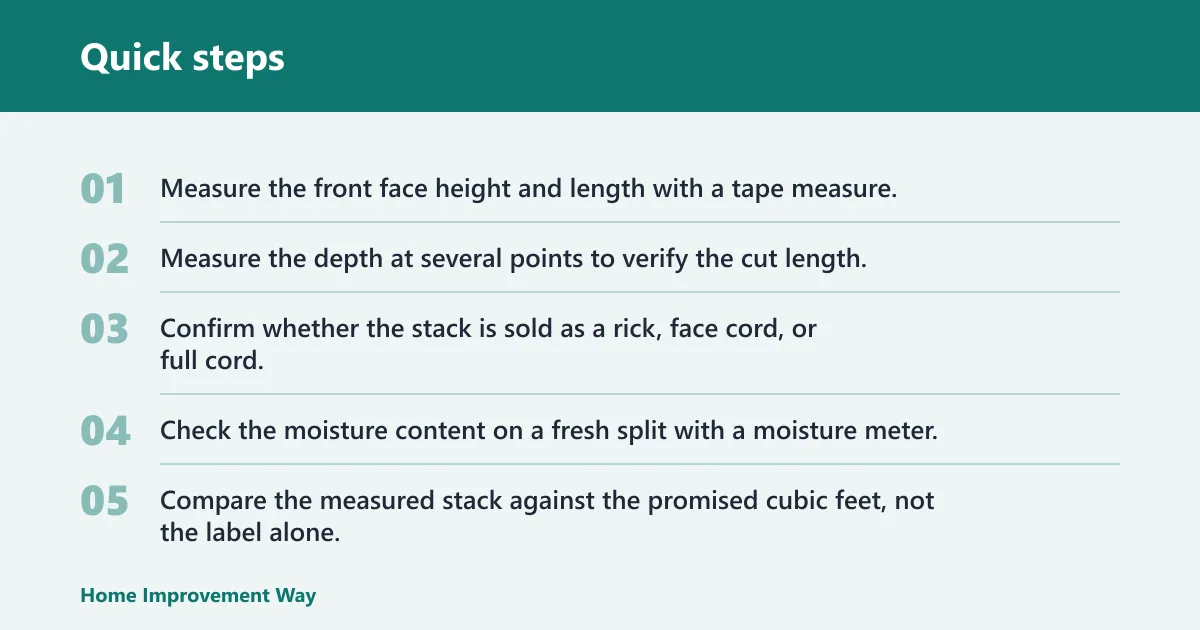
Use a moisture meter to check burn readiness, but do not treat it as proof of honesty by itself. It tells you whether the wood is dry enough to burn well. It does not tell you whether the stack is the promised size.
- Measure the front face height and length with a tape measure.
- Measure the depth at several points to verify the cut length.
- Confirm whether the stack is sold as a rick, face cord, or full cord.
- Check the moisture content on a fresh split with a moisture meter.
- Compare the measured stack against the promised cubic feet, not the label alone.
- Look for loose stacking, big gaps, or a short pile that was priced like a full stack.
Picture a delivered stack that looks full from the front but measures only 14 inches deep. That is not a 16-inch rick by volume, even if the seller called it one. The difference is real money when you compare it against the cord price.
Seasoned firewood usually costs more than green wood because it burns better and is ready sooner. Moisture content affects ignition, smoke, and heat output, so a dry stack can be worth the premium when you want easier lighting and cleaner burning.
Frequently asked questions
Is a rick of firewood the same as a face cord?
Often, yes. Many sellers use rick and face cord the same way, and both usually refer to a 4-foot by 8-foot face with variable depth. But the exact meaning can shift by region and seller, so confirm the depth before you buy.
How many cubic feet are in a rick of firewood?
It depends on the depth. A 4-by-8 stack at 12 inches deep is 32 cubic feet. At 16 inches, it is 42.67 cubic feet. At 24 inches, it is 64 cubic feet. The cut length is what changes the count.
How much wood is in a rick compared with a cord?
A rick can be about one-quarter cord, one-third cord, or one-half cord depending on depth. A 16-inch rick is about one-third cord. A 24-inch rick is commonly described as about one-half cord. A full cord is 128 cubic feet and stays fixed.
Does a rick always mean 16-inch firewood?
No. Sixteen-inch pieces are common, especially for stoves, but sellers also quote 12-inch, 14-inch, 18-inch, and 24-inch depths. The rick is the face size; the cut length sets the depth. Always ask for the actual measurement before you pay.
How do I know if I’m being shorted when buying a rick of wood?
Measure the stack, confirm the depth, and compare the result to the seller’s stated volume. If the pile is short in height, short in length, or shorter than the promised cut length, the price should change with it. A moisture meter can help verify quality, not quantity.
Sponsored / affiliate links. As an Amazon Associate I earn from qualifying purchases. I may earn additional commission from eligible campaigns.