Firewood BTU Chart: Which Woods Heat Your Home the Most?
White oak, hickory, hard maple, and beech sit near the top of most firewood BTU charts, with seasoned cords often around 24 to 28 million BTU. Wet or low-density wood can cut heat, foul the stove, and waste space. This guide compares peak heat, burn time, and seasoning so you can pick the right wood for your stove or fireplace.
Firewood BTU chart
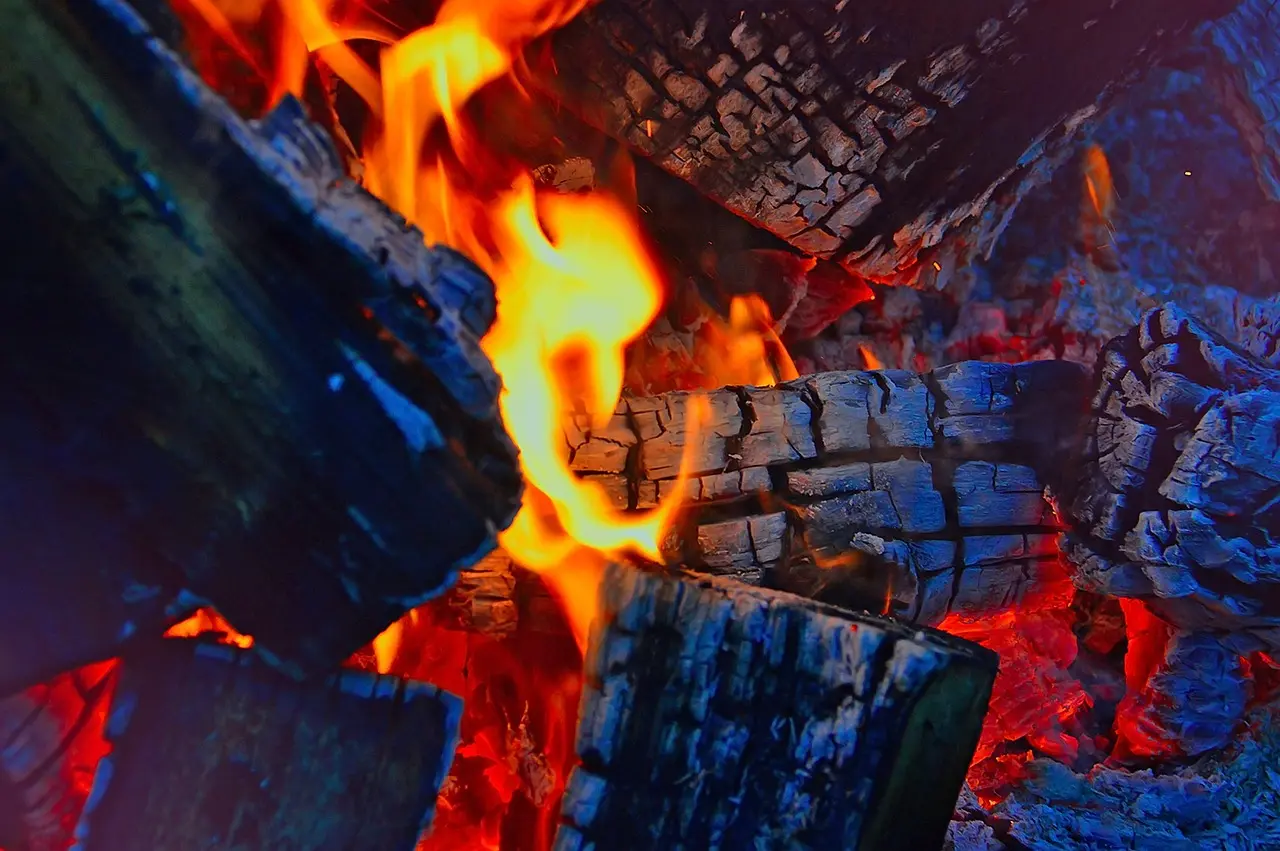


This chart groups common firewood species by approximate heat output per cord at similar dryness. A cord is the standard stacked volume used for firewood pricing, usually 4 ft by 4 ft by 8 ft, so the comparison stays on the same volume basis instead of loose piles or truckload guesses.
BTU per cord is the practical way to compare firewood heat output. A cord is a fixed volume, so the comparison stays fair only when the wood species and moisture level are similar. Dense wood packs more fuel into that volume, which raises usable heat per cord.
| Species | Approx. BTU per cord | Burn speed | Coal-bed longevity | Seasoning difficulty | Best use case |
|---|---|---|---|---|---|
| White oak | 24.0–28.0 million | Slow | Very long | Moderate to hard | Overnight burns, long steady heat |
| Hickory | 26.0–28.5 million | Slow | Very long | Hard | High-output heating, cold snaps |
| Beech | 23.0–27.0 million | Moderate | Long | Moderate | Steady heat with good coal support |
| Hard maple | 21.0–25.5 million | Moderate | Long | Moderate | All-around home heating |
| Red oak | 22.0–25.5 million | Slow | Long | Moderate to hard | Long burns and high heat |
| Yellow birch | 20.0–24.0 million | Moderate | Moderate to long | Moderate | Balanced heat and easier splitting |
| Ash | 19.0–23.0 million | Moderate | Moderate to long | Easy | Reliable everyday heating |
| Hard maple | 21.0–25.5 million | Moderate | Long | Moderate | General-purpose stove fuel |
| Soft maple | 17.0–21.0 million | Moderate to fast | Moderate | Easy | Shoulder-season fires, mix-in wood |
| Elm | 18.0–22.0 million | Slow once lit | Long | Hard | Longer burns if split and dried well |
| Pine | 13.0–17.0 million | Fast | Short | Easy | Kindling, quick starts, shoulder-season use |
| Spruce or fir | 14.0–18.0 million | Fast | Short | Easy | Fast ignition, fire starting, light heat demand |
| Cedar | 13.0–16.0 million | Very fast | Short | Easy | Kindling and short, quick fires |
Hardwoods usually provide more heat per cord and longer burn times than softwoods because they are denser. Density matters because a cord of dense wood contains more combustible material in the same stacked volume. That is why oak, hickory, maple, ash, and beech keep appearing near the top of common charts.
What does BTU per cord mean?
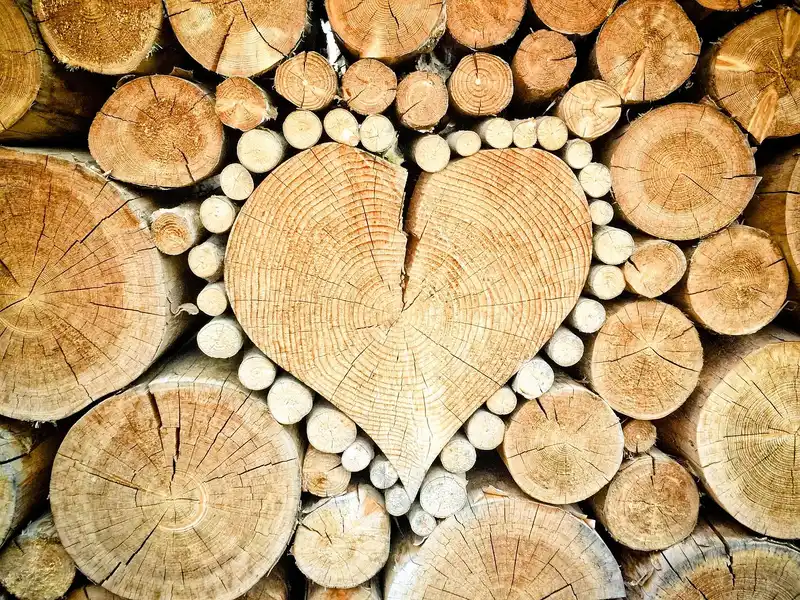
BTU per cord is the standard heat-output measure for firewood at the same stacked volume. A cord is a fixed volume, so the comparison is fair only when the wood species and moisture level are similar. Dense wood packs more fuel into that volume, which raises usable heat per cord.
Why the cord standard matters
If two loads look the same size but one is loosely stacked, the comparison is misleading. The cord standard keeps the math grounded in a known volume, so you can compare oak to pine, or ash to spruce, without guessing how much wood is actually there.
Moisture changes the result further. Wet wood still takes up space in the cord, but some of its energy gets spent boiling off water before the fire can heat the room.
Why dry wood compares more fairly
Seasoned wood burns more predictably because less energy is wasted on evaporation. A moisture meter helps verify this on a split face, which matters more than the bark surface alone. The same species can swing noticeably if one load is near 15% moisture and another is still near 30%.
Why density changes heat output
Denser species generally burn slower and longer because they contain more wood fiber per cord. That does not make them better in every situation. A very dense species may give excellent overnight heat but feel sluggish when you need a fast warm-up after a cold start.
Which firewood species has the highest BTU per cord?
Among common firewood species, hickory and white oak usually sit near the top of the chart, with beech and hard maple close behind. The exact winner depends on species, moisture content, and how the wood is cut and split, but high-density hardwoods are the usual leaders.
Where oak, hickory, ash, and maple fit
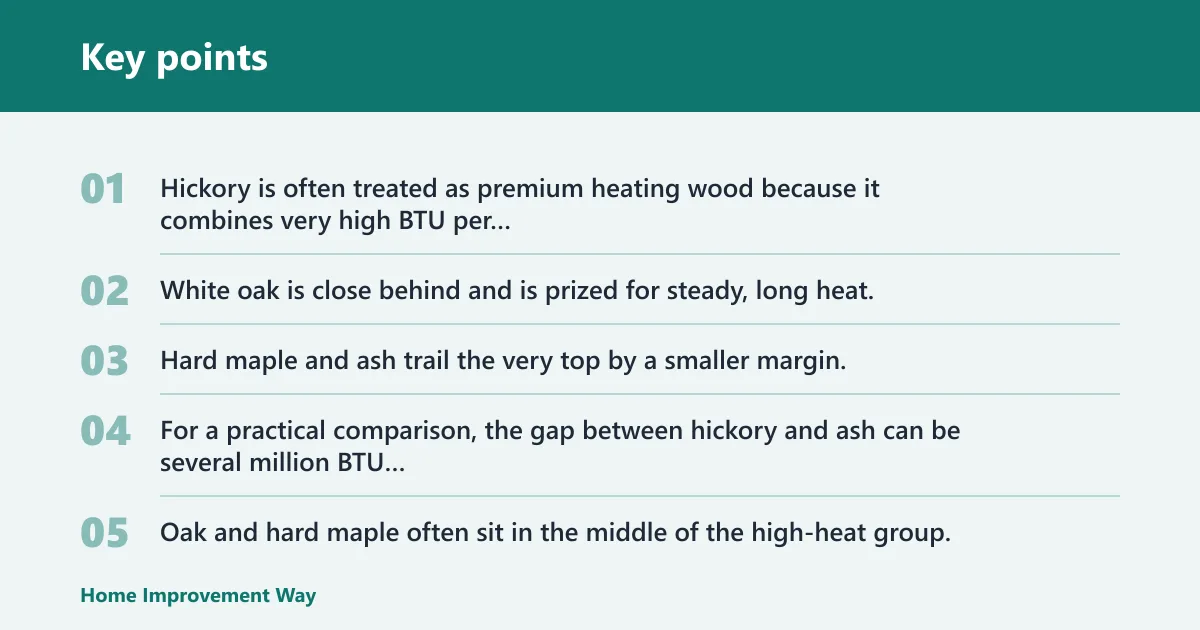
Hickory is often treated as premium heating wood because it combines very high BTU per cord with long burn time. White oak is close behind and is prized for steady, long heat. Hard maple and ash trail the very top by a smaller margin, but both remain strong home-heating choices.
For a practical comparison, the gap between hickory and ash can be several million BTU per cord, depending on the species and dryness. Oak and hard maple often sit in the middle of the high-heat group, with red oak generally outpacing soft maple by a wide margin.
Why the winner depends on moisture and species
The highest-BTU species on paper will not outperform a drier, better-prepared lower-ranked cord if the top wood is still too wet. Moisture content around 15% to 20% is the practical target for seasoned firewood. Above that range, usable heat drops and smoke rises.
Suppose you split a piece of oak and a piece of ash, then check the split face with a moisture meter. If the oak reads 24% and the ash reads 18%, the ash may heat the stove better that day even if the oak is the denser species on paper.
How does moisture content change heat output?
Moisture content has a direct effect on usable heat, smoke, and stove efficiency. Firewood around 15% to 20% moisture is the practical target for seasoned burning. Higher moisture lowers heat output because part of the fire’s energy is spent drying the wood before it can burn fully.
How wet wood wastes energy
When wood is too wet, the fire spends more time driving off water. That can produce more smoke, lower stove temperatures, and dirtier glass or flue conditions. Wet wood can also make it harder to maintain a hot coal bed, especially in smaller stoves or short fireboxes.
A common first-timer mistake is judging readiness by the split’s outside color or by how long the wood has been stacked. The more reliable check is the split-face reading with a moisture meter, because the interior often tells the real story.
Why a moisture meter is worth using
A moisture meter is a simple tool that measures wood readiness on a split face. That matters because bark can dry sooner than the core. If the center is still too wet, the fire can hiss, smoke, and deliver less heat than the species chart suggests.
- Split a representative piece from the middle of the stack.
- Measure the fresh split face, not the bark.
- Look for readings around 15% to 20% for seasoned firewood.
- Recheck wood that seems sluggish, smoky, or hard to light.
Do softwoods ever make sense for home heating?
Yes. Softwoods like pine, fir, spruce, and cedar can make sense for quick starts, shoulder-season fires, and kindling. They usually deliver lower BTU per cord than most hardwoods, but they ignite faster and can be useful when you need a quick response instead of a long overnight burn.
Fast ignition versus short burn time
Softwoods burn hotter for a short time, then fade sooner. That makes them useful when a stove needs a quick bed of flame, when outdoor temperatures are mild, or when you want to reheat a cool room without loading a full hardwood fire. They are less useful when you need long, steady heat.
Pine and cedar are not “bad” firewood by default. They are simply better at ignition and short-duration heat than at long coal-bed heating. In a proper mix, that can be an advantage.
Where softwoods fit in a firing plan
Use softwood to start the fire, then follow with a denser hardwood if the goal is longer heat. This approach is common in stoves that need strong initial draft or in homes that only need a short burn in the morning or evening.
Check the stove or fireplace manual before relying on softwood-heavy fuel. Some appliances need specific loading practices, and local availability often decides what you can actually source in quantity.
Which wood burns hottest versus longest?
These are not always the same thing. Wood that burns hottest can light fast and spike stove temperature quickly, while wood that burns longest keeps producing heat and leaves a larger coal bed. Dense hardwoods usually win the “longest” contest, but a slightly lighter wood can feel hotter during the first stage of the fire.
Peak heat versus coal-bed longevity
Hickory and white oak tend to hold heat and maintain a strong coal bed. Ash is easier to split and still gives dependable heat, though it often burns a bit faster than the very densest species. Softwoods often feel hotter at first because they ignite quickly, then drop off sooner.
If overnight burn time matters, dense hardwoods usually make more sense. If quick recovery after a cold start matters more, a mix that includes easier-lighting wood may be better.
How to match wood to your use case
For a long winter night, aim for seasoned oak, hickory, beech, or hard maple in appropriately sized splits with enough airflow. For a shoulder-season fire, soft maple or pine can be easier to manage because the fire does not need to run as long.
Split size and airflow change what you feel at the stove. A small, dry split can burn hotter than a huge one of the same species because more surface area is exposed. A tightly packed firebox with limited air can make any wood seem less powerful.
Moisture and heating wood chart
This chart helps separate seasoned wood from kiln-dried wood and from wood that is still too wet. Kiln-dried firewood is typically easier to light and cleaner-burning than green wood, and if its moisture content is low, it can perform similarly to well-seasoned wood. The key is the moisture number, not the label alone.
| Condition | Typical moisture target | Heat output | Smoke level | Practical note |
|---|---|---|---|---|
| Green wood | Often above 30% | Low usable heat | High | Not a good heating choice |
| Poorly seasoned wood | 20% to 30% | Reduced heat | Moderate to high | Can waste stove capacity |
| Seasoned wood | 15% to 20% | Good usable heat | Lower | Practical target for home burning |
| Kiln-dried wood | Often below 20% | High usable heat | Low | Typically lights easier and burns cleaner |
Look at the species chart and the moisture chart together. A high-BTU hardwood that is still wet will not beat a drier, lower-ranked wood by much, if at all. For home heating, the best choice is usually a dry dense wood that fits your stove’s air control and firebox size.
Check local availability before making a buying decision. Some regions have plenty of ash or maple, while others lean on oak, pine, or fir. Follow the stove or fireplace manufacturer’s guidance for fuel size, moisture limits, and burn practices.
Frequently asked questions
Which firewood has the highest BTU per cord?
Among common home-heating woods, hickory and white oak usually rank near the top, with beech and hard maple close behind. Exact values vary by species and moisture content, but the densest hardwoods generally deliver the most heat per cord when they are properly seasoned.
What is the BTU difference between oak, maple, ash, and hickory?
Hickory and white oak usually sit above ash and maple on most charts, often by a few million BTU per cord. Ash remains a strong performer, while hard maple usually lands in the middle of the high-heat group. Moisture can shrink or widen those gaps in real use.
Do softwoods like pine ever make sense for heating a home?
Yes. Pine, fir, spruce, and cedar can be useful for kindling, quick starts, and shoulder-season fires. They usually burn faster and deliver less total heat per cord than hardwoods, but their fast ignition can be an advantage when you need short, responsive heat.
How does moisture content change the BTU output of firewood?
Higher moisture lowers usable BTU output because part of the fire’s energy goes into boiling water out of the wood. Seasoned firewood around 15% to 20% moisture burns more efficiently, smokes less, and gives you more of the cord’s stored energy as room heat.
Is kiln-dried firewood hotter than seasoned firewood?
If both are truly dry, the heat difference is small. Kiln-dried wood is often easier to light and cleaner-burning because it usually leaves the kiln with very low moisture. Well-seasoned wood in the 15% to 20% range can perform similarly in a stove that has good airflow.
Which wood burns longest versus which wood burns hottest?
Dense hardwoods such as hickory and white oak usually burn longest and maintain a stronger coal bed. Softwoods can feel hotter at ignition because they catch quickly, but they fade sooner. For overnight heat, choose dense hardwood; for quick starts, softwood can help.
Sponsored / affiliate links. As an Amazon Associate I earn from qualifying purchases. I may earn additional commission from eligible campaigns.